A generalization of heterochromatic graphs
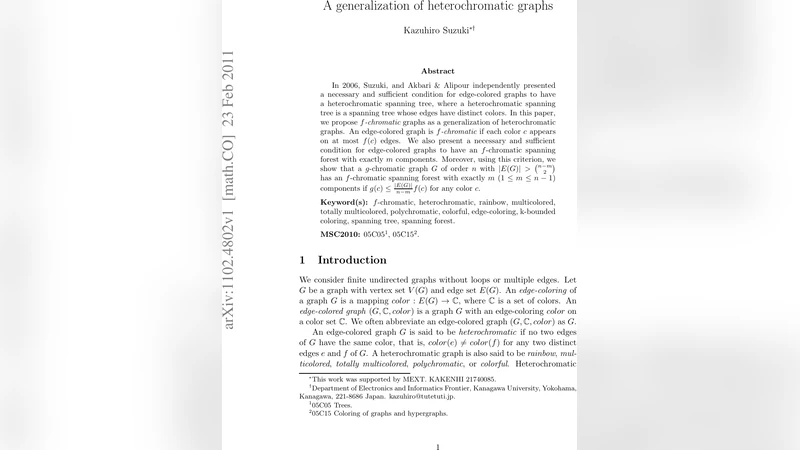
In 2006, Suzuki, and Akbari & Alipour independently presented a necessary and sufficient condition for edge-colored graphs to have a heterochromatic spanning tree, where a heterochromatic spanning tree is a spanning tree whose edges have distinct colors. In this paper, we propose $f$-chromatic graphs as a generalization of heterochromatic graphs. An edge-colored graph is $f$-chromatic if each color $c$ appears on at most $f(c)$ edges. We also present a necessary and sufficient condition for edge-colored graphs to have an $f$-chromatic spanning forest with exactly $m$ components. Moreover, using this criterion, we show that a $g$-chromatic graph $G$ of order $n$ with $|E(G)|>\binom{n-m}{2}$ has an $f$-chromatic spanning forest with exactly $m$ ($1 \le m \le n-1$) components if $g(c) \le \frac{|E(G)|}{n-m}f(c)$ for any color $c$.
💡 Research Summary
The paper introduces a broad generalization of heterochromatic (rainbow) graphs by defining f‑chromatic graphs. In an edge‑colored graph G with color set C, a function f :C → ℕ₀ assigns to each color c a non‑negative integer f(c). The graph is called f‑chromatic if for every color c the number of edges of that color does not exceed f(c). This definition subsumes the classical heterochromatic case (f(c)=1 for all c) and the k‑bounded coloring case (f(c)=k for all c), thereby providing a unified framework for a wide variety of color‑restriction problems.
The central theoretical contribution is Theorem 2.3, which gives a necessary and sufficient condition for the existence of an f‑chromatic spanning forest with exactly m connected components (1 ≤ m ≤ n‑1). For any subset R ⊆ C, let E_R(G) be the set of edges whose colors lie in R. The theorem states that such a forest exists iff \
Comments & Academic Discussion
Loading comments...
Leave a Comment