Advanced Frequency Identification Power Metering System for Energy Usage
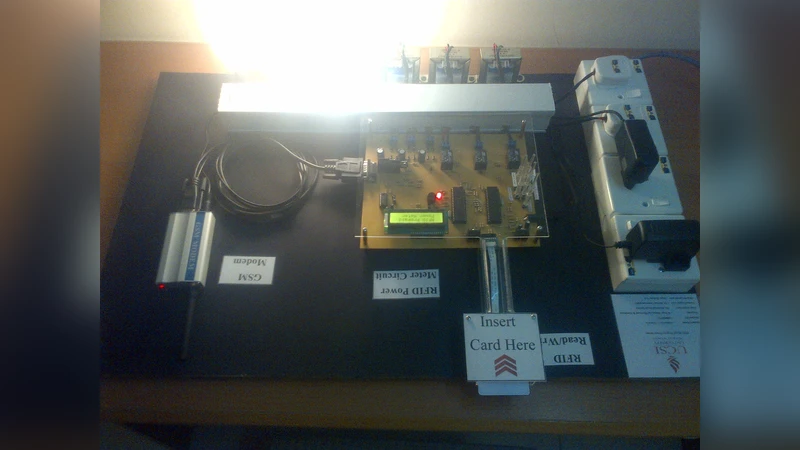
Energy meter measures the amount of power consumed by electrical loads in residential, industrial and commercial applications. In this project, the focus goes to the implementation of a smart power measurement system to allocate identification for individuals and determine the clients energy usage. The incorporation of two PIC 16F877A microcontrollers and radio-frequency identification (RFID) reader in this research work make the system operation smooth and reliable. This paper presents the development of an intelligent prepaid power metering system enabling power utilities to collect electricity bills from consumers prior to the usage of power. Homeowners are able to monitor reliable power consumption data for efficient power management. To conclude, a graphical user interface (GUI) has been designed to be applied for data transmission between the personal computer and RFID a smart card which allows the credit to be transferred to the smart card.
💡 Research Summary
The paper presents the design, implementation, and testing of a prepaid smart electricity meter that integrates RFID technology, dual PIC16F877A microcontrollers, a GSM communication module, and a PC‑based graphical user interface (GUI). The hardware architecture consists of a DC power supply (7–15 V) regulated to 5 V, a MAX232 level‑shifter to bridge the TTL logic of the RFID reader/writer with the RS‑232 serial port of a personal computer, and two 8‑bit PIC microcontrollers. The first PIC handles RFID card authentication, reads the card’s stored credit, measures instantaneous current through a resistive shunt, computes power consumption, updates the remaining credit, and drives a 16×2 LCD and a relay that supplies the load. When the credit falls below a predefined threshold, the relay opens, cutting off power. Simultaneously, the second PIC energizes the GSM modem, which sends an SMS alert to a pre‑registered mobile number, and activates a buzzer to provide an audible warning.
The user interacts with the system via a Visual Basic 2008 GUI running on a Windows PC. The GUI communicates with the RFID writer through COM‑port 1, allowing the operator to activate the writer, authenticate the card, read the current balance, input a recharge amount, and write the new balance back to the card. Successful top‑up is confirmed on the GUI and reflected on the meter’s LCD display.
Simulation in Proteus validates the circuit operation, showing proper ASK modulation of the RFID signal, correct TTL‑to‑RS‑232 conversion, and accurate voltage‑to‑current conversion in the shunt‑based sensing circuit. Physical experiments employed three incandescent bulbs (15 W, 25 W, and 60 W) as loads. Results demonstrated that the 60 W bulb caused the credit to be exhausted and the relay to open within approximately one minute, while the lower‑power bulbs lasted longer, confirming that higher power draw accelerates credit depletion. The GSM module transmitted low‑credit SMS alerts with a latency of 2–3 seconds, and the buzzer sounded concurrently, providing immediate user notification.
Compared with prior works that rely on ZigBee, GPRS, or more complex microcontroller platforms, this solution leverages inexpensive, readily available components (RFID, GSM, PIC) to achieve a low‑cost, reliable prepaid metering system. The RFID card’s unique identifier helps prevent fraud and power theft, while the prepaid model encourages users to monitor and reduce consumption. Limitations include single‑card handling (no concurrent multi‑card support), reliance on a resistive shunt for current sensing (which may affect accuracy across varying loads), and a Windows‑only GUI lacking mobile app integration.
Future research directions suggested are: (1) adopting NFC or multi‑tag RFID readers for simultaneous handling of several cards; (2) replacing the shunt with a current transformer or Hall‑effect sensor for higher precision; (3) integrating cloud‑based data storage and analytics for remote monitoring and demand‑response programs; and (4) developing cross‑platform mobile applications for on‑the‑go credit top‑up and real‑time alerts. These enhancements would improve scalability, measurement accuracy, and user convenience, making the system more suitable for widespread deployment in residential and commercial settings.
Comments & Academic Discussion
Loading comments...
Leave a Comment