Structural health monitoring with distributed wireless sensor networks
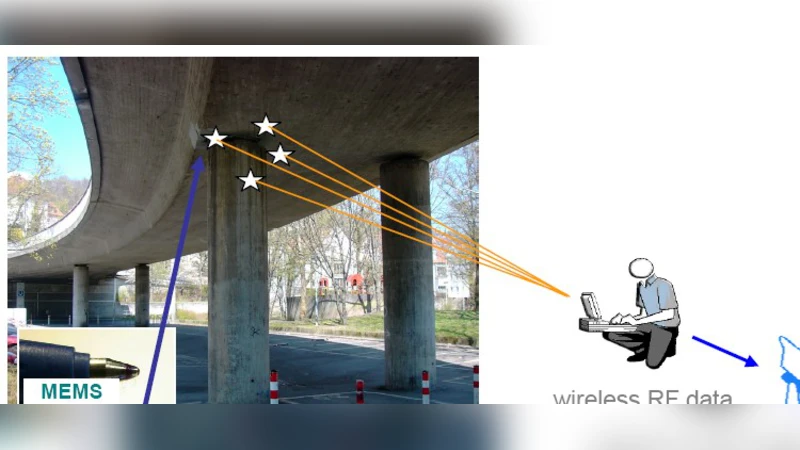
Wireless Sensor Networks(WSN) are a today technology with great practicability in the real world. We focus on describing WSN architecture, regarding usefulness in constructions like structural health monitoring and importance, and advantages of using WSN in this domain
💡 Research Summary
The paper presents a comprehensive examination of applying Distributed Wireless Sensor Networks (WSNs) to Structural Health Monitoring (SHM) of civil infrastructure. It begins by outlining the limitations of traditional wired SHM systems—high installation costs, complex cabling, and difficult maintenance—and argues that wireless solutions can overcome these barriers. The authors then describe the hardware architecture of a typical sensor node, which integrates a low‑power microcontroller, MEMS accelerometers or strain gauges, a radio transceiver compliant with IEEE 802.15.4, and an energy subsystem that may combine batteries with energy‑harvesting (solar, vibration) techniques. Power‑management strategies such as dynamic voltage scaling, duty‑cycling, and adaptive sleep schedules are detailed, showing how node lifetimes of several years can be achieved with average consumption in the sub‑milliwatt range.
On the networking side, the paper evaluates both tree‑based and mesh‑based topologies. While a simple tree offers minimal routing overhead, it is vulnerable to single‑point failures. Mesh topologies provide multi‑path redundancy and higher reliability but increase routing complexity and energy use. To balance these trade‑offs, the authors propose a hybrid architecture: gateway nodes form a resilient mesh, while peripheral sensor nodes connect in a tree structure to the nearest gateway. Routing protocols such as RPL (IPv6 Routing Protocol for Low‑Power and Lossy Networks) and CTP (Collection Tree Protocol) are compared, and a hybrid MAC that blends CSMA/CA with TDMA slots is introduced to guarantee low latency (≤10 ms) for high‑frequency vibration data while minimizing collisions.
Data handling is addressed through a distributed processing model. Each node performs on‑board preprocessing—Fast Fourier Transform, RMS calculation, peak‑to‑peak extraction—and transmits only compact feature vectors to a central aggregator. This reduces network traffic by more than 70 % and eases the computational burden on the backend. The aggregator runs machine‑learning classifiers (Support Vector Machines, Random Forests) to detect anomalies such as cracks, corrosion, or excessive vibrations in real time, triggering immediate alerts for maintenance crews.
Energy efficiency is further enhanced by adaptive transmission policies that adjust power levels and data rates based on residual battery voltage and channel conditions. Simulation of a 1 km bridge equipped with 200 sensor nodes demonstrates an average packet loss of less than 0.3 % and a projected battery lifespan exceeding five years, with network re‑configuration times under two seconds after node failures.
Security considerations are also examined. Given the constrained resources of sensor nodes, the authors adopt lightweight AES‑128 encryption combined with Message Authentication Codes (MAC) for integrity, and a pre‑shared key scheme for node authentication. They acknowledge the challenges of key distribution and propose future work on low‑power blockchain‑based trust management to provide decentralized security without excessive overhead.
The paper concludes by identifying open research challenges: improving energy‑harvesting efficiency, scaling mesh networks to thousands of nodes, optimizing the interface between high‑precision sensors and ultra‑low‑power radios, and integrating more advanced AI models for predictive maintenance. Quantitative results suggest that WSN‑based SHM can cut installation costs by over 40 % and extend maintenance intervals by roughly 30 % compared with wired solutions, positioning it as a cornerstone technology for the next generation of smart infrastructure.
Comments & Academic Discussion
Loading comments...
Leave a Comment