Standards-Based Worldwide Semantic Interoperability for IoT
Global IoT services (GIoTS) are combining locally available IoT resources with Cloud-based services. They are targeting world-wide services. GIoTS require interoperability between the locally installed heterogeneous IoT systems. Semantic processing is an important technology to enable data mediation as well as knowledge-based processing. This paper explains a system architecture for achieving world-wide semantic interoperability using international standards like oneM2M and the OMA NGSI-9/10 context interfaces (as used in the European Future Internet Platform FIWARE). Semantics also enables the use of Knowledge-based Semantic Processing Agents. Furthermore, we explain how semantic verification enables the testing of such complex systems.
💡 Research Summary
The paper presents a comprehensive framework for achieving worldwide semantic interoperability in Global IoT Services (GIoTS), which combine locally available heterogeneous IoT resources with cloud‑based analytics and orchestration. The authors argue that the current IoT landscape suffers from fragmentation and a lack of universally accepted standards, and they propose a solution that leverages two mature international standards: oneM2M for device‑level communication and OMA NGSI‑9/10 (as implemented in the FIWARE platform) for cloud‑level contextual data handling.
OneM2M defines a hierarchical resource model (CSE, AE, container, contentInstance) and a set of CRUDN operations. While the first release offered only simple string‑based annotations, Release 2 introduced “semantic descriptors” stored as RDF triples, enabling rich, ontology‑based description of resources. These descriptors can be added by third‑party tools, allowing legacy devices to be retro‑fitted with semantic metadata without redesign.
FIWARE, on the other hand, provides the Orion Context Broker, which implements NGSI‑9 for registration and discovery of context entities and NGSI‑10 for CRUD, subscription, and query operations. FIWARE’s strength lies in its plug‑and‑play generic enablers for big‑data storage, analytics, and visualization, but it lacks a global communication protocol.
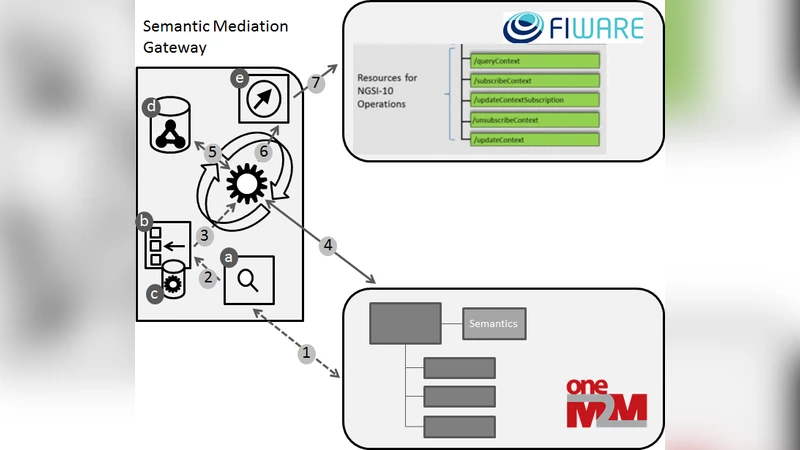
The core contribution of the paper is the design of a Semantic Mediation Gateway (SMG) that bridges oneM2M and FIWARE. The SMG translates RDF‑based semantic descriptors from oneM2M into NGSI entities, mapping ontology concepts to FIWARE attribute types, and conversely converts NGSI context updates back into oneM2M descriptors. This bi‑directional translation enables SPARQL‑based semantic discovery across both domains, far surpassing the simple label‑filtering of the original oneM2M specification.
To move beyond data exchange, the authors introduce Knowledge‑Based Semantic Processing Agents (KSPA). KSPA consume contextual streams from FIWARE, apply ontology‑driven reasoning, rule engines, and machine‑learning models to generate domain‑specific insights (e.g., predictive maintenance, sentiment‑augmented alerts). The results are fed back into the FIWARE context model, making them instantly available to any NGSI‑9/10 client. KSPA can also expose SPARQL endpoints for external semantic services.
Semantic validation is addressed through RDF schema checks and SHACL constraints, ensuring that incoming data conforms to the shared ontologies before it enters the processing pipeline. This pre‑emptive verification is crucial for large‑scale, distributed deployments where inconsistent metadata could cause service failures.
The proposed architecture consists of four layers: (1) Device layer – heterogeneous sensors/actuators using MQTT, CoAP, LwM2M, etc., registered in a oneM2M CSE; (2) Mediation layer – SMG performing RDF↔NGSI translation and SPARQL‑based discovery; (3) Cloud/Context layer – Orion Context Broker exposing NGSI‑9/10 APIs for storage, query, and subscription; (4) Knowledge layer – KSPA providing inference, analytics, and feedback.
A practical scenario described involves a smart city where street‑light sensors, waste‑bin monitors, and traffic cameras register via oneM2M, are semantically annotated, and become discoverable through NGSI‑9 queries. Applications can dynamically compose services (e.g., adaptive lighting based on traffic flow) and rely on KSPA to predict congestion and suggest optimal lighting schedules. The system also supports intermittent connectivity: oneM2M’s local caching and SMG’s offline mode preserve functionality during network outages, while synchronization resumes automatically when connectivity returns.
In conclusion, the paper demonstrates that by combining oneM2M’s worldwide communication foundation with FIWARE’s rich contextual data model, and by adding semantic mediation plus knowledge‑processing agents, GIoTS can achieve dynamic discovery, automatic composition, and intelligent operation across borders. Future work is outlined as automatic ontology generation, scaling SPARQL queries, enhancing security and privacy, and tailoring KSPA modules to specific industry domains.
Comments & Academic Discussion
Loading comments...
Leave a Comment