Evolutionary of Online Social Networks Driven by Pareto Wealth Distribution and Bidirectional Preferential Attachment
Understanding of evolutionary mechanism of online social networks is greatly significant for the development of network science. However, present researches on evolutionary mechanism of online social networks are neither deep nor clear enough. In this study, we empirically showed the essential evolution characteristics of Renren online social network. From the perspective of Pareto wealth distribution and bidirectional preferential attachment, the origin of online social network evolution is analyzed and the evolution mechanism of online social networks is explained. Then a novel model is proposed to reproduce the essential evolution characteristics which are consistent with the ones of Renren online social network, and the evolutionary analytical solution to the model is presented. The model can also well predict the ordinary power-law degree distribution. In addition, the universal bowing phenomenon of the degree distribution in many online social networks is explained and predicted by the model. The results suggest that Pareto wealth distribution and bidirectional preferential attachment can play an important role in the evolution process of online social networks and can help us to understand the evolutionary origin of online social networks. The model has significant implications for dynamic simulation researches of social networks, especially in information diffusion through online communities and infection spreading in real societies.
💡 Research Summary
**
The paper investigates the evolutionary mechanisms underlying online social networks (OSNs) by focusing on empirical data from Renren, one of China’s largest social platforms. The authors first document that during the first three months of Renren’s growth, the degree distribution evolves from an initial single power‑law to a two‑region power‑law: low‑degree nodes follow a steep decline while high‑degree nodes exhibit a flatter tail. Concurrently, the average degree rises steadily, the number of communities and connected components first increase and then decline, and modularity decreases monotonically. These dynamics differ markedly from the classic Barabási‑Albert (BA) preferential‑attachment model, which predicts a static power‑law degree distribution, constant average degree, a single connected component, and increasing modularity.
The authors identify three shortcomings of the BA model for OSNs: (1) unlimited network growth, whereas real OSNs are bounded by the finite human population; (2) reliance solely on node degree for attachment probability, ignoring socioeconomic attributes that influence link formation; and (3) a unidirectional attachment process where a new node selects an existing node without requiring mutual consent, which does not reflect the bidirectional nature of friendship formation in human societies.
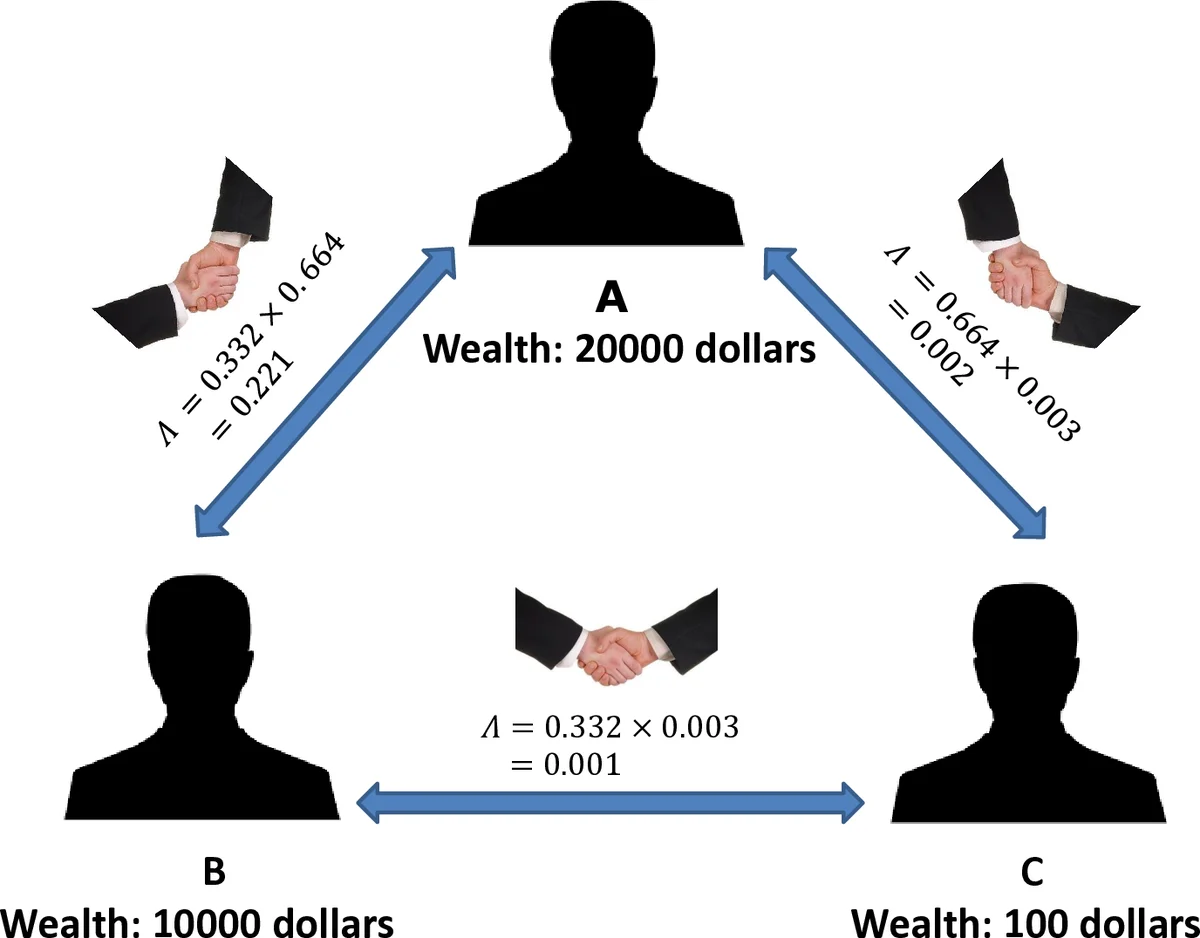
To address these gaps, the paper proposes a new generative model that integrates two key mechanisms: (i) Pareto‑distributed wealth (or “social stratum”) assigned to each node, reflecting empirical observations that individual wealth follows a power‑law; and (ii) bidirectional preferential attachment, where both the initiator and the target must agree to form a link. In the model, each node i possesses a wealth (w_i) drawn from a Pareto distribution (P(w) \propto w^{-\alpha}). When a new node joins, it selects a potential partner j with probability proportional to the product of j’s wealth and its current degree: (\Pi_j \propto w_j k_j). The selected node then accepts the request with a probability that also depends on its wealth, thereby implementing a mutual‑selection process. The network size is capped at a predefined maximum (N_{\max}) to reflect demographic limits.
Using a continuous‑approximation and master‑equation analysis, the authors derive an analytical expression for the degree distribution. The solution exhibits a two‑region power‑law with a “bowing” effect in the high‑degree tail: the distribution bends upward relative to a pure power‑law. This bowing arises because a small fraction of high‑wealth nodes attract a disproportionate number of links, causing the average degree to increase and flattening the tail. By adjusting the Pareto exponent (\alpha) and the coupling strength between wealth and degree, the model can reproduce a variety of empirical degree‑distribution shapes observed across different OSNs.
Extensive simulations validate the model against Renren data. The simulated networks match the empirical trajectories of average degree, community count, component count, and modularity. In contrast, BA‑generated networks fail to capture these trends, maintaining constant average degree, a single component, and rising modularity. Moreover, the model successfully predicts the bowing phenomenon reported in other platforms such as Facebook and Twitter, suggesting that the combined influence of wealth heterogeneity and bidirectional link formation is a universal driver of OSN structure.
The paper concludes that incorporating socioeconomic stratification (via Pareto wealth) and mutual‑selection attachment provides a more realistic framework for modeling OSN evolution. This framework not only explains static structural features but also dynamic processes such as information diffusion and epidemic spreading, which are sensitive to community structure and degree heterogeneity. Future work is suggested to extend the model with additional social attributes (education, geography) and to apply it to policy‑relevant scenarios like viral marketing, misinformation containment, and public‑health interventions.
Comments & Academic Discussion
Loading comments...
Leave a Comment