A Comprehensive Review of Technologies Used for Screening, Assessment, and Rehabilitation of Autism Spectrum Disorder
Autism Spectrum Disorder (ASD) is an umbrella term for a wide range of developmental disorders. For the past two decades, researchers proposed the use of various technologies in order to tackle specific symptoms of the disorder. Although there exist many literature reviews about screening, assessment, and rehabilitation of ASD, no comprehensive survey of types of technologies in all defined symptoms of ASD has been presented. Therefore, in this paper a comprehensive survey of previous studies has been presented in which the studies are classified into three main categories, and several sub-categories, and three main technologies. An analysis of the number of studies in each category and sub-category is given to help researchers decide on areas which need further investigation. The analysis show that the majority of studies fall into the software-based systems technology category. Finally, a brief review of studies in each category of ASD is presented for each type of technology. As a result, this paper also helps researchers to obtain an overview of the typical methods of using a specific technology in ASD screening, assessment, and rehabilitation.
💡 Research Summary
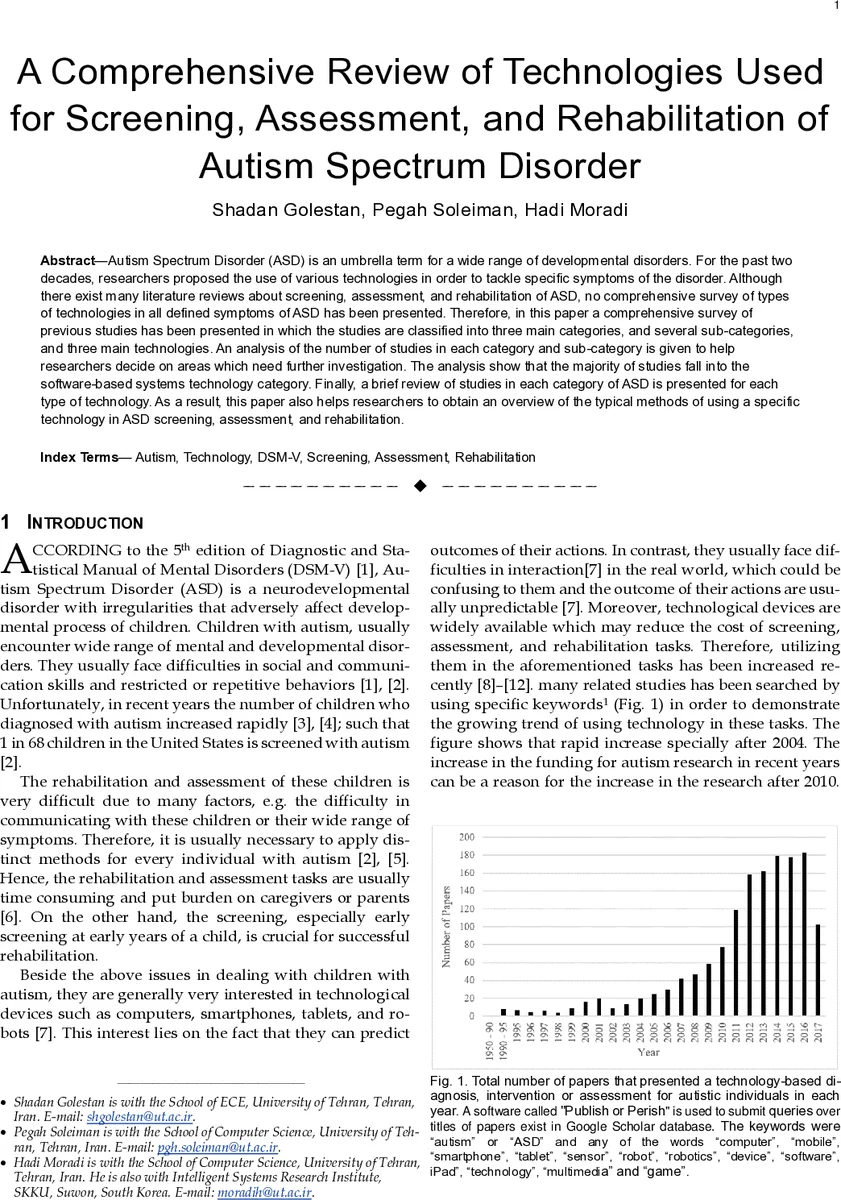
This paper presents a comprehensive review of technologies employed for screening, assessment, and rehabilitation of children with Autism Spectrum Disorder (ASD). By examining 212 peer‑reviewed studies published between the early 2000s and 2017, the authors categorize the technological approaches into three primary groups: software‑based systems (mobile apps, computer games, multimedia platforms), hardware‑based robots (humanoid, animal‑like, and interactive mechatronic devices), and dedicated devices (wearable sensors, intelligent toys, and custom data‑collection hardware). A bibliometric analysis shows a sharp increase in publications after 2004, with a pronounced surge following heightened research funding in the 2010s.
The review aligns the technological interventions with DSM‑5 diagnostic criteria, grouping ASD symptoms into three overarching domains: difficulties in social and communication skills, restricted or repetitive behaviors, and adversities in learning. Within these domains, twelve sub‑categories (e.g., lack of eye contact, joint attention deficits, fixated interests) are examined. The authors find that the majority of research (approximately 55 %) targets social and communication difficulties, where software solutions dominate due to low development cost, ease of distribution, and rapid update cycles. Robotic systems are preferentially applied to sub‑domains requiring embodied interaction, such as joint attention and imitation, while dedicated devices are mainly used for physiological monitoring and sensory input measurement.
Conversely, the restricted/repetitive behavior domain receives comparatively few studies, and several sub‑categories—particularly fixated interests, hyper‑reactivity to sensory input, and inflexible routine adherence—are virtually unexplored. The learning adversity domain is largely addressed through software‑based educational apps; robotic or dedicated‑device interventions are scarce.
Key insights include: (1) software‑based approaches are the most accessible and widely adopted; (2) robots offer unique affordances for embodied social skill training but are limited by cost and current technical capabilities; (3) dedicated devices excel at data acquisition but lack integration with therapeutic content; and (4) significant gaps exist in technology‑supported interventions for certain DSM‑5 symptom clusters.
The authors recommend future research directions such as enhancing robot perception and affective computing, developing integrated platforms that combine wearable sensor data with adaptive software, personalizing interventions through machine‑learning‑driven analytics, and promoting open‑source, low‑cost hardware to improve scalability. Addressing these gaps could lead to more holistic, individualized, and cost‑effective solutions for ASD screening, assessment, and rehabilitation.
Comments & Academic Discussion
Loading comments...
Leave a Comment