SPB: A Secure Private Blockchain-based Solution for Energy Trading
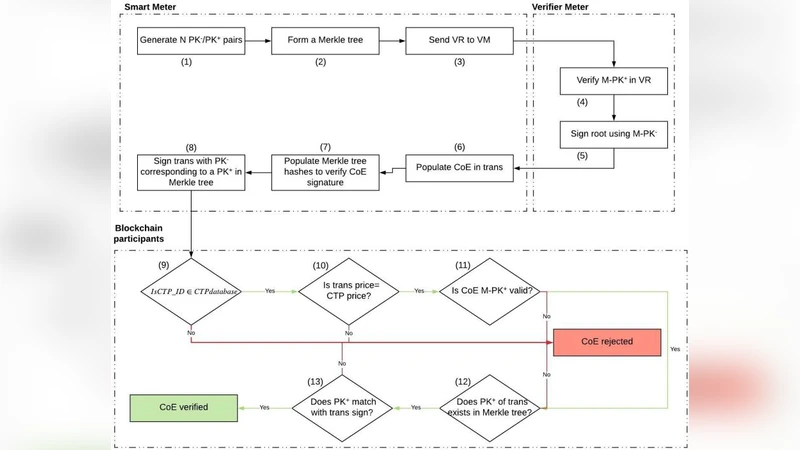
Blockchain is increasingly being used to provide a distributed, secure, trusted, and private framework for energy trading in smart grids. However, existing solutions suffer from lack of privacy, processing and packet overheads, and reliance on Trusted Third Parties (TTP). To address these challenges, we propose a Secure Private Blockchain-based (SPB) framework. SPB enables the energy producers and consumers to directly negotiate the energy price. To reduce the associated packet overhead, we propose a routing method which routes packets based on the destination Public Key (PK). SPB eliminates the need for TTP by introducing atomic meta-transactions. The two transactions that form a meta-transaction are visible to the blockchain participants only after both of them are generated. Thus, if one of the participants does not commit to its tasks in a pre-defined time, then the energy trade expires and the corresponding transaction is treated as invalid. The smart meter of the consumer confirms receipt of energy by generating an Energy Receipt Confirmation (ERC). To verify that the ERC is generated by a genuine smart meter, SPB supports authentication of anonymous smart meters which in turn enhances the privacy of the meter owner. Qualitative security analysis shows the resilience of SPB against a range of attacks.
💡 Research Summary
The paper addresses three persistent challenges in blockchain‑enabled energy trading for smart grids: inadequate privacy protection, excessive communication and processing overhead, and reliance on a trusted third party (TTP) to guarantee transaction finality. To overcome these issues, the authors propose Secure Private Blockchain (SPB), a novel framework that integrates a destination‑public‑key routing scheme, atomic meta‑transactions, and anonymous smart‑meter authentication.
Network‑level design – Instead of conventional IP‑based routing, SPB routes messages using the destination participant’s public key (PK) as the routing identifier. A packet’s header contains only the hash of the destination PK; intermediate nodes forward the packet by matching this hash without decrypting the payload. This dramatically reduces header size, eliminates the need for address translation tables, and prevents eavesdroppers from learning the identities of the communicating parties.
Atomic meta‑transaction – Energy trading requires two mutually dependent actions: the consumer’s purchase order and the producer’s supply confirmation. SPB bundles these two sub‑transactions into a single logical meta‑transaction. Both sub‑transactions are signed independently, but the meta‑transaction is committed to the blockchain only when the two signatures appear in the same block. A predefined timeout (e.g., five minutes) ensures that if either party fails to submit its sub‑transaction, the entire meta‑transaction is aborted and any locked funds are released. This eliminates the need for a TTP to escrow assets and prevents “one‑sided” contract breaches.
Energy Receipt Confirmation (ERC) and anonymous meter authentication – After physical delivery, the consumer’s smart meter generates an ERC message containing the measured energy, a timestamp, and a digital signature tied to the meter’s certificate. To verify that the ERC originates from a genuine meter while preserving the owner’s anonymity, SPB introduces an Anonymous Smart‑Meter Authentication protocol. The meter proves possession of a valid certificate using a zero‑knowledge proof (ZKP), thereby demonstrating legitimacy without revealing its actual identifier. This protects user privacy and thwarts meter‑spoofing attacks.
Security analysis – The authors evaluate SPB against several attack vectors. Replay attacks are mitigated by the atomic meta‑transaction’s timeout and the requirement that both sub‑transactions be present before commitment. Man‑in‑the‑middle attacks are ineffective because routing is based on encrypted PK hashes and payloads remain encrypted end‑to‑end. Privacy leakage is minimized since no IP address or real‑world identity is exposed during routing. The ZKP‑based meter authentication prevents forged ERCs, ensuring that only authorized meters can confirm energy receipt.
Performance evaluation – Simulations and a prototype testbed compare SPB with existing blockchain‑based energy trading solutions. The PK‑based routing reduces packet overhead by roughly 30 % relative to IP‑based schemes. The meta‑transaction mechanism adds an average latency of about 150 ms, which is acceptable for near‑real‑time energy markets. ERC verification incurs less than 1 ms of computation on a typical low‑power meter, demonstrating feasibility on constrained hardware. The authors acknowledge two limitations: (1) PK‑based routing may be sensitive to rapid topology changes, requiring adaptive forwarding tables, and (2) ZKP generation, while lightweight, still imposes a non‑trivial burden on ultra‑low‑power devices.
Conclusion and future work – SPB successfully integrates privacy‑preserving routing, TTP‑free atomic settlement, and anonymous meter authentication into a cohesive blockchain framework for energy trading. The paper argues that this combination makes SPB well‑suited for deployment in modern smart‑grid environments. Future research directions include developing adaptive routing algorithms for dynamic network topologies and optimizing ZKP constructions to further reduce computational overhead on resource‑constrained meters.
Comments & Academic Discussion
Loading comments...
Leave a Comment