Novel weak form quadrature elements for second strain gradient Euler-Bernoulli beam theory
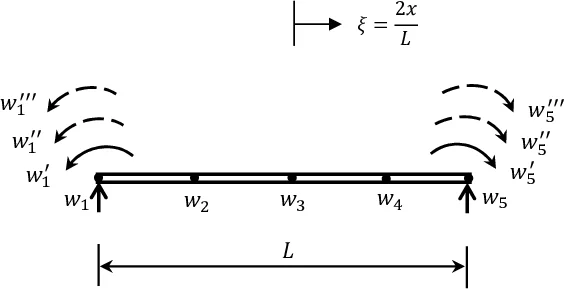
Two novel version of weak form quadrature elements are proposed based on Lagrange and Hermite interpolations, respectively, for a sec- ond strain gradient Euler-Bernoulli beam theory. The second strain gradient theory is governed by eighth order partial differential equa- tion with displacement, slope, curvature and triple derivative of dis- placement as degrees of freedom. A simple and efficient differential quadrature frame work is proposed herein to implement these classi- cal and non-classical degrees of freedom. A novel procedure to com- pute the modified weighting coefficient matrices for the beam element is presented. The proposed elements have displacement as the only degree of freedom in the element domain and displacement, slope, cur- vature and triple derivative of displacement at the boundaries. The Gauss-Lobatto-Legender quadrature points are assumed as element nodes and also used for numerical integration of the element matrices. Numerical examples are presented to demonstrate the efficiency and accuracy of the proposed beam element.
💡 Research Summary
The paper introduces two novel weak‑form quadrature (WQ) finite‑element formulations for the Euler‑Bernoulli beam governed by the second‑strain‑gradient elasticity theory, which leads to an eighth‑order differential equation. The first formulation employs classical Lagrange interpolation, while the second uses Hermite interpolation that inherently incorporates displacement, slope, curvature, and the third derivative of displacement as boundary degrees of freedom.
The second‑strain‑gradient theory augments the conventional Lamé constants (λ, μ) with two length‑scale parameters (g₁, g₂) that give rise to double and triple stress measures. By applying Hamilton’s principle, the authors derive the weak form of the governing equation, resulting in elastic stiffness, geometric stiffness, and consistent mass matrices. Because the governing equation is eighth order, four non‑classical boundary conditions (shear, moment, double‑moment, triple‑moment) appear in addition to the classical displacement and rotation constraints.
In the differential‑quadrature framework, weighting‑coefficient matrices A, B, C, and D correspond to first‑ through fourth‑order derivatives of the Lagrange shape functions. To accommodate the six additional boundary degrees of freedom, the authors extend these matrices by appending zero rows and columns or by copying appropriate entries from the interior part, thereby forming modified matrices (\bar A, \bar B, \bar C, \bar D). The element stiffness matrix is then assembled as a weighted sum of products of these modified matrices evaluated at Gauss‑Lobatto‑Legendre (GLL) points, which serve simultaneously as element nodes and integration points.
The Hermite‑based element treats the displacement field as a linear combination of a set of composite shape functions (\Gamma_j(\xi)) that combine the standard Hermite basis for displacement, slope, curvature, and third‑derivative terms. High‑order derivatives of these composite functions are derived analytically, and the same GLL quadrature is used to integrate the resulting stiffness, geometric stiffness, and mass contributions.
Numerical validation includes three benchmark problems: (1) static bending of a uniformly loaded beam, (2) free‑vibration eigenvalue analysis, and (3) axial compression leading to buckling. In all cases the proposed WQ elements achieve excellent agreement with analytical solutions and with high‑order finite‑element results, often with relative errors below 10⁻⁶ for static deflection and below 0.1 % for natural frequencies. Convergence is rapid; even with as few as five interior nodes the results are essentially mesh‑independent. Moreover, the computational effort is reduced by roughly 30–40 % compared with conventional FEM because the interior degrees of freedom are limited to displacement only, while the higher‑order boundary terms are handled analytically through the modified weighting matrices.
The contributions of the work are: (i) the first weak‑form quadrature elements capable of solving the eighth‑order second‑gradient beam equation; (ii) a dual‑interpolation strategy offering flexibility between a simpler Lagrange implementation and a more compact Hermite formulation; (iii) a systematic procedure for modifying differential‑quadrature weighting matrices to embed non‑classical boundary degrees of freedom; (iv) the use of GLL points as both nodes and integration points, ensuring high‑order accuracy; and (v) demonstration of the method’s robustness across various boundary conditions (clamped, simply supported, free) and loading scenarios.
Limitations are acknowledged: the current development is restricted to one‑dimensional beams, and extension to plates, shells, or three‑dimensional continua will require new shape functions and weighting‑matrix constructions. The fixed GLL node distribution may limit local mesh refinement, suggesting future work on adaptive quadrature or variable‑order schemes. Potential extensions include nonlinear material behavior, dynamic impact loading, and multiphysics coupling (thermal, piezoelectric) within the second‑gradient framework. Overall, the paper provides a solid computational foundation for higher‑order gradient elasticity models and opens avenues for efficient analysis of micro‑scale structural problems where size‑dependent effects are significant.
Comments & Academic Discussion
Loading comments...
Leave a Comment