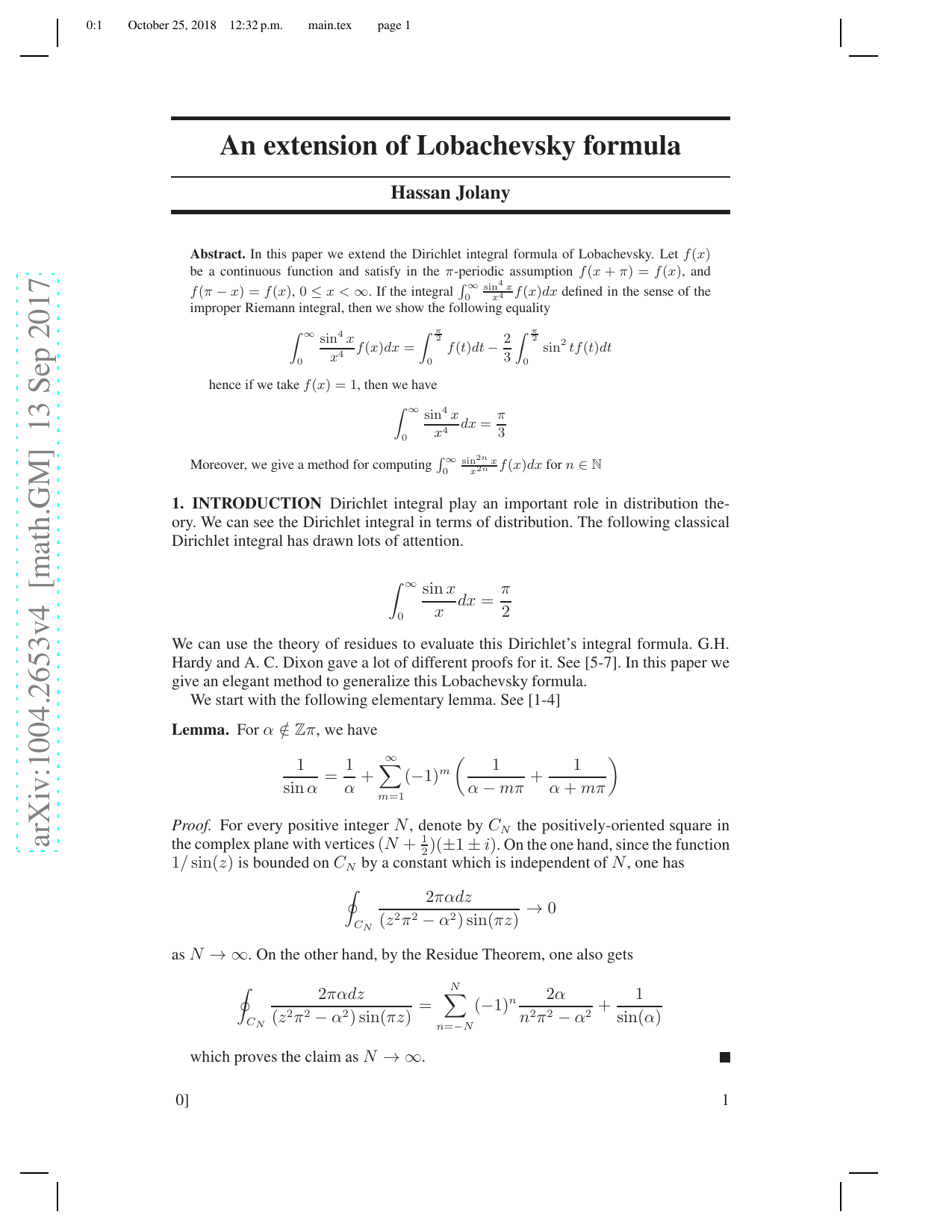
In this paper we extend the Dirichlet integral formula of Lobachevsky. Let $f(x)$ be a continuous function and satisfy in the $\pi$-periodic assumption $f(x+\pi)=f(x)$, and $f(\pi-x)=f(x)$, $0\leq x<\infty $. If the integral $\int_0^\infty \frac{\sin^4x}{x^4}f(x)dx$ defined in the sense of the improper Riemann integral, then we show the following equality $$\int_0^\infty \frac{\sin^4x}{x^4}f(x)dx=\int_0^{\frac{\pi}{2} }f(t)dt-\frac{2}{3}\int_0^{\frac{\pi}{2} }\sin^2tf(t)dt$$ hence if we take $f(x)=1$, then we have $$\int_0^\infty \frac{\sin^4x}{x^4}dx=\frac{\pi}{3}$$ Moreover, we give a method for computing $\int_0^\infty \frac{\sin^{2n}x}{x^{2n}}f(x)dx$ for $n\in \mathbb N$
Deep Dive into An extension of Lobachevsky formula.
In this paper we extend the Dirichlet integral formula of Lobachevsky. Let $f(x)$ be a continuous function and satisfy in the $\pi$-periodic assumption $f(x+\pi)=f(x)$, and $f(\pi-x)=f(x)$, $0\leq x<\infty $. If the integral $\int_0^\infty \frac{\sin^4x}{x^4}f(x)dx$ defined in the sense of the improper Riemann integral, then we show the following equality
$$\int_0^\infty \frac{\sin^4x}{x^4}f(x)dx=\int_0^{\frac{\pi}{2} }f(t)dt-\frac{2}{3}\int_0^{\frac{\pi}{2} }\sin^2tf(t)dt$$
Moreover, we give a method for computing $\int_0^\infty \frac{\sin^{2n}x}{x^{2n}}f(x)dx$ for $n\in \mathbb N$
1. INTRODUCTION Dirichlet integral play an important role in distribution theory. We can see the Dirichlet integral in terms of distribution. The following classical Dirichlet integral has drawn lots of attention.
We can use the theory of residues to evaluate this Dirichlet’s integral formula. G.H. Hardy and A. C. Dixon gave a lot of different proofs for it. See [5][6][7]. In this paper we give an elegant method to generalize this Lobachevsky formula. We start with the following elementary lemma. See [1][2][3][4] Lemma. For α / ∈ Zπ, we have
Proof. For every positive integer N , denote by C N the positively-oriented square in the complex plane with vertices (N + 1 2 )(±1 ± i). On the one hand, since the function 1/ sin(z) is bounded on C N by a constant which is independent of N , one has
as N → ∞. On the other hand, by the Residue Theorem, one also gets Lemma. For α / ∈ Zπ, we have the following identity
Proof. The identity follows by differentiating termwise the classical formula ,
- LOBACHEVSKY FORMULA Now, we present the Lobachevsky formula.
Theorem 1. Let f satisfy the conditions of the beginning of the article. Then we have the following Lobachevsky identity
we can write I as follows
and proof of the identity
0 f (x)dx is complete. Now we prove the second part of identity. Take
we can write J as follows
consequently we can write J in the following form
Hence from Lemma 1.2, we get
and proof is complete 0]
- EXTENSION OF THE LOBACHEVSKY FORMULA Now we give a general method for calculating the following Dirichlet integral.
where f (π + x) = f (x), and f (π -x) = f (x), 0 ≤ x < ∞. Here we have assumed f is continuous and ∞ 0 sin 2n x x 2n f (x)dx defined in the sense of the improper Riemann integral. We start with n = 2. As we did in the previous section, take
By a direct computation
Next, differentiating twice termwise the right-hand side of identity of Lemma 1.2, we get the following identity
From the previous method which we explained in section 2, we can write I as follows
So we proved the following theorem
defined in the sense of the improper Riemann integral, then we have the following equality As remark if we take f (x) = 1, then we have Remark. We have
We have also the following remark from Lobachevsky formula
Now, by the following important remark, we can calculate the Lobachevsky formula for any n ≥ 3. Let f (z) satisfy the conditions of the beginning of the article.
Remark. In fact, the Dirichlet integral
has the form (for n ≥ 3)
where the constants α i can be computed by the use of the following formulas (and the help of the engine Wolfram Alpha for instance) : For every positive integer n, one can compute
by Leibnitz rule and then apply the closed formula
where n k are the Stirling numbers of the second kind. Now by applying the identity
c HASSAN JOLANY [ 0
This content is AI-processed based on ArXiv data.