Using smartphones for low-cost robotics
Smartphones and robots can have an adversarial or a symbiotic relationship because they strive to serve overlapping customer needs. While smartphones are prevalent, humanoid robots are not. Even though considerable public and private resources are being invested in developing and commercializing humanoid robots, progress seems stalled and no humanoid robot can be said to be successful with consumers. A part from the obvious engineering differences between humanoids and smartphones, other economic factors influence this situation. On one hand, the product cycle of robots is slower than smartphones. This makes robot computing hardware, (as it with automobile’s infotainment systems), perennially outdated when side-by-side to a smartphone. On the other hand, the incentives to develop Apps are high for smartphones and they are comparatively low for robot platforms. Here, we point to how smartphones could be used to lower hardware cost and foster robot app development.
💡 Research Summary
The paper investigates why consumer‑facing humanoid robots have failed to achieve mass‑market success while smartphones dominate the consumer electronics landscape. The authors identify two intertwined problems: a persistent hardware performance gap and a lack of economic incentives for developers to create robot‑specific applications.
First, the hardware gap stems from the vastly different product‑cycle timelines. Smartphones typically refresh every 18 months, incorporating the latest CPUs, GPUs, cameras, and memory technologies. In contrast, humanoid robots have a 3‑to‑7‑year hardware refresh cycle, similar to automotive infotainment systems. The authors use CPU cache size as a proxy for parallel processing capability and show that six generations of a best‑selling smartphone provide roughly ten times the L2/L3 cache of three generations of the most popular humanoid robot (Pepper/NAO). This translates into a ten‑fold performance advantage at a fraction of the cost. A per‑dollar analysis (Fig. 2) demonstrates that the smartphone‑based robot delivers an order of magnitude more cache per dollar spent, and similar gaps exist for camera resolution, display quality, and sensor fidelity.
Second, the economic side is dominated by three forces: software network effects, economies of scale in hardware manufacturing, and product leadership. The mobile ecosystem hosts about 2.4 million apps, generates roughly $86 billion in revenue (2016), and supports a developer community of ~19 million, half of whom focus on mobile platforms. By contrast, robot‑specific app stores contain only about 1 000 apps and serve fewer than 10 000 robot units worldwide. The authors argue that the massive network effect—where a large user base attracts more developers, which in turn attracts more users—creates a virtuous cycle for smartphones that robots lack.
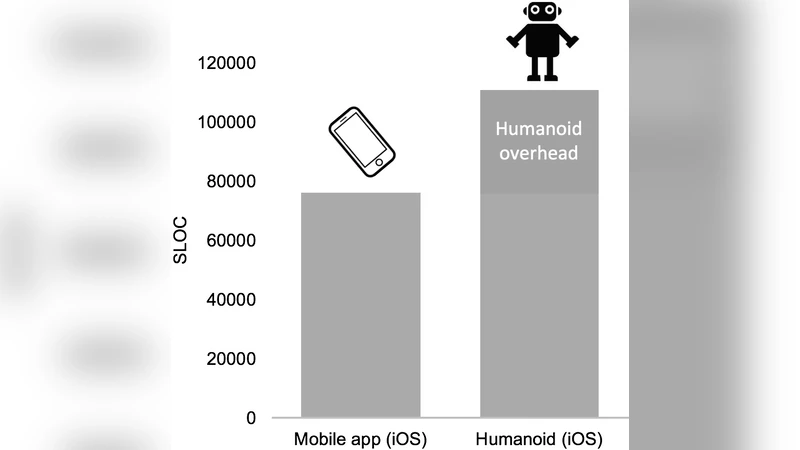
The paper presents a concrete case study: a humanoid robot built from two off‑the‑shelf smartphones (iPhone 6+ and iPad). This “smartphone‑powered” robot achieves 10 MB of total L‑cache, roughly 20 × the cache of Pepper/NAO models, at a hardware cost of $8 000 versus $20 000 for comparable commercial robots. The cost‑per‑performance ratio is therefore about 50 × better. Moreover, when porting an existing mobile app to the robot platform, only 31 % additional source‑lines of code (SLOC) were required, meaning 90 % of the original code could be reused. This demonstrates that mobile apps can be adapted to robot hardware with modest effort, provided the underlying SDK supports the necessary UI, payment, and sensor integration.
The authors contrast mobile SDKs (iOS, Android) with robot‑focused frameworks such as ROS. While ROS excels at hardware abstraction, navigation, and low‑level control, it does not provide the rich UI components, monetization mechanisms, and design guidelines that have driven the mobile app economy. Consequently, robot developers face higher entry barriers and lower potential returns, discouraging investment in robot‑specific applications.
In conclusion, leveraging smartphone hardware and the mature mobile software ecosystem offers a low‑cost pathway to bridge the performance and app‑availability gaps that currently hinder humanoid robot adoption. By reusing existing mobile apps, exploiting powerful mobile SDKs, and taking advantage of the massive developer community, robot manufacturers can avoid costly custom chip development, achieve competitive performance, and create a viable market for consumer‑grade robot applications. The paper argues that this symbiotic relationship between smartphones and robots is the most realistic route toward affordable, mass‑market humanoid robots.
Comments & Academic Discussion
Loading comments...
Leave a Comment