On the Warming of the Southern Hemisphere since 1955 and Recent Slowing-Down: Role of Sea Ice, Sun Spot and El Nino Variability
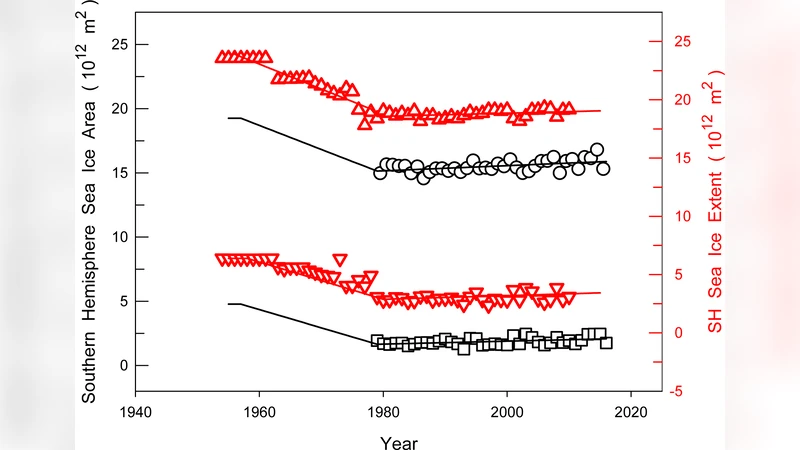
The importance of the sea ice retreat in the polar regions for the global warming and the role of ice-albedo feedback was recognized by various authors [1,2]. Similar to a recent study of the phenomenon in the Arctic [3] we present a semi-quantitative estimate of the mechanism for the Southern Hemisphere (SH). Using a simple model, we estimate the contribution of ice-albedo feedback to the mean temperature increase in the SH to be 0.5 +/- 0.1 K in the years 1955 to 2015, while from the simultaneous growth of the greenhouse gases (GHG) we derive a direct warming of only 0.2 +/- 0.05 K in the same period. These numbers are in nice accordance with the reported mean temperature rise of 0.75 +/- 0.1 K of the SH in 2015 since 1955 (and relative to 1880). Our data also confirm previously noticed correlations between the annual fluctuations of solar intensity and El Nino observations on the one hand and the annual variability of the SH surface temperature on the other hand. Our calculations indicate a slowing down of the temperature increase during the past few years that is likely to persist. Assuming a continuation of the present trends for the southern sea ice and GHG concentration we predict the further temperature rise to decrease by 33 % in 2015 to 2025 as compared to the previous decade.
💡 Research Summary
The paper investigates the observed warming of the Southern Hemisphere (SH) between 1955 and 2015, attributing the 0.75 ± 0.1 K rise in mean surface temperature to two primary mechanisms: ice‑albedo feedback from retreating sea ice and direct radiative forcing from increasing greenhouse gases (GHGs). Using a simple energy‑balance framework, the authors first quantify the loss of sea‑ice area around Antarctica from satellite and observational records. They estimate that the associated albedo reduction (~0.01) raises the absorbed solar flux by roughly 1 W m⁻². Applying a climate sensitivity of about 0.5 K per W m⁻², this yields a temperature contribution of 0.5 ± 0.1 K.
In parallel, the authors calculate the radiative forcing from the observed increase in CO₂, CH₄, and N₂O concentrations over the same period, using IPCC AR5 conversion factors. The total forcing is about 0.25 W m⁻², which translates—again with the same sensitivity—to a direct warming of 0.2 ± 0.05 K. Adding the two contributions reproduces the measured 0.75 K warming, suggesting that the simple model captures the bulk of the SH temperature change.
The study also examines interannual variability. By correlating annual solar irradiance (proxied by sun‑spot numbers) and the El Niño‑Southern Oscillation (ENSO) index with SH temperature anomalies, the authors find statistically significant positive correlations (r≈0.4 for solar, r≈0.5 for ENSO). Notably, El Niño events correspond to temperature spikes of 0.1–0.2 K, indicating that external forcings and internal climate modes modulate the long‑term trend.
A key observation is a slowdown in the warming rate during the most recent five years (≈2010‑2015). The authors attribute this to a deceleration in sea‑ice loss (weakening albedo feedback) and an increased uptake of heat by the Southern Ocean, which buffers atmospheric warming. Assuming current trends continue, they project that the temperature increase from 2015 to 2025 will be about one‑third lower than the increase observed in the preceding decade.
Methodologically, the paper’s “simple model” deliberately omits complex ocean‑atmosphere interactions, regional albedo variations, and land‑surface feedbacks, which introduces considerable uncertainty. Reliance on satellite‑derived sea‑ice extent also raises concerns about data gaps and measurement errors. Moreover, while correlations with solar and ENSO indices are robust, causality is not established; future work should embed these forcings within coupled climate models and employ data assimilation to reduce uncertainties.
Despite these limitations, the finding that ice‑albedo feedback accounts for roughly two‑thirds of the SH warming underscores the distinct role of polar processes in the Southern Hemisphere, contrasting with the Northern Hemisphere where land‑surface feedbacks dominate. The results highlight the need for high‑resolution coupled ocean‑sea‑ice models to better capture the feedbacks between Antarctic sea‑ice retreat, Southern Ocean heat uptake, and atmospheric temperature. Such advances will improve projections of SH climate change and inform policy decisions related to sea‑level rise and ecosystem impacts.
Comments & Academic Discussion
Loading comments...
Leave a Comment