Analysis of social media content and search behavior related to seasonal topics using the sociophysics approach
We studied the time interval between posting social media content and search action related to seasonal topics. The analysis was performed using a mathematical model of the search behavior as in the theory of sociophysics. As seasonal topics, the word cherry blossom was considered for spring, bikini for summer, autumn leaves for fall, and skiing for winter. We examined the influence of blogs and Twitter posts given the search behavior and found a time deviation of interest on these topics.
💡 Research Summary
This paper applies a sociophysics framework to quantify the relationship between seasonal online content and subsequent search behavior. The authors focus on four culturally salient seasonal keywords—“cherry blossom” (spring), “bikini” (summer), “autumn leaves” (fall), and “skiing” (winter)—and collect three types of data for each: daily counts of blog posts, daily counts of Twitter posts, and daily Google‑Trend search volumes for the keyword in English worldwide during 2017.
The theoretical core builds on the authors’ earlier “hit phenomenon” model, which treats individual intention I_i(t) as a stochastic differential equation driven by three forces: direct interpersonal communication (coefficient d_ij), indirect three‑person communication (coefficient h_ijk), and an external random force f_i(t) representing mass‑media advertising. By ensemble‑averaging over the population, they derive a collective‑intention equation I(t) that includes terms for direct communication strength D, indirect communication strength P, and five external‑force contributions: television advertising (C_adv_t), news‑website advertising (C_adv_n), blog influence (C_adv_blog), Twitter influence (C_adv_twitter), and Wikipedia influence (C_adv_wikipedia).
Parameter estimation proceeds by fitting the model to the observed time series of blog posts, tweets, and Google‑Trend data. The authors employ a Monte‑Carlo search combined with a Metropolis‑like acceptance rule, minimizing an R‑factor (borrowed from low‑energy electron diffraction) that quantifies the discrepancy between calculated I(t) and observed counts. All fits achieve R < 0.01, indicating an excellent match.
Results for the “bikini” keyword reveal that the direct (D) and indirect (P) communication coefficients remain essentially flat throughout the year, suggesting that interpersonal word‑of‑mouth does not drive the strong seasonal pattern. Television advertising also shows no clear seasonality. In contrast, news‑website advertising spikes in the summer months, and the model attributes significant pre‑summer influence to blogs (June), Twitter (April–May), and Wikipedia (March–April). This pattern aligns with the intuition that consumers research swimwear options before the beach season, using blogs for detailed reviews, Twitter for quick updates, and Wikipedia for background information.
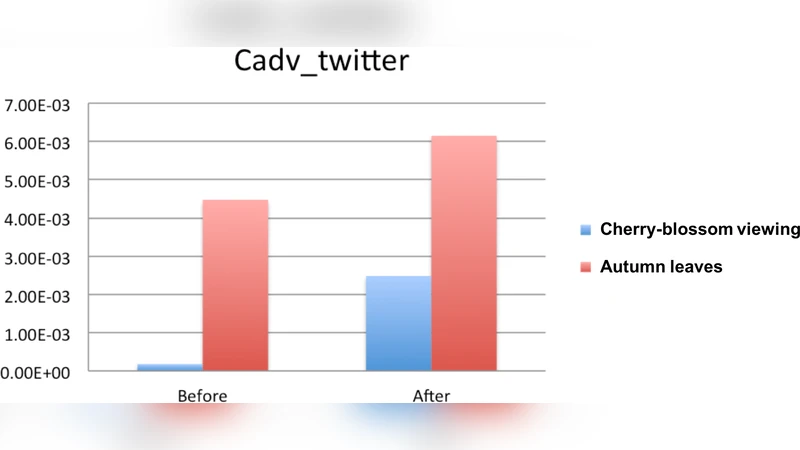
For “cherry blossom” and “autumn leaves,” the analysis uncovers a clear temporal division of labor between media: blog activity peaks before the optimal viewing dates, driving search activity as users plan trips and select viewing spots; Twitter activity peaks after the peak viewing period, reflecting post‑event sharing of experiences and photos. The “skiing” and “bikini” cases similarly illustrate that search interest is tightly coupled to the relevant season, with the Northern‑Hemisphere pattern evident even in globally aggregated English‑language data.
The authors conclude that blogs and Twitter play distinct, time‑shifted roles in shaping seasonal search behavior: blogs act as pre‑season information providers, while Twitter functions as a post‑season experience‑sharing platform. This insight has practical implications for marketers and content creators who must time their outreach according to the media’s functional niche.
However, the study has notable limitations. First, external forces are reduced to raw post counts, ignoring content quality, sentiment, or credibility, which could modulate their impact. Second, advertising influence is modeled as a homogeneous mean field, obscuring differences in targeting, budget allocation, or platform‑specific effectiveness. Third, the Monte‑Carlo optimization, while achieving low R‑factors, does not guarantee global optimality, and parameter interdependencies are not explored. Finally, the reliance on English‑language global search data masks regional cultural variations and may limit the generalizability of the findings.
Future work should incorporate natural‑language processing to weight posts by relevance and sentiment, expand the dataset to include multilingual and region‑specific searches, and apply more robust global‑optimization techniques (e.g., Bayesian optimization) to explore the parameter landscape. Such extensions would strengthen the sociophysics model’s predictive power and broaden its applicability to diverse digital ecosystems.
Comments & Academic Discussion
Loading comments...
Leave a Comment