External observer reflections on QBism
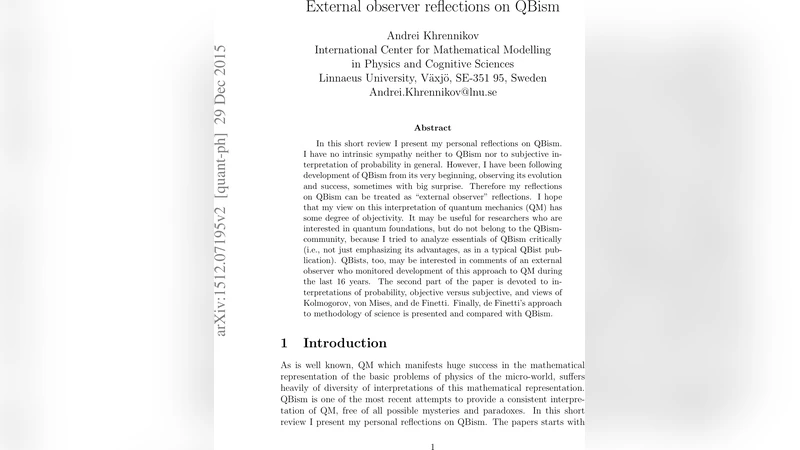
In this short review I present my personal reflections on QBism. I have no intrinsic sympathy neither to QBism nor to subjective interpretation of probability in general. However, I have been following development of QBism from its very beginning, observing its evolution and success, sometimes with big surprise. Therefore my reflections on QBism can be treated as “external observer” reflections. I hope that my view on this interpretation of quantum mechanics (QM) has some degree of objectivity. It may be useful for researchers who are interested in quantum foundations, but do not belong to the QBism-community, because I tried to analyze essentials of QBism critically (i.e., not just emphasizing its advantages, as in a typical QBist publication). QBists, too, may be interested in comments of an external observer who monitored development of this approach to QM during the last 16 years. The second part of the paper is devoted to interpretations of probability, objective versus subjective, and views of Kolmogorov, von Mises, and de Finetti. Finally, de Finetti’s approach to methodology of science is presented and compared with QBism.
💡 Research Summary
**
The paper is a reflective review of QBism written from the standpoint of an “external observer” who has followed the development of the theory for more than sixteen years. The author begins with a historical sketch of QBism’s emergence at the 2001 Växjö conference, noting that the quantum‑information revolution sparked a series of debates between proponents of realist statistical interpretations (including the author himself) and advocates of a personalist, knowledge‑centric view (most prominently Christopher Fuchs). The author admits an initial sympathy for realism but later recognized the conceptual power of QBism’s probability‑update scheme.
The core of QBism, as presented, is the reinterpretation of quantum mechanics as a machine for updating an agent’s personal degrees of belief. Quantum states ρ are treated as subjective belief assignments, and a measurement is an action that elicits a personal experience. The Born rule, p(Fj)=Tr(ρFj), is cast as a generalized version of the classical law of total probability (FTP). To achieve this, QBism relies on a special class of measurements known as symmetric informationally complete positive‑operator‑valued measures (SIC‑POVMs). By fixing a SIC‑POVM {Ei}, any quantum state can be mapped to a probability vector p(Ei)=Tr(ρEi), and any other POVM {Fj} can be expressed through conditional probabilities p(Fj|Ei)=Tr(Fjρi), where ρi is the post‑measurement state after obtaining outcome Ei. The Born rule then takes the form p(Fj)=f(p(Ei),p(Fj|Ei)), which the author identifies as the “cornerstone” of QBism: the Born rule is a coherence condition that generalizes FTP.
A major criticism advanced by the author concerns the necessity of SIC‑POVMs. While SIC‑POVMs provide a mathematically elegant reference measurement, the author argues that the same probability‑update structure can be built from an arbitrary informationally complete POVM. The insistence on counterfactual SIC‑POVMs, the author claims, adds an unnecessary layer of abstraction and may obscure the underlying physics. Moreover, the author points out that the QBist formalism does not depend on any particular interpretation of the probabilities involved; the same equations can be read through a frequentist or Kolmogorovian lens.
The second half of the paper shifts to a philosophical discussion of probability. Three major traditions are compared: (i) Kolmogorov’s axiomatic, measure‑theoretic approach, which treats probability as an objective mathematical object; (ii) von Mises’ frequency interpretation, which grounds probability in the limiting relative frequencies of infinite sequences of trials; and (iii) de Finetti’s subjectivist view, which identifies probability with personal belief and emphasizes Bayesian updating. The author notes that QBism aligns with de Finetti’s subjectivism, yet the author also observes that many of QBism’s mathematical results are compatible with objective, statistical interpretations. This dual compatibility suggests that QBism’s philosophical stance is not forced upon the formalism but rather chosen as a particular reading.
Finally, the author reflects on the broader methodological implications. De Finetti’s proposal of a fully subjective scientific method, which would apply not only to quantum phenomena but also to classical physics, is presented as more radical than QBism’s quantum‑only focus. The author argues that QBism has made a valuable contribution by clarifying the role of the Born rule as a probability‑coherence condition, but that it stops short of embracing the full methodological revolution envisioned by de Finetti. The paper concludes that future work should aim to (a) relax the dependence on SIC‑POVMs, (b) explore a unified framework that accommodates both subjective and objective probability interpretations, and (c) extend the personalist perspective to classical domains, thereby testing the limits of QBism’s philosophical claims.
Comments & Academic Discussion
Loading comments...
Leave a Comment