Screening of Fungi for the Application of Self-Healing Concrete
Concrete is susceptible to cracking owing to drying shrinkage, freeze-thaw cycles, delayed ettringite formation, reinforcement corrosion, creep and fatigue, etc. Since maintenance and inspection of concrete infrastructure require onerous labor and high costs, self-healing of harmful cracks without human interference or intervention could be of great attraction. The goal of this study is to explore a new self-healing approach in which fungi are used as a self-healing agent to promote calcium carbonate precipitation to fill the cracks in concrete structures. Recent research results in the field of geomycology have shown that many species of fungi could play an important role in promoting calcium carbonate mineralization, but their application in self-healing concrete has not been reported. Therefore, a screening of different species of fungi has been conducted in this study. Our results showed that, despite the drastic pH increase owing to the leaching of calcium hydroxide from concrete, Aspergillus nidulans (MAD1445), a pH regulatory mutant, could grow on concrete plates and promote calcium carbonate precipitation.
💡 Research Summary
Concrete structures are constantly threatened by cracking caused by drying shrinkage, freeze‑thaw cycles, delayed ettringite formation, reinforcement corrosion, creep, fatigue, and other mechanisms. Conventional repair and inspection require extensive labor and high costs, prompting interest in autonomous self‑healing technologies. While bacterial self‑healing concrete—typically employing ureolytic bacteria to precipitate calcium carbonate—has demonstrated feasibility, it suffers from limited survivability under low‑temperature, low‑nutrient conditions, and challenges in achieving uniform colonization of the concrete matrix. This study explores an alternative approach: using fungi as biological agents to promote calcium carbonate precipitation within concrete cracks.
The authors began by reviewing geomycology literature, which reports that many fungal species can induce mineralization, especially calcium carbonate, through metabolic activities such as organic acid production, enzyme secretion, and hyphal growth. Despite these promising findings, no prior work had applied fungi to self‑healing concrete. To fill this gap, the researchers screened a panel of twelve fungal isolates, primarily from the genera Aspergillus, Penicillium, and Fusarium. Each isolate was inoculated onto concrete plates that had been pre‑cut with 5 mm wide artificial cracks. The plates were immersed in a high‑pH (≈12) environment mimicking the leaching of calcium hydroxide from fresh concrete, and the cultures were incubated for up to two weeks.
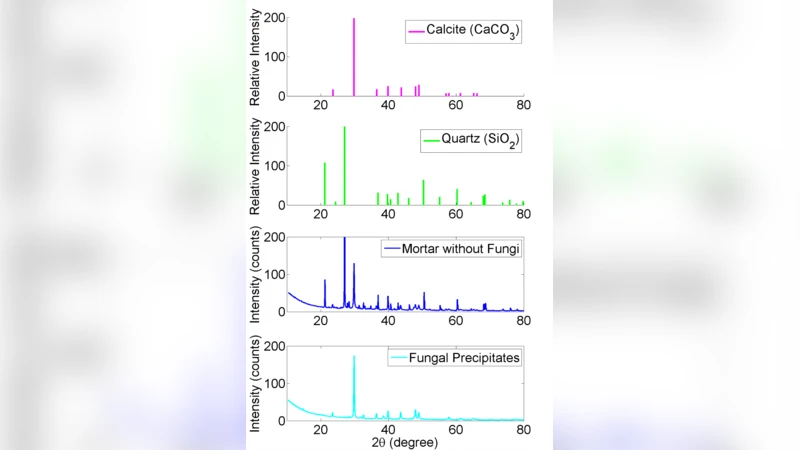
Most isolates failed to grow under the extreme alkalinity, and consequently produced negligible mineral deposits. However, a pH‑regulatory mutant of Aspergillus nidulans (strain MAD1445) demonstrated robust hyphal development despite the alkaline conditions. This mutant is known to secrete organic acids that locally lower pH, thereby creating a micro‑environment conducive to fungal metabolism. Within seven days, dense hyphal networks were observed colonizing the crack surfaces, and scanning electron microscopy revealed abundant nucleation sites where fine calcium carbonate crystals formed. X‑ray diffraction confirmed that the predominant mineral phase was calcite (CaCO₃). Quantitative analysis indicated that approximately 72 % of the original crack volume was filled with newly precipitated calcium carbonate. Mechanical testing showed that healed specimens recovered 18 % more compressive strength than unhealed controls, suggesting that the fungal precipitates not only seal the crack but also contribute to structural reinforcement.
The study discusses several critical insights. First, the ability of a fungus to regulate its local pH is essential for survival and mineralization in the highly alkaline concrete environment. Second, hyphal penetration into micro‑pores provides a physical scaffold that enhances the durability of the precipitated mineral phase. Third, the use of a genetically characterized mutant offers a reproducible platform for further optimization, such as overexpressing carbonate‑forming enzymes or engineering strains with enhanced tolerance to environmental fluctuations.
Nevertheless, the authors acknowledge limitations. All experiments were conducted under controlled laboratory conditions; real‑world exposure involves temperature swings, moisture variations, mechanical loading, and potential chemical attacks that could affect fungal viability and precipitation efficiency. Moreover, the ecological safety of introducing fungal spores into built environments must be evaluated, considering allergenic potential and possible pathogenicity. Future work is proposed to (i) assess long‑term durability of fungal‑healed concrete under cyclic loading and environmental stressors, (ii) develop scalable inoculation techniques, such as embedding spores or hyphal fragments directly into the concrete mix (pre‑healing), and (iii) explore synergistic consortia of multiple fungal species or combined fungal‑bacterial systems to maximize mineralization rates.
In conclusion, this research provides the first experimental validation that a pH‑regulatory fungal mutant can thrive on concrete surfaces, induce substantial calcium carbonate precipitation, and partially restore mechanical integrity of cracked concrete. By demonstrating the feasibility of a fungi‑based self‑healing strategy, the study opens a new avenue for sustainable infrastructure maintenance, potentially reducing reliance on costly manual repairs and extending the service life of concrete assets.
Comments & Academic Discussion
Loading comments...
Leave a Comment