Performance of Angle of Arrival Detection Using MUSIC Algorithm in Inter-Satellite Link
An attitude of satellite is not always static, sometimes it moves randomly and the antenna pointing of satellite is harder to achieve line of sight communication to other satellite when it is outage by tumbling effect. In order to determine an appropriate direction of satellite antenna in inter-satellite link, this paper analyze estimation performance of the direction of arrival (DoA) using MUSIC algorithm from connected satellite signal source. It differs from optical measurement, magnetic field measurement, inertial measurement, and global positioning system (GPS) attitude determination. The proposed method is characterized by taking signal source from connected satellites, after that the main satellite processed the information to obtain connected satellites antenna direction. The simulation runs only on the direction of azimuth. The simulation result shows that MUSIC algorithm processing time is faster than satellite movement time in orbit on altitude of 830 km with the period of 101 minutes. With the use of a 50 elements array antenna in spacing of 0.5 wavelength, the total of 20 angle of arrival (AoA) can be detected in 0.98 seconds of processing time when using MUSIC algorithm.
💡 Research Summary
The paper addresses the challenge of maintaining line‑of‑sight (LOS) communication between low‑Earth‑orbit (LEO) satellites when the platform attitude is not static but subject to random tumbling. Conventional attitude determination methods—optical star trackers, magnetometers, inertial measurement units, and GPS—rely on external references and may not react quickly enough to rapid attitude changes. The authors propose an alternative: use the radio signals emitted by neighboring satellites as reference sources, receive them with a smart antenna array on a “main” satellite, and estimate the direction‑of‑arrival (DoA) of each signal using the Multiple Signal Classification (MUSIC) algorithm.
A narrow‑band complex baseband model is defined, where the phase delay at each array element depends on the azimuth (θ) and elevation (φ) of the incoming wave. The steering vector a(θ, φ) incorporates element positions, inter‑element spacing, operating frequency, and element‑specific gain/phase responses. The received data matrix X (M × N, with M antenna elements and N snapshots) yields the sample covariance matrix R = (1/N)XXᴴ. Eigen‑decomposition separates the signal subspace from the noise subspace; the MUSIC pseudospectrum P(θ, φ) = 1/(aᴴUₙUₙᴴa) is evaluated over a grid, and peaks correspond to estimated AoAs. The peak magnitude, expressed as PMUSIC (dB), serves as a quality metric.
Simulation parameters reflect a realistic LEO scenario: altitude 830 km, orbital period 101 min, and a uniform linear array (ULA) of 50 elements spaced at 0.5 λ (λ≈9.4 mm at 32 GHz). The study varies several key parameters: maximum angular beamwidth, number of simultaneous AoAs (1–20), number of array elements (9–105), inter‑element spacing (0.25 λ–5 λ), carrier frequency (23, 24.5, 32, 56 GHz), and per‑element received power (1 W down to 0.0001 W). Signal‑to‑noise ratio (SNR) is swept from –14 dB to +14 dB, with a baseline of 5 dB.
Key findings:
-
Maximum Angular Beamwidth – Scanning the full 0°–180° azimuth with 1° steps, the algorithm reliably detects 20 AoAs within the 60°–80° sector, establishing the usable angular field for the inter‑satellite link.
-
Number of AoAs – Increasing the number of concurrent sources from 1 to 20 yields only modest fluctuations in PMUSIC (≈62.9–63.6 dB). The MUSIC spectrum remains well‑defined, indicating robustness to moderate source multiplicity.
-
Array Size – Adding elements reduces the average PMUSIC (e.g., 60 dB for 9 elements to 46 dB for 20 elements) but improves the minimum sensitivity, i.e., the ability to separate weak signals from noise. Larger arrays thus enhance detection reliability at the cost of lower peak magnitude.
-
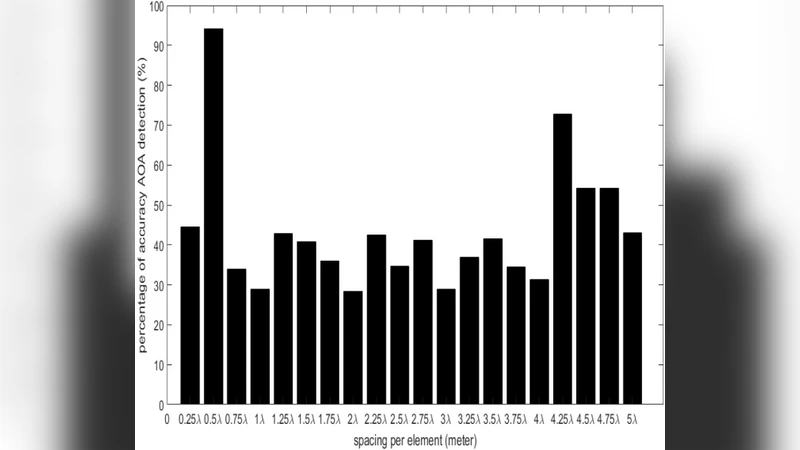
Inter‑Element Spacing – The optimal spacing is 0.5 λ (≈5 mm). At this spacing the detection accuracy reaches 95 %. Larger spacings introduce grating lobes, causing spurious peaks and reducing accuracy; very small spacings (<0.25 λ) also degrade performance due to mutual coupling (not modeled here).
-
Operating Frequency – Across 23–56 GHz the average PMUSIC varies only slightly (57–58 dB), with a marginal peak at 32 GHz. Hence, frequency selection within typical ISL bands does not critically affect MUSIC‑based AoA estimation.
-
Received Power / SNR – With 1 W per element (0 dB) the algorithm yields PMUSIC ≈24 dB; at 0.1 W (–10 dB) the value drops to ≈18 dB; below 0.01 W (–20 dB) the PMUSIC falls under 2 dB and AoA detection becomes unreliable. This underscores the necessity of maintaining sufficient link budget or employing higher‑order SNR‑enhancing techniques.
-
Computational Load – Detecting 20 AoAs requires 0.98 seconds of processing on a typical workstation, which is well below the satellite’s attitude change time (≈6 seconds for a full rotation at the given orbit). Therefore, real‑time beam steering based on MUSIC is feasible.
The authors conclude that MUSIC‑based AoA detection using a modest‑size phased array can provide timely attitude information for inter‑satellite links, enabling autonomous antenna pointing without reliance on external sensors. However, the study is limited to 2‑D azimuthal analysis; real‑world deployments would need 3‑D elevation estimation, handling of multipath, Doppler shifts, and hardware constraints such as ADC sampling rates and phase‑calibration errors. Future work should extend the model to full spherical DoA, incorporate cooperative multi‑satellite processing, and validate the approach with hardware‑in‑the‑loop experiments.
Comments & Academic Discussion
Loading comments...
Leave a Comment