Millimeter Wave Line-of-Sight Blockage Analysis
Millimeter wave (mmWave) communication systems can provide high data rates but the system performance may degrade significantly due to mobile blockers and the user's own body. A high frequency of interruptions and long duration of blockage may degrad…
Authors: Ish Kumar Jain
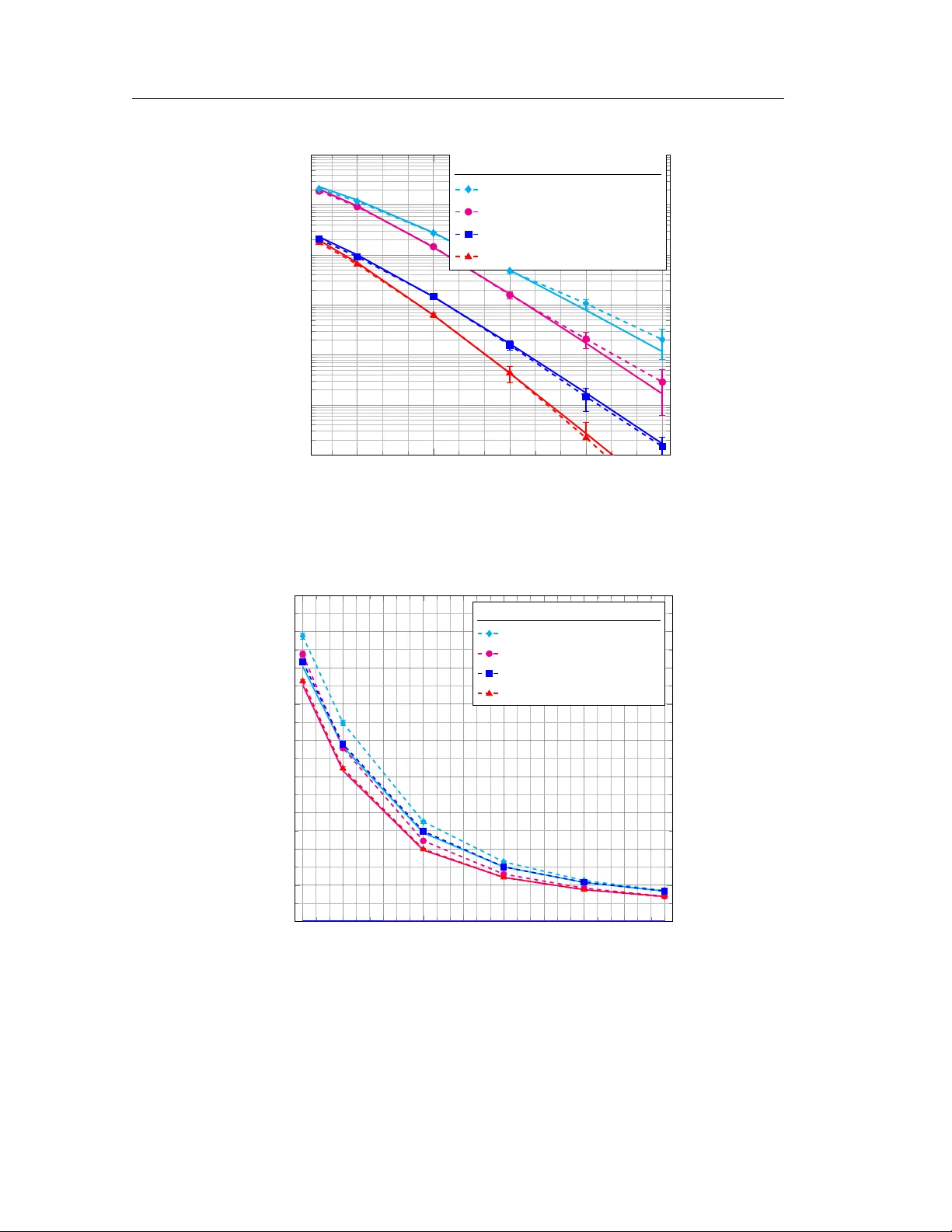
Millimeter W ave Line-of-Sight Blockage Analysis THESIS Submitted in Partial Fulfillment of the Requirements for the Degree of MASTER OF SCIENCE (Electrical Engineering) at the NEW YORK UNIVERSITY T ANDON SCHOOL OF ENGINEERING by Ish Kumar Jain May 2018 Millimeter W ave Line-of-Sight Blockage Analysis THESIS Submitted in Partial Fulfillment of the Requirements for the Degree of MASTER OF SCIENCE (Electrical Engineering) at the NEW YORK UNIVERSITY T ANDON SCHOOL OF ENGINEERING by Ish Kumar Jain May 2018 Approved: Advisor Signature Date Department Chair Signature Date University ID: N11066411 Net ID: ikj211 iii Approved by the Guidance Committee: Major: Electrical and Computer Engineering Shivendra S. Panwar Professor Electrical and Computer Engineering Date Elza Erkip Institute Professor Electrical and Computer Engineering Date Sundeep Rangan Associate Professor Electrical and Computer Engineering Date iv V itae Ish Kumar Jain was born in India. He received his Bachelor of T echnology in Electrical Engineering from Indian Institute of T echnology Kanpur , India, in May 2016. He received the Motorola gold medal for the best all-round perfor- mance in electrical engineering during his B.T ech. Since 2016, he has been engaged in the Master of Science in Electrical En- gineering at New Y ork University , T andon School of Engineering in Brooklyn, New Y ork. He was awarded the Samuel Morse MS fellowship to pursue r e- search at NYU. He did an internship at Nokia Bell Labs during the summer of 2017 where he applied machine learning tools to future generation wireless communication systems. During his M.S., he served as a T eaching Assistant for the Internet Architec- ture and Protocols lab in Spring 2017, and the Introduction to Machine Learning course in Fall 2017 and Spring 2018. His work on Millimeter-wave LOS block- age analysis has been accepted for publication as an invited paper at the Inter- national T eletraffic Congress (ITC) 2018 [1]. v Acknowledgments First and foremost, I would like to thank my advisor Prof. Shivendra Panwar for his guidance, inspiration, and constant support. He always gave me the freedom to choose the direction of research I wanted to pursue and helped me to find the most interesting topic for my MS thesis. I am grateful for the long hours of discussion with him on my research work. His valuable pieces of advice helped me to grow as a person and a r esear cher . I am immensely grateful to Prof. Elza Erkip and Prof. Sundeep Rangan for their valuable guidance and support in my resear ch projects. Many thanks for devoting their time to this thesis and serving on my committee. I am also thank- ful to Prof. Anna Choromanska who advised me on a Machine Learning side- project on proving the boosting-ability of tree-based multiclass classifiers. This work with Prof. Anna has been submitted for publication in the IEEE T ransac- tions on Pattern Analysis and Machine Intelligence. Finally , I thank Prof. Pei Liu, Prof. Y ong Liu, and Pr of. Y ao W ang for their guidance through healthy discussions throughout my MS. I was fortunate to have a perfect lab environment, which was only possible due to my lab colleagues and many other friends. I am particularly thankful to Rajeev Kumar for his active collaboration on my work. This thesis would not have been possible without his advice and the long discussions I had with him. I also thank Thanos Koutsaftis, Geor gios Kyriakou, Nicolas Barati, Amir Hosseini, Fraida Fund, Shenghe Xu, Muhammad Affan Javed, Abbas Khalili, Amir Khalilian, Sourjya Dutta, George MacCartney , Chris Slezak, Kishore Suri, Prakhar Pandey , Arun Parthasarathy , and others, who made working at NYU a pleasure. Gratitude should also go to V alerie Davis, Budget and Operations Manager for her constant support and paperwork throughout my Masters. vi Abstract Ish Kumar Jain Millimeter Wave Line-of-Sight Blockage Analysis Millimeter wave (mmW ave) communication systems can provide high data rates but the system performance may degrade significantly due to mobile block- ers and the user ’s own body . A high frequency of interruptions and long dura- tion of blockage may degrade the quality of experience. For example, delays of mor e than about 10ms cause nausea to VR viewers. Macr o-diversity of base stations (BSs) has been considered a promising solution where the user equip- ment (UE) can handover to other available BSs, if the current serving BS gets blocked. However , an analytical model for the frequency and duration of dy- namic blockage events in this setting is largely unknown. In this thesis, we consider an open park-like scenario and obtain closed-form expressions for the blockage pr obability , expected fr equency and duration of blockage events us- ing stochastic geometry . Our r esults indicate that the minimum density of BS that is requir ed to satisfy the Quality of Service (QoS) requir ements of AR/VR and other low latency applications is largely driven by blockage events rather than capacity requirements. Placing the BS at a greater height r educes the likeli- hood of blockage. W e present a closed-form expression for the BS density-height trade-off that can be used for network planning. vii Contents Abstract vi List of Figures ix List of T ables x List of Abbreviations xi 1 Introduction 1 1.1 Motivation . . . . . . . . . . . . . . . . . . . . . . . . . . . . . . . . 1 1.2 Contribution . . . . . . . . . . . . . . . . . . . . . . . . . . . . . . . 3 1.3 Related W ork . . . . . . . . . . . . . . . . . . . . . . . . . . . . . . 3 1.4 Organization . . . . . . . . . . . . . . . . . . . . . . . . . . . . . . . 5 2 System Model 6 2.1 BS model and blockage model . . . . . . . . . . . . . . . . . . . . . 6 2.2 Single BS-UE link . . . . . . . . . . . . . . . . . . . . . . . . . . . . 7 3 Generalized Blockage Model 12 3.1 Coverage Probability under Self-blockage . . . . . . . . . . . . . . 12 3.2 Generalized Model with Dynamic Blockage . . . . . . . . . . . . . 13 4 Blockage Events 17 4.1 Analysis of Blockage Events . . . . . . . . . . . . . . . . . . . . . . 17 viii 4.2 Marginal and conditional blockage pr obability . . . . . . . . . . . 17 4.3 Expected Blockage Frequency . . . . . . . . . . . . . . . . . . . . . 21 4.4 Expected Blockage Duration . . . . . . . . . . . . . . . . . . . . . . 23 5 Numerical Evaluation 27 5.1 Simulation Setup . . . . . . . . . . . . . . . . . . . . . . . . . . . . 27 5.2 Main Results . . . . . . . . . . . . . . . . . . . . . . . . . . . . . . . 30 5.3 Case Study . . . . . . . . . . . . . . . . . . . . . . . . . . . . . . . . 32 5.3.1 Required minimum BS density . . . . . . . . . . . . . . . . 32 5.3.2 BS density-height trade-off analysis . . . . . . . . . . . . . 32 6 Conclusions and Future W ork 33 6.1 Conclusion . . . . . . . . . . . . . . . . . . . . . . . . . . . . . . . . 33 6.2 Future W ork . . . . . . . . . . . . . . . . . . . . . . . . . . . . . . . 34 ix List of Figures 2.1 System Model . . . . . . . . . . . . . . . . . . . . . . . . . . . . . . 7 2.2 Probability that there are two or more blockers simultaneously blocking a single BS-UE link. The distance between BS and UE is 100 meters. . . . . . . . . . . . . . . . . . . . . . . . . . . . . . . . . 10 3.1 Markov Chain for N BSs . . . . . . . . . . . . . . . . . . . . . . . . 14 3.2 Markov Chain for 2 BSs . . . . . . . . . . . . . . . . . . . . . . . . 16 4.1 BS density vs blocker density for ¯ P = 1 e − 5. . . . . . . . . . . . . 20 5.1 Conditional blockage probability . . . . . . . . . . . . . . . . . . . 28 5.2 Conditional blockage frequency . . . . . . . . . . . . . . . . . . . . 29 5.3 Conditional blockage duration . . . . . . . . . . . . . . . . . . . . 29 5.4 The trade-of f between BS height and density for fixed blockage probability P ( B |C ) = 1 e − 7. . . . . . . . . . . . . . . . . . . . . . 31 x List of T ables 5.1 Simulation parameters . . . . . . . . . . . . . . . . . . . . . . . . . 28 xi List of Abbreviations LOS L ine O f S ight BS B ase S tation UE U ser E quipment PPP P oisson P oint P rocess QoS Q uality o f S ervice AR A ugmented R eality VR V irtual R eality CoMP Co ordinated M ulti- P oint RAN R adio A ccess N etwork BBU B ase b and U nit xii T o my parents and Atul 1 Chapter 1 Introduction 1.1 Motivation Millimeter wave (mmW ave) communication systems can provide high data rates of the order of a few Gbps [2], suitable for the Quality of Service (QoS) requir e- ments for Augmented Reality (AR) and V irtual Reality (VR). For these appli- cations, the user-equipment (UE) requir es the data rate to be in the range of 100 Mbps to a few Gbps, and an end-to-end latency in the range of 1 ms to 10 ms [3]. However , mmW ave communication systems are quite vulnerable to blockages due to higher penetration losses and r educed dif fraction [4]. Even the human body can r educe the signal str ength by 20 dB [5]. Thus, an unblocked Line of Sight (LOS) link is highly desirable for mmW ave systems. Furthermor e, a mobile human blocker can block the LOS path between User Equipment (UE) and Base Station (BS) for approximately 500 ms [5]. The frequent blockages of mmW ave LOS links and a high blockage duration can be detrimental to ultra- reliable and low latency communication (URLLC) applications. While many proposals to achieve low latency and high reliability have been proposed, such as edge caching, edge computing, network slicing [6, 7], a shorter T ransmission 2 T ime Interval (TTI), frame struc ture [8], and flow queueing with dynamic siz- ing of the Radio Link Control (RLC) buffer at Data Link Layer [9], we focus our analysis on issues related to Radio Access Network (RAN) planning to achieve the stringent Quality of Service (QoS) requir ements of URLLC applications. One potential solution to blockages in the mmW ave cellular network can be macro-diversity of BSs and coordinated multipoint (CoMP) techniques. These techniques have shown a significant r eduction in interfer ence and impr ovement in reliability , coverage, and capacity in the current Long T erm Evolution-Advance (L TE-A) deployments and other communication networks [10–12]. Furthermore, Radio Access Networks (RANs) are moving towar ds the cloud-RAN ar chitec- ture that implements macro-diversity and CoMP techniques by pooling a large number of BSs in a single centralized baseband unit (BBU) [13, 14]. As a single centralized BBU handles multiple BSs, the handover and beam-steering time can be reduced significantly [15]. In order to provide seamless connectivity for ultra-reliable and ultra-low latency applications, the pr oposed 5G mmW ave cel- lular architectur e needs to consider key QoS parameters such as the probability of blockage events, the frequency of blockages, and the blockage duration. For instance, to satisfy the QoS requir ement of mission-critical applications such as AR/VR, tactile Internet, and eHealth applications, 5G cellular networks target a service reliability of 99.999% [16]. In general, the service interruption due to blockage events can be alleviated by caching the downlink contents at the BSs or the network edge [17]. However , caching the content more than about 10ms may degrade the user experience and may cause nausea to the users particu- larly for AR applications [18]. An alternative when blocked is to offload traf fic to sub-6GHz networks such as 4G, but this needs to be carefully engineered so as to not overload them. Therefor e, it is important to study the blockage prob- ability , blockage frequency , and blockage duration to satisfy the desired QoS 1.2. Contribution 3 requir ements. 1.2 Contribution This work presents a simplified blockage model for the LOS link using tools from the stochastic geometry . In particular , our contributions are as follow: 1. W e pr ovide an analytical model for dynamic blockage (UE blocked by mo- bile blockers) and self-blockage (UE blocked by the user ’s own body). The expression for the rate of blockage of LOS link is evaluated as a function of the blocker density , velocity , height and link length. 2. W e evaluate the closed-form pr obability and expected frequency of simul- taneous blockage of all BSs in the range of the UE. Further , we present an approximation for the expected duration of simultaneous blockage. 3. W e verify our analytical results through Monte-Carlo simulations by con- sidering a random way-point mobility model for blockers. 4. Finally , we present a case study to find the minimum requir ed BS density for specific mission-critical services and analyze the trade-off between BS height and density to satisfy the QoS requir ements. 1.3 Related W ork A mmW ave link may have three kinds of blockages, namely , static, dynamic, and self-blockage. Static blockage due to buildings and permanent structur es has been studied in [19] and [20] using random shape theory and a stochastic geometry approach for urban microwave systems. The underlying static block- age model is incorporated into the cellular system coverage and rate analysis 4 in [4]. Static blockage may cause permanent blockage of the LOS link. However , for an open area such as a public park, static blockages play a small role. The sec- ond type of blockage is dynamic blockage due to mobile humans and vehicles (collectively called mobile blockers) which may cause frequent interruptions to the LOS link. Dynamic blockage has been given significant importance by 3GPP in TR 38.901 of Release 14 [21]. An analytical model in [22] considers a single access point, a stationary user , and blockers located randomly in an area. The model in [23] is developed for a specific scenario of a r oad intersection using a Manhattan Poisson point process model. MacCartney et al. [5] developed a Markov model for blockage events based on measurements on a single BS-UE link. Similarly , Raghavan et al. [24] fits the blockage measur ements with var- ious statistical models. However , a model based on experimental analysis is very specific to the measurement scenario. The authors in [25] considered a 3D blockage model and analyzed the blocker arrival probability for a single BS-UE pair . Studies of spatial corr elation and temporal variation in blockage events for a single BS-UE link ar e pr esented in [26] and [27]. However , their analyti- cal model is not easily scalable to multiple BSs, important when considering the impact of macro-diversity .. Apart from static and dynamic blockage, self-blockage plays a key role in mmW ave performance. The authors of [28] studied human body blockage through simulation. A statistical self-blockage model is developed in [24] thr ough exper - iments considering various modes (landscape or portrait) of hand-held devices. The impact of self-blockage on received signal strength is studied in [20] through a stochastic geometry model. They assume the self-blockage due to a user ’s body blocks the BSs in an area r epresented by a cone. All the above blockage models consider the UE’s association with a single BS. Macro-diversity of BSs is considered as a potential solution to alleviate the 1.4. Organization 5 effect of blockage events in a cellular network. The authors of [29] and [30] proposed an ar chitecture for macro-diversity with multiple BSs and showed the improvement in network throughput. A blockage model with macro-diversity is developed in [31] for independent blocking and in [32] for corr elated blocking. However , they consider only static blockage due to buildings. The primary purpose of the blockage models in previous papers was to study the coverage and capacity analysis of the mmW ave system. However , apart from the signal degradation, blockage fr equency and duration also affects the performance of the mmW ave system and are critically important for applica- tions such as AR/VR. In this paper , we present a simple closed-form expr ession for a compact analysis to pr ovide insight into the optimal density , height and other design parameters and trade-offs of BS deployment. 1.4 Organization The r est of the thesis is organized as follows. The system model is described in Chapter 2. A generalized blockage model considering dynamic and self- blockages is presented in Chapter 3. Chapter 4 generalizes the blockage model to multiple BSs and evaluates the key blockage metrics—blockage pr obability , blockage frequency , and the blockage duration. W e present simulation results and verify our theoretical formulations in Chapter 5. Finally , we conclude this thesis and discuss the future work in Chapter 6. 6 Chapter 2 System Model 2.1 BS model and blockage model Our system model consists of the following settings: • BS Model : The mmW ave BS locations ar e modeled as a homogeneous Pois- son Point Process (PPP) with density λ T . Consider a disc B ( o , R ) of radius R and centered around the origin o , where a typical UE is located. W e as- sume that each BS in B ( o , R ) is a potential serving BS for the UE. Thus, the number of BSs M in the disc B ( o , R ) of area π R 2 follows a Poisson distri- bution with parameter λ T π R 2 , i.e. , P M ( m ) = [ λ T π R 2 ] m m ! e − λ T π R 2 . (2.1) Given the number of BSs m in the disc B ( o , R ) , we have a uniform probabil- ity distribution for BS locations. The BSs distances { R i } ∀ i = 1, . . . , m from the UE are independent and identically distributed (iid) with distribution f R i | M ( r | m ) = 2 r R 2 ; 0 < r ≤ R , ∀ i = 1, . . . , m . (2.2) 2.2. Single BS-UE link 7 θ r i eff V θ 2 π - φ θ - φ V φ r i r i h T h B h R r i eff O (a) T op view (b) Side view ω Self-blockage Zone Blocker User BS F I G U R E 2 . 1 : System Model • Self-blockage Model : The user blocks a fraction of BSs due to his/her own body . The self-blockage zone is defined as a sector of the disc B ( o , R ) mak- ing an angle ω towar ds the user ’s body as shown in Figure 2.1(a). Thus, all of the BSs in the self-blockage zone are consider ed blocked. • Dynamic Blockage Model : The blockers are distributed according to a homo- geneous PPP with parameter λ B . Further , the arrival process of the block- ers crossing the i t h BS-UE link is Poisson with intensity α i . The blockage duration is independent of the blocker arrival process and is exponentially distributed with parameter µ . • Connectivity Model : W e say the UE is blocked when all of the potential serving BSs in the disc B ( o , R ) are blocked simultaneously . 2.2 Single BS-UE link For a sound understanding of the system model, consider a single BS-UE LOS link in Figure 2.1(a). The distance between the i t h BS and the UE is r i and the LOS link makes an angle θ with r espect to the positive x-axis. Further , the blockers in the region move with constant velocity V at an angle ϕ with the positive x-axis, 8 Chapter 2. System Model where ϕ ∼ Unif ( [ 0, 2 π ]) . Note that only a fraction of blockers crossing the BS- UE link will be blocking the LOS path, as shown in Figure 2.1(b). The effective link length r e f f i that is affected by the blocker ’s movement is r e f f i = ( h B − h R ) ( h T − h R ) r i , (2.3) where h B , h R , and h T are the heights of blocker , UE (receiver), and BS (trans- mitter) respectively . The blocker arrival rate α i (also called the blockage rate) is evaluated in Lemma 1. Lemma 1. The blockage rate α i of the i t h BS-UE link is α i = C r i , (2.4) where C is proportional to blocker density λ B as, C = 2 π λ B V ( h B − h R ) ( h T − h R ) . (2.5) Proof. Consider a blocker moving at an angle ( θ − ϕ ) relative to the BS-UE link (See Figure 2.1(a)). The component of the blocker ’s velocity perpendicular to the BS-UE link is V ϕ = V sin ( θ − ϕ ) , where V ϕ is positive when ( θ − π ) < ϕ < θ . Next, we consider a r ectangle of length r e f f i and width V ϕ ∆ t . The blockers in this area will block the LOS link over the interval of time ∆ t . Note there is an equiv- alent area on the other side of the link. Therefor e, the frequency of blockage is 2 λ B r e f f i V ϕ ∆ t = 2 λ B r e f f i V sin ( θ − ϕ ) ∆ t . Thus, the fr equency of blockage per unit time is 2 λ B r e f f i V sin ( θ − ϕ ) . T aking an average over the uniform distribution of 2.2. Single BS-UE link 9 ϕ (uniform over [ 0, 2 π ] ), we get the blockage rate α i as α i = 2 λ B r e f f i V Z θ ϕ = θ − π sin ( θ − ϕ ) 1 2 π d φ = 2 π λ B r e f f i V = 2 π λ B V ( h B − h R ) ( h T − h R ) r i . (2.6) This concludes the proof. Following [27], we model the blocker arrival process as Poisson with pa- rameter α i blockers/sec (bl/s). Note that ther e can be more than one blocker simultaneously blocking the LOS link. The overall blocking process has been modeled in [27] as an alternating renewal pr ocess with alternate periods of blocked/unblocked intervals, wher e the distribution of the blocked interval is obtained as the busy period distribution of a general M / G I / ∞ system. For mathematical simplicity , we assume the blockage duration of a single blocker is exponentially distributed with parameter µ , thus, forming an M / M / ∞ queu- ing system. W e further approximate the overall blockage process as an alter - nating renewal process with exponentially distributed periods of blocked and unblocked intervals with parameters α i and µ respectively . This approximation works for a wide range of blocker den sities as shown in Section 5.1. This ap- proximation is also justified in Lemma 2 as follow Lemma 2. Let P S denote the probability that there are two or more blockers simultane- ously blocking the single BS-UE link. Then, in order to have P S ≤ e , the blockage rate α i satisfies 1 − e α i / µ ( 1 + α i / µ ) ≤ e , (2.7) where α i in (2.6) is proportional to the blocker density λ B . 10 Chapter 2. System Model 0 5 · 10 − 2 0 . 1 0 . 15 0 . 2 0 . 25 0 . 3 0 . 35 0 . 4 0 . 45 0 . 5 0 0 . 1 0 . 2 0 . 3 0 . 4 Desit y of block ers ( λ B ) P S F I G U R E 2 . 2 : Probability that ther e are two or more blockers simul- taneously blocking a single BS-UE link. The distance between BS and UE is 100 meters. Proof. The probability P [ S j ] of event S j is calculated as the j t h state probability of the M / M / ∞ system. Therefor e, we have P S = P [ S 2 ] + P [ S 3 ] + · · · + P [ S N ] = 1 − P [ S 0 ] − P [ S 1 ] = 1 − e α i / µ − α i µ e α i / µ = 1 − e α i / µ ( 1 + α i / µ ) , (2.8) Hence, for P S ≤ e , we have 1 − e α i / µ ( 1 + α i / µ ) ≤ e From Lemma 2, we can say that the probability P S is low for lower blocker density λ B as shown in Figure 2.2. In the worst case scenario when the distance between BS and UE is 100 m, i.e., r n = 100, in order to have P S ≤ 0.1, the blocker density λ B can be as high as 0.2 bl/m 2 and the blocker arrival rate α i can be as high as 1.1 bl/sec. In fact, based on the r eal measur ements obtained in Brooklyn, New Y ork, USA, Geor ge et. al., have shown that the blockage rate of a single BS-UE link is approximately 0.2 bl/s in an urban scenario [5]. Ther efore, 2.2. Single BS-UE link 11 as a first-or der appr oximation and for reasonable values of blocker densities, we can ignore the events of simultaneously having more than one blockers in the blockage zone. In the next chapter , we consider a generalized blockage model for M BSs which are in the range of UE. The UE keeps track of all these M BSs using well- designed beam-tracking and handover techniques. Since the handover process is assumed to be very fast, the UE can instantaneously connect to any unblocked BS when the current serving BS gets blocked. Therefore, we consider the total blockage event occurs only when all the potential serving BSs are blocked. 12 Chapter 3 Generalized Blockage Model 3.1 Coverage Probability under Self-blockage Let there are N BSs out of total M BSs within the range of the UE that are not blocked by self-blockage. Lemma 3. The distribution of the number of BSs ( N ) outside the self-blockage zone and in the disc B ( o , R ) is P N ( n ) = [ p λ T π R 2 ] n n ! e − p λ T π R 2 , (3.1) where p = 1 − ω / 2 π (3.2) is the pr obability that a randomly chosen BS lies outside the self-blockage zone in the disc B ( o , R ) . Proof. Due to the uniformity of BSs locations in B ( o , R ) , the distribution of N given M follows a binomial distribution with parameter p = 1 − ω 2 π , i.e. , P N | M ( n | m ) = m n ( p ) n ( 1 − p ) m − n , n ≤ m . (3.3) 3.2. Generalized Model with Dynamic Blockage 13 The marginal distribution of N is obtained as P N ( n ) = ∞ ∑ m = n P N | M ( n | m ) P M ( m ) = ∞ ∑ m = n m n ( p ) n ( 1 − p ) m − n [ λ T π R 2 ] m m ! e − λ T π R 2 = [ p λ T π R 2 ] n n ! e − p λ T π R 2 ∞ ∑ m = n 1 ( m − n ) ! [ ( 1 − p ) λ T π R 2 ] m − n e − [ ( 1 − p ) λ T π R 2 ] = [ p λ T π R 2 ] n n ! e − p λ T π R 2 . This concludes the proof. Let C denotes an event that the UE has at least one serving BS in the disc B ( o , R ) and outside S ( o , R , ω ) , i.e. , N 6 = 0. The probability of the event C is called the coverage probability under self-blockage and calculated as, P ( C ) = 1 − e − p λ T π R 2 . (3.4) The proof follows dir ectly from (3.1) by putting n = 0. 3.2 Generalized Model with Dynamic Blockage Given ther e ar e n BSs in the communication range of UE and are not blocked by user ’s body , they can still get blocked by mobile blockers. The blocking event of these N BSs is assumed to be independent. Our objective is to develop a blockage model for the mmW ave cellular system where the UE can connect to any of the potential serving BSs. In such a system, the blockage probability , ex- pected blockage frequency , and expected blockage duration ar e the defining QoS parameters for low and ultra-low latency applications such as AR/VR. Since 14 Chapter 3. Generalized Model No BS blocked one BS blocked k BSs blocked (n-1) BSs blocked n BSs blocked μ μ μ μ α 1 α 2 α 1 α N S 0 1 S 1 1 S 1 n S 1 2 S k n k S k j S k 2 S k 1 S n-1 1 S n-1 2 S n-1 n α N μ S n 1 α 2 μ F I G U R E 3 . 1 : Markov Chain for N BSs the blockage events form an alternating r enewal pr ocess with exponentially dis- tributed duration of blocked and unblocked intervals, we formulate a Markov chain to obtain the probability and duration of the simultaneous blockage of k BSs out of the total N available BSs. The Markov chain shown in Figure 3.1 has 2 n states where each state repre- sents the blockage of a subset of n BSs. Let a set S = { 1, 2, · · · , n } represents the n BSs. Define P ( S ) as a power set of S of size 2 n . The elements of P can be repr esented by a set S j k for j = 1, · · · , ( n k ) and k = 0, · · · , n . Note that the set S j k is associated with the state S j k of our Markov model shown in Figure 3.1. Also, it is clear that the total number of states ar e ∑ n k = 0 ( n k ) = 2 n . W e ar e inter ested in the probability of the last state when k = n , since it repr esents the probability that all n available BSs are blocked. Lemma 4. Let P 1 n denote the probability of the last state (S 1 n ) of the Markov model in Figure 3.1, then P 1 n = n ∏ i = 1 α i / µ 1 + α i / µ = n ∏ i = 1 ( C / µ ) r i 1 + ( C / µ ) r i , (3.5) where C is defined in (2.5). 3.2. Generalized Model with Dynamic Blockage 15 Proof. The equilibrium steady-state distribution exists when α i < µ , ∀ i = 1 : n . These steady-state probabilities ar e derived as follow The state probabilities of our Markov model in Figur e 3.1 are computed as P j k = ∏ l ∈S j k α l µ P 1 0 , j = 1, · · · , n k , k = 1, · · · , n , (3.6) where P 1 0 repr esents the probability of the state S 1 0 . By putting the sum of all state probabilities to 1, W e obtain P 1 0 = 1 1 + ∑ n k = 1 ∑ ( n k ) j = 1 ∏ l ∈S j k α l µ = 1 ∏ n i = 1 ( 1 + α i / µ ) . (3.7) Therefor e, the state probabilities become P j k = ∏ l ∈S j k α l µ ∏ n i = 1 ( 1 + α i / µ ) , j = 1, · · · , n k , k = 1, · · · , n , (3.8) Note the sum of state probabilities for j = 1, · · · , ( n k ) and for fixed k repr esents the probability P k of the blockage of k BSs, i.e. , P k = ( n k ) ∑ j = 1 P j k = ∑ ( n k ) j = 1 ∏ l ∈S j k α l µ ∏ n i = 1 ( 1 + α i / µ ) , k = 1, · · · , n , (3.9) By putting k = n , we get the pr obability that all n BSs are blocked P 1 n = ∑ ( n n ) j = 1 ∏ n l = 1 α l µ ∏ n i = 1 ( 1 + α i / µ ) = n ∏ i = 1 α i / µ 1 + α i / µ . (3.10) A simplified example of 2 state Markov chain is given in Figure 3.2. The four 16 Chapter 3. Generalized Model No BS block ed One BS bl ock ed Al l BSs block ed 0 1 2 1,2 μ μ μ μ α 1 α 2 α 2 α 1 F I G U R E 3 . 2 : Markov Chain for 2 BSs states in this model are described as (i) state S 1 0 : no BS is blocked, (ii) state S 1 1 : BS 1 is blocked, (iii) state S 2 1 : BS 2 is blocked, and (iv) state S 1 2 : both BS 1 and 2 are blocked. The state probabilities of the four states can be calculated as P 1 1 = α 1 µ P 1 0 ; P 2 1 = α 2 µ P 1 0 ; P 1 2 = α 1 α 2 µ 2 P 1 0 , (3.11) where α i is the blocking rate of the i t h BS for which an expr ession is obtained in ( ?? ). As the sum of probabilities of all states is equal to 1, we get the pr obabil- ity P 1 0 as, P 1 0 = 1 1 + α 1 µ + α 2 µ + α 1 α 2 µ 2 = 1 1 + α 1 µ 1 + α 2 µ . (3.12) Finally , the Pr obability P 1 2 that both BSs ar e blocked is calculated using (3.11) and (3.12) as P 1,2 = α 1 α 2 µ 2 1 + α 1 µ 1 + α 2 µ . (3.13) The complete analysis of blockage events is provided in the next chapter . 17 Chapter 4 Blockage Events 4.1 Analysis of Blockage Events W e define an indicator random variable B that indicates the blockage of all avail- able BSs in the range of UE. The blockage probability P ( B | N , { R i } ) is condi- tioned on the number of BSs N in the disc B ( o , R ) which are not blocked by the user ’s body and the distances R i of BS i = 1, · · · , n fr om the UE. This probability is same as the state probability P 1 n in (3.5) P ( B | N , { R i } ) = P 1 n = n ∏ i = 1 ( C / µ ) r i 1 + ( C / µ ) r i . (4.1) Note that the notation P ( B | N , { R i } ) is a short version of P B | N , { R i } ( b | n , { r i } ) , where the random variables are repr esented in capitals and their realizations in the corresponding small letters. W e keep the short notation throughout the paper for simplicity . 4.2 Marginal and conditional blockage probability W e first evaluate the conditional blockage probability P ( B | N ) by taking the av- erage of P ( B | N , { R i } ) over the distribution of { R i } and then find P ( B ) by taking 18 Chapter 4. Blockage Events the average of P ( B | N ) over the distribution of N as follow P ( B | N ) = Z Z r i P ( B | N , { R i } ) f ( { R i } | N ) dr 1 · · · d r n (4.2) P ( B ) = ∞ ∑ n = 0 P ( B | N ) P N ( n ) . (4.3) Theorem 1. The marginal blockage pr obability and the conditional blockage probability conditioned on the coverage event (3.4) is P ( B ) = e − a p λ T π R 2 , (4.4) P ( B | C ) = e − a p λ T π R 2 − e − p λ T π R 2 1 − e − p λ T π R 2 , (4.5) where, a = 2 µ R C − 2 µ 2 R 2 C 2 log 1 + R C µ . (4.6) Note that C is proportional to blocker density λ B shown in (2.5) and p = 1 − ω / 2 π is defined in (3.2). 4.2. Marginal and conditional blockage probability 19 Proof. W e first derive P ( B | N ) in (4.2) as P ( B | N ) = Z Z r i P ( B | N , { R i } ) f ( { R i } | N ) dr 1 · · · d r n = Z Z r i n ∏ i = 1 ( C / µ ) r i 1 + ( C / µ ) r i 2 r i R 2 dr i = n ∏ i = 1 Z R r = 0 ( C / µ ) r 1 + ( C / µ ) r 2 r R 2 dr = Z R r = 0 ( C / µ ) r 1 + ( C / µ ) r 2 r R 2 dr n = Z R r = 0 2 r R 2 − 2 µ R 2 C + 2 µ R 2 C 1 ( 1 + C r / µ ) dr n = r 2 R 2 − 2 µ r R 2 C + 2 µ 2 R 2 C 2 log ( 1 + Cr / µ ) R 0 ! n = 1 − 2 µ R C + 2 µ 2 R 2 C 2 log ( 1 + R C / µ ) n = ( 1 − a ) n , (4.7) where a is given in (4.6). Next, we evaluate P ( B ) in (4.3) as P ( B ) = ∞ ∑ n = 0 P ( B | N ) P N ( n ) , = ∞ ∑ n = 0 ( 1 − a ) n [ p λ T π R 2 ] n n ! e − p λ T π R 2 = e − a p λ T π R 2 ∞ ∑ n = 0 [ ( 1 − a ) λ T π R 2 ] n n ! e − ( 1 − a ) λ T π R 2 = e − a p λ T π R 2 . Finally , the conditional blockage probability P ( B |C ) conditioned on coverage event is obtained as P ( B | C ) = P ( B , C ) P ( C ) = ∑ ∞ n = 1 P ( B | N ) P N ( n ) P ( C ) = e − a p λ T π R 2 − e − p λ T π R 2 1 − e − p λ T π R 2 , (4.8) 20 Chapter 4. Blockage Events Blocker density ( 6 B bl/m 2 ) 0 0.02 0.04 0.06 0.08 0.1 0.12 0.14 0.16 0.18 0.2 BS Density ( 6 T ) x100/km 2 3 3.5 4 4.5 5 5.5 F I G U R E 4 . 1 : BS density vs blocker density for ¯ P = 1 e − 5. This concludes the proof of Theor em 1. W e observed from Theorem 1 that the expected probability of simultaneous blockage decreases exponentially with the BS density λ T . Further , note that a ∈ ( 0, 1 ) , where a → 1 when R C / µ → 0 and a → 0 when R C / µ → ∞ . Since the upper bound is trivial, we only prove the lower bound. Consider the series expansion of log ( 1 + R C / µ ) in a , i.e. , a = 2 µ R C − 2 µ 2 R 2 C 2 R C µ − R 2 C 2 2 µ 2 + R 3 C 3 3 µ 3 + · · · ≈ 1 − 2 RC 3 µ , when R C µ is small. (4.9) Thus, when R C / µ → 0, then a → 1. Note that for the blocker density as high as 0.1 bl/m 2 , and for other param- eters in T able 5.1, we have R C / µ = 0.35, which shows that the approximation 4.3. Expected Blockage Frequency 21 holds for a wide range of blocker densities. For large BS density λ T , the cover- age probability P ( C ) is approximately 1 and P ( B | C ) ≈ P ( B ) . In order to have the blockage probability P ( B ) less than a threshold ¯ P P ( B ) = e − a p λ T π R 2 ≤ ¯ P , (4.10) the requir ed BS density follows λ T ≥ − log ( ¯ P ) a p π R 2 ≈ − log ( ¯ P )( 1 + 2 RC 3 µ ) p π R 2 , (4.11) where C is proportional to the blocker density λ B in (2.5). Thus, the approxima- tion holds for smaller λ B . The result (4.11) shows that the BS density appr ox- imately scales linearly with the blocker density and is plotted in Figure 4.1 for ¯ P = 1 e − 5 and other parameters in T able 5.1. 4.3 Expected Blockage Frequency From the Markov model in Figur e 3.1, we know that the total arrival rate of blockers in the state when all BSs get simultaneously blocked is same as the total departure rate from that state in the equilibrium. Ther efor e, the frequency/rate of simultaneous blockage of all N BSs is: ζ B = n µ P ( B | N , { R i } ) = n µ n ∏ i = 1 ( C / µ ) r i 1 + ( C / µ ) r i , (4.12) 22 Chapter 4. Blockage Events Thus, the expected rate of blockage is obtained where the expectation is taken over the joint distribution of N and { R i } . E [ ζ B | N ] = Z Z r i ζ B f ( { R i } | N ) dr 1 · · · d r n , (4.13) E [ ζ B ] = ∞ ∑ n = 0 E [ ζ B | N ] P N ( n ) . (4.14) Theorem 2. The expected frequency of simultaneous blockage of all BSs in the disc of radius R around UE is E [ ζ B ] = µ ( 1 − a ) p λ T π R 2 e − a p λ T π R 2 , (4.15) and the expected frequency conditioned on the coverage event (2.5) is E [ ζ B | C ] = µ ( 1 − a ) p λ T π R 2 e − a p λ T π R 2 1 − e − p λ T π R 2 , (4.16) where a is defined in (4.6). Proof. W e first evaluate E [ ζ B | N ] given in (4.13) i.e. , E [ ζ B | N ] = n µ Z Z r i n ∏ i = 1 ( C / µ ) r i 1 + ( C / µ ) r i 2 r i R 2 dr i = n µ ( 1 − a ) n , (4.17) 4.4. Expected Blockage Duration 23 and then we evaluate E [ ζ B ] given in (4.14), i.e. , E [ ζ B ] = ∞ ∑ n = 0 n µ ( 1 − a ) n [ p λ T π R 2 ] n n ! e − p λ T π R 2 = µ ( 1 − a ) p λ T π R 2 e − a p λ T π R 2 × ∞ ∑ n = 0 [ ( 1 − a ) p λ T π R 2 ] ( n − 1 ) ( n − 1 ) ! e − ( 1 − a ) p λ T π R 2 = µ ( 1 − a ) p λ T π R 2 e − a p λ T π R 2 . (4.18) Finally , the expected frequency of blockage conditioned on the coverage events (3.4) is given by E [ ζ B | C ] = ∑ ∞ n = 1 E [ ζ | N ] P N ( n ) P ( C ) = ∑ ∞ n = 0 E [ ζ | N ] P N ( n ) P ( C ) = µ ( 1 − a ) p λ T π R 2 e − a p λ T π R 2 1 − e − p λ T π R 2 . (4.19) This concludes the proof of Theor em 2 4.4 Expected Blockage Duration Recall that the duration of the blockage of a single BS-UE link is an exponential random variable T i ∼ exp ( µ ) , i.e. , f T i ( t i ) = µ e − µ t i , for i = 1 : n . (4.20) W e show that the duration of the blockage of all n BSs follows an exponen- tial distribution with mean 1/ n µ . Consider a time instant when all n BSs ar e 24 Chapter 4. Blockage Events blocked; the residual duration of the blockage period of the i th BS-UE link fol- lows the same distribution as f T i ( t i ) because of the memoryless property of the exponential distribution. Therefor e, the duration of the period of simultaneous blockage of all n BSs is a random variable T B = min { T 1 , T 2 , · · · , T n } . Note that T B follows the distribution T B ∼ exp ( n µ ) , conditioned on the number of BSs N = n . W e can write the expected blockage duration as E [ T B | N ] = 1 n µ . (4.21) Theorem 3. The expected blockage duration of the period of the simultaneous blockage of all the BSs in B ( o , R ) conditioned on the coverage event C in (3.4) is obtained as E [ T B | C ] = e − p λ T π R 2 µ 1 − e − p λ T π R 2 Ei h p λ T π R 2 i . (4.22) where, Ei p λ T π R 2 = R p λ T π R 2 0 e x − 1 x d x = ∑ ∞ n = 1 [ p λ T π R 2 ] n nn ! . Proof. Using the r esults from (4.21), we find the expected blockage duration E [ T B | C ] conditioned on the coverage event C defined in (3.4) as follow E [ T B | C ] = ∑ ∞ n = 1 1 n µ P N ( n ) P ( C ) = ∑ ∞ n = 1 1 n µ [ p λ T π R 2 ] n n ! e − p λ T π R 2 1 − e − p λ T π R 2 = e − p λ T π R 2 µ 1 − e − p λ T π R 2 ∞ ∑ n = 1 [ p λ T π R 2 ] n n n ! . (4.23) 4.4. Expected Blockage Duration 25 Let us consider the series expansion of e x . e x = 1 + x + x 2 2! + x 3 3! + x 4 4! + x 5 5! + · · · e x = 1 + ∞ ∑ n = 1 x n n ! = ⇒ e x − 1 = ∞ ∑ n = 1 x n n ! = ⇒ e x − 1 x = ∞ ∑ n = 1 x n − 1 n ! . (4.24) Integrating both side, we have Z λ T π R 2 0 e x − 1 x d x = ∞ ∑ n = 1 Z λ T π R 2 0 x n − 1 n ! d x Ei h λ T π R 2 i = Z λ T π R 2 0 e x − 1 x d x = ∞ ∑ n = 1 [ λ T π R 2 ] n n n ! . (4.25) Hence, E [ T B | C ] = e − λ T π R 2 µ 1 − e − λ T π R 2 Ei h λ T π R 2 i . Lemma 5. Ei λ T π R 2 converges. Proof. W e can use Cauchy ratio test to show that the series ∑ ∞ n = 1 [ λ T π R 2 ] n nn ! is con- vergent. Consider L = lim n → ∞ [ λ T π R 2 ] n + 1 / ( ( n + 1 ) ( n + 1 ) ! ) [ λ T π R 2 ] n / ( nn ! ) = lim n → ∞ [ λ T π R 2 ] n ( n + 1 ) 2 = 0. Hence, the series converges. An appr oximation of blockage duration can be obtained for a high BS density as follow E [ T B | C ] ≈ 1 µ p λ T π R 2 + 1 ( µ p λ T π R 2 ) 2 . (4.26) 26 Chapter 4. Blockage Events This approximation is justified as follow The expectation of a function f ( n ) = 1/ n can be approximated using T aylor series as E [ f ( n )] = E ( f ( µ n + ( x − µ n ) )) = E [ f ( µ n ) + f 0 ( µ n ) ( n − µ n ) + 1 2 00 ( µ n ) ( x − µ n ) 2 ] ≈ f ( µ n ) + 1 2 f 00 ( µ n ) σ 2 n = 1 µ n + σ 2 n µ 3 n , (4.27) where µ n and σ 2 n are the mean and variance of Poisson random variable N given in (3.1). W e get the requir ed expr ession by using µ n = p λ T π R 2 and σ 2 n = p λ T π R 2 . 27 Chapter 5 Numerical Evaluation 5.1 Simulation Setup This section compares our analytical results with MA TLAB simulation 1 where the movement of blockers is generated using the random waypoint mobility model [33, 34]. For the simulation, we consider a rectangular box of 200 m × 200 m and blockers ar e located uniformly in this area. Our area of inter est is the disc B ( o , R ) of radius R = 100m, which perfectly fits in the considered rectan- gular area. The blockers chose a direction randomly , and move in that direction for a time-duration of t ∼ Unif [ 0, 60 ] sec. T o maintain the density of blockers in the rectangular region, we consider that once a blocker reaches the edge of the rectangle, they get r eflected. W e used the Mathwork code for this purpose. The simulation r uns for an hour . W e note the time instant when the blocker cr osses a BS-UE link and gener- ate a blockage duration through a realization of an exponential distribution with mean µ = 2. Further , we collect the time-series of alternate blocked/unblocked intervals for all the BS-UE links and take their intersection to obtain a time-series that represent the events of blockage of all available BSs. The blockage proba- bility , fr equency , and duration can be obtained from this time-series. Finally , we 1 Our simulator MA TLAB code is available at github.com/ishjain/mmW ave. 28 Chapter 5. Numerical Evaluation 1 2 3 4 5 10 − 6 10 − 5 10 − 4 10 − 3 10 − 2 10 − 1 10 0 —— Theory - - - Sim ulation λ B = 0 . 1 bl/m 2 , ω = 60 o λ B = 0 . 1 bl/m 2 , ω = 0 o λ B = 0 . 01 bl/m 2 , ω = 60 o λ B = 0 . 01 bl/m 2 , ω = 0 o BS densit y λ T ( × 100/km 2 ) Blo c k age Probability P ( B |C ) F I G U R E 5 . 1 : Conditional blockage probability repeat the procedur e for 10,000 iterations and report the average results. Rest of the simulation parameters are pr esented in T able 5.1. T A B L E 5 . 1 : Simulation parameters Parameters V alues Radius R 100 m V elocity of blockers V 1 m/s Height of Blockers h B 1.8 m Height of UE h R 1.4 m Height of APs h T 5 m Expected blockage duration 1/ µ 1/2 s Self-blockage angle ω 60 o 5.2. Main Results 29 1 2 3 4 5 10 − 6 10 − 5 10 − 4 10 − 3 10 − 2 10 − 1 10 0 —— Theory - - - Sim ulation λ B = 0 . 1 bl/m 2 , ω = 60 o λ B = 0 . 1 bl/m 2 , ω = 0 o λ B = 0 . 01 bl/m 2 , ω = 60 o λ B = 0 . 01 bl/m 2 , ω = 0 o BS densit y λ T ( × 100/km 2 ) Blo c k age F requency E [ ζ B |C ] (bl/sec) F I G U R E 5 . 2 : Conditional blockage frequency 0 . 5 1 1 . 5 2 2 . 5 3 3 . 5 4 4 . 5 5 0 50 100 150 200 250 300 350 400 450 —— Theory - - - Simulation λ B = 0 . 1 bl/m 2 , ω = 60 o λ B = 0 . 1 bl/m 2 , ω = 0 o λ B = 0 . 01 bl/m 2 , ω = 60 o λ B = 0 . 01 bl/m 2 , ω = 0 o BS densit y λ T ( × 100/km 2 ) Block age Duration E [ T B |C ] (ms) F I G U R E 5 . 3 : Conditional blockage duration 30 Chapter 5. Numerical Evaluation 5.2 Main Results W e present the comparison between our analytical and simulation results with the joint impact of the dynamic and self-blockages. W e consider two values of mobile blocker density , 0.01 and 0.1 bl/m 2 , and two values of the self-blocking angle ω (0 and π /3) for our study . Figures 5.1, 5.2, and 5.3 present the statistics of blockages when the UE has at least one serving BS, i.e. , the UE is always in the coverage area of at least one BS. From Figure 5.1 and Figure 5.2, we can observe that the blockage probability and the expected blockage frequency decrease exponentially with BS density . From the point of view of interactive applications such as AR/VR, video conferencing, online gaming, and others, this means that a higher BS density can potentially decrease interruptions in the data transmission. For example, for a blocker density of 0.1 bl/m 2 , a BS density of 100/km 2 can decrease the interruptions to once in ten sec- onds, 200/km 2 can decrease them to once in 100 seconds, and 300/km 2 decrease them to once in 1000 seconds. Reducing the fr equency of interruptions is partic- ularly crucial for AR/VR applications, therefor e from this perspective a density of 200-300/km 2 may be requir ed. This corresponds to about 6 to 9 BS, respec- tively , within the range of each UE. From Figure 5.3, we can observe that caching of 100 ms worth of data is requir ed for a BS density 200/km 2 to have uninter- rupted services. For AR and tactile applications, caching is not a solution and a delay of 100 ms may be an unacceptable delay . Switching to microwave net- works such as 4G during blockage events may be an alternative solution instead of deploying a high BS density , but then this may need careful network plan- ning so as to not overload the 4G network. The amount of requir ed cached data decreases with increasing BS density . A BS density of 300/km 2 and 500/km 2 can bring down the required cached data to 60 ms and 40 ms, respectively . This 5.2. Main Results 31 2 3 4 5 6 7 8 9 10 2 4 6 8 10 BS heigh t h T m BS densit y λ T ( × 100/km 2 ) λ B = 0 . 1 bl/m 2 , ω = 60 o λ B = 0 . 1 bl/m 2 , ω = 0 o λ B = 0 . 01 bl/m 2 , ω = 60 o λ B = 0 . 01 bl/m 2 , ω = 0 o F I G U R E 5 . 4 : The trade-off between BS height and density for fixed blockage probability P ( B | C ) = 1 e − 7. may be acceptable for AR/VR applications if these fr eezes ar e infrequent. Thus, the cellular architecture needs to consider the optimal amount of cached data and the optimal BS density needed to mitigate the ef fect of these occasional high blockage durations to satisfy QoS r equirements for AR/VR application without creating nausea. A tentative conclusion is that perhaps a minimum acceptable density of 300/km 2 (which corresponds to about 9 BS within range of each UE) is needed to keep interruptions lasting about 60 ms to once every 1000 seconds. W e also observe that both simulation and analytical results are approximately the same for a low blocker density of 0.01 bl/m 2 . From Figure 5.3, we observe our analytical result deviates from the simulation result for lower values of BS densities. However , the percentage error ( ∼ 10 − 15%) is not significant. Thus, our approximation in Lemma 2 is validated. 32 Chapter 5. Numerical Evaluation 5.3 Case Study 5.3.1 Required minimum BS density 5G-PPP has issued r equirements for 5G use cases [16] with service reliability ≥ 99.999% for specific mission-critical services. Fr om Figure 5.1, we can in- fer that the minimum BS density requir ed for a maximum blockage probability P ( B | C ) = 1 e − 5 is 400 BS/km 2 for a blocker density of 0.01 bl/m 2 and self- blockage angle of 60 o . For a higher blocker density , the requir ed BS density increases linearly . Note that this again imposes a higher BS density than would be necessary from most models based solely on capacity needs (roughly 100 BS/km 2 [2]). 5.3.2 BS density-height trade-of f analysis The BS height vs. density trade-off is shown in Figure 5.4. Note, for example, that doubling the height of the BS from 4m to 8 m reduces the BS station density requir ement by approximately 20% for blocker density λ B = 0.1 bl/m 2 and self- blockage angle ω = 60 o . The optimal BS height and density can be obtained by performing a cost analysis. 33 Chapter 6 Conclusions and Future W ork 6.1 Conclusion In this thesis, we analyzed the blockage pr oblem in mmW ave cellular networks. Specifically , we considered an open park-like scenario with dynamic blockages due to mobile humans and vehicles collectively called the mobile blockers. The blockage rate which is defined as the rate of blockage of the BS-UE LOS link by the mobile blockers is evaluated as a function of blocker density , height, and velocity . W e also considered self-blockage due to user ’s own body . The block- age process of a single BS-UE link is modeled as an alternating renewal process with exponentially distributed intervals of blocked and unblocked periods. W e extend the blocking scenario to consider multiple BSs using stochastic geometry and a Markov chain model. In particular , we consider that the UE can instan- taneously switch between the BSs in case the currently serving BS gets blocked. In this setting, the blockage event occurs when all BSs in the range of UE ar e simultaneously blocked. W e derived the closed-form expressions for blockage probability and blockage frequency as a function of the density and height of the BS and blockers. W e also evaluated an approximate expression of the blockage duration. Finally , we verified our theoretical model with MA TLAB simulations 34 Chapter 6. Conclusions and Future W ork considering a random waypoint mobility model of the blockers. W e get the fol- lowing insights from our blockage analysis • The minimum density of BS requir ed to bound the blockage pr obability below 1 e − 5 for the blocker density of 0.01bl/m 2 and self-blockage angle ω = 60 o is 400 BS/km 2 (effective cell size 25m). This r equir ement is much higher than that obtained from capacity constraints alone. • The blockage duration at high BS density saturates to ar ound 40 ms which is higher than that requir ed for AR/VR applications. • The BS density can be reduced by incr easing the BS height. The incr ease in height fr om 4 m to 8 m can reduce the BS density by 20%. Further incr ease in height may not lead to a significant reduction in density . 6.2 Future W ork The following extensions are planned for futur e work • Generalized blockage model: W e can add a simple model for static block- age in our analysis of dynamic and self-blockage. • Data rate analysis: The data rates of a typical user can be evaluated using the generalized blockage model. W e are interested in evaluating whether 5G mmW ave is capacity limited or blockage limited. • Fallback to 4G L TE: W e plan to explore the potential solution to blockages as switching to 4G L TE. Whether 4G would be able to handle the huge intermittent 5G traffic. 6.2. Future W ork 35 • Deterministic networks: W e have considered a random deployment of BSs in our analysis. However , in most cases, the deployments of BSs are based on a deterministic hexagonal grid. Ther efore, a blockage model for the deterministic networks is more practical. • Backhoul capacity analysis: W ith the UEs switching between BSs in case of blockage events, the backhoul capacity requirements for the BS may have high fluctuations. It is interesting to study that random pr ocess. 36 Bibliography [1] Ish Kumar Jain, Rajeev Kumar , and Shivendra Panwar , “Limited by ca- pacity or blockage? a millimeter wave blockage analysis,” in to appear in International T eletraffic Congress ITC30 , Sep 2018. [2] M. R. Akdeniz et al., “Millimeter wave channel modeling and cellular ca- pacity evaluation,” IEEE J. Sel. Ar eas Commun. , vol. 32, no. 6, pp. 1164–1179, June 2014. [3] A. Seam et al., “Enabling mobile augmented and virtual reality with 5G networks,” T ech. Rep., Jan 2017. [4] T ianyang Bai and Robert W Heath, “Coverage and rate analysis for millimeter-wave cellular networks,” IEEE T rans. Wir eless Commun. , vol. 14, no. 2, pp. 1100–1114, 2015. [5] G. R. MacCartney , T . S. Rappaport, and S. Rangan, “Rapid fading due to human blockage in pedestrian crowds at 5G millimeter-wave frequencies,” in Proc. of IEEE GLOBECOM , Dec 2017. [6] E. Ba ¸ stu ˘ g et al., “Big data meets telcos: A proactive caching perspective,” Journal of Communications and Networks , vol. 17, no. 6, pp. 549–557, Dec 2015. [7] E. Bastug, M. Bennis, and M. Debbah, “Living on the edge: The role of proactive caching in 5G wir eless networks,” IEEE Communications Maga- zine , vol. 52, no. 8, pp. 82–89, Aug 2014. BIBLIOGRAPHY 37 [8] Chih-Ping Li et al., “5G ultra-reliable and low-latency systems design,” in Proc. of IEEE EuCNC , June 2017. [9] Rajeev Kumar et al., “Dynamic contr ol of RLC buffer size for latency mini- mization in mobile RAN,” in Proc. of IEEE WCNC , Apr . 2018. [10] Gun-Y eob Peter Kim, Jung Ah C Lee, and Sangjin Hong, “Analysis of macro-diversity in L TE-advanced,” KSII T ransactions on Internet and Infor- mation Systems , vol. 5, no. 9, pp. 1596–1612, 2011. [11] R. Kumar , R. Margolies, R. Jana, Y . Liu, and S. Panwar , “W iLiTV : reducing live satellite TV costs using wireless r elays,” IEEE J. Sel. Ar eas Commun. , vol. PP , no. 99, pp. 1–1, 2018. [12] Rajeev Kumar , Robert Margolies, Rittwik Jana, Y ong Liu, and Shivendra Panwar , “W iLiTV : a low-cost wireless framework for live TV services,” Proc. of IEEE INFOCOM CNCTV W orkshop , pp. 706–711, 2017. [13] Y . Lin et al., “W ir eless network cloud: Architectur e and system r equir e- ments,” IBM Journal of Resear ch and Development , vol. 54, no. 1, pp. 4:1–4:12, Jan. 2010. [14] K Chen and R Duan, “C-RAN the road towar ds gr een RAN,” China Mobile Research Institute, white paper , vol. 2, 2011. [15] A. Checko et al., “Cloud RAN for mobile networks – a technology overview ,” IEEE Communications Surveys T utorials , vol. 17, no. 1, pp. 405– 426, Firstquarter 2015. [16] W Mohr , “5G empowering vertical industries,” T ech. Rep. , 2016. 38 BIBLIOGRAPHY [17] Ejder Bastug et al., “T oward interconnected virtual reality: Opportunities, challenges, and enablers,” IEEE Commun. Mag. , vol. 55, no. 6, pp. 110–117, 2017. [18] Cedric W estphal, “Challenges in networking to support augmented r eality and virtual reality ,” in Pr oc. of IEEE ICNC , 2017. [19] T ianyang Bai, Rahul V aze, and Robert W Heath, “Using random shape theory to model blockage in random cellular networks,” in Pr oc. of IEEE SPCOM , Aug. 2012. [20] T ianyang Bai and Robert W Heath, “Analysis of self-body blocking effects in millimeter wave cellular networks,” in Proc. of IEEE Asilomar , Nov . 2014. [21] “Study on channel model for fr equencies from 0.5 to 100 GHz (release 14),” 3GPP TR 38.901 V14.1.1, Jul. 2017. [22] Margarita Gapeyenko et al., “Analysis of human-body blockage in urban millimeter-wave cellular communications,” in Pr oc. of IEEE ICC , July 2016. [23] Y uyang W ang et al., “Blockage and coverage analysis with mmwave cross street BSs near urban intersections,” in Pr oc. of IEEE ICC , July 2017. [24] V asanthan Raghavan et al., “Statistical blockage modeling and r o- bustness of beamforming in millimeter wave systems,” arXiv preprint arXiv:1801.03346 , 2018. [25] Bin Han, Longbao W ang, and Hans D Schotten, “A 3D human body block- age model for outdoor millimeter-wave cellular communication,” Physical Communication , vol. 25, pp. 502–510, 2017. BIBLIOGRAPHY 39 [26] Andrey Samuylov et al., “Characterizing spatial correlation of blockage statistics in urban mmW ave systems,” in Proc. of IEEE Globecom Workshops , Dec. 2016. [27] Margarita Gapeyenko et al., “On the temporal ef fects of mobile blockers in urban millimeter -wave cellular scenarios,” IEEE T rans. V eh. T echnol. , vol. 66, no. 11, pp. 10124–10138, Nov 2017. [28] Mohamed Abouelseoud and Gregg Charlton, “The effect of human block- age on the performance of millimeter-wave access link for outdoor cover- age,” in Proc. of IEEE VTC Spring , June 2013. [29] Y anfeng Zhu et al., “Leveraging multi-AP diversity for transmission re- silience in wireless networks: architectur e and performance analysis,” IEEE T rans. Wir eless Commun. , vol. 8, no. 10, pp. 5030–5040, Oct. 2009. [30] Xu Zhang et al., “Improving network throughput in 60GHz WLANs via multi-AP diversity ,” in Proc. of IEEE ICC , June 2012. [31] Jinho Choi, “On the macro diversity with multiple BSs to mitigate blockage in millimeter-wave communications,” EEE Commun. Lett. , vol. 18, no. 9, pp. 1653–1656, 2014. [32] Abhishek K Gupta, Jeffr ey G Andr ews, and Robert W Heath, “Macrodi- versity in cellular networks with random blockages,” IEEE T rans. Wir eless Commun. , vol. 17, no. 2, pp. 996–1010, 2018. [33] David B. Johnson and David A. Maltz, Dynamic Source Routing in Ad Hoc Wir eless Networks , pp. 153–181, Springer US, Boston, MA, 1996. 40 BIBLIOGRAPHY [34] Mathieu Boutin, “Random waypoint mobility model,” https://www.mathworks.com/matlabcentral/fileexchange/ 30939- random- waypoint- mobility- model , Accessed: 2018-03-18.
Original Paper
Loading high-quality paper...
Comments & Academic Discussion
Loading comments...
Leave a Comment