Prediction of the Optimal Threshold Value in DF Relay Selection Schemes Based on Artificial Neural Networks
In wireless communications, the cooperative communication (CC) technology promises performance gains compared to traditional Single-Input Single Output (SISO) techniques. Therefore, the CC technique is one of the nominees for 5G networks. In the Decode-and-Forward (DF) relaying scheme which is one of the CC techniques, determination of the threshold value at the relay has a key role for the system performance and power usage. In this paper, we propose prediction of the optimal threshold values for the best relay selection scheme in cooperative communications, based on Artificial Neural Networks (ANNs) for the first time in literature. The average link qualities and number of relays have been used as inputs in the prediction of optimal threshold values using Artificial Neural Networks (ANNs): Multi-Layer Perceptron (MLP) and Radial Basis Function (RBF) networks. The MLP network has better performance from the RBF network on the prediction of optimal threshold value when the same number of neurons is used at the hidden layer for both networks. Besides, the optimal threshold values obtained using ANNs are verified by the optimal threshold values obtained numerically using the closed form expression derived for the system. The results show that the optimal threshold values obtained by ANNs on the best relay selection scheme provide a minimum Bit-Error-Rate (BER) because of the reduction of the probability that error propagation may occur. Also, for the same BER performance goal, prediction of optimal threshold values provides 2dB less power usage, which is great gain in terms of green communicationBER performance goal, prediction of optimal threshold values provides 2dB less power usage, which is great gain in terms of green communication.
💡 Research Summary
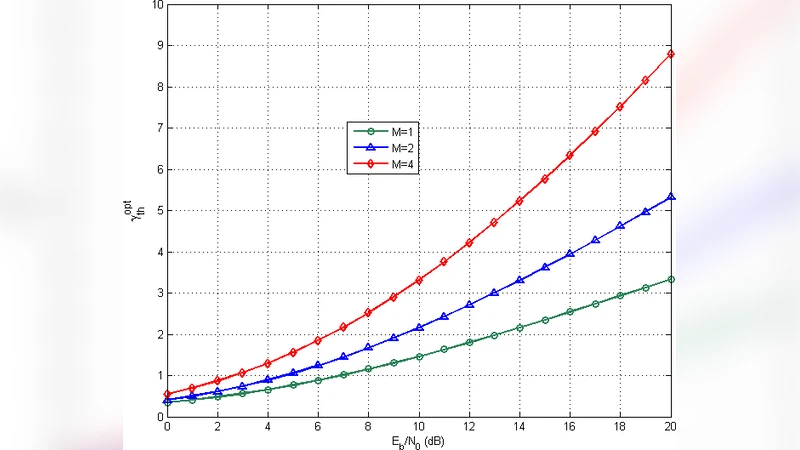
The paper addresses the problem of determining the optimal threshold value (γth) for relay transmission in Decode‑and‑Forward (DF) cooperative communication systems that employ best‑relay selection. In DF relaying, a relay forwards the source data only if the source‑to‑relay signal‑to‑noise ratio (SNR) exceeds a predefined threshold; otherwise the relay remains silent. Choosing γth appropriately is critical because a low threshold leads to error propagation (the relay may forward incorrectly decoded symbols), while a high threshold reduces the diversity gain by discarding potentially useful relays. Traditionally, the optimal γth is obtained by numerically minimizing the bit‑error‑rate (BER) expression, which is computationally intensive and unsuitable for real‑time adaptation, especially when the number of relays (M) and the average link qualities (γSR, γRD, γSD) vary.
To overcome this limitation, the authors propose using Artificial Neural Networks (ANNs) to predict the optimal γth directly from the system parameters. Two ANN architectures are investigated: a Multi‑Layer Perceptron (MLP) and a Radial Basis Function (RBF) network. The inputs to the networks are the normalized average SNRs of the three links (source‑relay, relay‑destination, source‑destination) and the number of available relays. The target output is the optimal γth obtained by exhaustive numerical minimization of the BER expression (derived from BPSK modulation and Maximum Ratio Combining at the destination).
A comprehensive dataset is generated by sweeping the SNR range and relay counts, resulting in 12,500 training samples and 3,125 testing samples. For the MLP, a single hidden layer with 12 neurons is selected after observing that increasing the hidden‑layer size beyond 12 yields diminishing returns in Mean Squared Error (MSE). The Levenberg‑Marquardt back‑propagation algorithm is employed, with tanh activation in the hidden layer and a linear activation at the output. The RBF network uses the same number of hidden neurons, Gaussian radial basis functions, and a spread parameter of 0.8, which is tuned empirically to minimize MSE.
Training results show that the MLP achieves an MSE of 8.59 × 10⁻⁶, whereas the RBF’s best MSE is 2.45 × 10⁻⁴, indicating that the MLP provides a more accurate approximation for the same network size. In the testing phase, ten randomly selected samples are evaluated. The MLP yields a Mean Absolute Error (MAE) of 0.0024 and a coefficient of determination R² of 0.9997, essentially matching the numerically derived optimal thresholds. The RBF, while still performing well, records an MAE of 0.0109 and R² of 0.9914. Graphical comparisons (Figures 5 and 6) demonstrate that both ANN outputs closely follow the optimal threshold curves for symmetric (equal average SNRs) and asymmetric channel configurations with M = 4 and M = 6, respectively.
The practical impact of using the ANN‑predicted thresholds is quantified in terms of BER and power consumption. With the optimal γth, the system achieves the minimum possible BER for a given SNR and relay configuration. Moreover, for a fixed BER target, employing the ANN‑derived threshold reduces the required transmit power by approximately 2 dB compared with a non‑optimized threshold, highlighting a significant “green communication” benefit.
Key contributions of the work include: (1) the first application of ANN techniques to predict optimal DF relay thresholds in multi‑relay scenarios; (2) a comparative analysis showing the superiority of MLP over RBF for this regression task; (3) demonstration that ANN predictions match exhaustive numerical optimization with negligible error, enabling fast, real‑time threshold selection; and (4) quantification of power savings associated with optimal threshold selection.
The paper also acknowledges several limitations. The dataset and simulations assume Rayleigh flat‑fading channels; extensions to other fading models (e.g., Nakagami‑m) or to MIMO configurations are not explored. The computational overhead of ANN inference on low‑power devices is not analyzed, nor is online adaptation to rapidly changing channel conditions considered. Future research directions suggested include testing the approach under diverse channel statistics, incorporating mobility, exploring lightweight deep‑learning models (e.g., CNNs or LSTMs) for online learning, and implementing hardware prototypes to assess real‑time feasibility and energy consumption.
In summary, the study demonstrates that ANN‑based prediction of the optimal DF relay threshold is both accurate and advantageous, offering a practical pathway to enhance cooperative communication performance while reducing power consumption in next‑generation wireless networks.
Comments & Academic Discussion
Loading comments...
Leave a Comment