Entrainment of Lymphatic Contraction to Oscillatory Flow
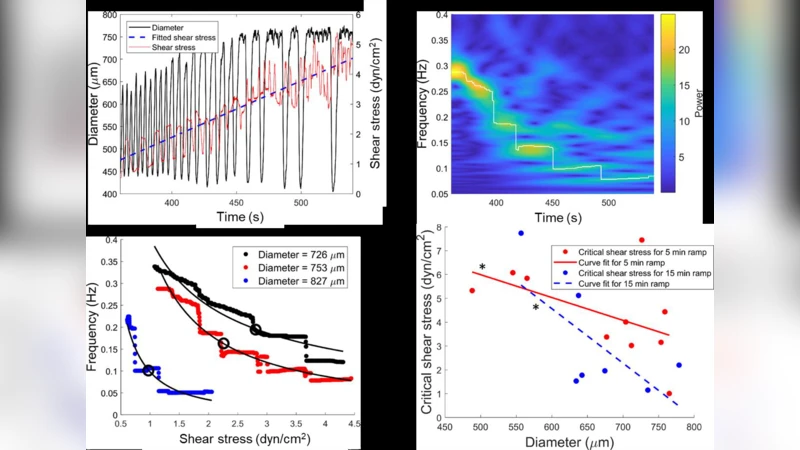
Lymphedema, a disfiguring condition characterized by the asymmetrical swelling of the limbs, is suspected to be caused by dysfunctions in the lymphatic system. Lymphangions, the spontaneously contracting units of the lymphatic system, are sensitive to luminal wall shear stress. In this study, the response of the lymphangions to dynamically varying wall shear stress is characterized in isolated rat thoracic ducts in relation to their shear sensitivity. The critical shear stress above which the thoracic duct shows substantial inhibition of contraction was found to be significantly negatively correlated to the diameter of the lymphangion. The entrainment of the lymphangion to an applied oscillatory shear stress was found to be significantly dependent on the difference between the applied frequency and intrinsic frequency of contraction of the lymphangion. The strength of entrainment was also positively correlated to the applied shear stress when this shear was below the critical shear stress. The results suggest an adaptation of the lymphangion contractility to the existing oscillatory mechanical shear stress as a function of its intrinsic contractility and shear sensitivity. These adaptations might be crucial to ensure synchronized contraction of adjacent lymphangions through mechanosensitive means and might help explain the lymphatic dysfunctions that result from impaired mechanosensitivity.
💡 Research Summary
This paper investigates how lymphangion contraction in isolated rat thoracic ducts responds to dynamically varying wall shear stress (WSS), focusing on the mechanisms of entrainment to oscillatory flow. The authors employ a continuous wavelet transform (CWT) to analyze diameter time‑series data, allowing simultaneous extraction of instantaneous contraction frequency and power across time and frequency domains.
First, the authors quantify shear sensitivity by applying a linearly ramped pressure gradient while keeping transmural pressure constant. The dominant contraction frequency, identified from the CWT spectrogram, declines as the imposed shear stress increases. By fitting a power‑law relationship (f = a·τ^b) to frequency versus shear stress data, they define a “critical shear stress” – the shear level at which the contraction frequency falls to half of its intrinsic (no‑flow) value. Across multiple vessels, this critical shear stress is strongly negatively correlated with the passive (diastolic) diameter (Spearman ρ ≈ ‑0.75 to ‑0.79, p < 0.001), indicating that larger lymphangions are more sensitive to shear. The correlation is independent of the ramp duration (5 min vs. 15 min).
Next, the study examines entrainment under oscillatory wall shear stress (O‑WSS). Three frequencies (0.075 Hz, 0.20 Hz, 0.35 Hz) representing below, near, and above the typical intrinsic contraction frequency (~0.3 Hz) are applied, each at three pressure‑gradient amplitudes (ΔP = 4, 6, 8 cmH₂O). CWT spectrograms reveal that the proportion of spectral power at the imposed frequency – a proxy for “strength of entrainment” – depends on two key factors: (1) the absolute difference between the imposed frequency and the intrinsic frequency, and (2) the magnitude of the applied shear relative to the vessel’s critical shear stress. When the imposed frequency is close to the intrinsic frequency, entrainment power is maximal; as the mismatch grows, power diminishes. Moreover, entrainment strength increases with higher shear amplitudes, but only while the applied shear remains below the critical value.
A striking observation occurs when the imposed frequency exceeds the intrinsic frequency: the dominant spectral peak shifts to half the imposed frequency (½ f). This half‑frequency entrainment is interpreted as a consequence of shear‑mediated inhibition – the high‑frequency oscillatory shear pushes the instantaneous shear above the critical threshold, suppressing the natural contraction rhythm and causing the vessel to lock onto a subharmonic (half‑period) of the external stimulus.
The authors further normalize the applied shear by each vessel’s critical shear stress, showing a positive linear relationship between normalized shear and entrainment power for similar and high frequencies. When power at both the imposed frequency and its half‑frequency are summed, no significant difference is found between medium and high frequencies, supporting the subharmonic entrainment hypothesis.
Overall, the study demonstrates that lymphangion contractility is not only inhibited by absolute shear magnitude but also can be synchronously driven by appropriately tuned oscillatory shear. The critical shear stress, inversely related to vessel diameter, serves as a key parameter governing both inhibition and entrainment. These findings have important implications for lymphatic physiology and pathology. In lymphedema, altered shear sensitivity or elevated critical shear stress could impair coordinated pumping, leading to fluid accumulation. Therapeutic strategies that modulate shear (e.g., compression garments, low‑frequency vibration, pharmacologic agents targeting shear‑responsive pathways) may restore proper entrainment and improve lymph transport.
Methodologically, the use of CWT provides a powerful tool for analyzing non‑stationary lymphatic signals, capturing transient frequency shifts that conventional Fourier analysis would miss. This approach could be extended to in‑vivo imaging of lymph flow, enabling quantitative assessment of lymphatic function under physiological and disease conditions.
In conclusion, the paper establishes a quantitative framework linking vessel geometry, shear sensitivity, and frequency‑dependent entrainment of lymphatic contraction. It highlights how mechanical cues can synchronize lymphangion activity, ensuring efficient lymph propulsion, and suggests that dysregulation of this mechanosensitive entrainment may underlie lymphatic disorders such as lymphedema. Future work should explore these mechanisms in larger animal models and human subjects, and test interventions that deliberately harness oscillatory shear to promote healthy lymphatic function.
Comments & Academic Discussion
Loading comments...
Leave a Comment