Cohomology of Substitution Tiling Spaces
Anderson and Putnam showed that the cohomology of a substitution tiling space may be computed by collaring tiles to obtain a substitution which "forces its border." One can then represent the tiling space as an inverse limit of an inflation and subst…
Authors: Marcy Barge, Beverly Diamond, John Hunton
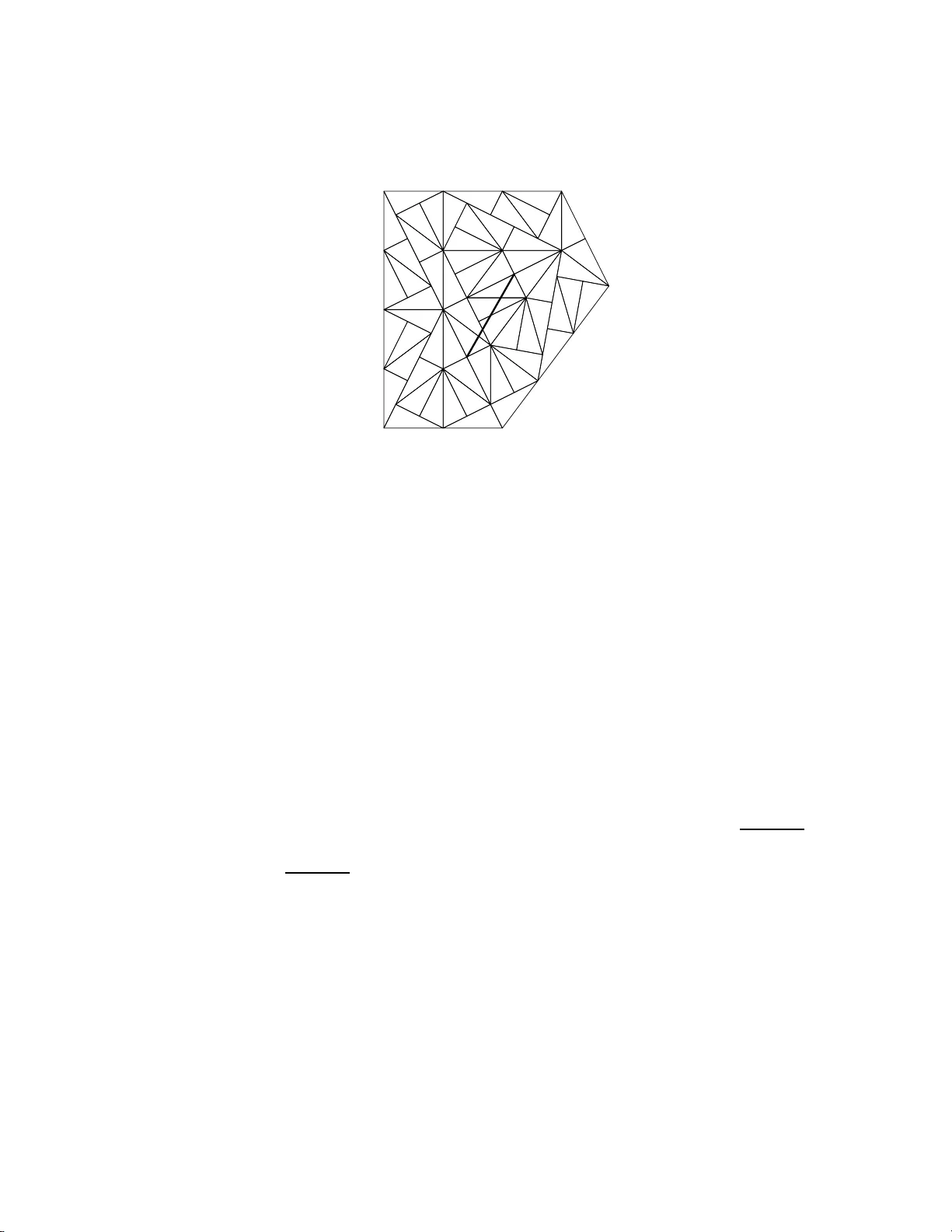
COHOMOLOGY OF SUBSTITUTION TILING SP A CES MAR CY BAR GE, BEVERL Y DIAMOND, JOHN HUNTON AND LORENZO SADUN Ma y 25, 2009 Abstract. Anderson and P utnam show ed tha t the cohomolog y of a substitution tiling space may be co mputed by collaring tiles to obtain a substitution which “for ces its b order.” One can then represent the tiling space as a n inv erse limit of an inflation and substitution ma p o n a cellula r co mplex formed fro m the collar ed tiles; the cohomo logy o f the tiling space is co mputed as the direct limit of the ho momorphism induced by inflation and subs titution on the cohomo logy of the com- plex. In e a rlier work, Ba rge and Diamond desc r ibed a mo dification o f the Anderson-Putnam complex on collar ed tiles for o ne-dimensional sub- stitution tiling s paces that allows for easier computation a nd pr ovides a means of ide ntifying certain sp ecial features of the tiling s pa ce with particular elements of the co homology . In this pap er, we extend this mo dified constr uction to higher dimensions. W e also examine the ac tion of the r o tation group o n cohomolo gy a nd compute the cohomolog y of the pin wheel tiling space. 2000 Mathematics Sub ject Classification: Primary: 37B05; Se c ondary: 54H20, 55N05 1. Intro duction The study of a p erio dic tilings of Euclidean space b egan in 1961 with t he w ork of W ang [W], whose in terest cen tered o n decidabilit y issues. Sc hec ht- man’s disco v ery of quasicrystaline mat eria ls in 198 4 [SBGC] shifted fo cus to the combinatorial structure of nonp erio dic tilings. Tiling space no w ar ises naturally: by passing to the space of all tilings lo cally indistinguishable from a give n tiling, combinatorial prop erties o f a n individual tiling are translated in to t o p ological properties of the tiling space. This space can b e studied with the aid of na t ur a lly defined dynamical systems. There are t w o main approa ches to the study of tiling dynamics. One approac h a ssociat es a C*-alg ebra to a gro up actio n on the tiling space a nd then studies the K-theory of this algebra. In the top olo g ical approac h, coho- mology is computed in some more direct manner. The C*-algebra approac h sta ys closer to the ph ysics, while the cohomo lo gy calculations are generally more straightforw ard. At an y rate, the K- theory and cohomolo gy typically 1 coincide and this p ermits cohomolo gical in terpretation of such ph ysically relev an t no tions as gap- lab eling ([B],[BBG], [KP], [S]). The tw o most general pro cedures for constructing no np erio dic tilings a re the cut-and-pro ject metho d and the substitution metho d. F or the calcula- tion o f cohomolo g y o f cut-a nd- pro ject spaces see [FHK], [GHK]. W e con- sider only substitution tilings in this article. In 1998, Anders on and Putnam [AP] sh o w ed ho w to describ e a subs ti- tution tiling space as an inv erse limit of branche d manifolds. There are t w o mo dels, depending on whether the substitution has a prop ert y called “forcing the b order”. If the substitution has that pro p ert y , they construct a CW complex K consisting of one copy of ev ery kind of tile, with certain edge iden tifications. The substitution σ maps K to itself and the inv erse limit lim ← − ( K , σ ) is homeomorphic t o the tiling space Ω σ . If the substitution do esn’t force the b order, then lim ← − ( K , σ ) is still w ell- defined, and there is a natural map Ω σ → lim ← − ( K , σ ), but this map fails t o b e inj ective . In that case, they build a complex K c from m ultiple copies of each tile t yp e, one cop y for e ac h pattern of ne arest-neigh b or tiles tha t can touc h the tile in question. A tile, t ogether with a lab el indicating the pattern of neighboring tiles, is called a “colla red tile”. Then K c is obtained b y iden tifying edges of collared tiles in a particular w a y , a nd Ω σ is alwa ys homeomorphic to lim ← − ( K c , σ ). (In [K] Kellendonk indep eden tly introduced collaring to compute the top dimensional cohomo lo gy of some tiling spaces.) Anderson-Putnam collaring is based on lab eling tiles . In this pap er we extend a 1 -dimensional construction of Barge and Diamond [BD] to de- v elop a collaring sc heme ba sed on la b eling p oints by their neighborho o ds to a distance t . These lab eled p oin ts naturally aggregate into a branche d man- ifold K t , a nd we sho w how to construct tiling spaces (not just substitution tiling spaces) a s in v erse limits o f the branched manifolds K t . Moreo v er, our construction extends to tiling spaces with contin uous rot a tional symmetry (e.g., the pinw heel tiling), and to spaces of tilings that do not hav e finite lo cal complexit y (see [FS]). There are tw o imp ortant inv erse limits. The first applies to all tiling spaces, whether arising via s ubstitutions or n ot. If t ′ > t , then there is a natural map f : K t ′ → K t that merely forgets collaring data from fa rther than a distance t . The tiling space Ω is alwa ys homeomorphic to lim ← − ( K t , f ). The second inv erse limit applies to substitution tiling spaces. If σ is an expanding substitution, then there is a constan t λ > 1 such that σ maps K t ′ to all K t with t < λt ′ . In particular, w e can tak e t ′ = t and compute lim ← − ( K t , σ ). F or a n y p ositiv e t , Ω σ is homeomorphic to this tiling space, and the ˇ Cec h cohomology of Ω σ is computed as ˇ H ∗ (Ω σ ) = lim − → ( H ∗ ( K t ) , σ ∗ ). 2 The problem with this construction is tha t σ do es not respect the cellular structure of K t , so computing σ ∗ can b e difficult. The solution is to tak e a cellular map ˜ σ : K t → K t , homotopic t o σ , and consider the space Ξ = lim ← − ( K t , σ ∗ ). In general, Ξ will not b e homeomorphic to Ω σ , but they will b oth hav e ( ˇ Cec h ) cohomolo gy lim − → ( H ∗ ( K t ) , ˜ σ ∗ ). An added b enefit is stratification. There are man y stratifications of K t (i.e., subsets S 0 ⊂ S 1 ⊂ S 2 ⊂ · · · ⊂ K t ) and w e can of ten pick a ˜ σ that maps eac h stratum S k to itself. W e then consider the in v erse limits Ξ k = lim ← − ( S k , ˜ σ ) and compute the relative coho mo lo gy groups ˇ H ∗ (Ξ k +1 , Ξ k ) = lim − → ( H ∗ ( S k +1 , S k ) , ˜ σ ∗ ). These assist b oth in computing ˇ H ∗ (Ξ) and in in ter- preting the different terms that a pp ear in the final answ er. In the next section w e fix terminology . Section 3 describ es the new v ersion of collaring that we emplo y in subsequen t computatio ns and in Section 4 w e set up the stratification of cohomology that this colla r ing p ermits. As a first example, the cohomology of the chair tiling space is computed in Section 5. Our approac h gives an efficien t “b y hand” computation in whic h top ological features of this space a re reflected in the stratified cohomology . In Section 6 w e extend consideration to the space obtained by allo wing the full Euclidean group to act on a tiling . F or a translationally finite tiling ( like a c hair tiling or a P enrose tiling) three spaces arise: the closure of the orbit under translations (Ω 1 ), the closure o f the orbit under the full Euclidean group (Ω r ot ), and Ω r ot mo d rotations (Ω 0 ). W e establish general relations b et w een the cohomologies of t hese spaces and, b y w a y of example, calculate these for the chair a nd Penrose . The top dimensional cohomology of Ω r ot for the P enrose tiling has 5-torsion, illustrating a general result linking n -to rsion to the existence of more than one tiling with n -fold rotational symmetry . In the concluding Section 7 w e giv e the first computation of the cohomol- ogy of the pin wheel tiling space. 2. Not a tion and Terminology Let P b e a finite set of compact subsets of R d , each the closure of its in terior; these subsets shall b e called pr ototiles . A tile is a set obtained from a prototile by r ig id motion (b y whic h w e will mean either a translation or an arbitrary Euclidean motion, dep ending on con text). A p atch for P is a set of tiles with pairwise disjoin t in teriors and the supp ort of a patc h is the unio n of its t iles. A tiling of R d with pr ototiles P is a patch with supp ort R d . If T is a tiling and A is a b ounded subset of R d , denote by [ A ] T the set of all tiles in T that hav e nonempty intersec tion with A . Tw o patc hes P 1 and P 2 are tr anslational ly e quivalent if there is a w ∈ R d so that P 1 + w = P 2 . A tiling has tr ansla tion a l ly fin ite lo c al c o m plexity , or is ’tr anslational ly finite’ , for short, if, for eac h r > 0, the tiling contains only finitely man y tra nslatio na l 3 equiv a lence classes of patches of diameter less than r . Tw o patc hes P 1 and P 2 are ri g id e quivalent if there is a rigid motion ta king P 1 to P 2 , a nd a tiling has finite lo c al c o mplexity if, for eac h r > 0, the t iling contains only finitely many rigid equiv alence classes of patc hes of diameter less tha n r . W e use a to p ology where tw o tilings are close if they agree on a large ball around the origin, up to a small motion of eac h tile. If the tilings hav e finite lo cal complexit y , a small motion of each tile must come from a small r ig id motion of the en tire tiling. If the tilings are translationally finite, this rigid motion mus t b e a translation. W e first consider substitutions on translationally finite tilings a nd then extend the definitions to co v er other cases. A substitution σ o n P is a map σ : P → P ∗ , where P ∗ is the collection of finite patches fr o m P , suc h that, for p ∈ P , the supp ort o f σ ( p ) is the rescaled prototile Lp , where L is a fixed expanding linear map (that is, all eigen v alues of L hav e mo dulus larger than one). The substitution map can b e extended to patc hes, dilating the en tire patc h b y a factor of L and replacing eac h dilated tile Lt i = L ( p + w ) with σ ( t i ) := σ ( p ) + Lw . A tiling T of R d is admis s ible for σ if, for ev ery finite patch P of T , t here is a prototile p and an in teger n suc h t ha t P is equiv a len t to a subpatc h of σ n ( p ). The substitution tiling sp ac e f or σ and P , written Ω σ or simply Ω, is then the set of all admissible tilings; Ω is also called the c ontinuous hul l . There are t w o natural dynamical systems on Ω: translation, and the action of substitution on en tire tilings. A substitution σ is primitive if there exists an in teger n suc h that f or an y t w o prototiles p 1 and p 2 , σ n ( p 1 ) con tains a cop y of p 2 . In the case σ is prim- itiv e, Ω is minimal under translation. In the follo wing, w e assume that σ is primitiv e and Ω is non-p erio dic , that is, contains no tilings p erio dic under translation. The substitution σ is tr anslational ly finite (resp., has finite lo c al c omple x ity ) if ev ery tiling in Ω is tra nslationally finite (resp., has finite lo cal complexit y). Substitutions fo r whic h σ : Ω → Ω is a homeomorphism are called r e c o gnizable . All non-p erio dic and tra nslationally finite substitutions are recognizable ([So], [Mo]). Things are slightly more complicated if w e wish to allow rotations. The substitution maps rotat ed v ersions of p to rotated vers ions o f σ ( p ) and maps rotated ve rsions of p + w to rotated v ersions of σ ( p ) + Lw . F or this to make sense, L m ust commute with the r otations b eing considered. In 2 dimensions, this means that L m ust b e a uniform dilation by a scaling factor λ , follow ed by a rotation. There exist theorems ab out suc h substitutions b eing r ecognizable [HRS ], but in 3 or more dimensions the h yp otheses are complicated. If σ is primitiv e then the space Ω is the closure of the orbit under trans- lation of a n y o ne tiling whose patc hes are all admissible. If σ is transla- tionally finite, this is the same as the set of admissible tilings. If σ is not 4 translationally finite, then Ω con tains tilings whose pat ches may not all b e admissible, but whic h can b e appro ximated arbitrarily closely b y a dmissible patc hes. F or instance, in the pinw heel tiling the admissible patches contain tiles p ointing in a coun table a nd dense set of directions, but the space Ω allo ws tiles to p oint in an uncountable contin uum of directions. Let X 0 , X 1 , X 2 , . . . b e a sequenc e of compact metric spaces with con tin u- ous b onding maps f n : X n → X n − 1 . The i n verse limit lim ← − ( X , f ) is the space defined by (1) { ( x 0 , x 1 , . . . ) ∈ Y X n : f ( x n ) = x n − 1 for n = 1 , 2 , . . . } with the top ology inherited from the pro duct top olog y on Q X n . The spaces X n are called app r oximants to lim ← − ( X , f ). F or a n y x ∈ R d and a n y p ositiv e t , let B t ( x ) denote the op en ba ll of radius t aro und x . 3. The modified complex Supp ose that T is a tra nslationally finite tiling and pick a p ositiv e real n um ber t . W e say that tw o p o in ts x, y ∈ R d are e q uiva lent to distanc e t if [ B t ( x )] T = [ B t ( y ) ] T + x − y , and write x ∼ t y . The space K t is the quotien t of R d b y this equiv alence relation, with the quotien t top ology . If Ω comes from a primitiv e substitution, then this quotien t space will b e the same for all c hoices of T ∈ Ω (since all tilings hav e the same sets of patche s of size t ), and K t can b e view ed a s an approx iman t t o the tiling space Ω, not just to the tiling T . T o define K t for tilings tha t ar e not necessarily translationally finite w e view ∼ t as an equiv alence relation on the trivial R d bundle E → Ω, where the fibre ov er T ∈ Ω may b e considered as a cop y of T itself. If x ∈ T and y ∈ T ′ , w e sa y that ( x, T ) ∼ t ( y , T ′ ) if [ B t ( x )] T = [ B t ( y ) ] T ′ + x − y . W e then define K t to b e the quotien t of E by ∼ t . There is also a natural pro jection π : Ω → K t sending T to the equiv alence class of 0 ∈ T . The space K t can b e view ed as the set of all p ossible instructions for tiling a region B t (0) (and therefore [ B t (0)]). If t 2 ≥ t 1 , then x ∼ t 2 y implies x ∼ t 1 y , so there is a “for g etful” map f : K t 2 → K t 1 . Similarly , if t is sufficien tly large there is a natural quotien t map from K t to the collared tile complex of Anderson and Putnam [AP], a result that extends to maps from K t for t large to the complex of n -fold collared tiles. W e obtain a con tin uous generalization of G ¨ ahler’s construction [G], applicable to all tiling spaces. Theorem 1. I f t 0 ≤ t 1 ≤ t 2 ≤ . . . is an infinite se q uenc e of r adii with lim t n = ∞ , then Ω is ho m e omorphi c to the inverse limit lim ← − ( K t , f ) 5 Pr o of. A p oin t in the inv erse limit lim ← − ( K t , f ) is a set of consisten t instruc- tions fo r tiling the plane out to all r a dii t n , i.e., a set of instructions for tiling the entire plane. This give s a bij ection b etw een lim ← − ( K t , f ) and Ω, and this bijection is easily seen to b e a homeomorphism. If L is an expansiv e linear map, then there is a constan t λ > 1 and a norm on R d suc h that, for all t > 0, B λt (0) ⊂ L ( B t (0)). If L is not dia g onalizable, or has eigen v ectors that are not orthogo na l, then this norm ma y not b e the usual Euclidean norm. How ev er, we can alwa ys pick an inner pro duct that is adapted to the geometry of L , or use linear norms that do not come from an inner pro duct, suc h as L p norms. Let σ b e a substitution with expansion L . If x ∈ K t , then all tilings in π − 1 ( x ) agree on B t (0), so all tilings in σ ( π − 1 ( x )) agree on B λt (0) ⊂ L ( B t (0)), so σ induces a map K t → K λt . Coupled with the forgetful map, w e get maps σ : K t 2 → K t 1 whenev er t 2 ≥ t 1 /λ . Theorem 2. L et σ b e a r e c o gnizab le substitution with exp ans ion L . If t 0 , t 1 , t 2 , . . . is a se quenc e of p ositive numb ers with e ach t n ≥ t n − 1 /λ and with λ n t n → ∞ , then the inverse l i m it lim ← − ( K t , σ ) is h ome omorp h ic to Ω σ . Pr o of. Let ( x 0 , x 1 , . . . ) ∈ lim ← − ( K t , σ ). Eac h x n defines a tiling out to distance t n . Applying the substitution n times g iv es a tiling o n t he region L n ( B t n (0)) that, when restricted to L n − 1 ( B t n − 1 (0)), agrees with the tiling defined by x n − 1 . Since B λ n t n (0) ⊂ L n ( B t n (0)) and λ n t n → ∞ , the p oint ( x 0 , x 1 , . . . ) defines a set of nested patc hes that exhaust t he entire plane. In other words , they define a tiling. This g iv es a contin uous map lim ← − ( K t , σ ) → Ω σ . The in v erse map sends a tiling T to ( x 0 , x 1 , . . . ), where x n is the ∼ t n equiv a lence class of the origin in σ − n ( T ). Corollary 3. L et t > 0 , and let σ b e a r e c o gniza b l e substitution with exp an- sion L . Then Ω σ is home omorphic to lim ← − ( K t , σ ) , wher e e ach a p pr oximant is the same and e ach m ap is the sa me. The space K t is easy to visualize if t is m uc h smaller than the diameter of an y tile. Tw o p oin ts, each far ther than t from the b oundary of the tiles they sit in, a re iden tified if they sit in corresp onding places in the same tile t yp e. Poin ts near edges a r e identifie d if they sit in corresp onding places in the same t ile t yp e, and the tiles across the nearby edges are of t he same t yp e. That is, these p oin ts “kno w” ab o ut their neigh b or a cro ss the edge. Lik ewise , p oin ts near vertice s “know” all t he tiles that meet that v ertex. Figure 1 show s the approximan ts K t for tw o 1- dimensional tilings, the Th ue-Morse substitution a → ab, b → ba and the p erio d-doubling substitu- tion a → bb, b → ba . In b oth cases w e tak e the tiles to ha v e length 1 and tak e t < 1 / 2. In each case there are interv als e a and e b of length 1 − 2 t 6 e a e b e a e b v aa v bb v ab v ba v ab v ba v bb 0 0 1 1 0 0 1 1 0 0 1 1 0 0 1 1 0 0 1 1 0 0 1 1 0 0 1 1 0 0 1 1 000 111 00 00 11 11 000 000 000 111 111 111 000 000 000 000 111 111 111 111 Thue−Morse Period−doubling Figure 1. Tw o approximan ts describing t he interiors of the a a nd b tiles. These are the images of tilings that ha v e no v ertices in B t (0). The tilings with a v ertex in B t (0) yield in terv als of length 2 t , one f or eac h p ossible transition b et w een tiles. The Th ue-Morse complex ha s four suc h “v ertex cells” v aa , v ab , v ba , v bb , since the transitions aa , ab , ba , and bb are all p ossible. The p erio d-doubling complex only has three suc h in terv a ls, v ab , v ba , and v bb , since consecutiv e a tiles nev er o ccur. 4. Homotopy, stra tifica tion, and cohomology The f ollo wing theorem ab out inv erse limits in the catego r y of top olog ical spaces is standard: Theorem 4. The ˇ Ce ch c ohomolo gy of an inverse limit lim ← − ( K , f ) is the di- r e ct limi t of the ˇ Ce ch c o h o molo gy of the appr ox imants K n under the pul lb ack map f ∗ . If e ach appr oximant is a CW c omplex, then this i s isomo rphic to the dir e ct lim i t of the singular or c el lular c ohomolo gy of the appr oximants. T o compute ˇ H ∗ (Ω), w e need only compute the cellular cohomology o f K t , compute the action of σ ∗ on this cellular cohomolog y , and take the direct limit. Unfortunately , σ is not a cellular map. In the Th ue-Morse and p erio d-doubling examples, the o b vious 1-cells in K t are in terv als of length 2 t and 1 − 2 t . How ev er, σ doubles length, and so sends a cell of length 2 t to an in terv al o f length 4 t , tha t is to a cell of length 2 t plus parts of tw o other cells. One solution is to find another map ˜ σ : K t → K t , that is cellular and homotopic to σ . F or instance, w e can follow the substitution by a flo w t ha t pushes p oin ts to w ards the nearest v ertex, so that p o ints that a r e 2 t aw ay from a v ertex flo w to p oin ts just t a w a y from a v ertex. Then ˇ H ∗ (Ω) = lim − → ( H ∗ ( K t ) , σ ∗ ) = lim − → ( H ∗ ( K t ) , ˜ σ ∗ ) = ˇ H ∗ (Ξ), where Ξ = lim ← − ( K t , ˜ σ ). 7 Another, a nd essen tially equiv alen t, solution when the expansiv e map L is just mag nificatio n by a constan t λ > 1 is to note that for all t > s > 0 sufficien tly small, K t and K s are ho mo t op y equiv alent, and th us share the same ˇ Cec h cohomology . A corollary o f Theorems 2 and 4 tells us that there is an isomorphism ˇ H ∗ (Ω) ∼ = lim − → n ( H ∗ ( K tλ − n )) and note that the map K tλ − n → K tλ 1 − n is cellular. In some simple examples, H ∗ ( K t ) and the a ction of ˜ σ ∗ can b e computed directly . In more complicated examples, it is useful to stratify K t in to pieces S 0 ⊂ S 1 ⊂ · · · ⊂ K t suc h that eac h stra t um S k is mapp ed to itself b y ˜ σ . D efining Ξ k = lim ← − ( S k , ˜ σ ), w e compute ˇ H ∗ (Ξ 0 ) and the relativ e groups ˇ H ∗ (Ξ k , Ξ k − 1 ) and use the long exact sequences of the pair (Ξ k , Ξ k − 1 ) to recursiv ely compute ˇ H ∗ (Ξ k ) for k > 0. In one-dimensional examples , the o b vious stratificatio n is giv en b y taking S 0 to b e the union of the v ertex cells a nd S 1 as K t . Barge and D iamond [BD] used this stratification via the long exact seque nce of the pair ( S 1 , S 0 ) to show that ˇ H 1 (Ω) fits into the exact sequence (2) 0 → ˜ H 0 (Ξ 0 ) → lim − → ( Z d , M T ) → ˇ H 1 (Ω) → ˇ H 1 (Ξ 0 ) → 0 , where d is the num b er of letters and M is the substitution matr ix. (Here, and in what f ollo ws, ˜ H indicates reduced cohomology .) F o r instance, in the p erio d-doubling space, S 0 is con tractible, so ˜ H 0 (Ξ 0 ) and ˇ H 1 (Ξ 0 ) v anish, and hence ˇ H 1 (Ω) is the direct limit of the action of the matr ix M T = ( 0 2 1 1 ), namely Z [1 / 2] ⊕ Z . In the Th ue-Morse space, S 0 has the top olog y of a circle, on whic h ˜ σ acts by reflection. W e then hav e (3) 0 → lim − → Z 2 , ( 1 1 1 1 ) → ˇ H 1 (Ω) → Z → 0 . Once aga in, ˇ H 1 (Ω) = Z [1 / 2] ⊕ Z , only no w the factor o f Z comes fro m the top ology of S 0 rather than fro m the substitution matrix. In tw o dimensions, there is some choice o v er the stratification that can b e used. It is o ften useful to ta k e S 0 to b e the p o in ts within t of a v ertex, S 1 the p oints within t of an edge and S 2 = K t , but other stratifications are also useful: w e shall see examples later in o ur calculations. F or instance, in a t iling b y rectangles w e could tak e S 0 to b e the p oin ts close to a v ertex, S 1 the p oints close to a horizon tal edge, S 2 the p oin ts close to a n y edge, and S 3 = K t . W e could a lso take S 0 to b e the p oints close to four tiles (i.e., close to a 4- w a y crossing), S 1 to b e the p oints close to 3 o r mor e tiles (i.e., close to crossings and T-in tersections), S 2 to b e the p oints close to 2 or more tiles (i.e., close to an edge) and S 3 to b e ev erything. In three or more dimensions, the p ossibilities a r e ev en more v aried. 8 The “ righ t” strat ificatio n dep ends on the example. What’s imp ortant is t o pic k a stratification for whic h a ˜ σ can b e found tha t resp ects the stratification, for whic h H ∗ ( S 0 ) a nd its limit ˇ H ∗ (Ξ 0 ) a r e computable, and for whic h the quotien t spaces S k /S k − 1 are w ell-b eha v ed. 4.1. E v en t ual ranges. The homotop ed substitution ˜ σ maps S k to itself, but this map need not b e onto. Since ˜ σ is cellular and S k consists of a finite n um ber of cells, the nested sequence of spaces S k ⊃ ˜ σ ( S k ) ⊃ ˜ σ 2 ( S k ) ⊃ · · · ev en tually stabilizes to the ev e ntual r ange , whic h w e denote ( S k ) E R . The k ey alg ebraic facts ab o ut ev en tual ranges are: Theorem 5. L et S 0 ⊂ S 1 ⊂ · · · ⊂ S b e a ne s te d se quen c e of finite CW c omple x es, and le t ˜ σ b e a map that sends e ach S k to itself. L et ( S k ) ER denote the eventual r ange of S k and Ξ k the in verse limit of S k . (1) Ξ k = lim ← − (( S k ) ER , ˜ σ ) (2) ˇ H k (Ξ k ) = lim − → ( H k (( S k ) ER ) , ˜ σ ∗ ) (3) ˇ H k (Ξ k , Ξ k − 1 ) = lim − → ( H k (( S k ) ER , ( S k − 1 ) ER ) , ˜ σ ∗ ) . (4) ˇ H k (Ξ k , Ξ k − 1 ) = lim − → ( H k (( S k ) ER , S k − 1 ∩ ( S k ) ER ) , ˜ σ ∗ ) . Pr o of. Let N k b e suc h that ˜ σ N k ( S k ) = ( S k ) ER . If ( x 0 , x 1 , . . . ) is a sequence of p oin ts in S k , with eac h x i = ˜ σ ( x i +1 ), t hen each x i = ˜ σ N k ( x i + N k ) ∈ ( S k ) ER , so ev ery p oin t in the in v erse limit o f S k is actually in the in v erse limit o f ( S k ) ER . This prov es the first claim, and the second and third claims follow immediately from the first. The subtlet y is in the fourth, where w e use the ev en tual ra ng e o f S k but do not use the ev en tual ra nge of S k − 1 . Supp ose that α ∈ C k (( S k ) ER , ( S k − 1 ) ER ). That is, α is a k -co c hain that v anishes on c hains supp orted in ( S k − 1 ) ER . How eve r, if c is a c hain on S k − 1 , then ˜ σ N k − 1 ( c ) is a c hain on ( S k ) ER , so (( ˜ σ ∗ ) N k − 1 α )( c ) = α ( σ N k − 1 ( c )) = 0. Th us the direct limit of C k (( S k ) ER , ( S k − 1 ) ER ) is the direct limit of C k (( S k ) ER , ( S k ) ER ∩ S k − 1 ). The relativ e cohomolog y of the inv erse limit is computed from the action of the cob oundary on this direct limit, and so can b e computed either from the direct limit of H k (( S k ) ER , ( S k − 1 ) ER ) o r from the direct limit of H k (( S k ) ER , ( S k ) ER ∩ S k − 1 ). 5. Example: The chair The c hair t iling is based on a single tile, a 2 × 2 square with a 1 × 1 corner remo v ed, app earing in four differen t orien tations. The c hair tiles substitute as in Figure 2. If we place arrows on the three 1 × 1 squares tha t mak e up a c hair, ց ր տ , then the ch air substitution induces a substitution σ on arrows: 9 Figure 2. T he c hair substitution (4) ր − → ց ր ր տ , etc. The con v ersion from c hair tiles to arro w tiles a nd bac k is lo cal, and the tw o tiling spaces are homeomorphic. W e construct K t for the arrow substitution, and will use this to compute the cohomology of the arrow (and therefore c hair) tiling space. W e use t he L ∞ norm on R 2 , f or whic h B t (0) is geometrically a square, of side 2 t , cen tered at t he orig in, and w e pick t < 1 / 4. W e stratify K t as follo ws: S 0 is the set of p oints within t of a v ertex (i.e., b oth the horizon tal and v ertical distances are less than or equal to t ), S 1 is the set of p oin ts within t of an edge, a nd S 2 is all of K t . The map ˜ σ is substitution follow ed b y a flow tow ards the nearest ve rtex. S 0 consists of one 2 t × 2 t square fo r ev ery p ossible v ertex (call these “v ertex p olygons”), S 1 consists of S 0 plus a 2 t × 1 − 2 t “ edge flap” for eve ry p ossible v ertical edge a nd a 1 − 2 t × 2 t edge flap for ev ery p ossible horizon tal edge, and S 2 consists of S 1 plus four 1 − 2 t × 1 − 2 t “tile cell” for eac h of the four p ossible tiles. F or typogra phical simplicity , w e will call a northeast arrow A, a north w est arro w B, a south w est arro w C, and a southeast arrow D. Let F A , F B , F C , F D denote t he tile cells. There are eight vertical edge flaps, 4 of the form ր ւ տ ց and 4 of the f o rm տ ց ր ւ , where the do uble-headed arrow ր ւ indicates that either ր o r ւ can app ear in this p osition. The edge fla p ր տ (denoted E AB ) is glued to F A on the left and F B on the right, and hence is also glued to E AD on the left and E C B on the right. The four flaps from the configura tions ր ւ տ ց glue together to form a vertical tub e, a s do the four flaps f rom տ ց ր ւ . Similarly , there are tw o distinct horizon tal tub es capturing allow ed configurations along horizon tal edges. There are tw o general patt erns of allow ed configurations at v ertices: T yp e 1, of the for m ր ւ տ ց տ ց ր ւ , and T yp e 2 , o f the fo r m տ ց ր ւ ր ւ տ ց . Under substitution, 10 a g k n α η κ λ b e k o β ε κ λ c f i o γ ε η λ c g j m δ ε η κ d h l p α β γ δ Figure 3. The 5 v ertex squares in ( S 0 ) ER eac h T ype 1 configurat ion maps to the Ty p e 2 configuration տ ր ւ ց . Only fiv e T yp e 2 corner configurations are allow ed for σ : (5) ց ր ր տ , տ ւ ր տ , ց ւ ւ տ , ց ւ ր ց , and տ ր ւ ց . Eac h of these is tak en to itself under substitution, so these constitute the ev en tual range ( S 0 ) E R . The diagram b elo w illustrates a par t of the complex K t . F C ւ ր F A ց F D F B տ E A D E B C E B A E C D ( S 0 ) ER consists of fiv e v ertex squares with b oundary identific ations as in Figure 3. Note that this complex has 5 faces, 16 edges and 8 v ertices, for an Euler characteristic of − 3. It is easy to c hec k that H 2 (( S 0 ) ER ) = 0, and H 0 = Z , so H 1 = Z 4 . ( S 0 ) ER has the homotopy type of the w edge of four circles. Since ˜ σ just p ermute s the cells of ( S 0 ) ER , ˜ σ ∗ is an isomorphism a nd ˇ H ∗ (Ξ 0 ) = H ∗ (( S 0 ) ER ). That is, ˇ H 0 (Ξ 0 ) = Z , ˇ H 1 (Ξ 0 ) = Z 4 and ˇ H 2 (Ξ 0 ) = 0. As noted earlier, the complex S 1 consists of S 0 together with 16 edge flaps. These edge flaps form fo ur tub es, and H 1 ( S 1 , S 0 ) = H 2 ( S 1 , S 0 ) = Z 4 . Substitution tak es each edge flap of the form ր ւ տ ց to itself plus տ ւ , tak es տ ց ր ւ to it self plus ր ց , t ak es ր ւ տ ց to itself plus տ ր , and ta kes տ ց ր ւ to itself plus ւ ց . ˜ σ ∗ acts b y 1 1 0 0 1 1 0 0 0 0 1 1 0 0 1 1 on H 1 , a nd the dir ect limit is 11 Z [1 / 2] 2 . One generato r coun ts horizon tal edges, while the other counts v ertical edges. Ho w ev er, ˜ σ ∗ acts trivially on H 2 . The exact sequence of the pair (Ξ 1 , Ξ 0 ) reads: (6) 0 → Z 4 → ˇ H 1 (Ξ 1 ) → Z 4 δ − → Z 4 → ˇ H 2 (Ξ 1 ) → 0 . The cob oundary map δ is no nsingular with determinant 3, so ˇ H 1 (Ξ 1 ) = ˇ H 1 (Ξ 1 , Ξ 0 ) = Z 4 and ˇ H 2 (Ξ 1 ) = Z 3 . The complex S 2 /S 1 is just the w edge of four spheres, so H 1 ( S 2 , S 1 ) = 0 and H 2 ( S 2 , S 1 ) = Z 4 . Under substitution, H 2 ( S 2 , S 1 ) simply g ets m ultiplied b y the transp ose of the substitution matrix, and the limit is Z [1 / 4] ⊕ Z [1 / 2] 2 . (As a set, Z [1 / 4] is t he same as Z [1 / 2], but w e denote it Z [1 / 4 ] to indicate that it quadruples under substitution.) The g enerator of Z [1 / 4 ] simply coun ts t iles, regardless o f t yp e, while the generators of Z [1 / 2] 2 coun t the v ector sum of all t he arr ows. Finally , we put it a ll together. The exact sequence o f the pair (Ξ 2 , Ξ 1 ) reads (7) 0 → ˇ H 1 (Ξ 2 ) → Z [1 / 2] 2 δ − → Z [1 / 4] ⊕ Z [1 / 2] 2 → ˇ H 2 (Ξ 2 ) → Z 3 → 0 . The map δ : ˇ H 1 (Ξ 1 ) → ˇ H 2 (Ξ 2 , Ξ 1 ) is zero (since the b oundary of ev ery tile has a net of zero horizon tal a nd zero v ertical edges), so ˇ H 1 (Ξ 2 ) = Z [1 / 2] 2 and ˇ H 2 (Ξ 2 ) is an extension of Z [1 / 4 ] ⊕ Z [1 / 2] 2 b y Z 3 . Whic h extension is seen b y considering the class in ˇ H 2 (Ω σ ) that counts c hair tiles regardless of orientation. Since ev ery c hair tile consists of thr ee arro w t iles, this class is one third of the generator of Z [1 / 4], so w e hav e ˇ H 2 (Ω) = 1 3 Z [1 / 4] ⊕ Z [1 / 2] 2 and ˇ H 1 (Ω) = Z [1 / 2] 2 . This w as a long route to a simple answ er. As an Ab elian group, ˇ H 2 (Ω) is isomorphic to the direct limit of H 2 ( S 2 , S 1 ), and also to the coho mo lo gy of the in v erse limit of the uncollared Anderson-Putnam complex. How ev er, there is mor e to this problem than the uncollared complex! The generator of the r otationally inv ar ia n t part of ˇ H 2 (Ω) c annot b e expressed in term of uncollared a rro w tiles. T he f a ctor of 3 has to do with the conv ersion from arrows to c hairs, whic h requires inf o rmation ab o ut the neigh b orho o d of eac h tile. This collaring information is captured in the Z 3 con tribution to ˇ H 2 (Ξ 1 ). 6. Tilings with rot a tions W e concen trate now on the case of tilings in the plane, so with d = 2, building into our theory the action of rotation groups. The work here will allo w us, in the final section, to compute the coho mo lo gy of the pinwhe el tiling. 12 6.1. Three tiling spaces. There are actually thr e e tiling spaces that are asso ciated with a translationally finite substitution suc h as the chair. The first, denoted Ω 1 , is the one considered ab ov e, and is the closure of the tr anslational orbit of a single tiling. F or the c hair substitution, it consists of all c hair tilings in whic h the edges are horizon tal and ve rtical. A finite rotation group ( Z 4 for the chair, Z 10 for the P enrose substitution) can act on Ω 1 , a nd w e can classify the terms in ˇ H ∗ (Ω 1 ) by ho w they tr a nsform under rotation. F or instance, in the c hair tiling space the Z [1 / 2] 2 con tributions to ˇ H 2 transform a s a v ector (i.e., b y the matrix ( 0 − 1 1 0 ) fo r a 90 degree rotation), as do the Z [1 / 2] 2 con tributions to ˇ H 1 , while t he 1 3 Z [1 / 4] con tribution to ˇ H 2 is rot a tionally inv ariant, as is ˇ H 0 = Z . A second tiling space, denoted Ω r ot , is the closure o f the Euclide an o rbit of a single tiling. That is, Ω r ot is the space of all tilings obtained b y a pplying (orien tation preserving) rigid motions to elemen ts of Ω 1 , with metric whic h stipulates tha t t w o tilings are close if o ne agrees with the other in a large neigh b orho o d of the origin, up to a small Euclidean motion. F or the c hair substitution, this giv es tilings with edges p oin ting in arbitr a ry directions, not just vertically and horizon tally . (Any o ne tiling will only hav e edges p oin ting in t w o p erp endicular directions, but these directions are arbitrary .) The third space, denoted Ω 0 , is the set of a ll tiling s mo dulo rot ations ab out the or igin. These a re related by (8) Ω r ot /S 1 = Ω 0 = Ω 1 / Z n , where n = 4 for the ch air tiling and n = 10 for the P enrose tiling. 6.2. Mo dified complexes and in v erse limits. W e mo dify our earlier construction to write Ω 0 and Ω r ot as inv erse limits of appro ximan t s K 0 t and K r ot t . Let E r ot b e the trivial R 2 bundle ov er Ω r ot , consisting of a cop y of R 2 for ev ery tiling in Ω r ot . There are t w o ob vious equiv alence relations on E r ot . The first says that x ∈ T and y ∈ T ′ are equiv alent ( x ∼ t y ) if [ B t ( x )] T = [ B t ( y ) ] T ′ + x − y . That is, if there is a t r anslation t ha t tak es [ B t ( x )] T to [ B t ( y ) ] T ′ and tak es x to y . The second equiv alence relation is that x ∼ r ot t y if there is a rigid mo tion that tak es [ B t ( x )] T to [ B t ( y ) ] T ′ and tak es x to y . K r ot t is the quotien t of E r ot b y ∼ t , while K 0 t is the quotien t of E r ot b y ∼ r ot t . As b efore, there are maps from Ω r ot and Ω 0 to K r ot t and K 0 t , taking a tiling to the equiv alence class of the or ig in. Viewe d in this wa y , a p oin t in K r ot t defines a tiling o n B t (0), while a p oin t in K 0 t defines a tiling o n B t (0) up to r otation ab out the origin. Substitution sends K r ot t to itself and K 0 t to itself, and the in v erse limits define tilings, or tilings mo dulo rotation, on a ll of R 2 . In other w ords, Theorem 6. Ω r ot = lim ← − ( K r ot t , σ ) a nd Ω 0 = lim ← − ( K 0 t , σ ) . 13 If σ has finite lo cal complexit y , then K r ot t is a branc hed 3-manifo ld. Around any p oin t is a 3-disk neighborho o d obtained b y applying rigid mo- tions to the patch [ B t (0)]. There a r e branc hes whenev er the closed ba ll ¯ B t (0) in tersects tiles that the op en ball B t (0) do es not. K 0 t is a branc hed 2-orbifold, with cone singularities at p oints that represen t patches with (fi- nite!) rotationa l symmetry ab out the origin. F o r a generic c hoice of t , these singularit ies are b o unded aw ay from the branch lo cus, and w e will henceforth assume that t is so chose n. Note that K r ot t has the structure of a (branc hed) Seifert manifold. Let P : K r ot t → K 0 t b e the natural pro jection. F or any x ∈ K 0 t , P − 1 ( x ) is a circle in K r ot t . If x represen ts a patch without rota t io nal symmetry ab out the origin, then this circle is obtained b y ro tating any represen tativ e of x thro ugh 2 π . W e call this circle a g eneric fibr e . The preimage of a neigh b orho o d D of x is D × S 1 . If x represen ts a patc h with n - fold rota t io nal symmetry , then P − 1 ( x ) is a circle obtained b y rotating a n y represen tat iv e of x thr o ugh 2 π /n . W e call this a n exc eptional fibr e . In this case, a neigh b orho o d N of x is mo deled by the cone B R (0) / Z n , with ( r, θ ) (in p olar co ordinates) iden tified with ( r , θ + 2 π /n ). The preimage P − 1 ( N ) is then B R (0) × S 1 / Z n , with ( r , θ, φ ) ∼ ( r, θ + 2 π /n, φ − 2 π /n ); this is a solid torus, but the longitude is the exceptional fibre P − 1 ( x ). F or tilings like t he pin wheel, with tiles a pp earing in an infinite num b er of orien tations, there is no distinction b et w een Ω 1 and Ω r ot , since the closure of a translational orbit already con tains t iles p ointing in arbitra ry directions. Ω r ot is still the in v erse limit of branc hed 3-manifolds K r ot t , Ω 0 is the in v erse limit o f branc hed 2-orbif o lds K 0 t , a nd we will not sp eak o f Ω 1 . 6.3. Cohomologies of the three spaces. F or translationally finite sub- stitution tilings, we will establish some relat io ns b etw een the cohomologies of Ω 1 and Ω 0 . F or all 2-dimensional substitutions with finite lo cal complex- it y , we will establish relations b etw een the cohomologies of Ω 0 and Ω r ot and demonstrate the existence of torsion in ˇ H 2 (Ω r ot ) f or the Pe nrose tiling. In the next section w e will compute ˇ H ∗ (Ω 0 ) for the pinwh eel tiling, a nd use this to compute ˇ H ∗ (Ω r ot ). Theorem 7. If σ is a tr anslationa l ly finite r e c o gn i z a ble substitution, then ˇ H ∗ (Ω 0 , R ) is isomorp h ic to the r otational ly invariant p art of ˇ H ∗ (Ω 1 , R ) . Pr o of. Ev ery real-v alued co chain on K t can b e written as a sum of co c hains that transform according to the irreducible represen tatio ns of the rota tion group Z n that acts on Ω 1 (and therefore K t ). The cob oundary map is equiv a rian t with resp ect to ro t a tion, so the cohomology of K t is the di- rect sum of terms, one for each irreducible represen tation of Z n . How ev er, the rotationa lly in v ariant co c ha ins are exactly the pullbacks of co c hains on 14 K 0 t , so H ∗ ( K 0 t , R ) is the rotatio nally inv ariant part of H ∗ ( K t , R ). Since σ comm utes with rotatio ns, the same observ ation applies to the direct limits ˇ H ∗ (Ω 0 , R ) = lim − → ( H ∗ ( K 0 t , R ) , σ ∗ ) and ˇ H ∗ (Ω 1 , R ) = lim − → ( H ∗ ( K t , R ) , σ ∗ ). This argumen t do es not work with in teger co efficien ts, since an integer- v alued co c ha in cannot necessarily b e written as a sum of irr educible com- p onen ts. F or instance, if n = 2, and tw o chains a re related by rota t ion by π , then the co ch ain (1 , 1) is rota tionally inv ar ia n t and the co c hain (1 , − 1) corresp onds t o the nontrivial irreducible represen tation of Z 2 , but (1 , 0) can- not b e written as an in teger linear combination of (1 , 1) and ( 1 , − 1). W e do not exp ect the conclusion of the theorem to hold with integer co efficien ts in general, but we kno w as yet of no sp ecific counterex amples. Theorem 8. If σ is a r e c o gnizable substitution with finite lo c al c omplexity, then the r e al c ohomolo gy of Ω r ot is the same as that o f Ω 0 × S 1 . Pr o of. Pic k a go o d co v er U of K 0 t , suc h that eac h symmetric p oin t lies in a single op en set that do es not touch the branch lo cus, and suc h that eac h op en set contains a t most one symmetric p oin t. This induces a co v er V of K r ot t suc h that every set, a nd ev ery non-empt y in tersection of sets, has the top ology of a circle. Ho w ev er, it’s not a lw a ys the same circle! Ove r the neigh b orho o ds of symmetric p oints the circle is a n exceptional fibre, while o v er all other neigh b orho o ds, and ov er inters ections of neigh b orho o ds, it is a generic fibre. No w consider the sp ectral sequence of the ˇ Cec h- de Rham complex for the co v er V of K r ot t . That is, E 0 p,q consists of q -fo rms on the p + 1-fold in ter- sections of sets in V , d 0 is a de Rham differen tial, d 1 is a ˇ Cec h differen tial, and so on. Since eac h nonempty in tersection of sets in V has the top ology of a circle, w e g et a n E 1 term whose 0 t h a nd 1st row s a r e each the ˇ Cec h complex o f U and whose ot her row s are zero. The generators of the first ro w can b e view ed as dθ / 2 π times the generators of the zeroth row , where dθ is the angular form on the generic fibre. The calculations in v olving d 1 are iden tical on the tw o rows, a nd the E 2 term is then the ˇ Cec h cohomology of U on the zeroth row , and again on the first ro w. All that remains is to compute the differen tial d 2 : E 1 0 , 1 → E 1 2 , 0 . T o do this w e start with a g enerator α of E 1 0 , 1 = R , represen t it as a 1-form on eac h op en set, take a ˇ Cec h difference of these 1-f o rms, write the result β as t he exterior deriv ative of a function γ on the inte rsection of sets in U , tak e the ˇ Cec h differen tial of γ , and view it as a class in ˇ H 2 ( U , R ). Ho w ev er, K r ot t admits a closed global angular form dθ : given any tw o nearby tiling patterns, we can unam big uo usly determine the small a ng le of rotation needed to mak e them mat ch, up to translation. Pic king α to b e this a ngular form, β is iden tically zero, so d 2 is the zero map. 15 This sho ws that the de Rham coho mo lo gy of K r ot t is the same as the de Rham cohomolog y of K 0 t × S 1 . T aking a limit under σ ∗ establishes the theorem. Note tha t this pro o f dep ends on the ability to find a form dθ / 2 π that ev aluates to 1 on ev ery generic fibre and ev aluates to 1 /n on exceptional fibres of order n . W orking with in teger co efficien t s, that is imp ossible. A co c hain that ev aluates to an in teger o n an exceptional fibre m ust ev aluate to a m ultiple of n o n a generic fibre. W e shall see that this t ypically give s rise to torsion in ˇ H 2 (Ω r ot ). Theorem 9. L et σ b e a r e c o gn izable substitution with finite lo c al c omplex ity. Supp ose that Ω 0 c ontains exactly m p oints with n -fold r otational symme try and no other symmetric p oints. Then ther e exists a sp e ctr al se quenc e c on- ver ging to ˇ H ∗ (Ω r ot ) whose E 2 term is ✻ ✲ ˇ H 0 (Ω 0 ) ˇ H 1 (Ω 0 ) ⊕ Z m − 1 n ˇ H 2 (Ω 0 ) ˇ H 0 (Ω 0 ) ˇ H 1 (Ω 0 ) ˇ H 2 (Ω 0 ) F urthermor e, the differ ential d 2 is zer o on p assin g to r e al c o efficients. R emark. The map d 2 need not b e in tegrally zero. If ˇ H 2 (Ω 0 ) has t o rsion, then d 2 can map E 2 0 , 1 = Z to a finite cyclic subgroup of ˇ H 2 (Ω 0 ): this is exactly what happ ens in the calculatio n o f the pin wheel t iling where d 2 sends the generator of E 2 0 , 1 to a torsion elemen t of or der 2. Pr o of o f the or em. Pick t lar ge enough that t he symmetric p oin ts of K 0 t are in 1 -1 corresp ondence with the symmetric p oin ts of Ω 0 , and pick t suc h that the exceptional p oints do not lie on the branch lo cus. As in the pro of of Theorem 8, pick a go o d cov er U of K 0 t , suc h tha t eac h symmetric p oin t lies in a single o p en set, and suc h that eac h op en set con tains at most one symmetric p o int. Let V be the preimage of U under the pro jection P : K r ot t → K 0 t . Instead of considering the ˇ Cec h- de Rham complex of V , consider the ˇ Cec h- singular complex, using integer co efficie n ts throug hout. Since ev ery neigh b orho o d has t he homotop y type of a circle, E 1 consists of t w o ro ws. The b o ttom row is the ˇ Cec h complex of U , and the first row is similar, with an infinite cyclic group for eve ry non-empt y inte rsection of sets in U . 16 Ho w ev er, the infinite cyclic groups for the first row cannot all b e iden tified. Ov er sets that do not con ta in symmetric p oints, the generators ev aluate to 1 on the g eneric fibre (call these groups Z ). Ov er neighborho o ds of symmetric p oin ts the generators ev aluate to 1 o n t he exceptional fibre, and hence to n on the generic fibre (call these gro ups n Z ). Since eac h symmetric p oint lies in just one op en set, this only affects E 1 0 , 1 . On the b ottom row, all generators coun t p o ints, and all g roups are identifie d with Z . The computations inv olving d 1 yield the ˇ Cec h cohomology of K 0 t on the b ottom r ow. F or p ≥ 1, the map d 1 : E 1 p, 1 → E 1 p +1 , 1 is the same as t he map d 1 : E 1 p, 0 → E 1 p +1 , 0 . This implies that, f o r p > 1, E 2 p, 1 iden tifies with E 2 p, 0 , and that the ke rnel of d 1 in E 1 1 , 1 can b e identifie d with the kerne l of d 1 in E 1 1 , 0 . Ho w ev er, with our identifications, E 1 0 , 1 corresp onds only to an index n m subgroup o f E 1 0 , 0 . This affects b oth t he k ernel and imag e of d 1 : E 1 0 , 1 → E 1 1 , 1 . The k ernel is generated by a co c hain that ev aluates to n on ev ery generic fibre and to 1 o n ev ery exceptional fibre. (In our identification of the first and second rows, this would b e all m ultiples of n in E 2 0 , 0 = Z .) The image d 1 ( E 1 0 , 1 ) corresp onds to a n index n m − 1 subgroup o f d 1 ( E 1 0 , 0 ). As a result, E 2 1 , 1 ∼ = E 2 1 , 0 ⊕ Z m − 1 n . Since d 2 w as zero as a map in the ˇ Cec h- de Rham double complex, it m ust b e zero as a map in the ˇ Cec h- singular double complex mo dulo torsion. This pro v es the theorem at the lev el of approximan ts. Finally , we note that substitution sends symmetric patterns to symmetric patterns, and all sym- metric p oints in K 0 t corresp ond to symmetric p oints in Ω 0 , so substitution can only p ermute these p oin ts. The con tributions o f the exceptional fibres therefore surviv e to the limit, and we obtain the theorem as a statemen t ab out Ω r ot and Ω 0 . R emark. The t orsion app earing in E 2 1 , 1 = E ∞ 1 , 1 can also b e understo o d in terms o f homology . A generic fibre is homologous to n times an y exceptional fibre, but exceptional fibres are not homologous to each other. Rather, the difference b et w een any tw o exceptional fibres is a torsion elemen t of o rder n , and t hese differences g enerate a Z m − 1 n subgroup of H 1 ( K r ot t ). By the univ ersal co efficien t theorem, to rsion in H 1 giv es rise to torsion in H 2 . W e turn to some examples. Example 10. The c hair tiling ha s ˇ H 1 (Ω 1 ) = Z [1 / 2] 2 and ˇ H 2 (Ω 1 ) = 1 3 Z [1 / 4] ⊕ Z [1 / 2] 2 . D irect calculation, a nd, equiv alen tly here, r estricting to the r ota- tionally in v arian t part, g ives ˇ H 1 (Ω 0 ) = 0 and ˇ H 2 (Ω 0 ) = 1 3 Z [1 / 4]. The space Ω 0 con tains one p oin t of 4-fo ld r o tational symmetry , obtained by rep eatedly substituting the pattern where four ar r ows p oin t out fro m the origin. The sp ectral sequence that computes ˇ H ∗ (Ω r ot ) has thu s only f o ur non-zero terms 17 b y the second page: E 2 0 , 0 = E 2 0 , 1 = Z , and E 2 2 , 0 = E 2 2 , 1 = 1 3 Z [1 / 4]. Since E 2 2 , 0 has no torsion, d 2 = 0, so E ∞ = E 2 . There are no extension problems, and w e can read off ˇ H 0 (Ω r ot ) = ˇ H 1 (Ω r ot ) = Z , with the generator of ˇ H 1 ev aluating to 1 on the exceptional fibre and to 4 on a generic fibre, a nd ˇ H 2 (Ω r ot ) = ˇ H 3 (Ω r ot ) = 1 3 Z [1 / 4]. Example 11. The P enrose tiling has ˇ H 1 (Ω 1 ) = Z 5 and ˇ H 2 (Ω 1 ) = Z 8 . The rotationally inv ariant part of this is ˇ H 1 (Ω 0 ) = Z , ˇ H 2 (Ω 0 ) = Z 2 . (This can also b e computed directly .) There ar e tw o Penrose tilings with 5-fold rotational symmetry , so our sp ectral sequence has E 2 1 , 1 = Z ⊕ Z 5 rather than Z . As E ∞ = E 2 , and we get ˇ H 0 (Ω r ot ) = Z , ˇ H 1 (Ω r ot ) = Z 2 , and ˇ H 3 (Ω r ot ) = Z 2 , and ˇ H 2 (Ω r ot ) fits in to the short exact sequence (9) 0 → Z 2 → ˇ H 2 (Ω r ot ) → Z ⊕ Z 5 → 0 . T o complete this calculation w e need a w a y to solve the extension pro b- lem. In fact we record the argumen t a s a general result as w e shall ha v e recourse to it la ter in the next section to complete the pinw heel calcu- lations: in all cases like this the extension problem splits and there is torsion in ˇ H 2 (Ω r ot ) of rank m − 1. In particular, for the P enrose tiling, ˇ H 2 (Ω r ot ) = Z 3 ⊕ Z 5 Theorem 12. Supp ose σ and Ω 0 satisfy the hyp otheses of T he or em 9, and supp ose also that E ∞ 2 , 0 = H 2 (Ω 0 ) / Im d 2 is torsion fr e e. Then ˇ H 2 (Ω r ot ) ∼ = E ∞ 1 , 1 ⊕ E ∞ 2 , 0 . In p articular, ˇ H 2 (Ω r ot ) h as torsio n sub g r oup Z m − 1 n . Pr o of. W e consider a differen t decomp osition of the spaces Ω 0 and Ω r ot , one whic h effectiv ely giv es us a splitting map for the torsion subgroup in the extension problem. As in the last theorem, we w ork with t he approx imation spaces K t , the final result coming from passing to the limit under σ . F ro m the result of Theorem 9 w e know that ˇ H 2 (Ω r ot ) has torsion subgroup a subgroup o f Z m − 1 n ; it suffices to sho w that it is at least Z m − 1 n . Let G ⊂ K 0 t denote the union of those op en sets in U whic h con tain an exceptional p oint, thus G is the disjoint union o f m o p en discs, and let F ⊂ K r ot t b e its pr eimage. W e consider the May er-Vietoris decompo sition of K r ot t as K r ot t \ F a nd F , the closure of F in K r ot t . Up to homotopy , F is a disjoin t union of m copies of S 1 , identifiable with the m exceptional fibres, while the in tersection o f t he t w o subspaces is the union of m copies of a 2-torus, T 2 . In cohomolo g y , H 1 ( T 2 ) = Z 2 and w e can c ho ose co ordinates so that one cop y of Z ev aluates to 1 on the generic fibre (and so to n on the exce ptional o ne), whic h w e shall call the fib r e c o or di n ate , 18 while the other coo rdinate represen ts the cohomology of the b oundary circle in the corresp onding b o undar y disc of the op en set in U . The relev an t pa rt o f the Ma y er-Vietoris sequence runs · · · → H 1 ( K r ot t \ F ) ⊕ Z m κ − → Z 2 m δ − → H 2 ( K r ot t ) → · · · where the Z m represen ts H 1 of the set of exceptional fibres, and the Z 2 m represen ts H 1 of the b o undar y tori. The map κ on eac h of these Z summands maps 1 to ( n, 0) in the corresp onding H 1 ( T 2 ). On the other hand, since there are paths in K 0 t b et w een eac h exceptional p oint, the image o f κ restricted to H 1 ( K r ot t \ F ) in the Z m corresp onding to the fibre co ordinates of the 2- t o ri is alwa ys diag onal. Th us the cok ernel of κ con tains n - torsion o f rank m − 1 and hence there is at least a cop y of Z m − 1 n in H 2 ( K r ot t ). With care, this argument can be extended to handle cases where E ∞ 2 , 0 also con tains torsion. The results of this section did not rely on the details of our approximan ts K r ot t and K 0 t . They could just a s we ll hav e b een deriv ed using Anderson- Putnam approx iman ts and their ro t a tional analogs [ORS]. Ho wev er, the spaces K 0 t pro vide a p o w erful to ol for computing ˇ H ∗ (Ω 0 ). W e illustrate this with an example tha t had heretofore resisted computation, the pin wheel tiling. 7. Example: The p inwheel The pin wheel substitution [R] in v o lv es tw o kinds o f (1 , 2 , √ 5) right trian- gles, with the substitution rule giv en in Figure 4. 1 2 1 2 Figure 4. The pinw heel substitution A triangle with v ertices a t (0,0), (2 ,0) and (2,1) is called righ t-handed, and one with v ertices at (0,0), (2,0) and (2,-1 ) is called left- handed. W e call the acute-angled v ertices B R , S R , B L , and S L (for big-right, small- righ t, big-left, and small-left). W e call the hy p oten uses of righ t-handed and left-handed tiles H R and H L . 19 Pic k t small, a nd stratif y K 0 t with S 0 b eing p oin ts within t of t w o o r mor e edges (i.e., close to a v ertex), S 1 b eing p oin ts within t of an edge, and S 2 b eing every thing. As alw a ys, the substitution σ do es not send S 0 to S 0 or S 1 to S 1 , but it is easy to find a ˜ σ , homotopic to σ , t ha t do es. V ertices in the pin wheel tiling in v olv e com binations of big acute, small acute, and right angles. On substitution, eac h right ang le gets divided in to a big acute a ng le a nd a small acute angle, so configurations with right angles do not app ear in ( S 0 ) ER . There a r e eigh t kinds of v ertices in ( S 0 ) ER , corresp onding to the patterns B R B L S L S R S L B L B R S R , B L B R S R S L S R B R B L S L , B L B R S R S L B L B R S R S L , B R B L S L S R B R B L S L S R , B L B R B L B R S R S L S R S L , B R B L B R B L S L S R S L S R , B R S R S L B L B R B L S L S R , and B L S L S R B R B L B R S R S L , where w e list the faces coun terclo c kwis e a r o und the v ertex. Under substitution, the first pa t tern b ecomes t he second (and vice-v ersa), the third b ecomes the fourth, the fifth b ecomes the sixth, and the sev en th b ecomes the eighth. W e represen t all but the third and fourth as o ctagons, meeting the prototile faces at p o in ts and the edge flaps along in terv als. The third and fourth patterns hav e 180 degree rotational symmetry . P oin ts related b y this ro tation are iden tified under ∼ r ot t , so in K 0 t the neigh b orho o ds of these v ertices corresp ond to quadrilaterals, r a ther than o ctagons, with patterns B L B R S R S L and B R B L S L S R , resp ectiv ely . There are eigh t edges in ( S 0 ) ER , cor r esponding to the tra nsitions B R B L , B L B R , S R S L , S L S R , B R S R , B L S L , S R B R and S L B L , and there are four v er- tices, na mely B R , B L , S R and S L . The b oundary maps are easily computed: (10) ∂ 1 = − 1 1 0 0 − 1 0 1 0 1 − 1 0 0 0 − 1‘ 0 1 0 0 − 1 1 1 0 − 1 0 0 0 1 − 1 0 1 0 − 1 (11) ∂ 2 = 1 1 0 1 1 2 1 1 1 1 1 0 2 1 1 1 1 1 1 0 2 1 1 1 1 1 0 1 1 2 1 1 1 1 1 0 1 0 1 1 1 1 0 1 0 1 1 1 1 1 0 1 0 1 1 1 1 1 1 0 1 0 1 1 and we compute ˇ H 2 (Ξ 0 ) = ˇ H 2 (( S 0 ) ER ) = Z 5 , ˇ H 1 (Ξ 0 ) = ˇ H 1 (( S 0 ) ER ) = Z 2 and ˇ H 0 (Ξ 0 ) = ˇ H 0 (( S 0 ) ER ) = Z . Edges in the pin wheel tiling come in t w o t yp es: h ypotenus es (of length √ 5) and other edges (of inte ger length). Substitution in terc hanges the t w o 20 classes, so the con tribution of each class to ˇ H ∗ (Ξ 1 , Ξ 0 ) m ust b e the same, and w e need only study the hy p oten uses. L L L R R R Figure 5. Three kinds of h yp oten uses, one without symme- try a nd tw o with symmetry . There are three kinds of hy p oten use edges, as sho wn in Figure 5: those where a r ig h t-handed tile meets a left-handed tile, those where tw o righ t- handed tiles meet, and those where tw o left-handed tiles meet. The first edge flap (call it A ) is a 2 t × ( √ 5 − 2 t ) rectangle running along the h y- p oten use. Since t he other configurat io ns ha v e rotational symmetry , the sec- ond and third edge flaps (call them B and C ) are quotien ts of 2 t × ( √ 5 − 2 t ) rectangles b y rota tion. The b oundary of a B edge flap is just one hypotenus e of a right handed t ile, not t w o. Our b oundaries are ∂ ( A ) = H R + H L , ∂ ( B ) = H R , and ∂ ( C ) = H L , so H 2 = Z and H 1 = 0. Adding the contribu- tions of the other class of edges, we get H 2 (( S 1 ) ER , S 0 ) = Z 2 . F urthermore, squared substitution multiplies these en tries by 3, so ˇ H 2 (Ξ 1 , Ξ 0 ) = Z [1 / 3] 2 . Com bining the edge flaps and v ertex disks, the cobo undary map from ˇ H 1 (Ξ 0 ) to ˇ H 2 (Ξ 1 , Ξ 0 ) is zero, so ˇ H 2 (Ξ 1 ) = Z 5 + Z [1 / 3] 2 , ˇ H 1 (Ξ 1 ) = Z 2 and ˇ H 0 (Ξ 1 ) = Z . There are t w o pro totiles, so S 2 /S 1 is the w edge of t w o spheres and H 2 ( S 2 , S 1 ) = Z 2 , and H 1 ( S 2 , S 1 ) = H 0 ( S 2 , S 1 ) = 0. Under substitu- tion, H 2 transforms b y the matrix M = ( 2 3 3 2 ), and the direct limit is ˇ H 2 (Ξ 2 , Ξ 1 ) = Z [1 / 5] ⊕ Z . In the long exact sequence of the pair (Ξ 2 , Ξ 1 ), the cob oundary map δ : ˇ H 1 (Ξ 1 ) → ˇ H 2 (Ξ 2 , Ξ 1 ) is not tr ivial. This is most readily seen a t the lev el of a pproximan ts, as the image of δ : H 1 ( S 1 ) → H 2 ( S 2 , S 1 ) = Z 2 is all m ultiples of ( 2 , − 2), a set that is in v arian t under substitution. The cok ernel is Z ⊕ Z 2 , and the direct limit of the cok ernel is Z [1 / 5] ⊕ Z 2 . This implies that ˇ H 1 (Ω 0 ) = Z and ˇ H 2 (Ω 0 ) = Z [1 / 5] ⊕ Z [1 / 3] 2 ⊕ Z 5 ⊕ Z 2 . There are six pin wheel tiling configurations with 180 degree rotational symmetry . Tw o corresp ond to t he third and f o urth v ertex disks. Tw o corresp ond to the B and C hy p oten use edge flaps. Tw o are in teger-length edge flaps obtained from the B and C edge flaps by substitution. These six configurations yield six exceptional fibres of the fibration Ω r ot → Ω 0 . 21 This means that the sp ectral sequence computing ˇ H ∗ (Ω r ot ) has E 2 term ✻ ✲ Z Z ⊕ Z 5 2 Z [1 / 5] ⊕ Z [1 / 3] 2 ⊕ Z 5 ⊕ Z 2 Z Z Z [1 / 5] ⊕ Z [1 / 3] 2 ⊕ Z 5 ⊕ Z 2 The generator of E 2 0 , 1 is a co c hain that ev a lua tes t o 1 on ev ery exceptional fibre and to 2 on ev ery generic fibre. The next step is computing d 2 . Since d 2 is zero ov er R , it m ust send the generator of E 2 0 , 1 either to zero or to the unique torsion elemen t in E 2 2 , 0 . In the first instance, E ∞ 0 , 1 w ould b e generated by a co c hain that ev aluat es to 1 on eac h exceptional fibre. In the second instance, E ∞ 0 , 1 w ould b e generated b y a co c hain that ev aluates to 2 o n eac h exceptional fibre. W e claim that the first is imp ossible, and that the second is correct. T o see this, we construct a path γ in K r ot t suc h that 2 γ is homologous to an exceptional fibre. This implies that an y cohomology class in H 1 ( K r ot t ), ev aluated on the exceptional fibre, mu st yield an eve n result, and in particu- lar cannot yield 1. Since eve ry cohomology class on Ω r ot can b e represen ted b y a class in an approximan t, there are no classes in ˇ H 1 (Ω r ot ) (or in E ∞ 0 , 1 ) that ev alua te to 1 on the exceptional fibre. Consider the patc h of the pin wheel tiling sho wn in Figure 6, and the path shown in it. This path induces a closed lo op γ 0 in K 0 t . Although γ 0 is not a b oundary , 2 γ 0 is. The lo op γ in K r ot t is induced b y the path in the figure, follow ed by a 9 0 degree counterclock wise ro tation. 2 γ is homoto pic to parallel transp or t by 2 γ 0 follo w ed b y a 1 80 degree rotation ab out the endp oin t, whic h in turn in homotopic to j ust a 180 degree rotation ab out the endp oint, whic h is o ne lap aro und an exceptional fibre. E ∞ is thus ✻ ✲ Z Z ⊕ Z 5 2 Z [1 / 5] ⊕ Z [1 / 3] 2 ⊕ Z 5 ⊕ Z 2 Z Z Z [1 / 5] ⊕ Z [1 / 3] 2 ⊕ Z 5 22 Figure 6. A path in a pin wheel tiling The generator of E ∞ 0 , 1 is a co c hain that ev a lua tes t o 2 on ev ery exceptional fibre and to 4 on ev ery generic fibre. In general, E ∞ do es not uniquely determe ˇ H ∗ . R ather, ˇ H k (Ω r ot ) fits in to the exact sequence (12) 0 → E ∞ k , 0 → ˇ H k (Ω r ot ) → E ∞ k − 1 , 1 → 0 . Since E ∞ 0 , 1 is free, and since E ∞ 3 , 0 v anishes, there are no extension pro blems in computing ˇ H 1 (Ω r ot ) = Z 2 or ˇ H 3 (Ω r ot ) = Z [1 / 5] ⊕ Z [1 / 3] 2 ⊕ Z 5 ⊕ Z 2 . The exact sequence in v olving ˇ H 2 (Ω r ot ) reads (13) 0 → Z [1 / 5 ] ⊕ Z [1 / 3 ] 2 ⊕ Z 5 → ˇ H 2 (Ω r ot ) → Z ⊕ Z 5 2 → 0 , so b y Theorem 12, ˇ H 2 (Ω r ot ) = Z [1 / 5] ⊕ Z [1 / 3] 2 ⊕ Z 6 ⊕ Z 5 2 . This calculation helps resolv e a longstanding question ab o ut v arian ts of the pin whe el tiling. One can build a pin whee l v arian t with an ( m, n, √ m 2 + n 2 ) righ t triangle, where m and n are a r bit r a ry in tegers. The linear expansion factor is √ m 2 + n 2 , a nd it was w ondered [ORS] whether pinwhe el spaces with the same stretc hing factor ( e.g., the (8 , 1) and (7 , 4)- pin whee ls) had homeomorphic tiling spaces. They do not. The strata S 0 for t he ( m, n ) pinwhe el spaces are more complicated than fo r the ordinary (2,1) pinwhee l space, but S 2 /S 1 is exactly as b efore. The edge flaps g iv e a Z 2 con tribution to H 2 ( S 2 , S 1 ), and these terms scale by m 2 + n 2 − 2 | m − n | under squared substitution. This giv es a con tribution of Z [1 / 51 ] 2 to ˇ H 2 of the (8 , 1) - pin wheel and Z [1 / 59] 2 to ˇ H 2 of the (7 , 4)-pinwhe el. There is also a con tribution of Z [1 / ( m 2 + n 2 − 2( m + n ))] from t he direct limit of the substitution mat r ix. This giv es a Z [1 / 47] 23 con tribution to ˇ H 2 of the (8 , 1) - pin wheel and Z [1 / 43 ] to ˇ H 2 of the (7 , 4)- pin wheel. H ∗ (( S 0 ) ER ) is in v ariant under substitution, so nothing in ˇ H ∗ (Ξ 0 ) can cancel or mimic these p -adic terms. Ac kno wledgmen ts. All four a uthors thank the Banff In ternational Re- searc h Sta t ion a nd the participants in tilings w orkshops held there in 2006 and 2008. Man y of the ideas for this article w ere dev eloped at these w ork- shops. J.H. tha nks the Ro y al So ciety fo r supp ort and the Univ ersit y of Leicester for study lea v e. The work of L.S. is partially supp orted b y the National Science F o undat io n. Reference s [AP] J.E . Anderson and I.F. P utnam, T op ological inv ar iants for substitution tiling s and their a sso ciated C ∗ -algebra s, Er go dic The ory & D ynamic al Systems 18 (199 8), 5 0 9– 537. [B] J. Bellissard, Gap la beling theo rems for Schr¨ odinger op erato rs. F r om Numb er The ory to Physics (Les Houches, 1989), 538-630 , Springe r, Berlin, 1 992. [BBG] J. Bellis s ard, R. Benedetti, and J.-M. Gambaudo, Spaces o f tilings finite telescopic approximations and gap-la belling , Comm. Math. Phys. 261 (200 6), 1-41. [BD] M. Barg e and B. Diamond, Cohomolog y in one-dimensio nal substitution tiling spaces, Pr o c. A mer. Math. So c. 136 , no. 6, (200 8 ), 2 183-21 91. [BJKR] O. Bratteli, P . Jo rgenson, K. K im, and F. Roush, Decidability o f the isomor- phism pr oblem for stationar y AF-algebr as, Er go dic The ory & Dynamic al Systems 21 (2001 ), 1625 –1655 . [FHK] A. F orr est, J . Hun ton, and J. Kellendo nk , T op olog ical Inv aria nts fo r P r o jection Metho d Patterns, Memoirs of the Amer. Math. So c. 758 (2002). [FS] N.P . F rank and L. Sadun, T op ology of some tiling spaces without finite lo cal com- plexity , to a ppea r in Disc. and Cont. Dynam. Sys. [G] F. Gaehler , Lectures given a t workshops Applic ations of T op olo gy to Physics and Biolo gy , Max -Planck-Institut fr Physik k omplexer Sys teme, Dres de n, J une 2002, and Ap erio dic Or der, Dynamic al S ystems, Op er ator Algebr as and T op olo gy , Victoria, British Columbia, August, 2002 . [GHK] F. Gaehler, J. Hunton, and J . Kellendonk , In teger Cech Coho mology of P r o jection Tilings, to app ear in Zeitschrift fuer Kristal lo gr aphie . [HRS] C. Holto n, C . Radin, and L. Sa dun, Conjugacies for Tiling Dynamica l Systems, Commun. Math. Phys. 254 (2005), 343– 359. [K] J. Kelle ndo nk, The lo cal structure of tiling s and their integer gr o up of coinv aria n ts, Commun. Math. Phys. 187 (199 7), 11 5-157. [KP] J. Kellendonk and I. Putnam, Tilings, C*- a lgebras and K-theo ry , in Dir e ctions in Mathematic al Q uasicrystals M. Baake and R.V. Mo o dy , editors, CRM Mo nograph Series, Amer. Math. So c., Providence, R.I., 2000. [Mo] B. Moss´ e, Puiss a nces de mots et reconnaiss a bilit ´ e des po in ts fixes d’une substitu- tion, The or etic al Computer Scienc e 99 (199 2), 32 7–334. [ORS] N. O rmes, C. Radin a nd L. Sadun, A homeomo rphism in v aria n t for substitution tiling spaces, Ge om. De d. 90 (20 02), 1 53–182 . [Pr] N. P rieb e, T ow ards a characteriz a tion of self-similar tilings in terms o f V orono i tesselations, Ge ometriae De dic ata 79 (2000 ), 239–2 65. 24 [R] C. Radin, The pin wheel tilings of the pla ne, Annals of Math. 139 (1994), 661– 702. [S] L. Sadun, T op olo gy of Tiling Spac e s, Un iversity L e ctur e S eries , AMS vol.46, (2 008). [SBGC] D. Shec htman, I. Blech, D. Gratias, and J . W. Cahn, Metallic Phase with Long- Range O r ient ational Or der and No T r anslational Symmetry , Phys. R ev. L ett. 53 (1984), 1951 -1953 . [So] B. Solomyak, Nonp erio dicity implies unique comp osition for self-s imilar translation- ally finite tilings, Discr ete Comput. Ge ometry 20 (199 8), 26 5 –279. [W] H. W ang , Proving theorems b y pa ttern r ecognition –I I, Bel l Syst em T e ch. Journal 40 (1961), 1–41. Department of Mathematics, Montana State Universit y , Bozeman, MT 59717 , USA barge@ma th.mon tana.edu Department of Mathematics, College of Charleston, Charleston, SC 29424, USA diamondb@cofc.edu Department of Mathematics, Universit y o f Leiceister, Leicester , LE1 7RH, England j.h unt on@mcs.le.a c.uk Department of Mathematics, Universit y o f T e x as, Austin, TX 7 8712, USA sadun@math.utexas.e du 25
Original Paper
Loading high-quality paper...
Comments & Academic Discussion
Loading comments...
Leave a Comment