Does Massive MIMO Fail in Ricean Channels?
Massive multiple-input multiple-output (MIMO) is now making its way to the standardization exercise of future 5G networks. Yet, there are still fundamental questions pertaining to the robustness of massive MIMO against physically detrimental propagat…
Authors: Michail Matthaiou, Peter J. Smith, Hien Quoc Ngo
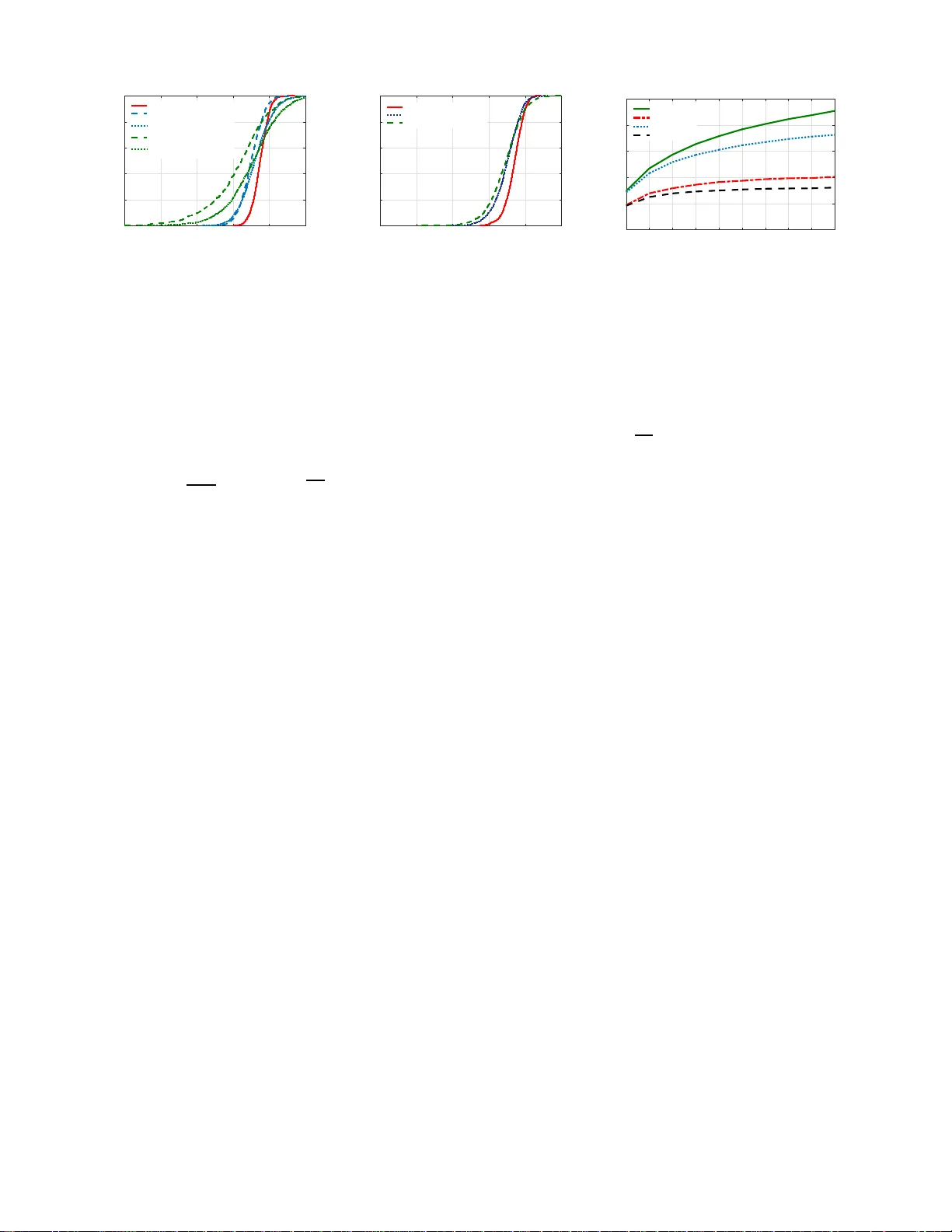
1 Does Massi v e MIMO F ail in Ricean Channels? Michail Matthaiou, Senior Member , I EEE, Pete r J. Smith, F ellow , IEEE, Hien Quoc Ngo, Member , IEEE, and Harsh T ataria, Member , IEEE Abstract —Massiv e multiple-in put m ultipl e-output (MIMO) is now making its way to the standardization exercise of future 5G networks. Y et, th ere are still fun damental qu estions pertaining to the robustness of massive MIMO aga inst physically detrimental propagation condi tions. On these gr ounds, we identify scenarios under which massiv e MIMO can potentially fail in Ricean chan- nels, and characterize them physically , as well as, mathematically . Our analysis extends and generalizes a stream of recent papers on this topic and articulates emphatically that such harmful scenarios in Ricean fading conditions are u nlikely and can be compensated using any standard sched uling scheme. This implies that massi ve MIMO is intrinsically effectiv e at combating inter- user interference and, if needed, can av ail of the base-station scheduler f or further rob ustness. Index T erms —Inter - user interference, massiv e multip le-input multiple-outp ut (MIM O), spatial corr elation. I . I N T R O D U C T I O N Massi ve multip le-input multip le - outpu t (MIMO) is nowa- days a well-established technolog y which forms the backbone of the fifth-g eneration (5G) [1]. The seamless development of massi ve MIMO since 2010 has b e e n based on the concep t of fa vorable propag ation [2], wh ich leverages asymp totic p rop- erties o f Gaussian rand om vectors. That is, as the number of base-station (BS) an tennas becomes unconventionally large, channel vectors beco me pair wise o rthogo nal. In order for this key prop e rty to hold, a common assum ption is that the in d ividual chann el vectors have indep enden t, zero -mean Gaussian entries with a particular finite variance. Surprisingly , once we star t moving away fr o m th e se condi- tions little is known abou t the massive MIMO perfo r mance. In [2], it was sho wn that, for a fixed number of user s an d un der pure line-of- sight (Lo S) conditio ns, the o r thogo nality be tween two random chann el vector s b reaks whenever their angu lar difference scales as O (1 / M ) , wh ere M is the num ber o f BS antennas. The authors of [3] in vestigated the pe r forman ce of massi ve MI MO when the total electrical length of the BS antenna array is fixed. Their resu lts showcased that inter-user interferen ce for pure L oS conditions do es not vanish in the massi ve MIMO regime. In [ 4 ], Bj ¨ ornson et al. proved that for Manuscript recei ved February 16, 2018; rev ised May 10, 2018; accepte d July 1, 2018. Date of publi cation July xxx, 2018; date of current version xxx xxx, 2018. The associate edit or coordinati ng the re view of thi s paper and appro ving it for publicati on was J. Lee. M. Mattha iou, H. Q. Ngo and H. T atar ia are with the Insti tute of Electronic s, Communicat ions and Information T echnology (ECIT), Queen’ s Uni versit y , Belf ast, Belfa st BT 3 9DT , U.K. (e-mail: m.m atthai ou@qub .ac.uk). P . J. Smith is with the School of Mathematic s and Stati stics, V ictoria Uni- versi ty of W ellington , W elling ton 6140, NZ (e- mail: peter .smith@vuw .ac.nz). The work of M. Matthaiou and H. T ataria was supported by EPS RC, UK, under grant EP/P000673/1 . The work of P . J. Smith was supported by the Royal Academy of Engineeri ng, UK, via the Distinguishe d V isiting Fello wship D VF1617/6/29. correlated Rayleigh fading condition s, if the pilo t-sharing u ser s have asy mptotically line arly in depend ent cov ariance ma tr ices, the massiv e MIMO capa city grows withou t b ound . The work of [5] leveraged tools of ran dom matr ix theo ry to derive asymptotic expressions for the a verage rate and co ncluded that Ricean fading is more b eneficial th an Rayleigh fading . Finally , [6] d erived conditio ns to guarantee fav orable propagation for different array topo logies. W e herein consider a far mor e g eneral prop a g ation scenario compare d to [2]–[6], which is modeled via the semi- c orrelated Ricean distribution, where each user has a different covari- ance matrix an d a different K -factor . This general model is inherently suitable fo r futu re den se n etworks, wh e r e different sets of incident direction s are likely to b e o bserved by geo- graphica lly separated term inals. These pro p agation cond itions cause variations in th e covariance profiles acro ss different users [7]. Then, we identify , both physically and mathemati- cally , scenarios u n der which the m ean inter-user inter ference power with maximu m -ratio processing does not vanish in th e large-antenna limit, th e reby limiting th e seemin g ly extensive massi ve M I MO gains. Our p erform ance metric is th e mean interferen ce power sinc e it pr ovides an av erage over the small- scale fading making possible a second- order characterization of a multi-user massive MIMO system. Our analysis provid es a numb e r of important observations, for this class of Ricean fading channels: (a ) It is unlikely that massiv e MIMO will fail; (b) Failure occu rs when we h ave strong alignment o f two distinct L oS respo n ses and/or n on-vanishing alig nment of a L oS response of the k -th user with th e eigenv ectors of the covariance matrix o f the ℓ -th user; (c) If any of these scenarios kicks in , a standar d scheduling sche m e can remove the undesire d user( s) f rom the comm unication link , hence, minimizing the inter-user interfer ence; ( d) under some mild condition s, the instantaneo us Gram matrix norm a lized by M conv erges to its mean in the mean-squ are sense, respectively . Notation: W e use upp er an d lo w e r case bold face to den ote matrices and vectors, respectiv ely . Th e n × n identity matrix is expressed as I n . A comp lex normal vector with mean b and covariance Σ reads as C N ( b , Σ ) . The expectation of a random variable is deno ted as E [ · ] , wh ile the matrix trace b y tr( · ) . The symbols ( · ) T and ( · ) H represent the tran spose and Hermitian transpo se of a matrix. I I . S Y S T E M M O D E L Consider an uplink cellular sy stem with M BS antennas which serve L single-anten n a users in the sam e time-f requen cy resource with M ≫ L . W e fo cus on a very gener al fading scenario with semi-co rrelated Ricean fading, wher e each user has a d ifferent K -factor and a semi-positiv e defin ite M × M covariance matrix R k , with tr( R k ) = M . In the subseque n t theoretical an a lysis, we temporar ily ignore the effects of 2 large-scale fading as they do n ot affect our find ings and, most imp ortantly , becau se we are exclusiv ely interested in the macr oscopic impact of small-scale fading . Y et, in the simulation results, we do co n sider a realistic la rge- scale fading model. The M × 1 chann e l from th e k -th u ser to the BS is g k = r K k K k + 1 ¯ h k + r 1 K k + 1 R 1 / 2 k e h k , (1) where K k is the Ricean K factor, ¯ h k is the determ inistic LoS compon ent with || ¯ h k || 2 = M and e h k ∼ C N ( 0 , I M ) mod els the diffuse mu ltipath co mpon e n ts. W ith maximum -ratio processing and perfect ch annel state informa tio n (CSI) 1 , the interference cr eated b y th e l -th to the k -th user is d efined as: T kℓ , | g H k g ℓ | 2 , such that the total inter f erence power seen by the k -th user is eq ual to L P ℓ =1 ,ℓ 6 = k | g H k g ℓ | 2 . Ou r perf orman c e metric will be the mean interferen ce power [8, Lemma 2 ]: E [ T kℓ ] = K ℓ K ℓ + 1 1 K k + 1 ¯ h H ℓ R k ¯ h ℓ | {z } term1 + tr( R ℓ R k ) ( K k + 1)( K ℓ + 1) | {z } term2 + K k K k + 1 K ℓ K ℓ + 1 | ¯ h H ℓ ¯ h k | 2 | {z } term3 + K k K k + 1 1 K ℓ + 1 ¯ h H k R ℓ ¯ h k | {z } term4 . (2) In the fo llowing section s, we will sep arately stu d y these fo ur individual terms in (2) and , in particular, their scalin g beh avior with an increasing n umber of antennas M . Our main o bjective is to identify p hysical scenarios under which any of these four terms scales as O ( M 2 ) , wh ich is also the scaling ord er of the desired signal power [1], [3]. I I I . W H E N D O E S M A S S I V E M I M O FA I L ? A. A nalysis of ter m1 in (2) T o analy ze this term, we focu s our attention on th e qu adratic form inside ter m1 , that is, ¯ h H ℓ R k ¯ h ℓ . This term is a qu a d ratic form of the LoS vectors ¯ h ℓ and th e covariance matrix of u ser k , R k . 2 W e can n ow sort the M real eigenv alu es of R k in de- scending or der as follows λ ( k ) 1 ≥ λ ( k ) 2 ≥ . . . ≥ λ ( k ) M ≥ 0 with P M i =1 λ ( k ) i = tr R k = M , ∀ k = 1 , . . . , L . Hen ce, the eigen- value d ecompo sition of R k reads as R k = U k Λ k U H k , where U k , h u ( k ) 1 , u ( k ) 2 , . . . , u ( k ) M i is a unitary m atrix tha t contains the eigenvectors o f R k and Λ k , diag λ ( k ) 1 , λ ( k ) 2 , . . . , λ ( k ) M . W e now have that 1 M 2 ¯ h H ℓ R k ¯ h ℓ = 1 M ¯ h H ℓ √ M R k ¯ h ℓ √ M = 1 M ¯ h H ℓ || ¯ h ℓ || R k ¯ h ℓ || ¯ h ℓ || (3) which from th e Rayleigh-Ritz theor em can be lower and u pper bound ed as follows λ ( k ) M M ≤ 1 M 2 ¯ h H ℓ R k ¯ h ℓ ≤ λ ( k ) 1 M ≤ 1 . (4) 1 Interest ingly , the case of perfect CSI is mathematica lly analogous to the case of imperfect CSI with orthogonal pilot s ignali ng with the only dif ference pertai ning to the cov ariance matrix of the estimate, which is a shifted version of R k . For this reason and to keep the notati on neat, we work with the former case. 2 Note that a similar analysis can be pursued for term4 in ( 2 ), which is omitted for the sake of brev ity . From (4), it is clear that situation s exist where ¯ h H ℓ R k ¯ h ℓ scales as O ( M 2 ) . One such case is the extreme (an d un likely) situation wh ere ¯ h ℓ is aligned with the weakest eigenvector of R k and λ ( k ) M is O ( M ) . A set o f milde r c o ndition s under which channel ortho g onality br eaks is considered below . Scenario 1. Note tha t by d efinition ¯ h ℓ can be e xpr essed as a linea r combin a tion of the linea rly indep endent eigenvectors u ( k ) i . If th e corr espondin g eigenvalue(s) scale as O ( M ) , then term1 / M 2 does not vanish a s M → ∞ . Pr oof. W e express ¯ h ℓ as a line a r combin ation of th e eigen- vectors u ( k ) i , i = 1 , . . . , M such that 1 √ M ¯ h ℓ = P M i =1 β i u ( k ) i , where P M i =1 | β i | 2 = 1 . T h us, we have 1 M 2 ¯ h H ℓ R k ¯ h ℓ = 1 M M X i =1 β ∗ i u ( k ) i H U k Λ k U H k M X j =1 β j u ( k ) j = 1 M M X i =1 β ∗ i (0 , . . . , 1 , . . . , 0 ) Λ k U H k M X j =1 β j u ( k ) j = 1 M M X i =1 β ∗ i λ ( k ) i β i = 1 M M X i =1 | β i | 2 λ ( k ) i . (5) Thus, (5) does no t conver ge to ze ro if h ℓ has non- vanishing alignment | β i | 2 > 0 as M → ∞ with one o r more eigen- vectors, u ( k ) i , whose eigenvalues, λ ( k ) i , scale as O ( M ) . Discussion: Funda m entally , te rm1 / M 2 will no t vanish if three conditio n s are fu lfilled : (a) R k has one or m ore eigenv alu es that scale as O ( M ) ; ( b) ¯ h ℓ must alig n with the correspo n ding eigenv ectors or any linear combin ation of the m; (c) this alignmen t should b e preserved as M → ∞ . Note that for full-ran k R k , all λ ( k ) i are d e facto positive and this increases the chan ces o f non-vanishing alignm ent betwee n the LoS response ¯ h ℓ and the eigen vecto rs u ( k ) i . On the con trary , if R k is rank-deficien t with rank r , th en t erm1 / M 2 will vanish unless we h av e n o n-vanishing alignment o f ¯ h ℓ with u ( k ) i , i = 1 , .., r , which is a g ain an imp robab le situation to kick in. Interestingly , [4] ar ticulated th at r a nk-deficie n t c ovariance matrices with orth ogona l suppo rt elimina te p ilot contam in ation resulting in unb ound ed m a ssi ve MIM O capacity . B. A nalysis of ter m2 in (2) T o analyze the behavior of this ter m , we first recall the decomp o sition of R k = U k Λ k U H k . Then, we have for th e trace term inside t erm2 : tr( R ℓ R k ) M 2 = tr Λ 1 / 2 k U H k R ℓ U k Λ 1 / 2 k M 2 = 1 M 2 M X i =1 λ ( k ) i u ( k ) i H R ℓ u ( k ) i ≤ λ ( ℓ ) 1 M X i =1 λ ( k ) i M 2 = λ ( ℓ ) 1 M ≤ 1 where λ ( ℓ ) 1 is the max imum eigenv alue of R ℓ . Note th at the upper boun d above, λ ( ℓ ) 1 / M , is achieved when all eigenvectors of R k align with the pr incipal eigenv ector of R ℓ . Although this scenario is m athematically possible, it is h ighly unrealistic in pr actice. W e will now delineate the ge neral condition s under which term 2 / M 2 does not vanish as M → ∞ . 3 Scenario 2 . By defin ition u ( ℓ ) i can be expr essed as a line ar combinatio n of the linearly indep e ndent eigen vectors u ( k ) i (or vice versa). If th e corr e sp onding eigenvalue(s) sca le as O ( M ) , then term 2 / M 2 does not vanish a s M → ∞ . Pr oof. W e simp ly r eplace ¯ h ℓ with u ( ℓ ) i in Scenario 1. This scenario requir es non -vanishing align ment of the eigen- vectors u ( ℓ ) i with the eigenvectors u ( k ) i and th e correspo nding eigenv alu e(s) of any of R ℓ , R k to be scaling as O ( M ) . C. Analysis of ter m3 in ( 2 ) In (2) , term3 represents the amount of cross-inter ference between two Lo S vectors. W e now identify two scen a r ios that make th is term have asymp to tically no n-vanishing power . Scenario 3 . Wh en the two LoS vectors ¯ h k and ¯ h ℓ ar e aligned , term3 / M 2 does not vanish a s M → ∞ . Pr oof. Assuming that ¯ h k = α ¯ h ℓ , where | α | 2 = 1 , we have 1 M 2 K k K k + 1 K ℓ K ℓ + 1 | ¯ h H ℓ ¯ h k | 2 = K k K k + 1 K ℓ K ℓ + 1 . Scenario 4. Let us no w co nsider the practical scenario wher e the BS is e q uipped with a u niform lin ear array (ULA) . This setup was also in vestigated in [2 ], [9]. When the angu lar differ ence b etween ¯ h k and ¯ h ℓ scales as O (1 / M c ) , with c ≥ 1 term3 / M 2 does not vanish in the ma ssive MIMO re gime. Pr oof. In this case, th e L o S vector ¯ h k can be expre ssed: ¯ h k = h 1 , e − j 2 πd λ sin ( θ k ) , · · · , e − j 2 πd λ ( M − 1) sin ( θ k ) i T . (6) W e no w assume that sin ( θ ℓ ) − sin ( θ k ) = γ / M wh e re γ ∈ R + . Then , we ca n show u sing the techniqu e of [ 2] that 1 M 2 K k K k + 1 K ℓ K ℓ + 1 | ¯ h H ℓ ¯ h k | 2 → K k K k + 1 K ℓ K ℓ + 1 λ 2 π γ d 2 e j 2 πγ d λ − 1 2 , as M → ∞ . Discussion: These two scen a rios showcase that whenever the LoS vector s are either ( a) aligned in th e com plex plane or (b) hav e similar angular cha r acteristics, the channel o rthogo - nality b r eaks down. As a matter o f fact, the higher th e values of α an d γ are, the furth er aw ay fro m fa vorable pro pagation we move. In terestingly , Scen ario 4 is a special case of Scenario 3, since it requires only correlated angular characteristics. Note that strong er LoS co nditions (i.e. h igher K -factors) will on ly make things even worse as it will be extrem ely difficult to discriminate any two c hannel vectors ¯ h k and ¯ h ℓ . D. I m p lications Putting ev erything together, we conclu de that m assi ve MIMO will n ot fail if these mild con ditions a re fulfilled : C1 : ¯ h H ℓ R k ¯ h ℓ M 2 → 0 , as M → ∞ , ∀ k , ℓ = 1 , . . . , L (7) C2 : tr( R ℓ R k ) M 2 → 0 , as M → ∞ , ∀ k , ℓ = 1 , . . . , L (8) C3 : | ¯ h H ℓ ¯ h k | 2 M 2 → 0 , as M → ∞ , ∀ k , ℓ = 1 , . . . , L. (9) W e can now leverage th e conditions above to present the following result that is very useful for the perfor mance analysis of massi ve MIMO. F or this analysis, we need to define G , [ g 1 , g 2 , . . . , g L ] ∈ C M × L . Proposition 1. If the cond itions C1 an d C2 are fulfilled, then the instantane ous Gram matrix G H G conver ges a s follo ws 1 M G H G m . s . − → 1 M E G H G (10) wher e m . s . − → deno tes conver gence in th e mean - square sense. Pr oof. The ( k , ℓ ) -th element of G H G can be e xpressed as 1 M G H G kℓ = 1 M r K k K k + 1 r K ℓ K ℓ + 1 ¯ h H k ¯ h ℓ + r K k K k + 1 r 1 K ℓ + 1 ¯ h H k R 1 / 2 ℓ e h ℓ (S 1 ) + r 1 K k + 1 r K ℓ K ℓ + 1 e h H k R 1 / 2 k ¯ h ℓ (S 2 ) + r 1 K k + 1 r 1 K ℓ + 1 e h H k R 1 / 2 k R 1 / 2 ℓ e h ℓ (S 3 ) . It is easy to see that for th e term S 1 , we h ave that E [S 1 ] = 0 (11) E | S 1 | 2 = 1 M 2 K k K k + 1 1 K ℓ + 1 ¯ h H k R ℓ e h ℓ (12) such tha t S 1 m . s . − → 0 if co ndition C1 is fulfilled. Clear ly , the same methodo logy can b e followed fo r S 2 . For S 3 , we h ave E [S 3 ] = 0 (13) E | S 3 | 2 = 1 M 2 1 K k + 1 1 K ℓ + 1 tr( R ℓ R k ) (14) such that S 3 m . s . − → 0 if condition C2 is fu lfilled. The proo f conclud e s by ev alu ating th e diagonal term s of G H G , i.e., 1 M G H G kk which also c o n verge in the mean-squ ared sense when cond itions C1 and C2 are fulfilled . Note that the a b ove result h olds for a very general fading model as outlin ed in (1). Alth ough Proposition 1 is an asymp- totic result we can utilize it even for a finite numbe r of an ten- nas to replace G H G ≈ E G H G with very goo d accuracy [10]. M ost impo rtantly , such a sub stitution c a n facilitate the perfor mance analysis of m assi ve MI MO with different linear precod in g/detection schemes in which the ra ndom term G H G appears very often [1]. I V . N U M E R I C A L R E S U LT S W e now provid e n umerical results to verify our an a lysis. Our first perf ormanc e m etric is the ca p acity per user: C = 1 L log 2 det I L + p u B H B , (15) where p u is the no rmalized transmit power and B = GD 1 / 2 , where D is th e L × L diagona l matrix con taining the large- scale fading coefficients, wh ich are generated using the mo del of [11]. T o explor e the ef fects o f ter m1 – term4 , we consider two special cases for the cov ariance matrix: 4 5 5.2 5.4 5.6 5.8 6 Capacity per user [bit/s/Hz/user] 0 0.2 0.4 0.6 0.8 1 Cumulative distribution function uncorrelated fading variable correlation, ∆ k = 60 0 variable correlation, ∆ k = 60 0 with user selection variable correlation, ∆ k = 10 0 variable correlation, ∆ k = 10 0 with user selection (a) 5 5.2 5.4 5.6 5.8 6 Capacity per user [bit/s/Hz/user] 0 0.2 0.4 0.6 0.8 1 Cumulative distribution function uncorrelated fading variable correlation, ∆ k = 60 0 variable correlation, ∆ k = 10 0 (b) 10 20 30 40 50 60 70 80 90 100 Number of base station antennas (M) 1 2 3 4 5 6 Average per user SE [bit/s/Hz/user] one-ring model Scenario 1 Scenario 2 Scenario 3 (c) Fig. 1: (a): Capacity pe r user CDF for non -LoS chan nels, i.e., K k = 0 ; (b) : Capacity p er user CDF f o r ra n dom K k ; ( c ): A verage SE per u ser with maxim um r atio combin ing (MRC). • Case 1 (un correlated fading) : R k = I M , f o r all k = 1 , . . . , L . • Case 2 (variable correlatio n ): W e use the one-r ing co rre- lation m odel [1 0]. Wit h th e o n e-ring cor relation mo del, the ( i, j ) -th en try o f R k is given by [ R k ] i,j = 1 2∆ k Z ∆ k + φ k 0 − ∆ k + φ k 0 e − j 2 πd λ ( j − i ) sin( φ k ) dφ k , (16) where ∆ k is the azimuth an g ular spread cor respond ing to the k -th user, φ k 0 is the nomin al direction- of-arr iv al, λ is the wa velength, and d is the antenna spacing . Furthermo re, the LoS component is m odeled as in ( 6). For now , we choose M = 100 , L = 10 , p u = 0 dB, and half- wa velength anten na spa c ing. In a ddition, the L angles { φ k 0 } are i.i.d. unifor m ran dom variables, distributed in [0 , 2 π ] wh ile D = diag[0 . 749 , 0 . 5 46 , 0 . 42 5 , 0 . 635 , 0 . 468 , 0 . 31 , 0 . 64 , 0 . 757 , 0 . 695 , 0 . 515] . Figu re 1(a) shows the cumulative distribution of the capacity per user fo r K k = 0 and different azimu th angular spread (in degrees). W ith K k = 0 , th e chan n el does not have the Lo S com p onent, and h ence, the effect of term2 ca n be exclusi vely explo ited . W e can see that the capacity fo r the practical case (variable co rrelation) is very close to the o ne for the ideal case (un correlated fading , i.e., R k = I M ) especially in the high CDF tail. Y et, we can see that in the low CDF tail there is still a noticeab le perf ormanc e gap between th ese cases, especially when ∆ k = 10 o . This comes from the effect of term2 . The do tted cur ves (with user selection) represent the cases that two u ser s which cause the largest te rm2 are dropp ed fro m service. W e see that after dropp in g two users from service, the performan ce gap between Case 1 and Case 2 reduces sign ificantly . T h is suggests that we need to d rop a small number of users from service to make massi ve MIM O working a s in the ide a l case. W e next co nsider the case wh ich includes both Lo S an d non- LoS com ponen ts to examine the effects of all te r ms ter m1 − term4 . Figure 1(b) shows the cumu lativ e distribution of the capacity per user for random K k and d ifferent angular spread s. The values of K k are rando mly an d indep endently c h osen such that they a re uniformly distributed in [0 , 2] . Due to the presence of all four terms, the ef fect of the azimuth angular sp read is not that sign ificant compar e d to Fig. 1. Finally , Fig. 1( c) shows th e average-per-user spe ctral ef- ficiency for an MRC d etector [3, Eq. (6) ] as a f u nction of M . W e co nsider a two-u ser network with ∆ k = 60 o , D = dia g[0 . 74 9 , 0 . 546 ] , K 1 = K 2 = 1 , wherea s all other parameters are kept the same. In line with o ur theor etical analysis, we study three detrimental scenarios: in Scenario 1 we assume that ¯ h 2 = √ M u (1) 1 ; in Scenario 2 we assume that R 1 = R 2 = diag[ M / 2 , M / (2 M − 2 ) , . . . , M / (2 M − 2)] and in Scen a rio 3, we assume that ¯ h 1 = ¯ h 2 . All three scenarios make the SE satur ate with M , wh ilst the most destructive scenario is when th e LoS respo nses are aligned. V . C O N C L U S I O N W e hav e iden tified a set of scen arios u n der which massi ve MIMO can poten tially fail in Ricean fading chan nels. These extreme scen arios require non- vanishing alignment between LoS vectors and /or between the covariance matrices and the LoS vectors. In case a massi ve MI MO system encoun ters such a case, any standard schedu ling scheme can comp ensate for the perfor mance lo ss b y dr oppin g the highly -corre la ted users. A s a final remark, we poin t ou t the small variations of the capacity around its mean value acro ss all cases in Figures 1 and 2, which corro borates the the o retical finding s of Pr oposition 1. R E F E R E N C E S [1] T . L. Marzetta , E. G. Larsson, H. Y an g, and H. Q. Ngo, Fundamentals of Massive MIMO . Cambridge , UK: Cambridge Uni versity Press, 2016. [2] H . Q. Ngo, E . G. Larsson, and T . L. Marz etta, “ Aspects of fav orable propagat ion in massiv e MIMO, ” in Pr oc. EUSIP CO , Sept. 2014. [3] C. Masouros and M. Matthai ou, “Space -constrain ed massi ve MIMO: Hitting the wall of fav orable propagation, ” IE EE Commun. Lett. , vol. 19, no. 5, pp. 771–774, May 2015. [4] E . Bj ¨ ornson, et al. , “Massiv e MIMO has unlimit ed capaci ty , ” IEEE T rans. W ire less Commun. , vol . 17, no. 1, pp. 574–590, Jan. 2018. [5] L . Sanguinetti, A. Kammoun, and M. Debbah, “ Asymptotic analysis of multice ll massiv e MIMO over Rician fading chan nels, ” in Proc. IEE E ICASSP , March 2017. pp. 3539–3543. [6] X . W u, N. C. Beaulieu, and D. Liu, “On fav orable propagati on in massiv e MIMO systems and differe nt antenna configura tions, ” IEEE Access , vol. 5, pp. 5578–5593, May 2017. [7] J . Nam, G. Caire, and J. Ha, “On the role of transmit correl ation div ersity in multiuser MIMO systems, ” IEE E T rans. Inf. Theory , vol. 63, no. 1, pp. 336–354, Jan. 2017. [8] H . T ataria, et al. , “Impact of line-of-si ght and unequal spatial correlati on in uplink MU-MIMO systems, ” IEEE W irel ess Commun. Lett. , vol. 6, no. 5, pp. 634–637, Oct. 2017. [9] J . H. Chen, “When does asymptotic ortho gonalit y exist for very large arrays?” in Proc. IEEE GLOBE COM , Nov . 2013, pp. 6–10. [10] H. T ataria , et al. , “Revisi ting MMSE combining for massi ve MIMO ove r heterog eneous propagation channel s, ” in Pr oc. IEEE ICC , May 2018. [11] H. Q . Ngo, et al. , “Multipair full-duplex relaying with massiv e arrays and linea r processing, ” IEEE J. Sel. Areas Commun. , vol. 32, no. 9, pp. 1721–1737, Oct. 2014.
Original Paper
Loading high-quality paper...
Comments & Academic Discussion
Loading comments...
Leave a Comment