Basin Effects in Strong Ground Motion: A Case Study from the 2015 Gorkha, Nepal Earthquake
The term “basin effects” refers to entrapment and reverberation of earthquake waves in soft sedimentary deposits underlain by concave basement rock structures. Basin effects can significantly affect the amplitude, frequency and duration of strong ground motion, while the cone-like geometry of the basin edges gives rise to large amplitude surface waves through seismic wave diffraction and energy focusing, a well-known characteristic of basin effects. In this research, we study the role of basin effects in the mainshock ground motion data recorded at the Kathmandu basin, Nepal during the 2015 Mw7.8 Gorkha earthquake sequence. We specifically try to understand the source of the unusual low frequency reverberating pulse that appeared systematically across the basin, and the unexpected depletion of the ground surface motions from high frequency components, especially away from the basin edges. In order to do that we study the response of a 2D cross section of Kathmandu basin subjected to vertically propagating plane SV waves. Despite the scarcity of geotechnical information and of strong ground motion recordings, we show that an idealized plane-strain elastic model with a simplified layered velocity structure can capture surprisingly well the low frequency components of the basin ground response. We finally couple the 2D elastic simulation with a 1D nonlinear analysis of the shallow basin sediments. The 1D nonlinear approximation shows improved performance over a larger frequency range relative to the first order approximation of a 2D elastic layered basin response.
💡 Research Summary
This paper investigates the basin effects observed during the Mw 7.8 Gorkha earthquake of April 2015, focusing on the Kathmandu basin in Nepal. “Basin effects” refer to the trapping and reverberation of seismic energy within soft sedimentary deposits that overlie a concave basement rock, leading to amplified low‑frequency motions, prolonged duration, and a depletion of high‑frequency content, especially away from basin edges. The authors aim to explain two striking observations from the strong‑motion records: (1) a systematic low‑frequency reverberating pulse (~0.3 Hz) that appears across the basin, and (2) an unexpected attenuation of high‑frequency components, particularly at stations located near the basin margins.
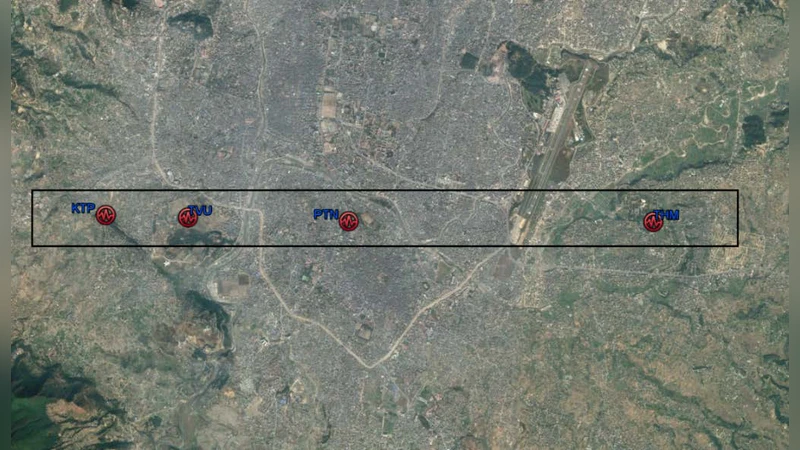
To address these phenomena, the study adopts a two‑stage modeling strategy. First, a two‑dimensional (2‑D) plane‑strain elastic finite‑element model (FEM) is built using the OpenSEES platform. The model represents a vertical SV (shear‑vertical) plane wave incident from the base of the domain. Because of limited geotechnical data, the basin geometry is idealized: shear‑wave velocity profiles from three strong‑motion stations (TVU, PTN, THM) and a rock reference station (KTP) are averaged, spline‑interpolated, and extended to a continuous basin‑bedrock interface. The bedrock is assigned a shear‑wave velocity of 1200 m s⁻¹ and a density of 2.67 g cm⁻³. Free‑field (FF) boundary conditions are applied on the lateral sides to mimic an infinite medium and reduce artificial reflections. The input motion is generated by de‑convolving the recorded horizontal components at the rock site to obtain a pure SV component, which is then applied at the model base.
The 2‑D elastic simulations successfully reproduce the observed low‑frequency pulse and the long‑duration motion in the basin interior. However, at the TVU station—situated close to the basin edge—the model underestimates the amplitude, indicating that the simplified elastic representation cannot capture the complex diffraction and energy focusing that occur at basin boundaries. Moreover, the elastic model rapidly attenuates frequencies above 1 Hz, failing to match the recorded high‑frequency content.
To improve the high‑frequency response, the authors introduce a one‑dimensional (1‑D) nonlinear site‑response analysis using the HH constitutive model (Shi & Asimaki, 2017). The HH model combines the MKZ and FKZ nonlinear stress–strain relationships via a transition function, allowing simultaneous fitting of stiffness‑reduction and damping curves while obeying non‑Masing hysteresis rules. Only shear‑wave velocity profiles are required as input; the model then derives the appropriate damping and modulus reduction curves. The same SV input motion used in the 2‑D simulations is applied to each 1‑D column representing the local soil column at the four stations.
The 1‑D nonlinear results show a markedly better fit to the observed spectra in the 3–10 Hz band, confirming that soil nonlinearity during the main shock contributed to the observed high‑frequency attenuation. The low‑frequency response remains comparable to the elastic case, as expected because nonlinearity is less pronounced at small strains. Nevertheless, the TVU station still exhibits discrepancies, reinforcing the conclusion that edge effects involve two‑dimensional wave phenomena that cannot be represented by independent 1‑D columns.
Overall, the study demonstrates that (i) a simplified elastic 2‑D model can capture the basin’s low‑frequency resonant behavior, (ii) a 1‑D nonlinear site‑response model can extend the frequency range of accurate predictions by accounting for strain‑dependent damping and stiffness reduction, and (iii) accurate representation of basin‑edge effects requires fully coupled 2‑D or 3‑D nonlinear simulations with realistic source characteristics. The authors acknowledge the scarcity of detailed geotechnical and strong‑motion data as a limitation and propose future work that integrates three‑dimensional nonlinear basin modeling, more sophisticated kinematic source descriptions, and the development of synthetic ground‑motion prediction equations for the Himalaya region.
Comments & Academic Discussion
Loading comments...
Leave a Comment