Over-the-Air Time Synchronization for URLLC: Requirements, Challenges and Possible Enablers
Ultra-reliable and low-latency communications (URLLC) is an emerging feature in 5G and beyond wireless systems, which is introduced to support stringent latency and reliability requirements of mission-critical industrial applications. In many potenti…
Authors: Aamir Mahmood, Muhammad Ikram Ashraf, Mikael Gidlund
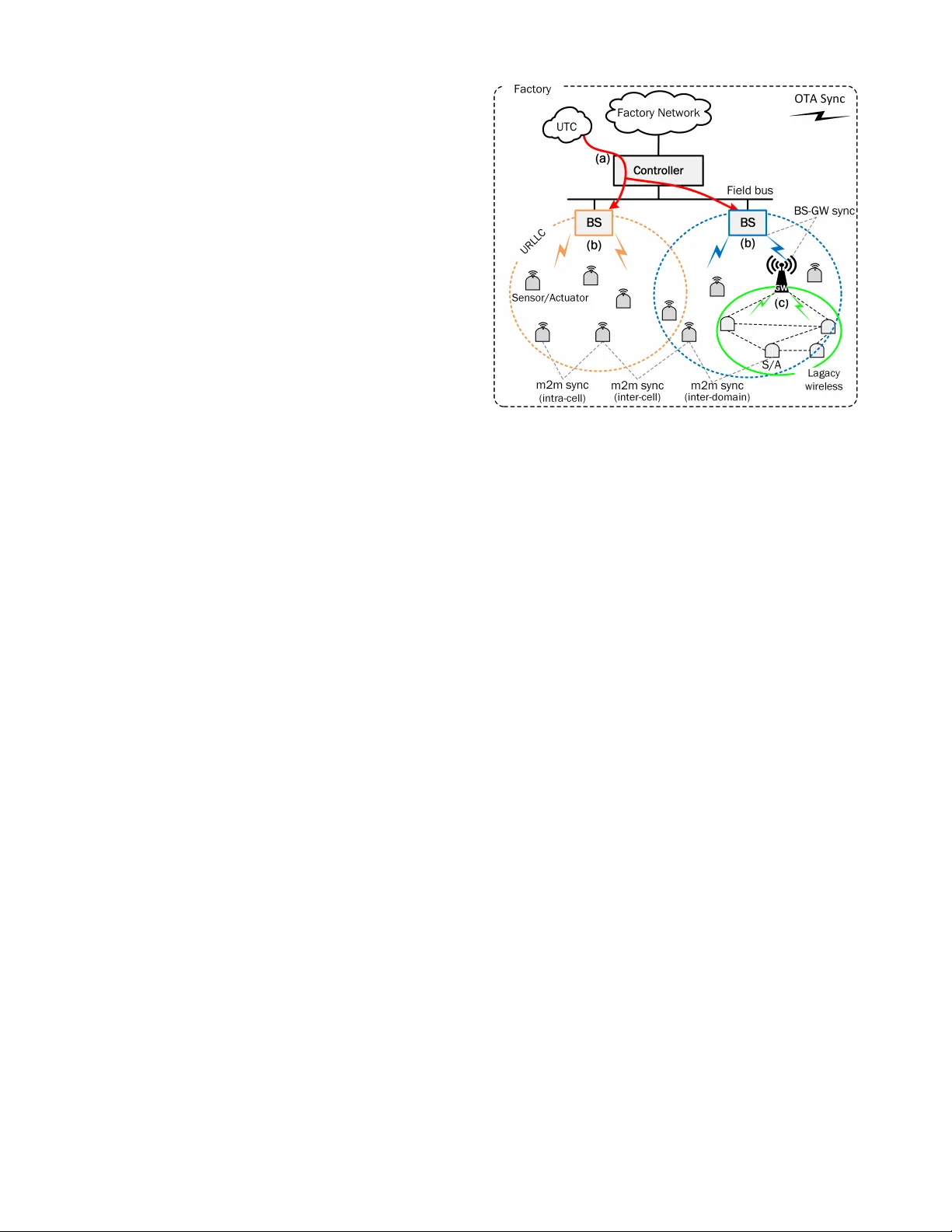
Ov er -the-Air T ime Synchronization for URLLC: Requirements, Challenges and Possible Enablers Aamir Mahmood ∗ , Muhammad Ikram Ashraf † , Mikael Gidlund ∗ and Johan T orsner † ∗ Department of Information Systems and T echnology , Mid Sweden Uni versity † Ericsson Research, Finland Email: ∗ firstname.lastname@miun.se, † { ikram.ashraf, johan.torsner } @ericsson.com Abstract —Ultra-reliable and low-latency communications (URLLC) is an emerging featur e in 5G and beyond wir eless systems, which is introduced to support stringent latency and reliability requir ements of mission-critical industrial applications. In many potential applications, multiple sensors/actuators collab- orate and requir e isochronous operation with strict and bounded jitter , e.g., 1 µ s . T o this end, network time synchr onization becomes crucial for real-time and isochronous communication between a controller and the sensors/actuators. In this paper , we look at differ ent applications in factory automation and smart grids to reveal the requir ements of device-level time synchroniza- tion and the challenges in extending the high-granularity timing information to the devices. Also, we identify the potential over - the-air synchronization mechanisms in 5G radio interface, and discuss the needed enhancements to meet the jitter constraints of time-sensitiv e URLLC applications. I . I N T RO D U C T I O N In 5G and beyond wireless systems, ultra-reliable and low- latency communications (URLLC) feature is focused on time- sensitiv e applications originating for vertical industries such as industrial automation, smart grids, tactile internet, automotive and more. There can be many use cases within a single industry while each use case presents a different set of require- ments and challenges. For instance in industrial automation, factory automation is one of the most challenging use case for URLLC that requires deterministic communication with bounded reliability and latency . In addition, factory automation often entails real-time interactions among multiple entities, and ultra-tight synchronization of the entities with a common time reference is need to complete manufacturing. As there are many existing industrial wired and wireless systems [1], 5G radio access requires a ne w time synchronization service for enabling URLLC in heterogeneous industrial setups. In factory automation, when classifying applications regard- ing their timeliness and reliability requirements, there can be three main application classes; i) non real-time (NR T) or soft real-time, ii) hard real-time (R T), and iii) isochronous real- time (IR T) as illustrated in Fig. 1. Most of the applications in process automation belong to NR T or soft real-time class. Whereas the discrete manufacturing applications, which rely on robotics and belt conv eyers for assembly , picking, welding and palletizing, execute tasks in a timely and sequential manner [2]. These jobs inv olve tightly synchronized real-time cooperation among multiple robots and the production line. T o generalize, discrete manufacturing applications are a part Fig. 1. Performance requirements of an industrial communication system. of hard R T or IR T class; that is, giv en deadlines must be met strictly or deadlines must be satisfied along with the constraints on jitter . In this regard, IEEE 802.1 time-sensiti ve networking (TSN) standards specify strict performance requirements: 1 ms cycle time, 99 . 999 % reliability and 1 µ s jitter i.e., allo wed variations in delay . T o satisfy the needed determinism and synchr onism in in- dustrial automation, 5G URLLC requires innov ati ve solutions. Sev eral radio access solutions are under consideration to meet the latency and reliability requirements (e.g., see [3], [4]). Howe v er , R T and IR T communication with tight jitter con- straint requires accurate time instants on a common time base at the device lev el. In a factory floor, the devices might belong to different base stations (BS) or ev en to different domains in case of coexisting industrial networks. T o get a common time reference for the devices would require over-the-air (O T A) synchronization mechanisms beyond timing advance-based frame alignment between UEs and BS. While, O T A synchro- nization procedures for L TE-TDD and radio coordination in small cells are limited to synchronization of BSs only [5]. T o enable time synchronization for the devices, a recent L TE URLLC work item includes that the synchronization shall be standardized for L TE Rel-15 [6]. In this article, we highlight the drivers and challenges of ultra-tight time synchronization in factory automation and smart grids. W e identify the opportunities in the L TE air interface to enable O T A synchronization solutions. In par- ticular , we summarize how these signaling parameters can be enhanced and grouped together to extend high-granularity timing information to the devices. Fig. 2. A sketch (top) showing two systems A and B maintaining: (a) frequency synchronization ( f A = f B ), (b) phase and time synchronization. The bottom sketch shows jitter in packet reception at the controller . I I . P R E L I M I NA R I E S A. Oscillator , Clock, Synchr onization, Accuracy , Jitter etc. Synchronization types. ITU-T G.8260 defines three types of synchronization: • F r equency : two systems are frequency synchronized when their significant instants occur at the same rate. • Phase : in phase synchronized systems, the rising edges occur at the same time, e.g., the point in time when the time slot of a frame is to be generated. • T ime : time synchronization is the distribution of an absolute time reference to a set of real-time clocks. The synchronized clocks have a common epoch timescale. Note that distribu- tion of time synchronization is a way of achie ving phase synchronization. The synchronization types are illustrated in Fig. 2. As we focus on time-aware URLLC applications, the further discussion is confined to time synchronization. What causes time de-synchronization? A device maintains the sense of time–a clock–by counting the pulses of an internal crystal oscillator [7]. But, there is an inherent inaccuracy in frequency (causing clock sk ew) and phase of the crystal oscillator . The inaccuracy is influenced by the operating con- ditions and aging (resulting in clock drift). As a result, the devices deviate from a reference clock after a synchronization epoch [8]. Jitter . Implies the packet delay variations from defined ideal position in time (Fig. 2). Many closed-loop control applica- tions are intolerant to such delay variations. B. T ime Synchr onization in Industrial Networks Networked distributed measurement and control systems (e.g., bus systems and factory automation setups) are reliant on IEEE 1588 precision time protocol (PTP) [9] for real- time and isochronous transmissions. IEEE 1588 is a master- slav e protocol designed to synchronize real-time clocks in the order of sub-microseconds in packet-based networks. Fig.3 shows the synchronization procedure, which is based on the Fig. 3. T ime synchronization procedure in precision time protocol (PTP). Even after synchronization, there can be synchronization error due to inac- curacy in timestamping and asymmetric link delays. Also, the devices need to be synchronized periodically while the synchronization period depends on the clock stability and required accuracy . timestamping of the exchanged signaling messages to find time offset of a device from the master clock. Ethernet-based automation networks, PR OFINET and IEEE 802.1 TSN, use IEEE 1588 v ariants (PTP profile) to ensure determinism. The 802.1 TSN task group [10] is dev eloping standards to support time-sensiti ve applications, for industries like factory automation and automotiv e, ov er IEEE 802 net- works. TSN contains a series of standards related to ultra reliability , low latenc y and resource management aspects while TSN 802.1AS is the standard for transport of precise timing and synchronization [11]. Note that W i-Fi T imeSync also includes an extension of 802.1AS [12]. I I I . D R I V E R S F O R U LT R A - T I G H T S Y N C H R O N I Z A T I O N A N D R E Q U I R E M E N T S T wo important use cases of URLLC are industrial factory automation and smart grids [13]. These use cases hav e strict jitter requirements among devices as we discuss next. A. Industrial F actory Automation or Automation Contr ol In factory automation, closed-loop control applications– robot manufacturing, round table production, machine tools, packaging and printing etc.–are the main URLLC targets. In these applications, the need for ultra-tight synchronization is dri ven by r eal-time and time-slotted communication , and isochr onous task execution . Real-time communication. A typical closed-loop control cycle consists of a downlink transaction to a set of sensors periodically , which is followed by uplink responses by the sen- sors to the controller . The control ev ents are executed within a cycle time and may occur isochronously . Cycle time is the time from the transmission of a command by the controller to the reception of its response from the de vices. TSN [11] specifies stringent end-to-end latency and reliability constraints on each transaction i.e., it must be completed within a 1 ms cycle time with 99 . 999 % reliability . Furthermore, a jitter constraint of 1 µ s is imposed on the deli very of responses which requires better than ± 500 ns synchronization accuracy among devices. These requirements are also endorsed by 3GPP [13]. Any violation of latenc y and jitter in control commands can damage the production line and cause the safety issues. Multi-robot cooperation–isochronous real-time. In motion control applications–mobilizing a fleet of tractors, symmetrical welding and polishing in the automobile production line–a group of robots collaborate to execute meticulously sequenced functions. A critical requirement to carry out these cooperative actions is synchronous task execution, which requires accurate time base across the collaborating entities. Therefore, when a controller sends a command to the robots to act at a specific time instant (isochronously), the robots should act/respond in less than 1 µ s . A lag in action may cause damages or inef ficient production. Time-slotted communication. T o transport packets with bounded delays in R T traffic, time-slotted communication is an effecti ve mechanism. Existing industrial wired and wireless networks implement a variant of time-slotted communication. It requires perfect time synchronization as an y timing error leads to the overlap of time slots among the de vices, which disrupts the communication reliability . In monitoring applications, the time information must be embedded into the sensory data for operations such as data fusion. Thus, the collaborating sensors must be synchronized. B. Smart Grids The traditional po wer grid is rapidly e volving to a smart grid through the automation of control and monitoring functions. T o support this ev olution, a cost-effecti ve wireless communi- cation infrastructure with wide-area cov erage and high per- formance is needed. 5G offers the needed coverage while the performance requirements are application dependent, hence, needing further study . Three main application areas are fault pr otection , contr ol , and monitoring and diagnostics [14]. Fault protection. High-speed communication of measure- ments between the two points of a transmission line can detect a fault using a line differential protection solution [14]. In line dif ferential protection, two relay de vices periodically sample the electric current in a section of distribution or transmission line, and exchange this information with each other . In case of a fault, the relays differ in measurements and can trigger a trip command to the breaker . Fault protection has the most stringent performance requirement: reliability > 99 . 99 % and latency < 10 ms . In addition, the protection algorithm is effecti ve if the relays are tightly synchronized (i.e., < 20 µ s ). Control and grid automation. In evolving power grids, with high penetration of renewable resources at various power output, we need ne w control and optimization mechanisms at both the transmission and distribution levels. The key con- trol challenge is to match power -supply and -demand within acceptable voltage and frequency regulations. It demands for innov ati ve centralized or decentralized control strategies based on fine-grained information of measured electrical values (e.g., voltage, power , frequency) of the load and the source. The difference in control actions impose different reliability and latency requirements. Howe ver , the performance requirements for control tasks are relaxed as compared to fault protection; 0 0.2 0.4 0.6 0.8 1 1.2 1.4 1.6 1.8 2 0 100 200 300 400 500 600 +150 m -150 m Fig. 4. Fault localization uncertainty w .r .t. synchronization error between two PMUs assuming the fault occurs at the middle of a 600 m electricity line. 99 . 9 % reliability and 100 ms latency while time synchroniza- tion accuracy is also less critical. Monitoring and diagnostics. W ide-area monitoring and diag- nostics requires ultra-tight synchronization. For instance, the phasor measurement units (PMU) in electricity distribution systems, deployed along the electricity line, are used for measuring the electrical value for fault detection. When a fault occurs, the fault location generates two electric waves tow ards the both ends. The two PMUs, acting as UEs, at both end of the electricity line detect the wa ves by the change in monitored parameters and record the time of detection. A monitoring system can estimate the fault location based on the reported time information given that the PMUs are perfectly synchronized. In most cases, synchronization accuracy of less than ± 1 µ s is required to keep the uncertainty in f ault location below 300 m (see Fig. 4). While, the reliability and latency requirements are relaxed for the monitoring; ∼ 99 % and 500 ms – 1000 ms . I V . C H A L L E N G E S A. Heter ogeneity of Industrial Networks/Standar ds URLLC can satisfy the requirements of most of the process and factory automation applications. Ho wev er , it can not replace the existing industrial wired (e.g., industrial field bus, Ethernet of plant automation (EP A), Powerlink, Profinet) and wireless (e.g., W irelessHAR T , ISA 100.11a, WIA-P A 1 , WIA- F A 2 ) communication systems completely , at once or in a short time. T wo main reasons behind this are: 1) updating the complete communication infrastructure is not cost-ef fectiv e, 2) lack of trust and/or unsuitability of replacing the existing wired system in critical manufacturing cells with wireless systems. As a result, a coexistence between the traditional wired/wireless networks and URLLC is a likely scenario that would give a heterogeneous character to industrial networks. Synchronization requisites. Owing to different requirements of industrial applications and different precision, resolution and stability of clocks running on the field devices, there are various existing synchronization solutions [9]. For the current 1 W ireless Networks for Industrial Automation-Process Automation: target- ing 99 . 9 % reliability and 10 ms latency . 2 W ireless Networks for Industrial Automation-Factory Automation: fulfills 99 . 99 % reliability and 1 ms latency . coexisting wired-wireless netw orks, 802.1 AS-2011 [11] of fers accurate time synchronization. If the devices from hetero- geneous domains (wired, traditional wireless and URLLC) need to collaborate and complete the production, cross-domain synchronization among heterogeneous industrial networks will be essential. Relative vs absolute time synchronization. For real-time communication, each industrial control entity should maintain a local clock to execute recei ved commands at deterministic time instants. It works well under relative synchronization of the nodes with the controller . Howe ver , when multiple devices from different domains must operate concurrently , an absolute time synchronization among the de vices will be mandatory . Hence, it is crucial that the devices are synchronized to an ab- solute time reference (e.g., UTC time) to perform coordinated operations. Synchronization cases. The need of absolute ti me base at UEs arises from following situations. • URLLC domain : In a URLLC network, it is plausible that the devices connected to different BSs may require absolute time synchronization to execute an operation synchronously . Therefore, to establish and maintain synchronization among the devices, the BSs must also be synchronized. • Heter ogeneous domain : The time-sensitiv e de vices might also belong to heterogeneous domains. For instance, an old wired de vice might need to perform a task synchronously with a ne w wireless de vice. As a result, it is not sufficient for the devices to synchronize with their respectiv e controllers. Accordingly the network synchronization architecture in a heterogeneous setup, must support synchronization among devices associated to i) a single BS, ii) dif ferent BSs, and iii) different domains (e.g., URLLC domain and local domain comprising traditional industrial networks.) B. T ime Synchr onization in Smart Grids In today’ s smart grids, wired communication is often used for the applications discussed in Sec. III-B. The synchro- nization among the measurement and control units, within a substation, is often maintained using IEEE 1588 or similar protocols. These protocols distribute the reference time, often acquired from GPS clocks, to the devices. T o replace the wired infrastructure with 5G URLLC, a 5G network-based synchronization solution is required where only BSs may need to acquire time from GPS clocks. A built-in timing service of the wireless infrastructure can be cost-effecti ve and it can av oid GPS vulnerabilities (e.g., jamming, signal reception). Howe v er , the challenge is to establish synchronization at the device le vel, which thus far is av ailable to the BS level with limited accuracy (see Sec. IV -D). C. GPS for Refer ence T ime GPS can align bases stations to a common time reference, howe v er , GPS signal is not always av ailable in e.g., indoor deployments, places with high constructions around and bad weather . The additional cost for GPS-based solution is also of a concern. For instance, in indoor industrial settings, the GPS T ABLE I P H AS E / T IM E S Y N CH RO N I Z A T IO N R E QU I R E ME N T S O F D I FF E RE N T A P PL I C A T IO N F E A T U RE S I N L T E A N D LT E- A [ 5 ] 3 Application Phase/Time Sync. Note L TE-FDD N/A - L TE-TDD ± 1 . 5 µ s cell radius ≤ 3 km ± 5 µ s cell radius > 3 km L TE-MBMS ± 5 µ s intercell time difference L TE-Advanced ± 1 . 5 µ s – ± 5 µ s e.g., eICIC, CoMP 4 antenna must be installed outdoors to ensure proper signal reception. Moreov er , a feeder cable from the antenna to the receiv er is required, along with an amplifier if the feeder cable is too long. T o avoid GPS based solution, 5G network need to be upgraded to distribute the reference time to BSs. In addition, 5G network can be considered stable, adaptive and scalable as compared to wired/GPS solutions. Howe ver , the challenge is to devise O T A synchronization mechanisms to synchronization UEs to an absolute time through BS such that the devices are synchronized with each other . D. Limitations of O T A Synchr onization Solutions in LTE In L TE, the distribution of accurate timing reference is limited up to radio BS le vel for L TE-TDD to a void interference among adjacent cells. Meanwhile, the small cell deployments and the benefits of radio coordination features therein is now increasing the demands for accurate synchronization of BSs. Examples of radio coordination features are enhanced intercell interference coordination (eICIC) and coordinated multipoint (CoMP). T able I summarize the synchronization needs in L TE. Radio interface based synchronization. The current solu- tions, av oiding GPS- or backhaul network-based solutions, are focused on radio interface based synchronization (RIBS)- based OT A mechanisms. In particular, the first solution uses network listening of the reference signals from neighboring BSs [15]. Howe ver , the accuracy target is < = 3 µ s and the impact of propagation delay on synchronization accuracy is not considered. As the new interference coordination features in small cells require high synchronization accuracy , new RIBS-based solutions for intercell synchronization are under consideration in [16], e.g., • Exchanging the reference signals (like IEEE 1588) between the neighboring base stations, which allo w to calculate the propagation delay . • Listening of reference signals from neighboring BSs by a target small cell, and compensating the propagation delay measured by a UE using timing advance (T A) while assum- ing negligible propagation delay between the UE and the target small cell. 3 L TE requirs frequency synchronization of ± 50 ppb as in earlier network generations, while GSM, UMTS and W -CDMA do not require phase syn- chronization. 4 Coordinated multipoint (CoMP) and enhanced intercell interference coor- dination (eICIC) are interference coordination mechanisms. CoMP includes: joint transmission/reception, coordinated beamforming, dynamic point selec- tion, and dynamic point blanking. Implications for URLLC. The current activities in 3GPP are limited to intercell time synchronization while the tightest synchronization target among the base stations is ± 0 . 5 µ s . The industrial automation and smart grid applications require the same order of jitter ho wev er among the collaborating UEs. If the UEs belong to the same BS, we need an O T A synchronization mechanism that can accurately synchronize UEs to the BS. Howe ver , achieving synchronization among UEs is challenging if collaborating UEs belong to dif ferent BSs. This is because the time alignment error between the base stations and the expected error in O T A synchronization procedure to distribute time to UEs will add up. Therefore, for URLLC applications, the synchronization among BSs must be tight to achiev e better synchronization at the device level. V . E N A B L ER S F O R OT A S Y N C H R O N I Z A T I O N In this section, we explore the existing signaling parameters in L TE that could be potential enablers of achie ving ultra- tight synchronization for URLLC. Also, we discuss how these features could lead to a new synchronization architecture. A. 3GPP and O T A T ime Synchr onization T A Enhancement. Timing advance (T A) adv ances or re- tards the uplink transmissions of UEs in time relati ve to the distance-dependent propagation delay from the serving BS. A BS estimates the UE-BS propagation delay and issues T A up- dates to the UE in order to ensure that the uplink transmissions of all UEs are synchronized. In this way , the uplink collisions due to changing propagation delays are mitigated. T A negotiation occurs during network access and connected states. At network access, T A v alue is estimated at BS from the network access request sent by UE. If the request is successful, the BS sends a T A command in random access r esponse with 11 bit v alue where T A ∈ { 0 , 1 , · · · , 1282 } . The T A command directs the UE to transmit its uplink frame by multiples of 16 T s seconds, i.e., T A × 16 T s , before the start of the corre- sponding downlink frame, where T s is the sampling period. In connected state, T A is negotiated with periodic MA C control messages–to maintain BS-UE connection–which adjust the uplink timing of a UE relati ve to its current timing. It is 6 bit value i.e., T A ∈ { 0 , 1 , · · · , 63 } while each command adjusts the UE’ s current uplink timing by ( T A − 31) × 16 T s seconds. The frequency of T A command is configurable as { 500, 750, 1280, 1920, 2560, 5120, 10240 } , which corresponds to the maximum number of subframes sent in between two T As. As the subframes are consecutiv e and each subframe is 1 ms , the timer duration can be interpreted as the number of milliseconds and offers a trade-off between the accuracy of transmissions’ alignment and the network load. Note that T s is the basic unit of time in L TE, which is equal to 32 . 55 ns . Due to discrete nature of T A (multiple of 16 T s ), the propagation delay adjustment at UE is subject to an error of 260 ns –half of the T A step. In addition, the delay estimation error at the BS is also affected by the multipath propagation especially in harsh channel conditions. The error could be large if the wrong T A bin is selected due to random error . Therefore, T A enhancement is required to get better synchronization accuracy . SIB16 Enhancement. System information (SI) is an essential aspect of L TE air interface, which is transmitted by BS over broadcast control channel (BCCH) [17]. SI is comprised of a static and dynamic parts termed as master information block (MIB) and system information blocks (SIB), respectiv ely . MIB contains frequently transmitted essential parameters needed to acquire cell information such as system bandwidth, system frame number , and physical hybrid-ARQ indicator channel configuration. It is carried on BCH transport channel and trans- mitted by physical broadcast channel (PBCH) e very 40 ms . All SIBs except SIB1 are scheduled dynamically . SIB1 contains information including; cell access restrictions, cell selection information and scheduling of other SIBS. Unlike MIB, SIBs are carried on DL-SH and transmitted on physical do wnlink shared channel (PDSCH). SIB1 configures the SI-window length and transmission periodicity of the SI messages. Al- though SIB1 is transmitted with a fixed schedule of 80 ms , the resource allocation of PDSCH carrying all SIBs is dynamic. The resource allocation of PDSCH transmissions is indicated by downlink contr ol information message, which is transmitted on physical downlink control channel (PDCCH). In time-aw are applications, a UE can get a common time reference (UTC and GPS) contained in SIB16. Ho wev er , time information in SIB16 has limited granularity (i.e., ∼ 10 ms ). T o enable high accuracy synchronization service for URLLC applications, the granularity of SIB16 needs to be enhanced to µ s or ns lev el. B. New Synchr onization Arc hitectur e Considering emerging heterogeneity of industrial networks, a new ultra-tight synchronization architecture should provide: a) a flexible infrastructure for reference time, b) the absolute synchronization among de vices. The 5G base stations can be used to provide time reference inside the URLLC domain and to the devices accessed via gateway . In this respect, each base station acts as a master clock while UEs/GWs as slave clocks. An example of such architecture is depicted in Fig. 5, where the flo w of time reference in an heterogeneous industrial network setting is as follows: • Base stations acquire the reference time from a common source and act as master clocks for their associated devices. • GW/URLLC devices acquire the reference time from base stations using O T A time synchronization procedure. While the GW acts as a master clock to its local domain and distributes time to the devices. Accordingly , with already discussed signaling options in L TE, a few O T A synchronization enablers for URLLC are: T A + SIB16. By mitigating the UEs-to-BS propagation delay based on T A, UEs can only establish a relativ e synchronization with the BS. Moreover , the indication of UTC time to the de- vices via SIB16 will suffer a loss in synchronization accuracy due to distance-dependent propagation delay . Therefore, the distribution of high-granularity UTC time with T A-based time offset adjustment can be a possible enabler to synchronize UEs to an absolute time reference. Howe v er , multiple factors can still disrupt the synchroniza- tion accuracy: for instance, 1) the dynamic resource allocation for the transmission of SIB16 will add an uncertainty in UE-to- BS time-offset. T o tackle it, either the timestamping of SIB16 must take place just before its transmission or the delay in the resource allocation must be statistically characterized and handled, 2) T A is only an approximation of propagation time. The statistical errors in T A must be estimated and analyzed under the impact of industrial wireless channels. RIBS for UEs. Inspired by the RIBS based synchronization of small cells, a UE-BS synchronization scheme can be de- signed based on the exchange of uplink/downlink timestamped reference signals. In comparison with T A+SIB16 scheme, this solution allows to calculate the effect of propagation delay in UE-BS time offset. Note that the reference signals could be the existing ones, howev er , must not conflict with the reference signals used in RIBS. Dedicated RRC signaling. A bi-directional exchange of timing information between the UEs and the BS, as in IEEE 1588, can be another enabling solution to obtain time synchro- nization at the UEs. If properly ex ercised, the reference clock at the BS can be accurately distributed to the devices without an additional propagation delay estimator . T o achieve this, the timing information can be exchanged via dedicated radio resource control (RRC) signaling. Considering the security concerns in industrial automation, the RRC signaling with integrity protection will also ensure that the timing information is reliable and not altered with fake time by an adversary . Howe v er , the exchange of time information over dynami- cally scheduled RRC messages can directly affect the accuracy of time distribution. Therefore, the timestaming procedure of RRC messages must be scrutinized and/or these messages must be categorized as time critical to enable prioritized handling. Adversely , adding dedicated signaling for synchro- nization can result in an increase in the network load. V I . C O N C L U S I O N S In summary , ultra-tight synchronization can be considered as the third axis of URLLC-model when targeting time-critical applications. T wo important URLLC use cases, industrial automation and smart grids, demand accurate synchronization of the devices with an absolute reference time. As 5G URLLC will not replace the existing industrial bus systems completely , new interfaces with the existing wired/wireless systems are required. The ne w interf aces must be designed carefully as an additional interface normally causes additional latency and jitter problems. Based on the existing signaling parameters in 5G radio interface and their enhancements, a certain level of device-le v el synchronization accuracy can be achieved. How- ev er , non-dedicated allocation of signaling resources can still lead to a time uncertainty that must be scrutinized. Therefore, a careful design of a synchronization service is required to avoid network congestion and to keep the device cost/comple xity reasonable yet ensuring device-le v el synchronism. Fig. 5. Synchronization architecture to distribute time to obtain machine- to-machine (m2m) synchronization. Time flo ws as: (a) BSs synchronize with UTC time, (b) BSs distribute UTC time using O T A synchronization to URLLC devices and the legac y GW while the propagation delay is adjusted using T A, (c) the legac y GW acts as a master clock for its domain. R E F E R E N C E S [1] A. Frotzscher et al. , “Requirements and current solutions of wireless communication in industrial automation, ” in IEEE ICC , Jun. 2014, pp. 67–72. [2] J. ˚ Akerberg, M. Gidlund, and M. Bj ¨ orkman, “Future research challenges in wireless sensor and actuator networks targeting industrial automa- tion, ” in IEEE INDIN , Jul. 2011, pp. 410–415. [3] M. Bennis, M. Debbah, and H. V . Poor, “Ultra-reliable and low-latenc y wireless communication: T ail, risk and scale, ” CoRR , 2018. [Online]. A vailable: http://arxiv .or g/abs/1801.01270 [4] J. Sachs, G. Wikstrom, T . Dudda, R. Baldemair, and K. Kittichokechai, “5G radio network design for ultra-reliable lo w-latency communication, ” IEEE Network , vol. 32, no. 2, pp. 24–31, Mar . 2018. [5] D. Bladsj ¨ o, M. Hogan, and S. Ruffini, “Synchronization aspects in L TE small cells, ” IEEE Commun. Mag. , vol. 51, no. 9, pp. 70–77, 2013. [6] 3GPP RP-172845, “Revised W ork item on Ultra Reliable Low Latency Communication for L TE, ” Dec. 2017. [7] H. Y i ˘ gitler , A. Mahmood, R. V irrankoski, and R. J ¨ antti, “Recursive clock skew estimation for wireless sensor networks using reference broadcasts, ” IET WSS , vol. 2, no. 4, pp. 338–350, Dec. 2012. [8] A. Mahmood and R. J ¨ antti, “Time synchronization accuracy in real-time wireless sensor networks, ” in IEEE MICC , Dec. 2009, pp. 652–657. [9] IEEE Std 1588-2008, “IEEE std. for a precision clock synchronization protocol for networked measurement and control systems, ” Jul. 2008. [10] “IEEE 802.1 TSN T ask Group, ” [Online]. A v ailable: http://www .ieee802. org/1/pages/tsn.html. [Accessed: 2018-06-06]. [11] IEEE Std 802.1AS-2011, “IEEE std. for local and metropolitan area networks - timing and synchronization for time-sensitive applications in bridged local area networks, ” Mar . 2011. [12] “Wi-Fi T imeSync, ” [Online]. A vailable: https://www .wi- fi.or g/ discover - wi- fi/wi- fi- timesync. [Accessed: 2018-06-06]. [13] 3GPP TR 22.804, “T echnical Specification Group Services and System Aspects; Study on Communication for Automation in V ertical Domains, ” Dec. 2017. [14] G. Bag, L. Thrybom, and P . Hovila, “Challenges and opportunities of 5G in power grids, ” CIRED - Open Access Pr oceedings Journal , vol. 2017, no. 1, pp. 2145–2148, 2017. [15] 3GPP TS 36.872, “T echnical Specification Group Radio Access Net- work;Small cell enhancements for E-UTRA and E-UTRAN, ” Dec. 2013. [16] 3GPP TR 36.898, “T echnical Specification Group Radio Access Net- work;Network Assistance for Network Synchronization, ” Jan. 2017. [17] 3GPP TS 36.331, “T echnical Specification Group Radio Access Net- work; Evolv ed Universal T errestrial Radio Access (E-UTRA); Radio Resource Control (RRC); Protocol specification, ” Jan. 2018.
Original Paper
Loading high-quality paper...
Comments & Academic Discussion
Loading comments...
Leave a Comment