Computational complexity of reconstruction and isomorphism testing for designs and line graphs
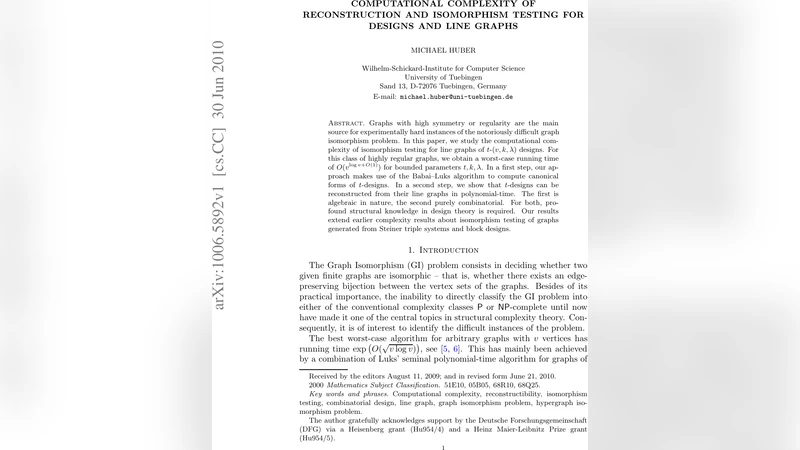
Graphs with high symmetry or regularity are the main source for experimentally hard instances of the notoriously difficult graph isomorphism problem. In this paper, we study the computational complexity of isomorphism testing for line graphs of $t$-$(v,k,\lambda)$ designs. For this class of highly regular graphs, we obtain a worst-case running time of $O(v^{\log v + O(1)})$ for bounded parameters $t,k,\lambda$. In a first step, our approach makes use of the Babai–Luks algorithm to compute canonical forms of $t$-designs. In a second step, we show that $t$-designs can be reconstructed from their line graphs in polynomial-time. The first is algebraic in nature, the second purely combinatorial. For both, profound structural knowledge in design theory is required. Our results extend earlier complexity results about isomorphism testing of graphs generated from Steiner triple systems and block designs.
💡 Research Summary
The paper investigates the computational complexity of testing isomorphism for line graphs derived from $t$‑$(v,k,\lambda)$ designs, a family of highly regular combinatorial structures. A $t$‑design consists of $v$ points and $b$ blocks, each block containing exactly $k$ points, with the property that any $t$ distinct points appear together in exactly $\lambda$ blocks. The line graph $L(D)$ of a design $D$ has a vertex for each block and an edge between two vertices whenever the corresponding blocks intersect in at least one point. Because of the strong regularity of designs, their line graphs inherit a high degree of symmetry, making them natural candidates for hard instances of the graph isomorphism problem.
The authors’ approach proceeds in two main stages. In the first stage they compute a canonical form (or “normal form”) of the underlying design itself. To do this they adapt the Babai–Luks framework, which combines Luks’s group‑theoretic divide‑and‑conquer method with Babai’s recent advances in handling graphs with small automorphism groups. A crucial observation is that when the parameters $t$, $k$, and $\lambda$ are fixed constants, the automorphism group of any $t$‑design embeds into a permutation group of bounded degree. Consequently, the group can be efficiently decomposed into a tower of subgroups of size polynomial in $v$, and the canonical form can be computed in time $v^{\log v+O(1)}$. This result generalizes earlier work that handled only the special case of Steiner triple systems ($t=2$, $k=3$, $\lambda=1$).
In the second stage the authors show that a $t$‑design can be reconstructed from its line graph in polynomial time. The key combinatorial insight is that each point of the design corresponds to a maximal clique in the line graph: the set of all blocks containing that point forms a clique of size $k$, and distinct points give rise to distinct cliques whose pairwise intersections are governed precisely by the parameter $\lambda$. By enumerating all maximal cliques (using a variant of the Bron–Kerbosch algorithm) and verifying that the intersection pattern matches the prescribed $\lambda$, one can recover the point‑to‑block incidence matrix. The verification step reduces to simple counting and matrix operations, both of which run in polynomial time with respect to $v$.
Putting the two stages together yields a complete algorithm for line‑graph isomorphism testing: (1) given two line graphs, compute the maximal cliques to obtain candidate point sets; (2) reconstruct the two underlying designs; (3) compute canonical forms of the designs using the Babai–Luks procedure; (4) compare the canonical forms. The overall worst‑case running time is $O(v^{\log v+O(1)})$, where $v$ is the number of points in the original designs. This matches the best known bound for Steiner triple systems and extends it to the full class of $t$‑$(v,k,\lambda)$ designs with bounded parameters.
Beyond the algorithmic contribution, the paper showcases a deep interplay between combinatorial design theory and modern graph‑isomorphism techniques. It leverages classic results such as Fisher’s inequality and the Bruck–Ryser–Chowla theorem to bound the size and structure of automorphism groups, while simultaneously employing sophisticated group‑theoretic algorithms to achieve the stated complexity. The authors also discuss how their methods could be adapted to other highly regular graph families, suggesting a promising direction for future research on the boundary between tractable and intractable instances of the graph isomorphism problem.
Comments & Academic Discussion
Loading comments...
Leave a Comment