Vehicles as sensors: high-accuracy rainfall maps from windshield wiper measurements
Connected vehicles are poised to transform the field of environmental sensing by enabling acquisition of scientific data at unprecedented scales. Drawing on a real-world dataset collected from almost 70 connected vehicles, this study generates improv…
Authors: Matthew Bartos, Hyongju Park, Tian Zhou
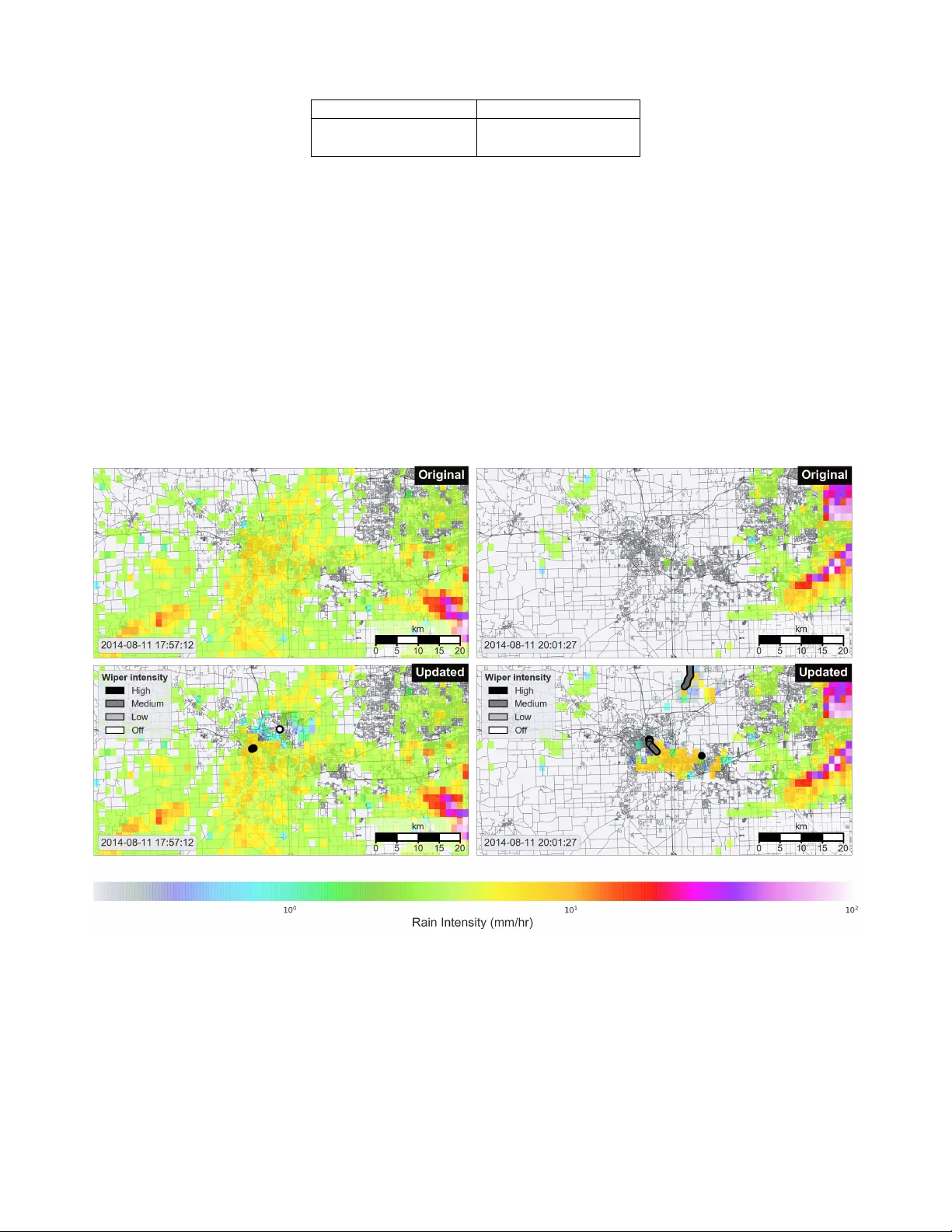
V ehic les as sensor s: high-accuracy rainfall maps fr om windshield wiper measurements Matthew Bartos 1,+ , Hy ongju P ark 2,+ , Tian Zhou 2 , Branko K erkez 1,* , and Ramanaray an V asudev an 2 1 Depar tment of Civil and Environmental Engineering, Univ ersity of Michigan, Ann Arbor , MI, 48109, United States 2 Depar tment of Mechanical Engineering, University of Michigan, Ann Arbor , MI, 48109, United States * Correspondence to: bkerkez@umich.edu + These authors contributed equally to this work ABSTRA CT Connected vehicles are poised to transf or m the field of environmental sensing by enabling acquisition of scientific data at unprecedented scales. Drawing on a real-w or ld dataset collected from almost 70 connected v ehicles, this study generates improv ed rainf all estimates by combining w eather radar with windshield wiper observations . Existing methods for measuring precipitation are subject to spatial and temporal uncer tainties that compromise high-precision applications like flash flood f orecasting. Windshield wiper measurements from connected vehicles correct these uncer tainties by providing precise inf or mation about the timing and location of rainf all. Using co-located vehicle dashboard camer a footage , we find that wiper measurements are a stronger predictor of binar y rainf all state than traditional stationary gages or radar-based measurements. W e introduce a Ba yesian filtering frame work that generates improv ed rainf all estimates b y updating radar r ainfall fields with windshield wiper obser v ations. We find that the resulting rainf all field estimate captures rainfall e vents that would otherwise be missed by con ventional measurements. We discuss ho w these enhanced rainfall maps can be used to improv e flood warnings and f acilitate real-time operation of stor mw ater infrastructure. Introduction Accurate rainfall measurements are essential for the ef fectiv e management of water resources 1 . Historical rainfall records are used extensi vely in the design of water infrastructure 2 , while at finer scales, real-time rainf all measurements are an integral component of flood forecasting systems 3 . Despite the central role that precipitation measurements play in the design and operation of water infrastructure, current methods for measuring precipitation often do not provide the spatial resolution or measurement certainty required for real-time applications 3 . As the demand for real-time precipitation data increases, new sensing modalities are needed to address deficiencies found in con ventional data sources. The need for high-resolution precipitation estimates is perhaps best illustrated by the problem of urban flash flooding. Flooding is the number one cause of natural disaster fatalities w orldwide, with flash floods accounting for a majority of flooding deaths in developed countries 4 . Despite the risks posed by flash flooding, there is “no existing model [that is] capable of making reliable flash flood forecasts in urban w atersheds” 3 . Flash flood forecasting is to a lar ge extent hindered by a lack of high-resolution precipitation data, with spatial resolutions of < 500 m and temporal resolutions of 1-15 minutes required for urban areas 5 , 6 . Contemporary rain measurement technologies—such as stationary rain gages and weather radar —struggle to achie ve the lev el of precision necessary for flash flood forecasting. While rain gages have long served as a trusted source of surface- lev el precipitation measurements 7 , they often fail to capture the spatial v ariability of rain ev ents, especially during con vecti ve storms 8 – 10 . This inability to resolv e spatial patterns in rainf all is made w orse by the fact that the number of rain gages w orldwide is rapidly declining 1 . W eather radar is a useful tool for capturing the spatial distribution of rainfall. Howe ver , radar -rainfall estimates are subject to large spatial and temporal uncertainties 11 – 14 . Additionally , weather radar tends to show systematically large biases for major flood e vents, and may perform poorly for small watersheds 6 , making urban flood forecasting problematic. The rise of connected and autonomous v ehicles of fers an unprecedented opportunity to enhance the density of en vironmental measurements 15 , 16 . While dedicated sensor networks are expensi ve to deplo y and maintain, fleets of connected v ehicles can capture real-time data at fine spatial and temporal scales through the use of incidental onboard sensors. W ith regard to rainfall measurement, windshield wiper activity offers a nov el means to detect the location and timing of rainfall with enhanced precision. When used in conjunction with modern signal processing techniques, wiper -based sensing offers se veral attracti ve properties: (i) vehicles achie ve v astly improv ed coverage of urban areas, where flood monitoring is important; (ii) windshield Figure 1. Over view of the study ar ea on June 12, 2014. Blue circles represent rain gages. V ehicle paths are sho wn as green lines, while roads are shown in gray . A radar overlay sho ws the av erage precipitation intensity as estimated by radar . wiper intensity is easy to measure and requires little ov erhead for processing (as opposed to video or audio data); and (iii) vehicle-based sensing can be readily scaled as vehicle-to-infrastructure communication becomes more widespread. Moreover , many ne w vehicles come equipped with optical rain sensors that enable direct measurement of rainfall intensities. When paired with data assimilation techniques, these sensors may enable even higher -accuracy estimation of rainfall fields compared to wipers alone. While a small number of studies ha ve in vestigated vehicle-based precipitation measurements, the results of these studies are strictly based on simulated wiper data instead of real measurements. As such, the premise that windshield wiper data can be used to improve rainf all estimates has never been verified using a lar ge real-world dataset. Hill (2015) combines simulated binary (wet/dry) rainfall sensors with weather radar observations to generate impro ved areal rainfall estimates, which are then v alidated against rainf all fields produced by interpolation of tipping-b ucket rain gages 15 . Similarly , Haberlandt (2010) combines simulated vehicle wiper measurements with rain gage observ ations to improve rainfall field estimates, and then v alidates the resulting product against weather radar 16 . Although these studies highlight the potential for vehicle-based measurements to improv e the spatial and temporal resolution of rainfall estimates, their findings have not yet been v alidated using data from real-world connected vehicles. T o address these challenges, this study lev erages windshield wiper measurements collected from nearly 70 vehicles to produce corrected rainfall maps (see Figure 1 for a description of the study area and data sources). In the first part of this paper, we demonstrate that windshield wiper measurements of fer a reliable indicator of rainf all by comparing wiper measurements against dashboard camera footage that indicates the ground truth binary rainfall state (raining/not raining). In the second part of this paper , we de velop a Bayesian data fusion procedure that combines weather radar with vehicle-based wiper measurements to produce an updated probabilistic rainfall field map. W e validate this nov el data product by showing that it is more ef fectiv e than the original radar data at predicting the binary rainfall state. Finally , we discuss how these enhanced rainfall maps can be used to improv e flood warnings and facilitate real-time operation of stormwater infrastructure. 2/ 13 Results Figure 2. Analysis of a single vehicle trip occurring fr om 21:46 - 22:26 on A ugust 11, 2014. The top two panels sho w video footage during the rainy (left) and dry (right) se gments of the trip. The bottom left panel shows a map of the vehicle’ s trip, with the wiper intensity indicated by color . A radar overlay sho ws the av erage rainfall intensity ov er the 40-minute time period. Blue circles represent the gages nearest to the v ehicle path. The two bottom right panels sho w the precipitation intensity as estimated by radar and gage measurements (center), and the 1-minute av erage wiper intensity (bottom). Windshield wipers impr ove binary rainfall detection W indshield wiper measurements enhance rainfall estimation by enabling greater certainty about the timing and location of rainfall. While wiper intensity is generally a poor predictor of rainfall intensity (see Figure S1 in the Supplementary Information), we find that wiper status (on/of f) is a stronger predictor of binary rainfall state than either radar or gage-based measurements. This result suggests that vehicle-based measurements can be used to validate and correct rainf all fields derived from con ventional data sources. W iper measurements provide a more accurate indicator of binary rainfall state than either radar or gage measurements. W e determine the binary classification performance for each technology (gages, radar and wipers) by comparing the measured rainfall state with co-located dashboard video footage. Dashboard video is taken to represent the ground truth, giv en that the presence or absence of rainfall can readily be determined by visually inspecting the windshield for raindrops. Figure 2 shows an e xample of co-located radar, gage, wiper and camera measurements for a single vehicle trip. In this case, rainfall is visible during the first half of the trip (top left). Aggregating these cross-comparisons for e very vehicle trip across three storm e vents, we find that wiper status is the best estimator of binary rainf all state, with a true positi ve rate (TPR) of 93.1%, and a true ne gativ e rate (TNR) of 98.2%. By comparison, weather radar achiev es a smaller TPR of 89.5%, while stationary gages show a much smaller TPR of 44.5% (see T able 2 ). These results can partly be explained by the superior spatial and temporal resolution of the vehicle-based measurements. W ipers detect intermittent changes in rainfall at a temporal resolution on the order of seconds, while radar and gage measurements can only detect the a verage rate o ver a 5-minute period. When ground truth camera observations are collected at a 3-second temporal resolution, the benefit of wiper measurements over radar measurements becomes even more pronounced, with a TPR advantage of 5.2%, a TNR adv antage of 7.7%, and an ov erall wiper TPR of 97.0% (see the supplementary note on factors af fecting binary detection performance). The results of this analysis suggest that con ventional rainf all measurement technologies can be enhanced through the inclusion of vehicle-based measurements. 3/ 13 Metric Gage Radar W iper T rue Positiv e Rate (%) 44.5 89.5 93.1 T rue Negati ve Rate (%) 96.7 97.5 98.2 T able 1. Classification performance of each rainfall measur ement technology . The true positiv e rate indicates the percentage of instances where the giv en technology successfully detects rainfall when rainfall is actually occurring. The true negati ve rate indicates the percentage of instances where the technology does not detect rainfall when rainfall is not occurring. Assimilation of wiper data yields corrected rainfall maps Based on the observ ation that wiper measurements are a strong binary predictor of rainfall, we de velop a Bayesian filtering framew ork that combines radar rainfall estimates with wiper observations to generate corrected rainfall maps. Radar is used to estimate a prior distrib ution of rainfall intensities. This prior is then updated with wiper observ ations to produce a corrected rainfall field. The results of this filtering procedure are demonstrated in Figure 3 , which shows the original rainfall field (top) along with the corrected rainfall field (bottom). In some cases (left panel), vehicles detect no rain in re gions where radar had previously estimated rain. In these cases, the updated product reduces the rainfall field in the proximity of the vehicle. In other cases (right panel), the updated product predicts rainf all in re gions where little to no rainfall w as observed in the original dataset. This outcome sho ws that windshield wiper acti vity is sensiti ve to intermittent rainfall e vents that radar may not otherwise detect. T o see the full evolution of the rainf all field under both the original and corrected data sets, refer to V ideo S1. Figure 3. Original and updated rainfall maps . T op (left and right): Original weather radar rainfall intensity map. Radial radar scans hav e been resampled to a 1 km grid to ensure computational tractability . Bottom (left and right): updated rainfall intensity map, combining radar data with wiper measurements using the Bayesian filter . In the bottom left panel, a “hole” in the rainfall field occurs when a vehicle detects no rain in a location where radar alone estimated rain. In the bottom right panel, vehicles detect rainfall where radar pre viously did not detect rainfall. The wiper-corrected rainf all field predicts the binary rainfall state with greater accuracy than the radar -only data product. T o validate the wiper -corrected rainfall field, we use an iterated “lea ve-one-out” approach, in which an updated rainfall field is generated while e xcluding a vehicle, and the resulting data product is compared against the measured rainf all state of the omitted vehicle. Repeating this process for each vehicle yields the recei ver operator characteristics sho wn in Figure 4 . These 4/ 13 curves map the relationship between the TPR and TNR for both the original rainfall field (radar only) and the corrected rainfall field (radar and wiper). Curves located closer to the upper-left corner (i.e. those with a larger area under the curve) exhibit the best performance, gi ven that the y have a large true positiv e rate and a small fals e negati ve rate. Based on these curves, it can be seen that the corrected data product performs consistently better than the original radar product at predicting the presence or absence of rain, with a TPR and TNR close to unity . These results confirm that inclusion of vehicle-based measurements enables improv ed prediction of the underlying rainfall field. Discussion The enhanced rainfall maps developed in this study hav e the potential to assist in the real-time operation of transportation and water infrastructure. In particular, high accurac y rainfall field estimates will enable improv ed prediction of flash floods in urban centers, and will help to inform real-time control strategies for stormwater systems. As mentioned pre viously , flash flood forecasting is contingent on high-resolution areal rainfall estimates, with accurate measurements on the order of 500 m or finer required for forecasting in urban areas. By enabling real-time validation and filtering of radar rainfall estimates, v ehicle-based sensors may help fill measurement gaps and improve the prediction of flood e vents near roadways. Monitoring of roadways is especially important giv en that in the US, roughly 74% of flood fatalities are vehicle related 4 . While the vehicles used in this study provide only binary measurements of rainfall state, many newer vehicles feature optical rain sensors that are capable of measuring precipitation rate directly . When combined with the Bayesian sensor fusion frame work described in this study , these optical rain sensors may enable robust mapping of rainfall volumes at the fine spatial and temporal scales needed for high-accuracy flash flood forecasting. Moreo ver , as connected and autonomous vehicles become more widely adopted, the spatial cov erage and measurement certainty of this new rainfall sensing modality will be e ven further enhanced. In addition to assisting with flash flood response, high-precision rainf all data products may one day inform the operation of new “smart” water infrastructure. Recent work has highlighted the potential of “smart” water systems to mitigate water hazards through real-time control of distributed gates, valv es and pumps 17 – 21 . When informed by accurate and timely data, these systems can significantly reduce operating costs, prev ent combined sewer o verflo ws, and halt the degradation of aquatic ecosystems by adapti vely reconfiguring water infrastructure in real time 17 , 18 . Howe ver , recent findings suggest that optimal control strategies for “smart” water systems are highly sensiti ve to the location, timing and intensity of rainfall inputs 22 . In this regard, the wiper -corrected rainfall product presented in this study may help to enable more fine-grained control of water infrastructure by reducing uncertainty in con ventional rainfall field estimates. Figure 4. Binary classification performance of the updated rainfall pr oduct . Receiv er operator characteristic (R OC) curves indicate the rainfall state prediction accurac y for the original radar estimate and the updated (wiper-corrected) data product. The area under the curve (A UC) measures overall classification performance. 5/ 13 Conclusions This study generates enhanced probabilistic rainfall maps by combining con ventional radar-based precipitation fields with ubiquitous windshield wiper measurements from almost 70 unique vehicles. W e find that while windshield wiper intensity is a poor predictor of rainfall intensity , wiper activity is a stronger predictor of binary rainfall state than conv entional radar and gage-based data sources. W ith this result in mind, we de velop a nov el Bayesian filtering frame work that combines a radar -based rainfall prior with binary windshield wiper observations to produce an updated rainfall map. W e find that the Bayesian filtering process is ef fectiv e at detecting changes in the rainfall field that con ventional measurement technologies may otherwise miss. W e v alidate the updated rainfall data product by assessing its ability to reproduce the binary rainfall state anticipated by an omitted vehicle. Based on this analysis, we find that the corrected rainfall field is better at predicting the binary rainf all state than the original radar product. As connected vehicles become more widespread, the ubiquitous sensing approach proposed by this study may one day help to inform real-time warning and control systems for water infrastructure by providing fine-grained estimates of the rainfall field. Materials and Methods Evaluating vehic le-based measurements In the first part of this study , we assess the degree to which windshield wiper acti vity serv es as a proxy for both rainf all intensity and binary rainfall state. First, wiper measurements are compared against con ventional rainfall measurement technologies to determine if there is a direct relationship between wiper intensity and rain intensity . Ne xt, we assess the degree to which each data source reflects the ground truth rainfall state by comparing measurements from all three sources (gages, radar and wipers) with vehicle-based video footage. V ideo footage provides instantaneous visual confirmation of the rainfall state (raining or not raining), and is thus taken to represent the ground truth. W e characterize the binary classification performance of each technology in terms of its true positiv e and true negati ve rates. T o ensure that our analysis is computationally tractable, we isolate the study to a subset of three storms in 2014. W e assess the validity of our procedure for storms of different magnitudes by selecting a large storm (2014-08-11), a medium-sized storm (2014-06-28) and a small storm (2014-06-12). Storms are selected during the summertime months to av oid conflating rainfall measurements with snow measurements. The year 2014 is chosen because it is the year for which the greatest number of vehicles are a vailable. Unless otherwise specified, data are co-located using a nearest neighbor search. For comparison of wiper and gage readings, we select only those gages within a 2 km range of any gi ven vehicle. Data sources W e consider four data sources: (i) stationary rain gages, (ii) weather surveillance radar , (iii) vehicle windshield wiper data, and (iv) v ehicle dashboard camera footage. W e provide a brief description of each data source here: Gage data are obtained from personal weather stations maintained by the W eather Underground 23 . W ithin the city of Ann Arbor (Michigan), W eather Underground hosts 21 personal weather stations, each of which yield rainfall estimates at a time interval of approximately 5 minutes. Locations of gages are indicated by blue circles in Figure 1 . Although verified gage data from the National W eather Service (NWS) and the National Oceanic and Atmospheric Administration (NO AA) are av ailable, W eather Underground gages are selected because (i) NO AA and NWS each maintain only a single gage in the city of Ann Arbor , meaning that intra-urban spatial variations in precipitation intensity cannot be captured, and (ii) the temporal resolution of NOAA and NWS gages are relativ ely coarse for real-time applications (with NOAA of fering a maximum temporal resolution of 15 minutes and NWS offering a maximum temporal resolution of 1 hour). W eather radar observations are obtained from NO AA ’ s NEXRAD Le vel 3 Radar product archi ve 24 . W e use the “Instanta- neous Precipitation Rate” data product (p176). Radar precipitation estimates are obtained at a temporal resolution of 5 minutes, and a spatial resolution of 0.25 km by 0.5 degree (azimuth). Radar station KDTX in Detroit is used because it is the closest radar station to the City of Ann Arbor . Radial radar scans are interpolated to cartesian coordinates using a nearest neighbor approach. V ehicle-based wiper intensities are obtained from the Uni versity of Michigan T ransportation Research Institute (UMTRI) Safety Pilot Model Deployment database 25 . For each vehicle, this dataset includes time series of latitude, longitude, and windshield wiper intensity at a temporal resolution of 2 milliseconds. W indshield wiper intensity is gi ven on an ordinal scale from 0 to 3, with 0 indicating that the wiper is turned off, 1 representing the lowest wiper intensity , and 3 representing the highest wiper intensity . A wiper reading of 4 indicates that the vehicle’ s “mister” is activ ated, distinguishing between wiper use for rain remov al and wiper use for windshield cleaning. F or the year 2014, 69 unique vehicles are a vailable in the UMTRI dataset. Howe ver , typically less than ten vehicles are activ e at any giv en time during 6/ 13 the observ ation period. V ehicles with no sensor output or in valid readings were remov ed from the dataset prior to the analysis (see the Supplementary Note for more details). Camera observations are also obtained from the UMTRI vehicle database 25 . Located on the inside of each vehicle, cameras provide streaming video footage of the windshield, side-facing windo ws, rear -facing windows, and the dri ver . For the purposes of validation, we use the front-facing windshield camera. Camera frames are manually inspected for rain drops striking the windshield. Time interv als where rain is observed are classified as “raining”; similarly time intervals where no new droplets are observed are classified as “not raining”. Manual inspection and labeling of the video data was performed independently by two re viewers to ensure rob ustness. A Bay esian filtering framework In the second part of this study , we develop a Bayesian filtering framework that combines binary wiper observations with radar-based rainf all intensity measurements to generate corrected rainfall maps. In simple terms, the Bayesian filter generates an updated rainfall field map, in which binary (on/of f) wiper measurements adapti vely correct the underlying radar rainfall field. W indshield wiper status is tak en to represent a measurement of the ground truth binary rainf all state, giv en that it is a better predictor of the binary rainfall state than radar- or gage-based measurements. Under this framework, four distinct cases are possible. If both the wiper and radar measure precipitation, the radar reading is taken to be correct, and the original rainf all field remains the same. Similarly , if neither the wiper nor the radar measure precipitation, the radar rainfall field remains zero. Howe ver , if the radar measures precipitation at a target location and the wiper does not, then the filter will update the rainfall field such that rain intensity is reduced within the proximity of the vehicle (with a decay pattern corresponding to the Gaussian kernel and an intensity of zero at the location of the wiper reading). Similarly , if the wiper measures precipitation, but the radar measures no precipitation, the rainfall intensity will be increased around the proximity of the vehicle (with an intensity defined by the empirical intensity distribution associated with the gi ven wiper intensity). A more formal description of the filtering framework is gi ven here in terms of a noisy sensor model (for additional details, see 26 ). Consider a noisy sensor model in which each sensor produces a binary measurement gi ven a tar get state. The target state is represented as a random tuple z z z = ( q , I I I ) where q is a location state (e.g. the latitude and longitude at the target), and I I I is an information state (e.g. the precipitation intensity at the target) with all the random quantities indicated by bold italics. W e denote by M t the ev ent that sensors correctly measure the intensity , and by M t the ev ent that sensors fail to measure the intensity correctly . The joint measurement likelihood at any time t is giv en by: p ( M t | z z z , x t ) (1) where x t represents the locations of the sensors at time t . Equation 1 yields the probability distribution of precipitation intensity measurement at q by sensors at x t . The expected value of Equation 1 with respect to I I I is equiv alent to the rainfall intensity experienced at the location q . Because the ef fectiv e range of the wipers is limited, we account for the probability of detection as a function of the distance between the sensor and the target. W e denote by D t the ev ent that sensors detect the target, and by D t the e vent that sensors f ail to detect the tar get at time t . The probability of detecting a target located at q by sensors located at x t , p ( D t | q , x t ) , is taken to decay with increasing distance to the sensor . Using the law of total probability , the conditional probability of a correct measurement is then giv en by: p ( M t | z z z , x t ) = p ( M t | z z z , D t , x t ) p ( D t | q , x t ) + p ( M t | z z z , D t , x t ) p ( D t | q , x t ) (2) where D t is conditionally independent of I I I when conditioned on q . For e xample, consider x t = ( 0 , 0 ) , and q = ( q 1 , q 2 ) . If the decay function is tak en to be a 2D Gaussian centered at x t with cov ariance matrix σ I where I is a 2 by 2 identity matrix, then: p ( D t | q , x t ) = e η t 1 2 π σ 2 exp − q 2 1 + q 2 2 2 σ 2 (3) Where e η t is a normalization constraint. If the target is not detected (i.e., D t ), then the measurement is assumed to be unreliable, and the likelihood, p ( M t | z z z , D t , x t ) , is modeled using a prior distrib ution. If there is no prior information av ailable, the function is modeled using a uniform distribution. No w let b t ( z z z ) represent the posterior probability of the precipitation intensity giv en a target location q at time t . Using Bayes’ Theorem, b t ( z z z ) can be formulated: b t ( z z z ) = η t p ( M t | z z z , x t ) b t − 1 ( z z z ) , t = 1 , 2 , . . . (4) 7/ 13 Where η t is a normalization constant and b 0 is uniform if no information is av ailable at t = 0 . This filtering equation forms the basis of the rainfall field updating algorithm. T o reduce computational complexity , the filtering operation is implemented using a Sequential Importance Resampling (SIR) Particle Filter 27 . The results of the Bayesian sensor fusion procedure are e v aluated by determining the proportion of instances where the combined data product is able to predict the binary rainfall state. W e characterize the true and false positiv e rates for the largest storm e vent (2014-08-11) using an iterated “leav e-one-out” cross-validation approach. First, a single vehicle is remov ed from the set of vehicles. The Bayesian update procedure is then executed using all vehicles except the excluded vehicle, and an updated rainfall map is generated. Next, the rainfall states predicted by the corrected rainfall field (radar and wiper) and the original rainfall field (radar only) are compared against the rainf all states predicted by the omitted vehicle. The performance of each data product is ev aluated based on its ability to reproduce the binary rainfall state observed by the omitted vehicle. Performing this process iterati vely yields the true and false positi ve rates for both the original (radar only) and updated (radar and wiper) rainfall fields. This procedure is repeated for each vehicle in the set of vehicles to generate Receiv er-Operator Characteristic (R OC) curves, which characterize the true and false positi ve rates across an ensemble of simulations. References 1. Overeem, A., Leijnse, H. & Uijlenhoet, R. Country-wide rainfall maps from cellular communication networks. Pr oc. Natl. Acad. Sci. 110 , 2741–2745 (2013). DOI 10.1073/pnas.1217961110. 2. Cheng, L. & AghaK ouchak, A. Nonstationary precipitation intensity-duration-frequency curves for infrastructure design in a changing climate. Sci. Reports 4 (2014). DOI 10.1038/srep07093. 3. Hapuarachchi, H. A. P ., W ang, Q. J. & Pagano, T . C. A revie w of advances in flash flood forecasting. Hydr ol. Pr ocess. 25 , 2771–2784 (2011). DOI 10.1002/hyp.8040. 4. Doocy , S., Daniels, A., Murray , S. & Kirsch, T . D. The human impact of floods: a historical revie w of e vents 1980-2009 and systematic literature revie w . PLoS Curr. (2013). DOI 10.1371/currents.dis.f4deb457904936b07c09daa98ee8171a. 5. Berne, A., Delrieu, G., Creutin, J.-D. & Obled, C. T emporal and spatial resolution of rainfall measurements required for urban hydrology . J. Hydr ol. 299 , 166–179 (2004). DOI 10.1016/j.jhydrol.2004.08.002. 6. Smith, J. A., Baeck, M. L., Meierdiercks, K. L., Miller , A. J. & Krajewski, W . F . Radar rainfall estimation for flash flood forecasting in small urban watersheds. Adv. W ater Resour. 30 , 2087–2097 (2007). DOI 10.1016/j.advwatres.2006.09.007. 7. Grimes, D., Pardo-Ig ´ uzquiza, E. & Bonifacio, R. Optimal areal rainfall estimation using raingauges and satellite data. J. Hydr ol. 222 , 93–108 (1999). DOI 10.1016/s0022-1694(99)00092-x. 8. Xiaoyang, L., Jietai, M., Y uanjing, Z. & Jiren, L. Runof f simulation using radar and rain gauge data. Adv . Atmos. Sci. 20 , 213–218 (2003). DOI 10.1007/s00376-003-0006-7. 9. Y ilmaz, K. K. et al. Intercomparison of rain gauge, radar , and satellite-based precipitation estimates with emphasis on hydrologic forecasting. J. Hydr ometeor 6 , 497–517 (2005). DOI 10.1175/jhm431.1. 10. Sun, X., Mein, R., Keenan, T . & Elliott, J. Flood estimation using radar and raingauge data. J. Hydrol. 239 , 4–18 (2000). DOI 10.1016/s0022-1694(00)00350-4. 11. W inchell, M., Gupta, H. V . & Sorooshian, S. On the simulation of infiltration- and saturation-e xcess runoff using radar- based rainfall estimates: Effects of algorithm uncertainty and pixel aggreg ation. W ater Resour. Res. 34 , 2655–2670 (1998). DOI 10.1029/98wr02009. 12. Morin, E., Krajewski, W . F ., Goodrich, D. C., Gao, X. & Sorooshian, S. Estimating rainfall intensities from weather radar data: the scale-dependency problem. J. Hydrometeor ol. 4 , 782–797 (2003). DOI 10.1175/1525- 7541(2003)004¡0782:ERIFWR¿2.0.CO;2. 13. Smith, J. A., Seo, D. J., Baeck, M. L. & Hudlo w , M. D. An intercomparison study of NEXRAD precipitation estimates. W ater Resour. Res. 32 , 2035–2045 (1996). DOI 10.1029/96wr00270. 14. Islam, T ., Rico-Ramirez, M. A., Han, D. & Sri vasta va, P . K. Artificial intelligence techniques for clutter identification with polarimetric radar signatures. Atmospheric Res. 109-110 , 95–113 (2012). DOI 10.1016/j.atmosres.2012.02.007. 15. Hill, D. J. Assimilation of weather radar and binary ubiquitous sensor measurements for quantitati ve precipitation estimation. J. Hydr oinformatics 17 , 598 (2015). DOI 10.2166/hydro.2015.072. 16. Haberlandt, U. & Sester, M. Areal rainfall estimation using moving cars as rain gauges – a modelling study . Hydr ol. Earth Syst. Sci. 14 , 1139–1151 (2010). DOI 10.5194/hess-14-1139-2010. 8/ 13 17. Bartos, M., W ong, B. & Kerkez, B. Open storm: a complete framework for sensing and control of urban watersheds. En vir on. Sci. W ater Res. & T echnol. (2017). DOI 10.1039/c7ew00374a. 18. Kerk ez, B. et al. Smarter stormwater systems. En vir on. Sci. & T echnol. 50 , 7267–7273 (2016). DOI 10.1021/acs.est.5b05870. 19. W ong, B. P . & K erkez, B. Adaptiv e measurements of urban runoff quality . W ater Resour. Res. 52 , 8986–9000 (2016). DOI 10.1002/2015WR018013. 20. W ong, B. P . & Kerkez, B. Real-time environmental sensor data: An application to water quality using web services. En vir on. Model. & Softw. 84 , 505–517 (2016). DOI 10.1016/j.en vsoft.2016.07.020. 21. Mullapudi, A., W ong, B. P . & K erkez, B. Emerging in vestigators series: building a theory for smart stormw ater systems. En vir on. Sci.: W ater Res. T echnol. 3 , 66–77 (2017). DOI 10.1039/c6ew00211k. 22. W ong, B. Real-time measur ement and contr ol of urban stormwater systems . Ph.D. thesis, University of Michigan (2017). 23. W eather Underground. W eather Underground personal weather stations (City of Ann Arbor) (2014). 24. NO AA National W eather Service (NWS) Radar Operations Center. NOAA next generation radar (NEXRAD) level 3 products (instantaneous precipitation rate) (1992). DOI 10.7289/V5W9574V . 25. Univ ersity of Michigan T ransportation Research Institute. Safety pilot model deployment / Ann Arbor connected vehicle test en vironment data (2014). 26. Park, H., Liu, J., Johnson-Roberson, M. & V asudev an, R. In Robust En vironmental Mapping by Mobile Sensor Networks. IEEE International Confer ence on Robotics and Automation (2018). URL: https://arxi v .org/abs/1711.07510. 27. Berzuini, C., Best, N. G., Gilks, W . R. & Larizza, C. Dynamic conditional independence models and marko v chain monte carlo methods. J. Am. Stat. Assoc. 92 , 1403–1412 (1997). Ackno wledgements Funding for this project was provided by MCubed (grant 985), the Ford Motor Company–Uni versity of Michigan Alliance (grant N022977), and the Univ ersity of Michigan. V ehicle metadata and camera footage are provided courtesy of the Uni versity of Michigan T ransportation Research Institute. A uthor contributions statement M.B. wrote the paper , performed the analysis, and helped with the implementation of the filtering algorithm. H.P . dev eloped, implemented, and validated the filtering algorithm. T .Z. analyzed the dashboard camera data and assisted with analysis of the windshield wiper data. B.K. and R.V . originated the concept of the study , guided the development of the methods, and assisted in writing the paper . Additional inspection and labeling of vehicle dashboard footage was performed by Aditya Prakash Singh. All authors revie wed the manuscript. Additional inf ormation Data access links Upon publication, code and data for this study will be made av ailable at: github.com/kLabUM/vehicles-as-sensors . Competing financial interests statement The authors declare no competing interests. 9/ 13 Supplementary Materials Supplementary note on binary detection performance Binary detection performance is sensiti ve to a number of factors, including the temporal resolution of the ground truth data and the configuration of wiper sensors. While these factors can affect the magnitude of binary classification performance, under all scenarios considered, wiper measurements are a better detector of the binary rainf all state than either radar or gage measurements. Binary detection performance can be af fected by the temporal resolution at which the ground truth data is collected. T o ensure robustness, labeling of v ehicle footage was performed independently by tw o revie wers. The first revie wer labeled the observed rainfall state for each vehicle over all three days of the study period (2014-06-12, 2014-06-28, 2014-08-11) at a temporal interval of 1 minute. A second revie wer labeled the observed rainfall and wiper state for the largest storm ev ent (2014-08-11) at an enhanced time resolution of roughly 3 seconds. Due to the time-intensi ve nature of labeling video data at this temporal resolution, and due to the strong agreement between the two labeled datasets, this second round of labeling w as not performed for the remaining two days (2014-06-12 and 2014-06-28). Despite the dif ference in time resolution, manual labeling of the video data sho wed strong agreement. T aking the high-resolution dataset to represent the ground truth rainfall state (and aggregating the high-resolution dataset to the temporal resolution of the low-resolution dataset), the true positiv e rate of the low temporal-resolution camera observ ations was 92.6%, while the true negati ve rate was 99.3%. Agreement in terms of positiv e detection was lo wer due to the difference in temporal resolution between the tw o sources. The low-resolution camera observation dataset classifies each minute-long interval as either “raining” or “not raining”. Ho wev er , the high-resolution ground truth dataset contains many instances in which part of a given minute-long interv al contains rain, and part does not. Thus, when the high-resolution dataset is aggre gated to match the resolution of the lo w-resolution dataset, there are more interv als where some amount of rain is detected (yielding more instances of positiv e detection ov erall). A similar mismatch occurs if the lo w-resolution dataset is interpolated to match the time resolution of the high-resolution dataset. This time resolution mismatch also af fects comparisons between the ground truth and other data sources (e.g. wiper , radar and gages). In general, the difference in classification performance between data sources decreases when the ground truth dataset is aggregated in time. Differences in classification performance become more pronounced when a high-resolution ground truth dataset is used. Many vehicles exhibited data quality issues such as non-reporting wiper sensors, malfunctioning wiper sensors, or unobservable wiper modes. These data quality issues may impact the performance of the wiper as a classifier , but are largely attributable to the f act that the data is taken from a pilot study in which sensor configurations are not standardized. For some vehicles, wiper sensors were simply not configured to report wiper data. In these instances, the reported wiper value was zero for the entire observation period e ven though wiper mo vement w as observed during manual inspection of the dashboard footage. V ehicles for which wiper sensors were not configured were remov ed from the analysis. Other vehicles exhibited malfunctioning or poorly configured sensors. For instance, in some cases the wiper intensity fluctuated between 0 and 1 at a frequenc y on the order of milliseconds—a beha vior which is clearly not possible for a human dri ver . V ideo footage confirmed that the sensor was malfunctioning during these time periods. Malfunctioning vehicles were also removed from the analysis. Perhaps the most common data quality issue, ho wev er , is that se veral v ehicles exhibited unobserv able wiper modes. In this case, sensors were configured to report some wiper intensity states but not others. For example, the sensor may report the wiper intensity when the wiper switch is in a “continuous” mode, but may not report the wiper intensity when the wiper is placed in a manual “wipe” mode. These cases could only be detected by manual inspection of the camera footage. These data issues can largely be attributed to the fact that the sensor data is taken from a pilot study in which sensor configurations vary from vehicle to v ehicle. As manufacturers standardize sensor configurations for connected vehicles, the rele vance of these issues is likely to diminish. The performance of the wiper as a classifier can be improv ed by (i) comparing wiper data against a ground truth dataset obtained at a high temporal resolution, and (ii) correcting errors in the wiper sensor readings. When manual observations of the wiper state are used to correct unobserv able wiper modes, and the resulting corrected wiper data is compared to the 3-second resolution camera observ ations, the binary classification performance o ver weather radar is significantly enhanced: the true positiv e rate of the wiper data is 5.2% higher than radar , while the true negati ve rate is 7.7% higher . T able S1 shows the true and false positi ve rates for all technologies (during the 2014-08-11 storm e vent) when these two conditions are met. 10/ 13 Fig. S1 0 1 2 3 Wiper Intensity 0 2 4 6 8 10 12 14 Radar Intensity (mm/hr) n = 1 , 0 4 0 , 5 1 1 Wiper intensity vs. radar rainfall intensity Mean 0 1 2 3 Wiper Intensity 0 2 4 6 8 10 12 14 Gage Intensity (mm/hr) n = 4 2 6 , 9 6 6 Wiper intensity vs. gage rainfall intensity Mean Figure 5. Comparison of radar , gage and wiper intensities for thr ee storm events on 6/12/2014, 6/28/2014, and 8/11/2014. The left panel shows the distrib ution of radar precipitation measurements associated with each wiper intensity . The right panel shows the distrib ution of gage precipitation measurements associated with each wiper intensity for vehicles located within 2 kilometers of the gage. Note that the range limitation reduces the number of data points av ailable. No clear relationship is observed between wiper intensity and rainfall intensity . 11/ 13 T able S1 Metric Gage Radar W iper T rue Positiv e Rate (%) 55.1 91.8 97.0 T rue Negati ve Rate (%) 96.9 87.4 95.1 T able 2. Classification performance of each rainfall measur ement technology when using high-temporal resolution ground truth data, and corr ecting misreporting wiper states . These binary performance metrics hold when (i) ground truth observ ations at a resolution of 2.4 seconds are used, and (ii) manual corrections are made to the wiper state according to the wiper state in the observed camera footage (i.e. unobservable wiper modes are corrected). 12/ 13 Video S1 Original rainfall field (top) vs. updated data product (bottom) for a large storm ev ent on 2014-08-11. V ehicle paths can be seen in the bottom frame, with windshield wiper intensities indicated by greyscale intensity from of f (white) to high intensity (dark grey). 13/ 13
Original Paper
Loading high-quality paper...
Comments & Academic Discussion
Loading comments...
Leave a Comment