On repetition thresholds of caterpillars and trees of bounded degree
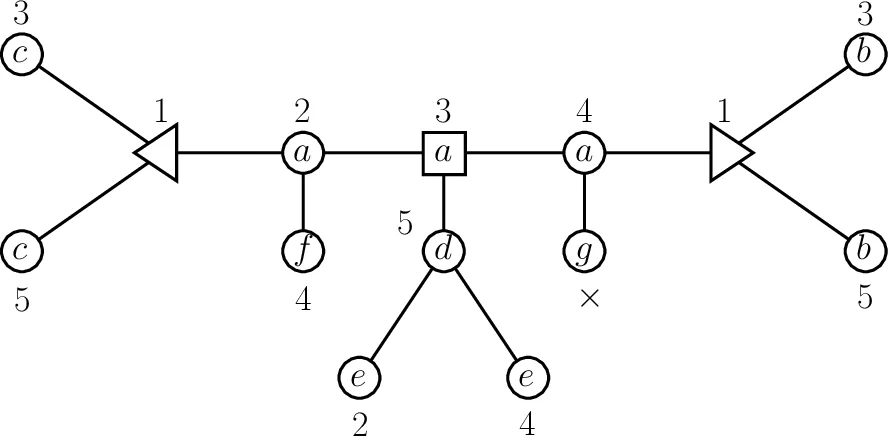
The repetition threshold is the smallest real number $\alpha$ such that there exists an infinite word over a $k$-letter alphabet that avoids repetition of exponent strictly greater than $\alpha$. This notion can be generalized to graph classes. In this paper, we completely determine the repetition thresholds for caterpillars and caterpillars of maximum degree $3$. Additionally, we present bounds for the repetition thresholds of trees with bounded maximum degrees.
💡 Research Summary
The paper extends the classical notion of the repetition threshold (RT) from infinite words over a k‑letter alphabet to vertex colorings of graphs. For a graph G and a k‑coloring c, the exponent of a factor (a contiguous sequence of colors along a non‑intersecting path) is defined as the length of the factor divided by the length of its shortest period. The repetition threshold RT(k,G) is the infimum over all k‑colorings of the supremum exponent that appears as a factor; for a class of graphs 𝔾, RT(k,𝔾) is the supremum of RT(k,G) over G∈𝔾. The authors focus on two families of trees: caterpillars (trees whose vertices of degree at least two induce a path, called the backbone) and trees of bounded maximum degree, especially the case Δ=3.
Main contributions
- Caterpillars (unrestricted degree)
- For k=2 the exact threshold is 3. The lower bound follows from the unavoidable appearance of the patterns “xxx” or “xyx” on the backbone, which force a 3‑repetition. The upper bound is achieved by coloring the backbone with a 2⁺‑free binary word (e.g., (0011)^ω) and assigning the opposite color to every pendant vertex.
- For k=3 the exact threshold is 2. Any 2‑free 3‑coloring would require the backbone to contain “xyx”, which inevitably creates a 2‑repetition; conversely, a 2⁺‑free binary coloring of the backbone together with a third color on all leaves yields a 2⁺‑free 3‑coloring.
- For k=4 the exact threshold is 3/2. The lower bound follows from the known result RT(4,T)=3/2 for general trees; the upper bound is constructed by a 3/2‑free 4‑coloring of the backbone and a cyclic use of the remaining colors on the leaves.
- For every k>5 the exact threshold is (1+1/\lceil k/2\rceil). Lemma 8 shows that any (1+1/⌈k/2⌉)‑free k‑coloring would require more than k distinct colors within distance ⌈k/2⌉, which is impossible. Lemma 10 builds a (1+1/⌈k/2⌉)⁺‑free coloring by first coloring the backbone with a (1+1/⌈k/2⌉)⁺‑free (⌈k/2⌉+1)‑coloring (possible by Dejean’s theorem) and then coloring the pendant vertices cyclically with the remaining ⌈k/2⌉−2 colors. Hence for all k>5, \
Comments & Academic Discussion
Loading comments...
Leave a Comment