Request for Comments: Proposal of a Blockchain for the Automatic Management and Acceptance of Student Achievements
Staying abroad during their studies is increasingly popular for students. However, there are various challenges for both students and universities. One important question for students is whether or not achievements performed at different universities can be taken into account for either enrolling at a foreign university or for completing the studies at their home university. In addition to university achievements, an increasing proportion of the 195 million students worldwide increasingly receive certificates from MOOCs or other social media services. The integration of such services into university teaching is still in the initial stages and presents some challenges. In this paper we describe the idea to manage all these study achievements worldwide in a blockchain, which might solve the national and international challenges regarding the recognition of student achievements. The aim of this paper is to encourage discussion in the global community instead of presenting a finished concept. Some of the open research questions are: How to ensure student data protection, how to deal with fraud and how to deal with the possibility that students can analytically calculate the easiest way through their studies?
💡 Research Summary
The paper proposes a blockchain‑based framework for globally managing and automatically recognizing student achievements, ranging from traditional university credits to certificates earned through MOOCs and other online platforms. The authors begin by highlighting the rapid growth of student mobility—4.5 million students studied abroad in 2012, projected to reach 6.4 million by 2025—and the persistent administrative burden that hampers the recognition of these achievements across institutions and borders. Even within Europe, where the Bologna Process has standardized credit systems, the actual validation and acceptance of transcripts remain labor‑intensive and fragmented.
To address these challenges, the authors introduce the core concepts of blockchain technology: a decentralized peer‑to‑peer ledger, cryptographic hashing for immutability, and smart contracts that execute automatically when predefined conditions are met. They argue that a public blockchain, supplemented by lightweight clients, can provide a scalable, cost‑effective substrate where any university, MOOC provider, or credentialing body can act as a node without the need for powerful dedicated servers.
The proposed architecture stores each achievement (exam result, assignment grade, course completion, etc.) as an individual block containing rich metadata—credit points, duration, issuing institution, and covered topics. Student identities are protected using randomly generated UUIDv4 identifiers, preserving anonymity while ensuring each record is uniquely linked to its owner. To safeguard privacy, the actual achievement data are encrypted; only the student holds the decryption key, while the blockchain itself remains publicly readable for verification purposes.
Write access is regulated through consensus mechanisms such as Proof‑of‑Work or Proof‑of‑Stake, preventing malicious mass entry. Institutions must sign transactions with digital certificates, ensuring that only authorized entities can add new records. Errors or disputes are handled by appending corrective blocks rather than altering existing ones, preserving the chain’s immutable history.
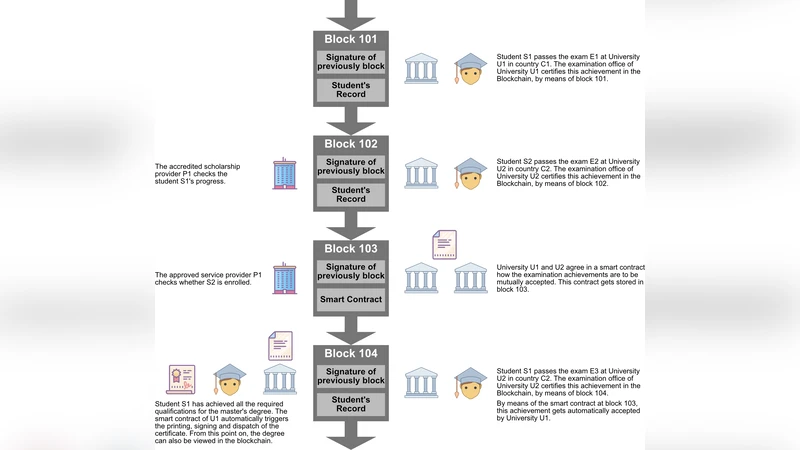
Smart contracts encode the specific requirements of degree programs (e.g., a minimum number of credits, completion of mandatory courses, and a set of topics). When a student’s accumulated metadata satisfy these contracts, the system automatically issues a verifiable degree token, which can be rendered as a printable certificate or shared with third‑party verifiers. The authors illustrate several use cases: (1) a student taking an exam at any participating university sees the result instantly recorded and recognized by their home institution; (2) scholarship agencies monitor progress in real time, reducing bureaucratic overhead; and (3) graduation processes become fully automated, eliminating manual transcript checks.
The paper does not shy away from potential drawbacks. Because blockchain entries are permanent, erroneous records cannot be deleted, only superseded, which may raise concerns about data hygiene. The authors warn of “degree optimization” where students might exploit the system to find the easiest path to a qualification, potentially undermining academic rigor. They also raise philosophical questions about the devaluation of traditional degrees if learning becomes entirely modular and interchangeable across providers. Moreover, cross‑jurisdictional legal compliance, data‑protection regulations, and the need for a global governance framework are identified as critical hurdles.
In conclusion, the authors view the blockchain approach as a promising avenue to reduce administrative costs, increase transparency, and facilitate seamless international mobility for the estimated 195 million students worldwide. However, they stress that successful deployment requires coordinated technical standards, robust privacy safeguards, and comprehensive policy discussions involving universities, governments, and industry stakeholders. Only with such a holistic effort can the envisioned “global student achievement ledger” become a practical reality.
Comments & Academic Discussion
Loading comments...
Leave a Comment