T0 Fan-out for Back-n White Neutron Facility at CSNS
the main physics goal for Back-n white neutron facility at China Spallation Neutron Source (CSNS) is to measure nuclear data. The energy of neutrons is one of the most important parameters for measuring nuclear data. Method of time of flight (TOF) is…
Authors: X.Y. Ji, P. Cao, T. Yu
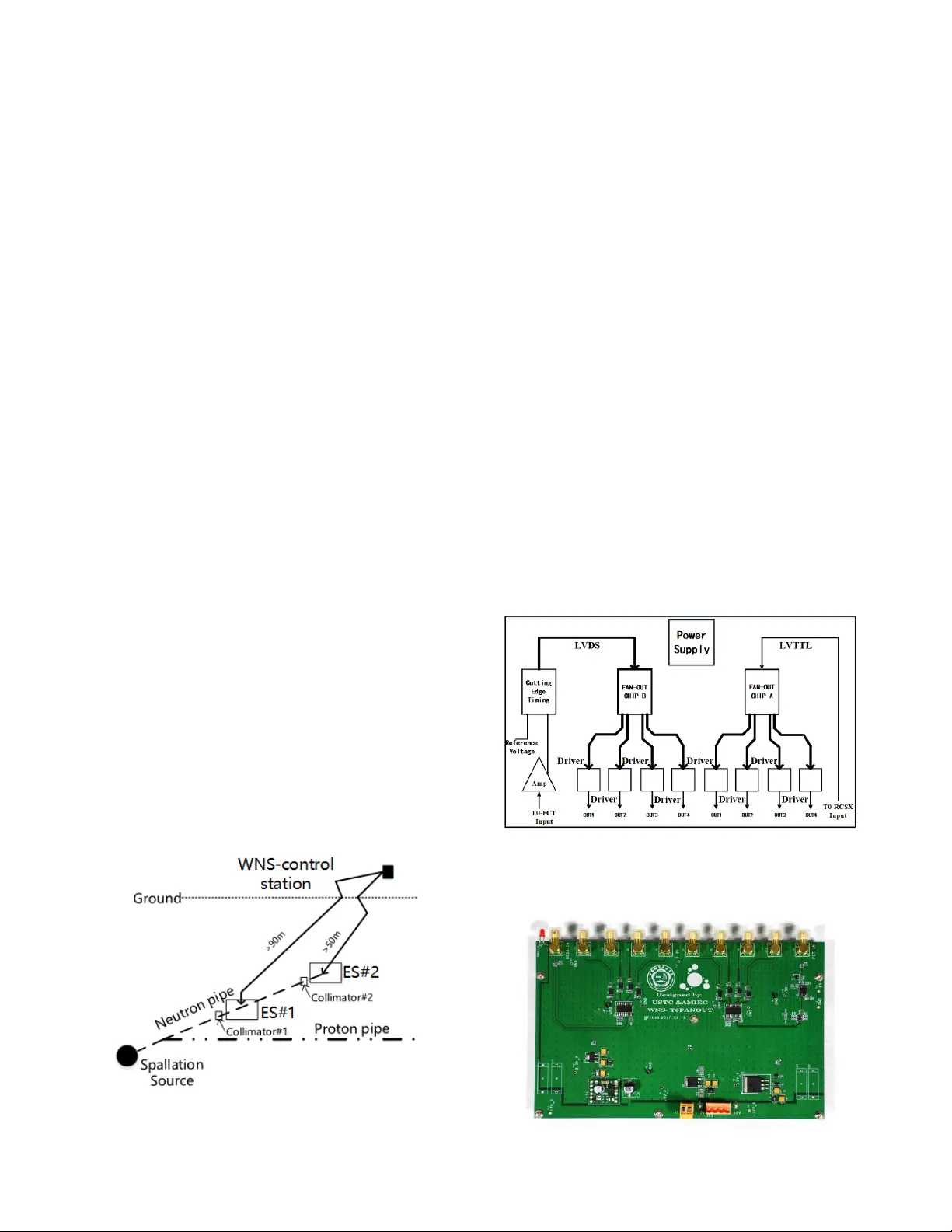
> REPLACE THIS LINE W ITH YOUR P APER IDENTIFICAT ION NUMBER (DOUB LE -CLICK HERE T O EDIT) < 1 Abstract — the main physics goal for Back -n w hite neutron facility at China Spallation Neutron So urce (CSNS) is to m easure nuclear data. The energy of neutrons is one of the most important parameters for measurin g nu clear data. Method of ti me of flight (TOF) is used to obtain the energy of neutrons. The time w hen proton bunches hit the thick tu ngsten target is considered as the start point of TOF. T0 signal, generated from the CSNS accelerator, r epresents this start tim e. Beside s, the T0 signa l is also used as the gate c ontrol signal that trigg ers the readout electronics. Obviously, the ti ming precision of T0 directly affects t he measurement precision of TOF and controls th e running or readout e lectronics. In this paper, th e T0 fan-out for Back-n white neutron facility at CSNS is pr oposed. The T0 signal travelling from the CSNS accelerator is fanned out to the tw o underground experiment stations respect ively over l ong cables. To guarantee the timing precision, T0 signal is conditioned w ith good signal edge. Furthermore, techniques of signal pre-emphasizing and equalizing are used to improve signal quality after T0 being tr ansm itted over long cables w ith about 1 00 m length. Ex periments show that the T0 fan-out works w ell, the T0 signal transmitted ove r 100 m remains a good time r esolution with a standard dev iation of 25 p s. It absolutely meets the require d accuracy of the measurem ent of TOF. Index Terms — CSNS, Fan-out, Timing, TOF, T0, WNS I. I NTRODUCTION HE China Spallatio n Ne utron Source (CS NS) is a lar ge Manuscript submitted June 24, 2018. This work is supported by the Nat ional Key Research an d D evel opment Program of Chi na (Proje ct: 2 016YFA 0 401602) and NSAF (No. U153011) (Corre sponding author: P. Cao, e-mail: cping@ustc.edu. cn). X.Y. Ji, P. Cao, T. Yu, L.K. Xie, X.R. Huang , Q. An, C.Q. Feng, S.B. Liu, L. Yu , Z.J. Su n, R.R. F an and L .Y. Zhang are w i th the State K ey Laboratory of Particle Detection and Electronics , Beijing 100049, Hefei 230026, China (hwjxy@mail.us tc.edu.cn). P. Ca o, X.Y. Ji and L.K. Xie are with the Department of Engineering and Applied Physics, University of Scie nce and Technology of China, Hefei, China. Q. An, C.Q. Feng, X.R. Huang, S.B. Liu, T. Yu and L. Yu are with the Department of Mo d ern Physics, U niversity of Science and T echn ology of China, Hefei, China. H.Y. Bai, Z .Q. Cui, H.Y. Jia n g, and G .H. Zhang are w ith t he Peking University, Be ijing 100871, Chin a. J. Bao, G.Z. He , H .X. H uang, G . Y. L u an, J . Ren, X.C. Ruan, H.Q. Tang, Qi Wang, Z .H. Wang, X.G. Wu, Q .W. Zhang, Q .P. Z hong a nd Z.Y. Z hou are w ith the China I n stitute of Atomic E nergy, Beij ing 102413, China. scientific facility that is mainl y desi gned to carry out multidisciplinary research on ma terial characterizatio n making the use of neutron scatteri ng techniques. The B ack-n w hite neutron experimental facility for nuclear d ata measurement is based on the back -streaming neutrons [1][2] [3][4]. It takes the advantages o f a 15 ° d eflection angle of t he p roton beam li ne RTBT. The neutrons produced by the spallatio n are canalized to the ES#1 (Experiment Station) and ES#2, which is about 56m and 76 m a way from the target respective, through a vacuum pipe. There will be 7 spectrometers i n these two experiment stations: C6D6 detectors, a 4 π -BaF2 arr ay na med GT AF- Ⅱ (Gamma Total Absorp tion Facility Ⅱ ) for neutron capture cross - section (n, γ ) measurements, FIXM (Fast Ionizatio n Cha mber Spectrometer for Fission C ross-sec tion Measure ment) for fission cross -section (n, f) measurements, NTOX (N eutron Total Cross-section Spectro meter) for total cross -section (n, t) measurements, LPDA (Light -charged Particle Detector Array), FINDA (Fission Neutron Spectrum Detector Array) for prompt fission neutron spectrum measurements and GAEA (Gamma spectrometer with Ger manium Arra y) for ga mma spec trum (n, n’γ/2nγ) measurements. Detailed descr iption is given in re f. [5]. Neutron e nergy sp ectrum is a very important part for the measurement, t he TOF (time of flight) is applied for the acquisition o f neutron ener gy [5 ]. The kinetic energ y of the neutrons is calculated relying on the measurement o f the arrival M.H. Gu, X.L. Ji, Y. Li and K.J. Zhu are with the Institute of High Energy Physics, CAS, Bei jing 100049, China. Y.H. Chen, R.R. Fan, W.L . Huang, Y.C. He, H.T. Jing, W.Jiang, N. Kang, B. Li, L. Li, Q. L i, X. Li, Y.L . Ma, C.J. Ning, H. Sun, X.Y . Sun, Z.J. S un, J.Y. Tang, Z.X. Tan, P.C. Wang, Q.B. Wu, X. Wu, Y.F. Wang, Y.J. Wu, Z. Wang, H. Yi, J. Zhang, L. Z h ou and L.Y. Zhang are with the Institute of High Ener gy Physics, CAS, Beijing 100049, China and Dongguan Neutron Science Center, Dongguan 52380 3, China. Y.F. He a nd P.J. Cheng are with the University of S outh C hina, Hengyang 421001, China. Z.J. Han, R. Liu, X.Y. Liu, J. Wen, Z.W. Wen and Y.W. Yang are with the Institute of Nu clear Phy sics and Chemistry , CAEP, Miany an g, China. Z.H. Song and X.P . Zhang are with the Northwest I nstitute of Nuclear Technolo gy, Xi’an, China. Q.M. Zhang and Y.T. Zhao are with th e Xi’an Jiaotong University , Xi’an 710049, China. T.F. Wang is wit h the Beihang U ni versity , Beijing, China . T0 Fan-out for Back-n White Neutron Facility at CSNS X.Y. Ji, P. Cao, T . Yu, L.K. Xie, X .R. Huang, Q. A n, H.Y . Bai, J. Bao, Y.H. C hen, P. J. Cheng, Z.Q. Cui, R.R . Fan, C.Q. Feng , M.H. Gu, Z.J. Han, G. Z. He, Y.C . He, Y.F. He, H.X. Huang, W.L. Huang, X.L. J i, H.Y. Jiang, W. Jiang, H.Y . Jing, L. Kang, B. Li, L . Li, Q. Li, X. Li, Y. Li, R. Liu, S.B. Liu, X.Y. Liu, G.Y. Luan, Y.L. Ma , C.J. Ning, J. Ren, X .C. Ruan, Z.H . Song, H. Sun, X.Y. Sun, Z. J. Sun, Z.X. Tan, J.Y. Tang, H.Q. Tang, P.C. Wang, Q . Wang, T.F. Wang, Y.F. Wang , Z.H. Wang , Z. Wang, J. W en, Z.W. Wen, Q.B. Wu, X.G. Wu, X. Wu, Y.W. Yang , H. Yi, L. Yu, Y.J. Yu, G.H. Zhang , L.Y. Zhang, J. Zhang, Q.M. Z ha ng, Q.W. Zhang , X .P. Zhang , Y.T. Zhao, Q.P. Zhong , L. Zhou, Z .Y. Zhou and K.J. Zhu T > REPLACE THIS LINE W ITH YOUR P APER IDENTIFICAT ION NUMBER (DOUB LE -CLICK HERE T O EDIT) < 2 time and the starting time of the neutrons. There is going to be a timing pulse t hat represents the ver y emission time o f the neutrons, so-called T0 , and the detectors will give the exact time when the neutrons arrive, and both of them are record ed down by the DAQ (Data Acquisition), actually the ti ming p ulse is used to trigger the DAQ. The DAQ is detailed descripted in ref. [6]. II. F EATURES OF T0 SIG NAL Actually, the e xact neutro n emissio n time fro m the tar get i s not p ossible to m easure w ithout changing it [7], but we can find other times which are relative t o the neutro n e mission time with a fixed time interval. In Back -n white neutron source, there are three kinds o f timing pulses, and we will choose the o ne with better time resolution depending on t he final evaluatio n test. Another way to ti ming by d etecting the p rompt gam ma bur st from the target in the neutron b eam line is also available at Back-n, as it could be record ed by the DA Q directly, it will not discuss further. Her e is the detailed description for the three kinds of T0. The first timing p ulse come s from RCS (Rapid Cycling Synchrotron) kic ker magnet, supported by the control system. When t he kicker magnet o pens the gate to let the protons beams hit t he lead target t hrough t he tube, a sensing signal will b e generated by the control system, and converted to a ligh t signal for a long distance tran smission from the RCS Statio n to WNS CS (Control Station). I n WNS Control Station the signal will be converted back to a LVTT L signal, features a range from 1 μs to 10μs pulse width. I t is ca lled RCSX -T0, it is supposed to trigger the WNS read out electronics i mplemented in W NS CS, ES#1 (Experiment Statio n) and ES#2, respec tively. As described in ref. [5] . The seco nd timing p ulse com es from t he bea m monitoring system, t he sensing probe with 0.5V/ A sen sitivity, located beside the sixth magnet away from the 15° bending ma gnet, will generate a sensing s ignal when the proto n bea ms goes by. The pulse features an 86ns pul se width. T he bea m peak intensit y reaches up to 40A when the beam p ower is 100kW [5]. The signal tr aveling along t he ca ble to W NS Control Station, is attenuated to 8V peak amplit ude w hen the RCS r uns full power, 100kW, and 0.8V peak amplitude with the 10kW b eam power . The charac teristics of the signal m ai nly depend on the o peration mode, the operation mode is detailed in ref. [5]. And it is called FCT-T0. The last T0 signal is p rovided by a B aF2 detector at Collimator#1 which is used for online detec tion of the pr om pt gamma. We named it Ga mma-T0 . We p ropose a kind solutio n of T 0 Fan -out taking consideration o f the Back -n la yout. The T0 fan-out struct ure is indicated in Fi g. 1. Both RCSX-T0 and FCT-T0 will b e f an-o ut from WNS Control Statio n to ES#1 and ES#2, and the y share the same cable. As for the Ga mma-T0, w e process the s ignal at Collimator#1 and dr ive the signal back to WNS Control Stati on, then the Gamma -T0 could b e f an-out like FCT-T 0. III. I MPLEMENTA TION OF T HE T 0 FAN - OUT BOARD The ke y is ho w to ensure the r esolution o f the ti ming p ulse after such a lo ng distance trans mission for an elec tronic signal. There are two main factors wh ich will increase the timing no n - determinacy. First, the ri se time of the signal have a sig nificant impact o n the ti ming re solution, especially when the cutting - edge-timing is implemented. Because the white noise always exists, the stochastic noise add ed to the rise edge will make the point which crosses the thresho ld m uch more nondeter ministic, it is so -called ti me-walk e ffect, the slower t he rise edge is, the worse t he si tuation will be. Second, the proce ssing model may cause extra neous jitter , it will also have bad i nfluence o n the timing resolution. The blo ck diagram of T0 -Fanout-Board is illustrated in Fig. 2. The T0-Fanout-Boar d includes FCT-T0 process function block and RCSX-T0 function blo ck. As for the FCT -T0, the Fig. 1. Structure of ES#1, ES#2 and WNS (White Neutron Source) Control Station. The WNS Control Station is above the ground, and the coaxial cable for T0 fan-out have been laid. The l onge st cable is more than 100m. Fig. 2 . Block diagram of T0 F a n-out Board Fig. 3 . The photograph of T0 Fan-out Board > REPLACE THIS LINE W ITH YOUR P APER IDENTIFICAT ION NUMBER (DOUB LE -CLICK HERE T O EDIT) < 3 signal goes t hrough the ampli fier to adap t to the comparator, cooperating with the L MH722 0 to im p lement the cutting -edge- timing. The T 0 signal has been transferred into digital signal by LMH7220, w ith LVDS standar d. Then the LVDS remaining the information of the T 0 w ill be fan-out by SN65LVDS104, which offers four lo w-noise coupling LVDS o utput. The next, each LVDS output signal will be d riven by DS15 BA101 to ensure a long d istance transpo rtation. T he DS15NA101 features a very high speed si gnal buffer for cable driving. T he RCSX -T0 is fan- out by SN65 LVDS105 direc tly, because the c hip supports a LVTTL input model and o ffers the sa me output features with SN65LVDS104 . Th e photograph of T 0 Fan-out board is shown in Fig. 3. IV. T EST R ESULT The T 0 Fan-out Boar d has been tested, focused on the difference ab out signal shaking between t he input and outp ut, the RMS of tra nsport delay is an index to e valuate the performance of the board. The RCSX -T0 fan-out function block and FCT-T0 fan-out function block have been tested, respectively. The d iagram of test is sho wn in Fig. 4. The RCSX-T0 test is using a signal ge nerator to produce a cycle square wave with a leading and trailing edge of 10n s. Take the advantage o f T ektronix DP O5104, we co mpare the input sig nal and the o utput signal which travels alo ng a 100 meters LMR-240 coaxial-cable. The result is sho wn i n Fi g. 5 , the standard deviation o f the transport delay is 17.3ps, and it is enough to meet the requir ement of the TOF r esolution 1ns . The FCT -T0 test is al most t he sa me as t he RC SX-T 0 test except of the a mplitude of the input signal, which is set to 800mV. The s tandard deviation o f the transport delay is 24.9ps, this result is also meet the req uirement. On the other ha nd, another te st also proves that the fan-o ut model meets the r equirement. We use the signal generator to provide a per iodic pulse to the T 0 fan-out board , and ca lculate the jitter o f the output si gnal whic h travel s along a 100 meters LMR-240 coaxial-cable by using the Tektro nix DPO5104 . The result is illustrated in Fig. 6. The result of RCSX-T0 test is 31.6p s, indicating that the fan-o ut model meets the requirement. The test of FCT -T0 jitter is also car ried out, w i th the s tandard deviation of jitter 33.9ps. the T0 fan-out board is eno ugh to satisfy t he demand of the TOF measurement suppor ted by all the test results. V. C ONCLUSION In this p aper, we propose the idea of T0 -Fanout to satisfy t he needs of the T OF measure ment at the Back -n white neutron source in CSNS, aiming at the problem of the T0 signal’s fa n - out and long distance transportation, we design the T0 -Fanout- Board. T he board could fan out fo ur channel signal for each kind of T0 signal, drive the signal transmittin g a long d istance and ensure an extremely sm all jitter of th e rise edge. The m od el has been te sted to p roving that it works well d uring the TO F experiment. R EFERENCES [1] J. Y. Tang et al., “Key nuclear data measurements for advanced fission energy and white neutron source at CSNS,” Atom. Energ. Sci. Technol, vol.47, pp.1089-1 095, 2013. [2] J. Y. Tang et al., “Characteristics and Potential Applications of the Proton Beams at the CSNS,” J. Kor. Phys. Soc. vol.52, pp. 710 -713, Mar. 15, 2008. [3] J. Y. Tang et al., “P roposal for muo n and white neutron source s a t C SNS,” Chin. Phy s. C, vol.34, pp.121, 2010. [4] H. T. Jing et al., “Studies of back -streaming white n eu trons at CSNS,” Nucl. I nstrum. Meth. A, vol . 621, Iss.1-3 pp.91-96, Se p. 2010. [5] J. Y. Tang, “Back -n w hite neutron fac ility for nucle ar data measureme n t at CSNS,” J. i nst., vol. 12, P0 7022, Dec. 2017 [6] Q. Wang et al., “Ge neral -purpose readout ele ctronics for white neutron source at China Spallation Neutron Source ,” R ev. Sci. Instrum, vol.89, Jan.25, 2018, DOI : 10.1063/1.5006346 [7] W. Christina et al., “A CVD Diamond Detector for (n, a) Cross -Section Measurements,” CERN -TH ESIS, 101, pp.155, Se p .26, 2014. Fig. 5 . RMS of transport delay test result Standard deviation 17.3ps Fig. 6 . The te st re sult of the RCSX-T0 w h ich tra nsmits ove r 10 0m, the Standard deviation is 31.6ps, Fig. 4 . The diagram of test
Original Paper
Loading high-quality paper...
Comments & Academic Discussion
Loading comments...
Leave a Comment