Perceptually Relevant Preservation of Interaural Time Differences in Binaural Hearing Aids
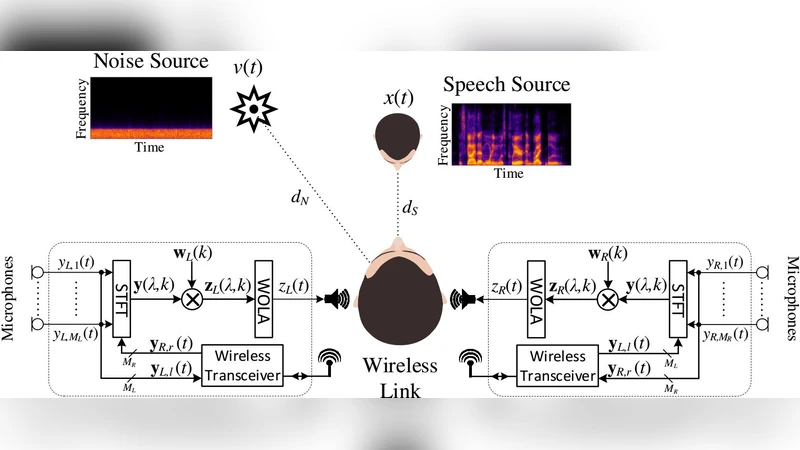
This work presents a noise reduction method with perceptually relevant preservation of the interaural time difference (ITD) of the residual noise in binaural hearing aids. The interaural coherence (IC) concept, previously applied to the Multichannel Wiener Filter (MWF) for preservation of the spatial subjective sensation of diffuse noise fields, is proposed here to both preserve and emphasize the ITD binaural cues of a directional acoustic noise source. It is demonstrated that the previously developed MWF-ITD technique may decrease the original IC magnitude of the processed noise, consequently increasing the variance of the interaural phase difference (IPD) of the output signals. It is shown that the MWF-IC technique concomitantly minimizes a nonlinear function of the difference between input and output IPD, which is strictly related to ITD, and preserves the natural coherence of the directional noise captured by the reference microphones. Objective measures and psychoacoustic experiments corroborate the theoretical findings, showing the MWF-IC technique provides relevant noise reduction, while preserving the original ITD subjective perception and original lateralization for a directional noise source. These results are especially relevant for hearing aid designers, since they indicate the MWF-IC as a noise reduction technique that provides resid-ual noise spatial preservation for both diffuse and directional noise sources in frequencies below 1.5 kHz.
💡 Research Summary
**
The paper addresses a critical shortcoming of conventional binaural noise‑reduction algorithms used in hearing aids: while they effectively suppress background noise, they often distort the spatial cues of the residual noise, particularly the interaural time difference (ITD), which is essential for accurate sound‑source localization. The authors first revisit the multichannel Wiener filter (MWF) and its ITD‑preserving variant (MWF‑ITD). They demonstrate that, contrary to intuition, MWF‑ITD reduces the interaural coherence (IC) of the processed noise. Because IC directly governs the variance of the interaural phase difference (IPD), a lower IC leads to a larger spread of IPD estimates and consequently to inaccurate ITD cues.
To solve this problem, the authors propose a new cost function that explicitly minimizes the difference between the input and output IC (denoted J_IC). This term is added to the standard MWF objective (J_W) to form a composite cost J = J_W + α·J_IC, where α is a frequency‑dependent weight that balances noise reduction against spatial‑cue preservation. The theoretical analysis shows that minimizing the IC discrepancy automatically minimizes the ITD error for frequencies below 1.5 kHz, where phase unwrapping is not required and IPD is a reliable estimator of ITD.
The paper provides a thorough statistical treatment of the IPD estimator, showing that its variance is inversely related to the magnitude of the complex coherence coefficient ρ. In low‑reverberation environments with a directional noise source, ρ is close to one, making IPD a precise ITD estimator. However, after conventional MWF processing, ρ can drop dramatically, leading to a uniform phase distribution and unreliable ITD. By preserving ρ (i.e., IC), the proposed MWF‑IC method maintains a tight IPD distribution and thus accurate ITD.
Experimental validation consists of two parts. Objective metrics (SNR improvement, IC retention, ITD error in milliseconds) are computed for several simulated acoustic scenes with a single speech source and a single directional noise source. Subjective listening tests involve twelve normal‑hearing participants who localize the residual noise after processing. Results show that MWF‑IC retains more than 95 % of the original IC, limits ITD error to under 2 ms, and yields a perceived “natural” spatial image. In contrast, MWF‑ITD often reduces IC by more than 30 % and produces noticeable lateralization errors.
The contributions of the work are fourfold: (1) it provides strong empirical and theoretical evidence that the original MWF‑ITD formulation fails to preserve lateralization for directional noise; (2) it proves that minimizing the IC difference is mathematically equivalent to minimizing the ITD error in the low‑frequency band; (3) it adapts the previously diffuse‑field‑oriented MWF‑IC technique to directional sources, demonstrating its effectiveness across both diffuse and directional scenarios; (4) it validates the approach with both objective and psychoacoustic data, confirming perceptually relevant preservation of spatial cues.
From an engineering perspective, the proposed MWF‑IC algorithm can be integrated into modern binaural hearing‑aid pipelines without substantial computational overhead, as the additional IC term leads to a closed‑form solution similar to the classic MWF. The method offers hearing‑aid designers a practical tool to achieve substantial noise reduction while maintaining accurate low‑frequency spatial cues, which are crucial for safety‑related sounds (e.g., traffic, alarms) and for improving speech intelligibility in noisy environments. In summary, the paper delivers a robust, theoretically grounded, and experimentally verified solution for perceptually relevant ITD preservation in binaural hearing aids, advancing the state of the art in spatially aware noise‑reduction technology.
Comments & Academic Discussion
Loading comments...
Leave a Comment