Challenges of Internet of Things and Big Data Integration
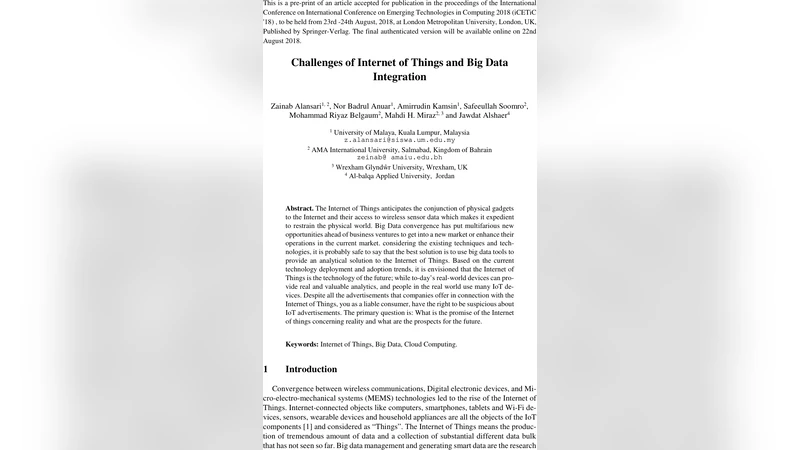
The Internet of Things anticipates the conjunction of physical gadgets to the In-ternet and their access to wireless sensor data which makes it expedient to restrain the physical world. Big Data convergence has put multifarious new opportunities ahead of business ventures to get into a new market or enhance their operations in the current market. considering the existing techniques and technologies, it is probably safe to say that the best solution is to use big data tools to provide an analytical solution to the Internet of Things. Based on the current technology deployment and adoption trends, it is envisioned that the Internet of Things is the technology of the future, while to-day’s real-world devices can provide real and valuable analytics, and people in the real world use many IoT devices. Despite all the advertisements that companies offer in connection with the Internet of Things, you as a liable consumer, have the right to be suspicious about IoT advertise-ments. The primary question is: What is the promise of the Internet of things con-cerning reality and what are the prospects for the future.
💡 Research Summary
The paper titled “Challenges of Internet of Things and Big Data Integration” attempts to outline the technical, organizational, and security challenges that arise when trying to fuse the massive streams of sensor data generated by IoT devices with big‑data analytics platforms. The authors begin by emphasizing the three‑V characteristics—volume, velocity, and variety—of IoT data, arguing that traditional data warehouses are ill‑suited for handling the heterogeneous, high‑frequency, and large‑scale datasets produced by billions of connected objects. Consequently, they propose a “data supply chain” perspective that requires a redesign of data acquisition, storage, processing, and consumption pipelines.
In the data‑acquisition layer, the paper surveys lightweight communication protocols such as MQTT, XMPP, and CoAP, recommending MQTT (with the open‑source Mosquitto broker) as the default choice because of its low bandwidth and resource footprint. While the discussion acknowledges QoS levels, security (TLS), and scalability concerns, it stops short of providing quantitative benchmarks or a systematic comparison that would guide practitioners in selecting the most appropriate protocol for a given deployment scenario.
The authors then turn to storage and processing infrastructure, noting the rise of NoSQL databases (Cassandra, MongoDB) and cloud‑based platforms as necessary to accommodate unstructured and semi‑structured IoT streams. However, the paper does not delve into concrete design decisions such as data partitioning strategies, consistency models, cost‑performance trade‑offs, or the integration of stream‑processing engines (e.g., Apache Flink, Spark Structured Streaming) with batch analytics frameworks.
A central contribution is a five‑layer analytical framework: (1) Data Collection, (2) Extract‑Transform‑Load (ETL), (3) Semantic Reasoning, (4) Machine‑Learning‑Based Learning, and (5) Action Execution. This architecture mirrors existing Lambda/Kappa models but lacks detailed specifications of the technologies, algorithms, or orchestration tools that would operationalize each layer. The paper also glosses over model lifecycle management (MLOps), data versioning, and real‑time feedback loops, leaving a gap between high‑level vision and implementable solutions.
On the human side, the authors stress a skills gap: organizations need personnel who combine expertise in big‑data analytics with domain knowledge of specific IoT applications (e.g., smart agriculture, intelligent transportation). Yet the manuscript provides no concrete roadmap for training, role definition, or talent acquisition, making it difficult for managers to translate this insight into actionable HR strategies.
Security and privacy considerations are mentioned in passing. The authors acknowledge that data traverses multiple stages—capture, transmission, storage, and analysis—each exposing potential attack vectors. Nevertheless, the paper does not present a threat model, nor does it discuss concrete countermeasures such as end‑to‑end encryption, fine‑grained access control, secure multi‑party computation, or compliance with regulations like GDPR and CCPA.
Finally, the paper attempts to link IoT‑big‑data integration to business value, claiming that real‑time analytics can improve decision‑making across sectors ranging from finance to healthcare. However, it offers no quantitative ROI analysis, KPI definitions, or case studies that demonstrate measurable benefits. This omission weakens the persuasive power of the argument for senior executives and investors.
In summary, the manuscript provides a broad, albeit repetitive, overview of the challenges associated with merging IoT and big‑data technologies. Its strengths lie in highlighting the need for a holistic data‑supply‑chain view and in enumerating a set of high‑level architectural components. Its weaknesses are the lack of empirical validation, insufficient technical depth (especially regarding protocol performance, storage architecture, and analytics pipeline implementation), and an absence of concrete guidance on security, talent development, and business case justification. Future research should focus on (1) rigorous benchmarking of communication protocols and storage solutions under realistic IoT workloads, (2) detailed design and deployment of hybrid stream‑batch analytics pipelines with clear technology stacks, and (3) development of organizational frameworks that quantify ROI, define KPIs, and address regulatory compliance, thereby turning the conceptual vision into a practicable roadmap for industry adoption.
Comments & Academic Discussion
Loading comments...
Leave a Comment