Characterization and Classification of Human Body Channel as a function of Excitation and Termination Modalities
Human Body Communication (HBC) has recently emerged as an alternative to radio frequency transmission for connecting devices on and in the human body with order(s) of magnitude lower energy. The communication between these devices can give rise to different scenarios, which can be classified as wearable-wearable, wearable-machine, machine-machine interactions. In this paper, for the first time, the human body channel characteristics is measured for a wide range of such possible scenarios (14 vs. a few in previous literature) and classified according to the form-factor of the transmitter and receiver. The effect of excitation/termination configurations on the channel loss is also explored, which helps explain the previously unexplained wide variation in HBC Channel measurements. Measurement results show that wearable-wearable interaction has the maximum loss (upto -50 dB) followed by wearable-machine and machinemachine interaction (min loss of 0.5 dB), primarily due to the small ground size of the wearable devices. Among the excitation configurations, differential excitation is suitable for small channel length whereas single ended is better for longer channel.
💡 Research Summary
The paper presents a comprehensive experimental study of Human Body Communication (HBC) channels under a wide variety of interaction scenarios and excitation/termination configurations. While prior work has largely focused on intra‑body links and reported highly variable loss values, this work systematically measures channel loss for 14 distinct cases, covering wearable‑wearable, wearable‑machine, and machine‑machine interactions, each implemented with both single‑ended (SE) and differential (DE) excitation.
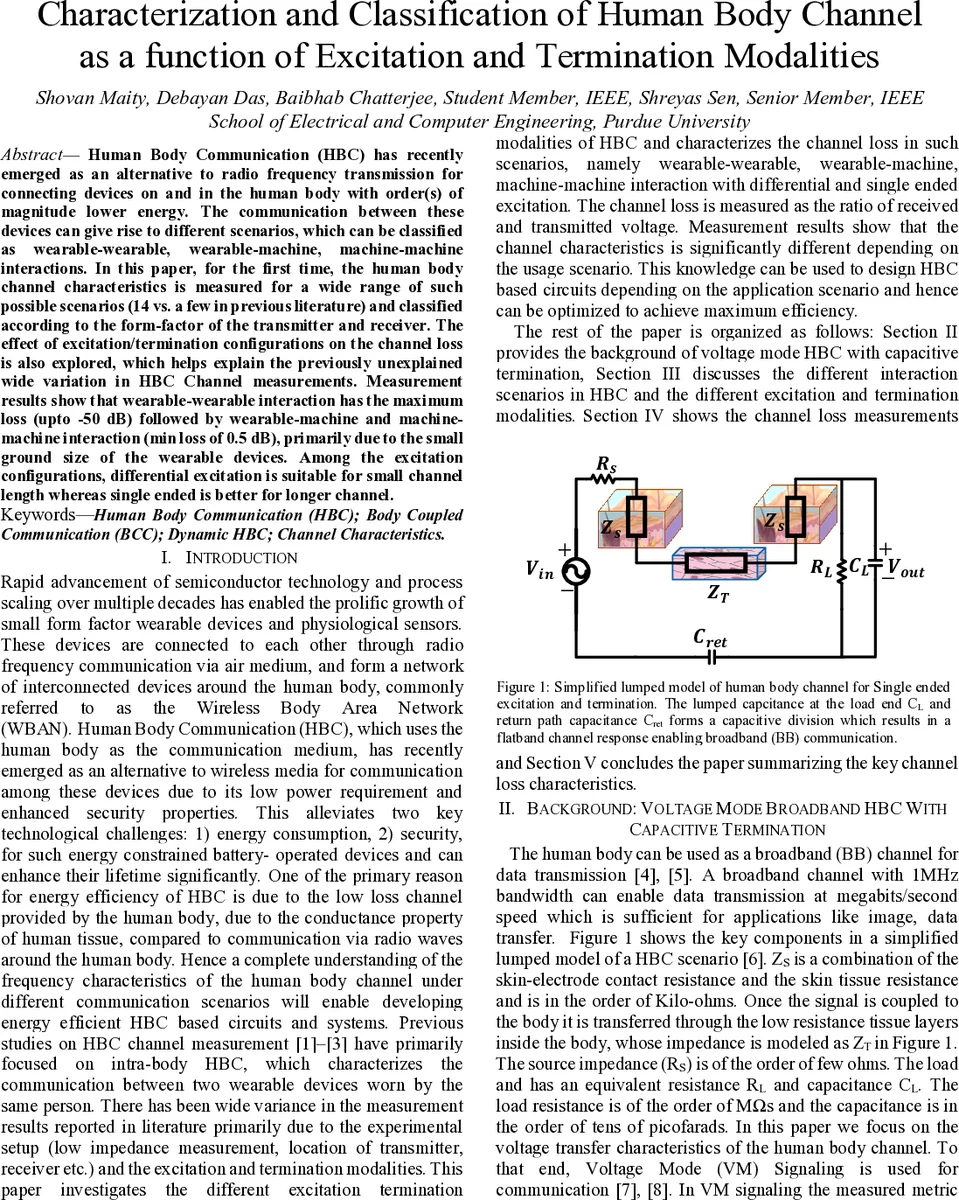
A voltage‑mode signaling approach is employed, using a low‑impedance Texas Instruments TM4C123G board as the transmitter and a high‑impedance oscilloscope as the receiver. The equivalent circuit includes skin‑electrode contact resistance, tissue impedance, and load resistance/capacitance. In SE mode, the return path is formed by the capacitance between the transmitter ground and earth, creating a frequency‑independent capacitive voltage divider that yields a flat‑band loss characteristic. In DE mode, both signal and ground electrodes are attached to the body, forming a closed loop that generates an electric field; the received voltage is the differential potential between two receiver electrodes.
Key findings: (1) Wearable‑wearable links exhibit the highest loss (up to –50 dB) because both devices have small ground planes, resulting in a small return‑path capacitance. Loss increases with distance, especially for DE excitation. (2) Wearable‑machine links show considerably lower loss; the larger ground of the machine provides a larger return‑path capacitance, making SE excitation superior to DE in this case. (3) Machine‑machine links, particularly when devices are mains‑connected, experience almost negligible loss (≈0 dB) because the ground is effectively infinite. (4) DE excitation is advantageous only for short channel lengths or when the receiver electrodes lie within the transmitter’s closed loop; otherwise SE excitation consistently yields lower loss.
These results reconcile the wide discrepancies reported in earlier HBC measurements by attributing them to differences in ground size and excitation modality. The study provides practical design guidance: select SE excitation for long‑range or ground‑limited wearable scenarios, use DE excitation for short, closed‑loop links, and consider augmenting ground area or adding intentional return‑path capacitance to minimize loss. The insights are directly applicable to low‑power wearable networks, secure human‑machine interfaces, and machine‑to‑machine data exchange using the human body as a communication medium.
Comments & Academic Discussion
Loading comments...
Leave a Comment