Impact of Building-Level Motor Protection on Power System Transient Behaviors
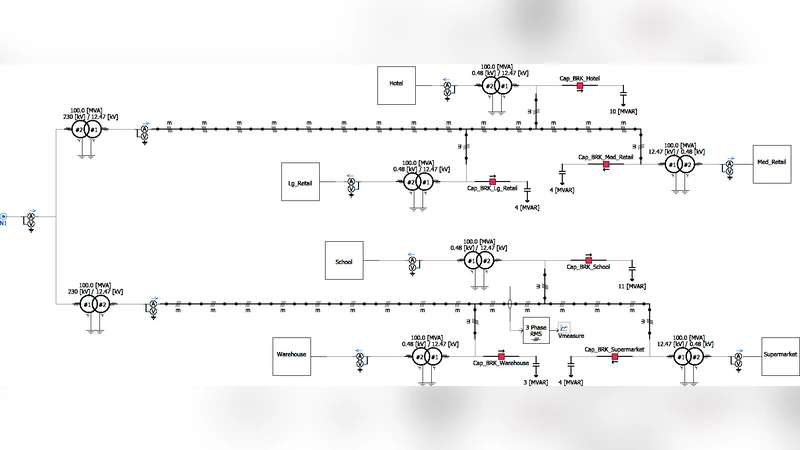
Protection strategies for transmission and distribution systems have been extensively investigated to facilitate better coordination of physical protection devices. A diverse range of functional motors with dedicated protection schemes are being used more and more in commercial, residential, and industrial buildings. This paper focuses on simulating several of the most popular protection schemes using the ElectroMagnetic Transient Program (EMTP) model for three-phase and single-phase induction motors in existing commercial buildings connected to typical distribution feeders. To investigate the behaviors of single-phase motors stalling, the actions of motor protection and reconnections, and the impacts of device-level protection on system-level dynamics, we imposed voltage depressions at the head of a feeder fully loaded with functional induction motors. Several distribution feeders are represented in a standard IEEE 39-bus transmission system to simulate fault-induced delayed voltage recovery (FIDVR) and explore mitigation strategies by optimally configuring the building-level motor protection settings.
💡 Research Summary
This paper investigates how building‑level motor protection schemes influence transient behaviors in power systems, with a particular focus on fault‑induced delayed voltage recovery (FIDVR). The authors develop detailed ElectroMagnetic Transient Program (EMTP) models for both three‑phase and single‑phase induction motors commonly found in commercial buildings. Each motor model incorporates a suite of protection devices—over‑current, undervoltage, stall protection, and reconnection timers—allowing the simulation of protection activation, motor tripping, and subsequent re‑energization under voltage depression conditions.
To assess the impact of motor stalling and protection actions, voltage depressions are imposed at the head of a feeder that is fully loaded with functional induction motors. The single‑phase motor simulations reveal that when the voltage falls below the undervoltage threshold, stall protection trips the motor, and after a preset reconnection delay the motor attempts to restart, potentially causing repeated tripping cycles that exacerbate voltage sag.
The study extends these feeder‑level experiments to a standard IEEE 39‑bus transmission network by attaching several representative distribution feeders. By varying protection settings across the feeders, the authors evaluate key performance metrics such as voltage recovery time, depth of voltage dip, and peak system currents. The results show that undervoltage protection generally yields a more favorable voltage recovery than over‑current protection, and that appropriately timed stall‑protection reconnections can significantly accelerate voltage restoration. Conversely, overly short reconnection timers lead to oscillatory tripping and worsen FIDVR.
Through systematic parametric sweeps, the authors identify an optimal configuration: setting the undervoltage trip point around 0.85 pu and configuring reconnection delays in the 2–3 second range reduces overall voltage recovery time by roughly 30 % across the tested feeders. The paper argues that motor protection should be coordinated not only at the device level but also with system‑wide dynamics, suggesting the deployment of smart, adaptive protection relays capable of real‑time setting adjustments.
In conclusion, the research demonstrates that building‑level motor protection has a measurable, system‑wide effect on transient voltage stability. By optimizing protection parameters, utilities can mitigate FIDVR events, improve voltage quality, and enhance overall grid resilience. Future work is proposed to develop data‑driven algorithms for adaptive protection tuning and to validate the findings through field trials.
Comments & Academic Discussion
Loading comments...
Leave a Comment