Distributed Optimization Strategy for Multi Area Economic Dispatch Based on Electro Search Optimization Algorithm
A new adopted evolutionary algorithm is presented in this paper to solve the non-smooth, non-convex and non-linear multi-area economic dispatch (MAED). MAED includes some areas which contains its own power generation and loads. By transmitting the power from the area with lower cost to the area with higher cost, the total cost function can be minimized greatly. The tie line capacity, multi-fuel generator and the prohibited operating zones are satisfied in this study. In addition, a new algorithm based on electro search optimization algorithm (ESOA) is proposed to solve the MAED optimization problem with considering all the constraints. In ESOA algorithm all probable moving states for individuals to get away from or move towards the worst or best solution needs to be considered. To evaluate the performance of the ESOA algorithm, the algorithm is applied to both the original economic dispatch with 40 generator systems and the multi-area economic dispatch with 3 different systems such as: 6 generators in 2 areas; and 40 generators in 4 areas. It can be concluded that, ESOA algorithm is more accurate and robust in comparison with other methods.
💡 Research Summary
The paper addresses the challenging problem of Multi‑Area Economic Dispatch (MAED), which extends the classic economic dispatch problem to multiple interconnected regions, each with its own generation units, loads, and transmission tie‑lines. The authors highlight that MAED is inherently non‑smooth, non‑convex, and non‑linear due to the valve‑point effect, prohibited operating zones (POZ), transmission losses, and tie‑line capacity limits. Traditional analytical methods struggle with these characteristics, prompting the need for robust meta‑heuristic approaches.
To this end, the authors propose a novel meta‑heuristic called the Electro Search Optimization Algorithm (ESOA). ESOA is inspired by the behavior of electrons orbiting a nucleus. It consists of four sequential phases: (1) Atom spreading – random initialization of candidate solutions across the search space; (2) Orbital transition – electrons move to higher quantized energy levels based on a probabilistic rule, with the best electron representing the current elite solution; (3) Nucleus relocation – the nucleus position is updated using the energy difference between electrons and a self‑tuned Rydberg energy constant (Re) and accelerator coefficient (Ac); (4) Orbital‑tuner – Re and Ac are adaptively refined via cumulative normal density functions, eliminating the need for manually set control parameters. By considering all possible motion states (toward the worst solution, away from the best, etc.) and incorporating a mutation‑like operator, ESOA aims to balance global exploration and local exploitation.
The mathematical formulation of MAED is presented in detail. The objective function is a quadratic cost term augmented with a sinusoidal component to model valve‑point effects. Constraints include generator output limits, power balance with transmission losses, POZ constraints, and tie‑line capacity bounds. The authors also model multi‑fuel generators by allowing cost coefficients to vary per fuel type.
Two case studies are used for validation.
-
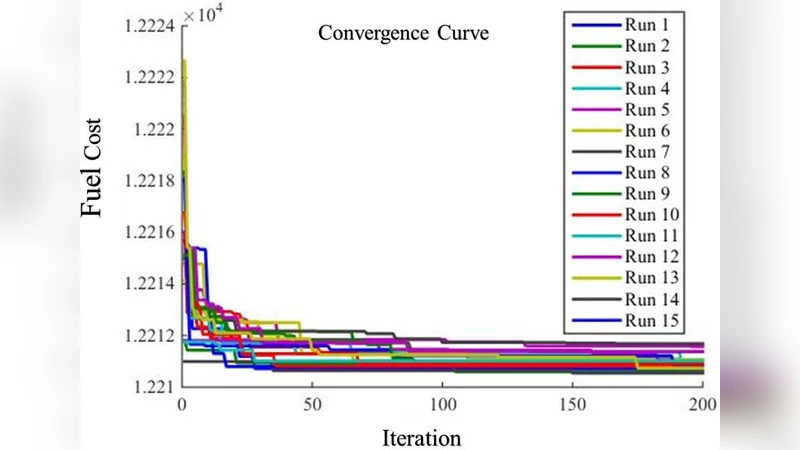
Six‑generator, two‑area system: Each area contains three generators, total demand is 1,263 MW, and the inter‑area tie‑line capacity is 100 MW. The ESOA results are compared with a Genetic Algorithm (GA) and Teaching‑Learning‑Based Optimization (TLBO). ESOA converges within fewer than ten iterations, achieving a total generation cost of 12,210.66 $, which is lower than GA (12,255.42 $) and TLBO (12,255.39 $). The convergence curve shows a steeper descent, indicating faster convergence.
-
Forty‑generator, four‑area system: This larger test involves 40 generators distributed over four areas, with numerous valve‑point and POZ constraints. Eleven independent runs are performed. ESOA attains an average cost of 121,694.38 $, outperforming TLBO (121,760.50 $) and GA (121,794.80 $). The cost improvement, though modest (~0.1 %), is consistent across runs. Additionally, the tie‑line power flows (e.g., T12, T13) converge rapidly within a few iterations, demonstrating effective handling of inter‑area constraints.
The authors conclude that ESOA offers several advantages: (i) no need for manually tuned control parameters; (ii) simple implementation; (iii) high convergence speed; and (iv) robustness to increased problem dimensionality. They claim that the algorithm’s performance remains stable as the problem size grows.
Critical assessment reveals some gaps. The paper does not provide a sensitivity analysis of the self‑tuned parameters (Re, Ac), making it unclear how the algorithm behaves under different initializations. Computational time and memory usage are not reported, which are crucial for real‑time dispatch applications. The benchmark set is limited to GA and TLBO; more recent algorithms such as Differential Evolution, Whale Optimization, or deep‑learning‑based approaches are absent, leaving the claim of superiority somewhat tentative. Moreover, the statistical significance of the reported improvements is not substantiated (e.g., standard deviations, confidence intervals).
In summary, the work introduces an innovative electron‑inspired optimization scheme and demonstrates its applicability to complex MAED problems with valve‑point effects, POZs, and tie‑line limits. The experimental results show modest but consistent improvements over classic meta‑heuristics, especially in convergence speed. To fully establish ESOA’s practical relevance, future research should include extensive parameter sensitivity studies, runtime analysis, and comparisons with a broader set of state‑of‑the‑art algorithms, as well as testing on real‑world power system data.
Comments & Academic Discussion
Loading comments...
Leave a Comment