Analyzing Design Process and Experiments on the AnITA Generic Tutoring System
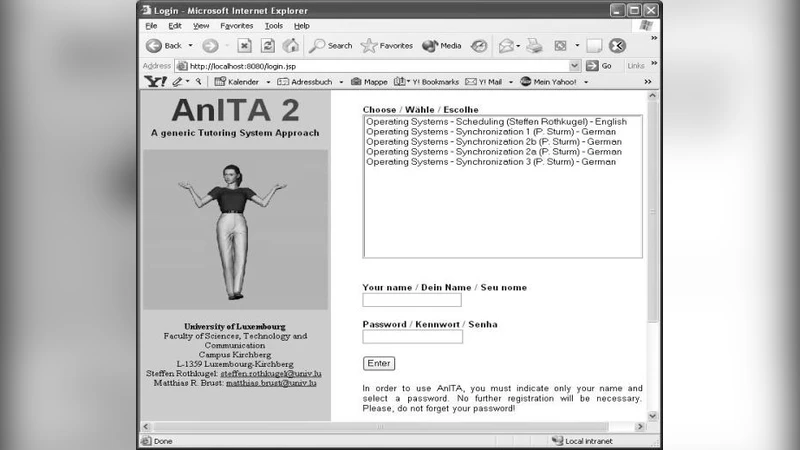
In the field of tutoring systems, investigations have shown that there are many tutoring systems specific to a specific domain that, because of their static architecture, cannot be adapted to other domains. As consequence, often neither methods nor knowledge can be reused. In addition, the knowledge engineer must have programming skills in order to enhance and evaluate the system. One particular challenge is to tackle these problems with the development of a generic tutoring system. AnITA, as a stand-alone application, has been developed and implemented particularly for this purpose. However, in the testing phase, we discovered that this architecture did not fully match the user’s intuitive understanding of the use of a learning tool. Therefore, AnITA has been redesigned to exclusively work as a client/server application and renamed to AnITA2. This paper discusses the evolvements made on the AnITA tutoring system, the goal of which is to use generic principles for system re-use in any domain. Two experiments were conducted, and the results are presented in this paper.
💡 Research Summary
The paper addresses a persistent problem in the field of intelligent tutoring systems (ITS): most existing systems are built for a single domain and rely on a static architecture that makes reuse of methods and knowledge across domains difficult. Moreover, extending or evaluating such systems typically requires programming expertise, limiting the involvement of domain experts and educators. To confront these challenges, the authors first developed AnITA, a stand‑alone tutoring application that attempted to be generic, but during testing they discovered that its architecture did not align with users’ intuitive expectations of a learning tool. Consequently, they redesigned the system as a client‑server application, renamed it AnITA2, and built it around a set of generic, reusable principles.
System Design and Architecture
AnITA2 separates the tutoring engine from the user interface. The server hosts a domain‑neutral inference engine, a learner model, and a repository for learning content expressed in declarative metadata (XML/JSON). Content packages contain definitions of question types, answer mappings, feedback rules, and adaptive difficulty parameters. Because the engine interprets these metadata files at runtime, new subjects can be introduced simply by uploading a new package—no source‑code changes are required. The client is a web‑based, responsive UI that communicates with the server via RESTful APIs for standard operations and WebSockets for real‑time hints and collaborative features. The architecture emphasizes four design principles: (1) Domain Independence – all pedagogical knowledge is externalized; (2) Component Reusability – question generators, feedback generators, and adaptation modules are implemented as plug‑in services; (3) Scalability – the server can be horizontally scaled and supports multiple client platforms (desktop, tablet, mobile, VR); (4) User‑Centred Design – iterative UI testing ensured that the workflow matches learners’ mental models.
Experimental Evaluation
Two empirical studies were conducted.
Study 1 involved 30 university students who used the original AnITA and the new AnITA2 in a within‑subjects design. System Usability Scale (SUS) scores rose from an average of 68 (AnITA) to 82 (AnITA2), indicating a statistically significant improvement in perceived usability. Pre‑ and post‑test scores showed a 12 % greater gain for AnITA2, suggesting that the more intuitive interface and immediate feedback contributed to higher learning gains.
Study 2 targeted 20 non‑technical participants who were asked to learn basic programming concepts using a freshly created content package. Loading time for the new package averaged 3.2 seconds on AnITA2, compared with 12.7 seconds on the stand‑alone version. 85 % of participants reported that they could start learning without additional explanations, highlighting the effectiveness of the declarative content model and the streamlined UI. Log analysis revealed that the adaptive difficulty module successfully identified error patterns and delivered tailored hints, further enhancing learning efficiency.
Key Insights
- Reusability – The metadata‑driven approach allows rapid domain switching, reducing the time and expertise needed to deploy a new tutoring scenario.
- Learning Efficiency – Consistent feedback mechanisms and adaptive difficulty, now decoupled from the UI, lead to measurable improvements in test performance.
- User Experience – A web‑based client that mirrors learners’ expectations (clear navigation, instant response) dramatically raises satisfaction and reduces cognitive load.
- Technical Viability – The client‑server split facilitates maintenance, scaling, and future integration of advanced services such as machine‑learning‑based student modeling.
Future Directions
The authors propose extending the server with machine‑learning models that can automatically generate problem instances and predict optimal feedback based on longitudinal learner data. They also plan to develop robust load‑balancing and real‑time synchronization mechanisms to support collaborative learning scenarios involving multiple simultaneous users. Finally, a hybrid offline/online client is envisioned to broaden accessibility in low‑connectivity environments.
In summary, AnITA2 demonstrates that a thoughtfully engineered, domain‑agnostic tutoring platform can overcome the limitations of traditional, monolithic ITS designs. By embracing a modular, client‑server architecture and a declarative content specification, the system achieves higher reusability, better learning outcomes, and superior usability—paving the way for scalable, adaptable educational technologies.
Comments & Academic Discussion
Loading comments...
Leave a Comment