Reversibility in space, time, and computation: the case of underwater acoustic communications
Time reversal of waves has been successfully used in communications, sensing and imaging for decades. The application in underwater acoustic communications is of our special interest, as it puts together a reversible process (allowing a reversible so…
Authors: Harun Siljak
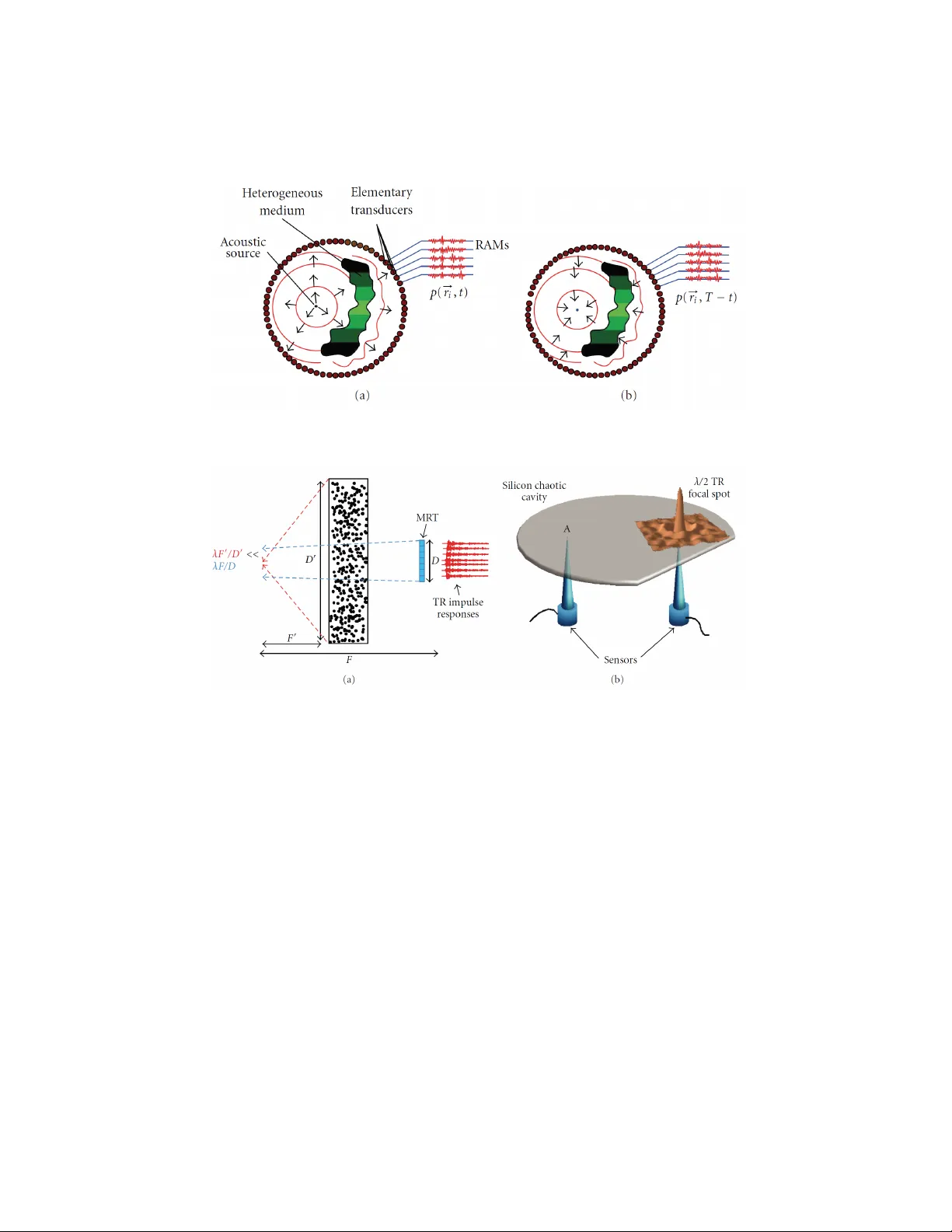
Rev ersibilit y in space, time, and computation: the case of underw ater acoustic comm unications ? W ork in Progress Rep ort Harun Siljak [0000 − 0003 − 1371 − 2683] CONNECT Cen tre, T rinit y College Dublin, Ireland siljakh@tcd.ie Abstract. Time rev ersal of w av es has been successfully used in comm u- nications, sensing and imaging for decades. The application in underwa- ter acoustic communications is of our special interest, as it puts together a reversible pro cess (allowing a rev ersible softw are or hardware realisa- tion) and a reversible medium (allowing a reversible mo del of the envi- ronmen t). This w ork in progress rep ort addresses the issues of modelling, analysis and implemen tation of acoustic time rev ersal from the rev ersible computation persp ectiv e. W e sho w the potential of using rev ersible cellu- lar automata for modelling and quan tification of reversibilit y in the time rev ersal communication pro cess. Then we present an implementation of time rev ersal hardware based on reversible circuits. Keyw ords: Acoustic time reversal · Digital signal pro cessing · Lattice gas · Reversible cellular automata · Reversible circuits. 1 In tro duction The idea of w av e time reversal has been considered for decades: among other references, we can find an early mention in Rolf Landauer’s w ork [5]. The the- ory and practice of mo dern time reversal of wa ves stems from Mathias Fink’s idea of time reversal mirrors [3]. While the first theoretical and practical re- sults came from the case of sound w av es (acoustics), the concept was translated in electromagnetic domain as w ell, through applications in optics [11] and ra- dio technology [7]. The particular scenario w e are considering here is the case of underwater acoustic communications (UAC), an application where the p oor electromagnetic w av e propagation makes sound wa v es the b est solution. Fluid dynamics (motion of liquids and gases) using rev ersible cellular au- tomata (RCA) has b een discussed extensively in the past [4,9]. How ever, this ? This publication has emanated from researc h supp orted in part by a researc h grant from Science F oundation Ireland (SFI) and is co-funded under the Europ ean Re- gional Developmen t F und under Grant Number 13/RC/2077. The pro ject has re- ceiv ed funding from the Europ ean Unions Horizon 2020 research and innov ation programme under the Marie Sko dowsk a-Curie grant agreement No 713567 and was partially supp orted by the COST Action IC1405. 2 H. Siljak cen tury has seen only a few applications of RCA to macro-scale engineering problems suc h as acoustic underwater sensing [10]. Similarly , pro ofs of concept for hardw are and soft w are implemen tations of rev ersible digital signal pro cessing exist [1], and we yet hav e to see it applied. This work will combine these under- utilised metho ds of mo delling and hardware implementation and relate them to time reversal, another physical form of rev ersibility . The work is fully practical in nature, as it is conducted on the UAC use case. The style of exp osition is tailored to give the first introduction to time re- v ersal of wa ves to reversible computation communit y . Linking the tw o fields in b oth analytic (RCA) and synthetic sense (reversible hardware) is the main con- tribution of this pap er: in future publications w e will present the results. The wide approach taken, ranging from ph ysical phenomena to cellular automata and reversible hardware is intended to show the role of different asp ects of re- v ersibility in a single practical application. W e first in tro duce time reversal and its application in UAC, follo wed by a section motiv ating the use of RCA in mo delling and quantification of the time reversal pro cess. Second, we present a rev ersible hardw are solution for the time reversal pro cessing chain and a brief set of conclusions and future w ork p ointers. 2 State of the Art: Time Rev ersal The concept of (acoustic) time rev ersal is illustrated in Fig. 1 [3]. If we place a sound source in a heterogeneous medium within a cavit y and let it emit a pulse, this pulse will tra vel through the medium and reach an array of transducers 1 placed on the cavit y walls (Fig. 1(a)). If w e emit what the transducers hav e receiv ed in a reversed time order (Fig. 1(b)), w e will get a sound wa ve resem bling an ec ho. How ev er, unlike an echo, this sound w a ve will not disp erse in the ca vity , but b e focused instead, con verging at the p oin t where the original wa ve was generated, at the acoustic source. Co vering the whole cavit y with transceivers is not feasible: not only do es it ask for a large num ber of transceivers, but sometimes the system is deploy ed in (partially) open space, not a ca vity . Hence, the option of a lo calised time rev ersal mirror (TRM) has to be considered: only a few transceiv ers co-located in a single p osition that use the multipath effects resulting from multiple reflections of the emitted sound wa ve on the scatterers in the environmen t. As it turns out, it is p ossible to ha ve the time reversal effect and a coherent pulse at the original source if the environmen t is complex enough (Fig. 2(a) illustrates such an exp erimen t). This counter-in tuitive result relies on the effect of ergo dicity inheren t to ray- c haotic systems [2]: the wa ve will pass through every p oin t in space ev entually and collect all the en vironment information on the wa y to the mirror. 1 F rom the electronic p oint of view, these elements are piezo transducers capable of conv erting mechanical to electrical energy while operating as receivers and the opp osite while operating as transmitters. F rom the communications standp oint, they are transceiv ers, and from the everyda y standp oint they are microphones/sp eak ers. Rev ersibility and Underwater Acoustic Communications 3 Fig. 1. The time reversal mechanism in a cavit y (from [6]) Fig. 2. (a) Lo calised time reversal mirror with a complex propagation medium (b) A simplified rev ersal scheme with a 3-D fo cal sp ot visualisation (from [6]) The application of this concept to comm unications is straightforw ard: the w av e, when returned to the original sender may con vey information from the receiv er (TRM) and it will b e fo cused only at the lo cation of the original source (prev enting both ea vesdropping and in terference at other locations). While there are other applications as well (e.g. lo calisation, imaging) we fo cus on the com- m unications asp ect as it allo ws us to introduce multiple transmitters and re- ceiv ers (multiple inputs, multiple outputs, MIMO) and analyse the effects of (irrev ersible) signal interference in the (reversible) mo del. 3 Mo delling and Quan tification Time reversal in the UA C setting is an example of a rev ersible pro cess in a nom- inally reversible environmen t. While dynamics of w ater (or any fluid for that 4 H. Siljak Fig. 3. Collision rules for FHP gas purp ose) sub ject to sound wa ves, streams, wa ves and other motions are inher- en tly reversible, most of the sources of the w ater dynamics cannot b e reversed: e.g. we cannot reverse the Gulf stream or a school of fish even though their mo- tion and the effect on w ater is in fact reversible. Hence, even though it would rarely b e completely reversed, the mo del for UAC should b e reversible. R CA give us such an option through the lattice gas mo dels [13]: cellular automata ob eying the laws of fluid dynamics describ ed b y the Navier-Stok es equation. One such mo del, the celebrated FHP (F risch-Hasslac her-P omeau) lat- tice gas [4] has had several improv emen ts after its original statement in 1986 [17], but its basic form is simple and yet following the Navier-Stok es equations exactly . This is a mo del defined on a hexagonal grid through a set of rules of particle collision shown in Fig. 3. The mo del can b e interpreted as an RCA via partitioning approaches 2 [16], but the randomness of transitions when colli- sions include more p ossible outcomes (as seen in the figure) has to b e taken in to accoun t. The FHP lattice gas pro vides us a t wo-dimensional mo del for UA C, easily im- plemen table in softw are and capturing the necessary prop erties of the reversible medium. It is not a nov el idea to use a lattice gas to mo del water, but neither acoustic underwater communications or time reversal of w av es ha ve b een ob- serv ed through this lens b efore. As already noted, how ev er, time rev ersal is not going to b e conducted b y running the cellular automaton backw ards in time, as that would reverse parts of the environmen tal flow we usually hav e no influence o ver. The acoustic time reversal is p erformed the same wa y as in real systems, b y time reversing the signal received at the time reversal mirror. The mo del we observe consists of the original source (transmitter) which causes the spread of an acoustic wa v e, the original sink (receiv er) w aiting for the wa v e to reach it, as w ell as scatterers and constant flo ws (streams) in the en vironment. The constant stream and the loss of information caused by some w av e comp onen ts never reac hing the sink will result in an imp erfect reversal at 2 P artitioning of cellular automata is an approach rules are applied to blo c ks of cells and the blo cks change in successiv e time steps. Different approaches exist, dep ending on the grid shap e, e.g. Margolus neighbourho o d for square grids, and Star of David and Q*Bert neigh b ourho ods for hexagonal grids. Rev ersibility and Underwater Acoustic Communications 5 Fig. 4. The reversible hardware scheme for acoustic time reversal the original source when the roles are switc hed (i.e. when the time reversal mirror returns the wa ve). If we measure the p o wer returned, w e will hav e a directivity pattern (fo cal p oint) similar to the one in Fig. 2(b). The amplitude of the p eak will fluctuate based on the location of the original source and ma y serve as a metric: a measure of reversibilit y . If we mo ve the source ov er the whole surface of the mo del and measure this metric (whose analogue in quan tum reversibilit y studies is fidelity or Loschmidt Echo [14]) we obtain a heatmap of the surface with resp ect to the qualit y of time reversal. In the context of time rev ersal studies, it is used as a measure of the quality of comm unication, but in a more general con text it can measure reversibilit y of a cellular automaton. The functionalit y of the mo del increases if we observe several transceiv ers distributed ov er the area (e.g. underwater v ehicles communicating with a central communication no de) and/or allo w motion of transceivers. The complexit y of the mo del increases as well, and the rev ersibility metrics b ecome a measure of interference. This is the first part of our ongoing work, as we in vestigate the effects con tributing to communication quality loss in the FHP mo del for UAC. 4 Rev ersible Hardw are Implementation The rev ersibility in time of the comm unication scheme w e use and the reversibil- it y in space of the medium b oth suggest that the reversibilit y in computation should exist as well. Fig. 4 gives an ov erview of a reversible architecture we are prop osing, which consists of sp eakers/microphones, AD/D A (analogue to digi- tal/digital to analogue) conv erters, F ast F ourier T ransform (FFT) blo c ks and a phase conjugation blo c k. This architecture is already the one used in wa ve time rev ersal–here we interpret it in terms of reversible hardware. F rom the electromechanical p oin t of view, a microphone and a sp eak er are the same device, running on the same physical principle, which mak es the tw o ends of the scheme equiv alent. The next element, the AD conv erter on one and D A conv erter on the other end are traditionally made in an irrev ersible fashion as the signal in traditional circuits flows unidirectionally . How ever, one of the first categories in the international patent classification of AD/DA con verters is H03M1/02: Reversible analogue/digital con verters. There has b een a significant 6 H. Siljak n umber of designs prop osed to allo w bidirectional AD/DA conv ersion. With that in mind, w e may consider this step to b e reversible as well. The signal received is manipulated in the F ourier (frequency) domain by conjugation (change of the sign of the complex image’s phase) as conjugation in frequency domain results in time reversal in time domain. This asks for a chain of transform, manipulation and in verse transform so the new time domain signal can b e emitted. All elements in this chain are inherently rev ersible. Reversibilit y of the F ourier transform has b een long utilised, and rev ersible soft ware and circuit implementations of its commonly used computational scheme, FFT ha ve b een prop osed [8,12,18]. Hence, the FFT blo c k can b e considered reversible, and the Inv erse F ast F ourier T ransfom (IFFT) is just the FFT blo c k with the rev ersed flo w. Finally , the phase reversal is simply changing the sign of the half of the outputs coming from the FFT blo c k, as the whole set of outputs comprises of phase and amplitude of the signal in frequency domain. Changing the sign is the straightforw ardly reversible action of subtraction from zero or simple complementation of the num b er, and as such has b een solved already in the study of rev ersible arithmetical logic unit [15]. Once we hav e determined the rev ersibility of the scheme, we note its sym- metry as well. If we fold the structure in the middle (at the conjugation blo ck), the same hardware can b e used b oth to propagate the inputs and the outputs. While the particular details of circuit implementation are left for future work, where details of the additional circuitry will b e addressed as well, we hav e here presen ted this scheme as a pro of of concept, a reversible signal processing sc heme con venien t for an implemen tation in reversible hardware. That is the second part of our ongoing w ork. 5 Conclusion In this work in progress rep ort, we ha ve presented the p otential of reversible computation for time reversal in UAC. F uture w ork will fo cus on b oth the mo d- elling prospects using RCA and the rev ersible circuit implemen tation of the time rev ersal hardware. While going into more detail to cov er all the practical issues of it, future w ork also needs to address the appropriateness of the same or similar approac h to the question of time reversal in optics and radio wa ve domain. The in tegration of reversible computation with ph ysical time reversal in this con- text op ens a general discussion on the relationship of different interpretation s of rev ersibility and new ven ues for reversible computation. References 1. De V os, A., Burignat, S., Thomsen, M.: Reversible implemen tation of a discrete in teger linear transformation. In: 2nd W orkshop on Reversible Computation (RC 2010). pp. 107–110. Universit¨ at Bremen (2010) 2. Draeger, C., Aime, J.C., Fink, M.: One-channel time-reversal in c haotic cavities: Exp erimen tal results. The Journal of the Acoustical So ciet y of America 105 (2), 618–625 (1999) Rev ersibility and Underwater Acoustic Communications 7 3. Fink, M.: Time reversal of ultrasonic fields. i. basic principles. IEEE transactions on ultrasonics, ferro electrics, and frequency control 39 (5), 555–566 (1992) 4. F risch, U., Hasslacher, B., Pomeau, Y.: Lattice-gas automata for the navier-stok es equation. Ph ysical review letters 56 (14), 1505 (1986) 5. Landauer, R.: Parametric standing wa v e amplifiers. Pro ceedings of the Institute of Radio Engineers 48 (7), 1328–1329 (1960) 6. Lemoult, F., Ourir, A., de Rosny , J., T ourin, A., Fink, M., Lerosey , G.: Time rev ersal in subw av elength-scaled resonan t media: b eating the diffraction limit. In- ternational Journal of Microw a ve Science and T echnology 2011 (2011) 7. Lerosey , G., De Rosny , J., T ourin, A., Dero de, A., Montaldo, G., Fink, M.: Time rev ersal of electromagnetic wa ves. Physical review letters 92 (19), 193904 (2004) 8. Li, J.: Reversible fft and mdct via matrix lifting. In: Acoustics, Sp eech, and Signal Pro cessing, 2004. Pro ceedings.(ICASSP’04). IEEE International Conference on. v ol. 4, pp. iv–iv. IEEE (2004) 9. Margolus, N., T offoli, T., Vic hniac, G.: Cellular-automata sup ercomputers for fluid- dynamics mo deling. Physical Review Letters 56 (16), 1694 (1986) 10. McKerrow, P .J., Zhu, S.M., New, S.: Simulating ultrasonic sensing with the lattice gas mo del. IEEE T ransactions on rob otics and automation 17 (2), 202–208 (2001) 11. Popoff, S.M., Aubry , A., Lerosey , G., Fink, M., Bo ccara, A.C., Gigan, S.: Exploiting the time-reversal operator for adaptive optics, selective fo cusing, and scattering pattern analysis. Ph ysical review letters 107 (26), 263901 (2011) 12. Skoneczn y , M., V an Ren tergem, Y., De V os, A.: Reversible fourier transform chip. In: Mixed Design of Integrated Circuits and Systems, 2008. MIXDES 2008. 15th In ternational Conference on. pp. 281–286. IEEE (2008) 13. Succi, S.: The lattice Boltzmann equation: for fluid dynamics and b ey ond. Oxford univ ersity press (2001) 14. T addese, B., Johnson, M., Hart, J., Antonsen Jr, T., Ott, E., Anlage, S.: Chaotic time-rev ersed acoustics: Sensitivity of the loschmidt echo to p erturbations. Acta Ph ysica Polonica, A. 116 (5) (2009) 15. Thomsen, M.K., Gl ¨ uck, R., Axelsen, H.B.: Reversible arithmetic logic unit for quan tum arithmetic. Journal of Physics A: Mathematical and Theoretical 43 (38), 382002 (2010) 16. T offoli, T., Margolus, N.: Cellular automata mac hines: a new en vironmen t for mo d- eling. MIT press (1987) 17. W olf-Gladrow, D.A.: Lattice-gas cellular automata and lattice Boltzmann mo dels: an in tro duction. Springer (2004) 18. Y oko yama, T., Axelsen, H.B., Gl ¨ uc k, R.: Principles of a reversible programming language. In: Proceedings of the 5th conference on Computing fron tiers. pp. 43–54. A CM (2008)
Original Paper
Loading high-quality paper...
Comments & Academic Discussion
Loading comments...
Leave a Comment