The History of Software Architecture - In the Eye of the Practitioner
Software architecture (SA) is celebrating 25 years. This is so if we consider the seminal papers establishing SA as a distinct discipline and scientific publications that have identified cornerstones of both research and practice, like architecture views, architecture description languages, and architecture evaluation. With the pervasive use of cloud provisioning, the dynamic integration of multi-party distributed services, and the steep increase in the digitalization of business and society, making sound design decisions encompasses an increasingly-large and complex problem space. The role of SA is essential as never before, so much so that no organization undertakes `serious’ projects without the support of suitable architecture practices. But, how did SA practice evolve in the past 25 years? and What are the challenges ahead? There have been various attempts to summarize the state of research and practice of SA. Still, we miss the practitioners’ view on the questions above. To fill this gap, we have first extracted the top-10 topics resulting from the analysis of 5,622 scientific papers. Then, we have used such topics to design an online survey filled out by 57 SA practitioners with 5 to 20+ years of experience. We present the results of the survey with a special focus on the SA topics that SA practitioners perceive, in the past, present and future, as the most impactful. We finally use the results to draw preliminary takeaways.
💡 Research Summary
The paper “The History of Software Architecture – In the Eye of the Practitioner” investigates how software architecture (SA) practice has evolved over the past 25 years and what challenges lie ahead. The authors adopt a two‑stage empirical approach. First, they collect 5,622 peer‑reviewed SA publications spanning the last quarter‑century and apply text‑mining, TF‑IDF weighting, and Latent Dirichlet Allocation (LDA) to extract the ten most salient research topics. These topics are: (1) Architecture Views and Representations, (2) Architecture Description Languages (ADLs), (3) Quality‑Attribute Evaluation, (4) Cloud and Micro‑service Paradigms, (5) DevOps and Continuous Integration/Delivery, (6) People, Organization and Process, (7) System Complexity and Scaling, (8) Security and Privacy, (9) Tooling and Automation, and (10) Business‑Strategy Alignment.
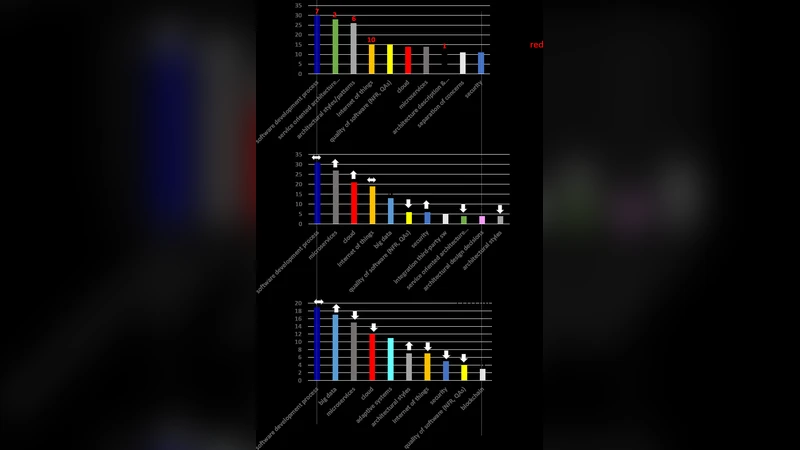
Second, the ten topics are used to design an online questionnaire that is answered by 57 SA practitioners with 5 to more than 20 years of experience. Respondents are asked to rate, on a five‑point Likert scale, the perceived impact of each topic in three chronological windows: past (1995‑2005), present (2006‑2016), and future (2017‑2027). The results reveal a clear shift in perceived importance. In the past, “Architecture Views & Representations” and “ADLs” dominate, reflecting a research focus on formal modeling and documentation. In the present, “Cloud & Micro‑services” and “DevOps/CI‑CD” surge to the top, while “People/Process” and “Tooling & Automation” also receive high scores, indicating that modern practice is driven by rapid delivery pipelines and cross‑functional collaboration. Looking forward, “Security & Privacy” and “Business‑Strategy Alignment” are expected to become the most influential, as practitioners anticipate tighter regulatory environments, AI‑driven services, and the need to tie architectural decisions directly to business outcomes.
Beyond topic importance, the survey uncovers two overarching challenges: managing growing system complexity and ensuring sustainable architectural evolution. Practitioners cite difficulties in integrating legacy systems with cloud‑native and AI components, involving business stakeholders in architectural decision‑making, and controlling the cost and risk of continuous redesign.
From these findings the authors derive four actionable recommendations for both academia and industry. (1) Curriculum and training programs should embed cloud‑native design, security‑by‑design, and AI‑centric architecture. (2) Organizations need to revamp architecture governance so that technical and business goals are continuously aligned, and stakeholder participation is institutionalized. (3) Automation tools and metric‑based evaluation should be expanded to reduce manual effort in design, verification, and deployment. (4) A gradual migration strategy—leveraging APIs, micro‑services, and gateways—should replace “big‑bang” replacements of legacy assets, thereby mitigating risk.
The paper acknowledges limitations: the practitioner sample is relatively small and geographically concentrated, and the topic modeling relies on abstracts and keywords, which may not capture the full depth of each publication. Future work is suggested to broaden the practitioner pool, incorporate full‑text and citation‑network analyses, and explore longitudinal changes in more fine‑grained sub‑domains.
In conclusion, the study maps a 25‑year trajectory from a model‑centric, documentation‑heavy discipline to a dynamic, cloud‑driven, automation‑focused practice, with an emerging emphasis on security and strategic alignment. By triangulating bibliometric trends with practitioner perception, the work bridges the research‑practice gap and offers a concrete roadmap for educators, researchers, and organizations seeking to keep software architecture relevant in an increasingly complex digital landscape.
Comments & Academic Discussion
Loading comments...
Leave a Comment