Complex network representation through multi-dimensional node projection
Complex network topology might get pretty complicated challenging many network analysis objectives, such as community detection for example. This however makes common emergent network phenomena such as scale-free topology or small-world property even more intriguing. In the present proof-of-concept paper we propose a simple model of network representation inspired by a signal transmission physical analogy, which is apparently capable of reproducing both of the above phenomena. The model appears to be general enough to represent and/or approximate arbitrary complex networks. We propose an approach constructing such a representation by projecting each node into a multi-dimensional space of signal spectrum vectors, where network topology is induced by their overlaps. As one of the implications this enables reducing community detection in complex networks to a straightforward clustering over the projection space, for which multiple efficient approaches are available. We believe such a network representation could turn out to be a useful tool for multiple network analysis objectives.
💡 Research Summary
**
The paper introduces a novel way to represent complex networks by projecting each node into a multi‑dimensional “signal spectrum” space. In the simplest incarnation, called the Binary Signal Spectrum Model (BSSM), a node is encoded as a binary vector of length D, where each entry corresponds to a particular signal type (or frequency). Two nodes are linked if they share at least one “1” in the same dimension. This rule is reminiscent of a threshold‑based connection scheme, but here the dimensions themselves encode structural information.
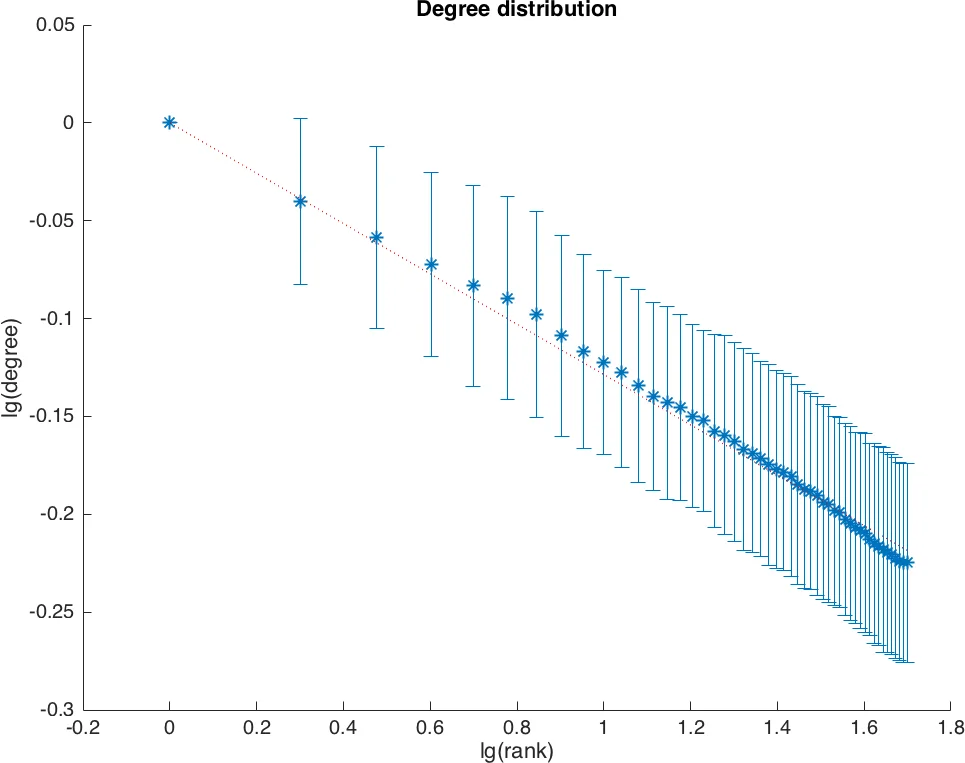
The authors first demonstrate that a random BSSM can reproduce two hallmark properties of many real‑world networks: a scale‑free degree distribution and the small‑world effect. In simulations with 1 000 nodes, 100 dimensions, and a per‑dimension activation probability p = 0.02, the top 50 degrees follow a power law with exponent q ≈ ‑0.13, while the largest connected component contains about 95 % of the nodes. The average shortest‑path length is 2.18 and the maximum distance is roughly 3.3, matching the typical small‑world pattern. Thus, even a very simple overlap rule can generate realistic topologies.
Next, the paper proves (Theorem 1) that any unweighted undirected graph can be represented exactly by a BSSM. The construction relies on covering the graph with a set of (possibly overlapping) cliques. Each clique is assigned to a distinct dimension, and a node’s binary vector has a “1” in those dimensions corresponding to the cliques it belongs to. The required number of dimensions m equals the size of a minimal clique cover, which is bounded above by the number of edges (or by n²/4). As an illustration, the classic Zachary Karate Club network (34 nodes) can be encoded with 35 dimensions, i.e., 35 overlapping cliques.
To handle weighted (including signed) networks, the authors generalize the model to a Weighted Signal Spectrum Model (WSSM). Here each node j is described by a real‑valued vector w₍j₎ = (w₁ⱼ,…,w_Dⱼ). The adjacency matrix is approximated by the outer product sum
E ≈ ∑{d=1}^{D} w{d}^{out} (w_{d}^{in})ᵀ,
or, for undirected graphs, simply E ≈ W Wᵀ. The optimal low‑dimensional representation is obtained by taking the leading eigenvectors of the adjacency matrix, which yields a compact approximation even when D ≪ n. The model also admits an integer‑weight version (WIASSM) where a threshold θ converts the real inner products back into binary edges.
The most consequential application presented is community detection. Modularity Q, traditionally defined as a sum over edges of (observed − expected) weights, can be rewritten in the WSSM framework as a sum of dot products of community‑level signal vectors:
Q = ∑_{c} (w^{out}_c · w^{in}c).
For undirected graphs this reduces to Q = ∑{c} ‖w_c‖². Consequently, maximizing modularity becomes equivalent to clustering the node vectors w _j in the D‑dimensional space. When D = 1 the optimal partition is trivial (positive vs. negative entries). For D > 1 the authors employ an iterative k‑means‑like algorithm: assign nodes to clusters, recompute each cluster’s centroid (the aggregated signal vector), reassign nodes to the cluster that maximizes the dot product, and repeat until convergence.
Applying this procedure to the Zachary Karate Club network, the authors find that a 7‑dimensional (or higher) WSSM yields a partition into four communities with Q = 0.4198, which matches the best known modularity for this graph. With D = 1 the method reproduces a near‑optimal bipartition (Q ≈ 0.3715), only slightly below the benchmark value 0.3718. The authors note that the clustering is sensitive to the initial random seed and can become trapped in local optima, suggesting that more sophisticated initialization or meta‑heuristics would improve robustness for larger graphs.
In the concluding section the authors emphasize three contributions: (1) a simple random BSSM that naturally exhibits scale‑free and small‑world characteristics; (2) a constructive proof that any unweighted graph can be exactly encoded by a BSSM with a bounded number of dimensions, and an eigenvector‑based scheme for low‑dimensional weighted approximations; (3) a reformulation of modularity maximization as a vector‑clustering problem, enabling the use of fast, well‑studied clustering algorithms for community detection. They argue that once an efficient projection algorithm is available, many network‑analysis tasks—such as hub detection, centrality measures, or link prediction—could be performed directly in the signal‑space, potentially offering computational advantages for large‑scale or dynamic networks.
Overall, the paper presents a fresh perspective on network representation, bridging physical intuition (signal overlap) with algebraic techniques (eigen‑decomposition) and practical algorithmic implications (clustering‑based community detection). While the approach is promising, challenges remain in scaling the dimensionality for massive graphs, finding minimal clique covers efficiently, and mitigating sensitivity to initialization in the clustering stage. Future work could explore sparse or compressed representations, adaptive dimensionality selection, and extensions to temporal or multiplex networks.
Comments & Academic Discussion
Loading comments...
Leave a Comment