Capacity Releasing Diffusion for Speed and Locality
Diffusions and related random walk procedures are of central importance in many areas of machine learning, data analysis, and applied mathematics. Because they spread mass agnostically at each step in an iterative manner, they can sometimes spread mass “too aggressively,” thereby failing to find the “right” clusters. We introduce a novel Capacity Releasing Diffusion (CRD) Process, which is both faster and stays more local than the classical spectral diffusion process. As an application, we use our CRD Process to develop an improved local algorithm for graph clustering. Our local graph clustering method can find local clusters in a model of clustering where one begins the CRD Process in a cluster whose vertices are connected better internally than externally by an $O(\log^2 n)$ factor, where $n$ is the number of nodes in the cluster. Thus, our CRD Process is the first local graph clustering algorithm that is not subject to the well-known quadratic Cheeger barrier. Our result requires a certain smoothness condition, which we expect to be an artifact of our analysis. Our empirical evaluation demonstrates improved results, in particular for realistic social graphs where there are moderately good—but not very good—clusters.
💡 Research Summary
The paper addresses a fundamental limitation of classical spectral diffusion methods used for graph clustering, community detection, and related machine learning tasks. Traditional diffusion spreads mass uniformly across edges at each iteration, which can cause mass to “leak” aggressively through high‑degree nodes or noisy edges, preventing the algorithm from isolating the “right” clusters. This phenomenon is illustrated with the Cockroach graph, where a random walk requires Ω(ℓ²) steps to explore a cluster of k paths of length ℓ, yet a substantial fraction of the mass escapes before the cluster is adequately explored.
To overcome this, the authors introduce the Capacity Releasing Diffusion (CRD) process. CRD adapts ideas from the push‑relabel maximum‑flow algorithm: each vertex v maintains a label ℓ(v) (initially 0) and each edge (u,v) can transmit at most ℓ(u) units of mass from u to v. The label acts as a “height” that controls how much capacity is released on incident edges; as the label rises, more capacity becomes available. The generic CRD process consists of (1) initializing every vertex with up to 2·deg(v) mass, and (2) repeatedly performing an inner CRD step that pushes excess mass (mass exceeding deg(v)) along eligible downhill edges (ℓ(u) > ℓ(v) and current flow < ℓ(u)). If a vertex has excess but no eligible edge, its label is incremented, thereby releasing additional capacity. After each inner step the algorithm doubles the mass at all vertices, ensuring rapid expansion while still respecting the capacity constraints.
The authors prove several key theoretical results. First, a specialized CRD algorithm for local clustering runs in time linear in the total mass and the maximum label bound, and either succeeds in distributing the mass or leaves all remaining excess at vertices with high labels, which correspond to bottleneck boundaries. Second, under two natural assumptions about a target cluster B—(i) its internal conductance φ_S(B) is a constant factor larger than its external conductance φ(B), and (ii) a smoothness condition stating that any subset T⊂B has polylog(vol B) times more internal edges than edges leaving B—CRD can recover B from any seed vertex inside B. This breaks the quadratic Cheeger barrier (which forces spectral methods to incur an O(√φ) factor loss) and yields a conductance guarantee of O(φ log ℓ) with a speedup of 1/(φ log ℓ) compared to prior local spectral algorithms such as those of Zhu et al. (2013). Moreover, the algorithm’s performance does not depend on starting from a “good” seed; any vertex in B suffices, unlike earlier approaches that require a constant‑fraction of good seeds.
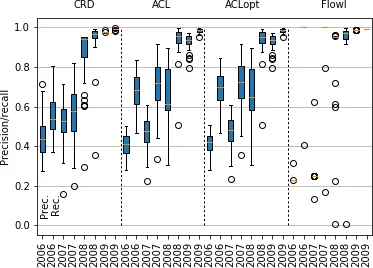
Empirically, the paper evaluates CRD‑based local clustering on several real‑world social and information networks that are known to be challenging for spectral methods—networks with flat Network Community Profiles (NCPs) where only moderately good clusters exist. The experiments demonstrate that CRD finds clusters with lower conductance, higher recall, and faster running times than personalized PageRank‑based baselines, especially when the clusters are not extremely well‑separated. The results confirm the theoretical predictions: CRD’s capacity‑releasing mechanism limits mass leakage, allowing the diffusion to remain localized long enough to discover the underlying community structure.
In summary, the contribution of the work is threefold: (1) a novel diffusion process that releases edge capacity gradually via label‑based control, (2) a local clustering algorithm that leverages this process to break the Cheeger barrier and achieve provably better conductance guarantees with linear‑time complexity, and (3) extensive experimental validation showing superior performance on realistic graphs. By marrying flow‑based techniques with diffusion dynamics, the paper opens a new direction for designing fast, local, and robust graph clustering methods.
Comments & Academic Discussion
Loading comments...
Leave a Comment