A Wireless Multimedia Sensor Network Platform for Environmental Event Detection Dedicated to Precision Agriculture
Precision agriculture has been considered as a new technique to improve agricultural production and support sustainable development by preserving planet resource and minimizing pollution. By monitoring different parameters of interest in a cultivated field, wireless sensor network (WSN) enables real-time decision making with regard to issues such as management of water resources for irrigation, choosing the optimum point for harvesting, estimating fertilizer requirements and predicting crop yield more accurately. In spite the tremendous advanced of scalar WSN in recent year, scalar WSN cannot meet all the requirements of ubiquitous intelligent environmental event detections because scalar data such as temperature, soil humidity, air humidity and light intensity are not rich enough to detect all the environmental events such as plant diseases and present of insects. Thus to fulfill those requirements multimedia data is needed. In this paper we present a robust multi-support and modular Wireless Multimedia Sensor Network (WMSN) platform, which is a type of wireless sensor network equipped with a low cost CCD camera. This WMSN platform may be used for diverse environmental event detections such as the presence of plant diseases and insects in precision agriculture applications.
💡 Research Summary
The paper presents MiLive, a modular, multicore Wireless Multimedia Sensor Network (WMSN) platform designed specifically for precision agriculture applications that require detection of complex environmental events such as plant diseases and insect infestations. Traditional scalar Wireless Sensor Networks (WSNs) can monitor basic parameters (temperature, humidity, soil moisture, light) but lack the rich data needed for visual or acoustic event detection. To bridge this gap, the authors integrate a low‑cost CCD camera with a powerful processing unit while addressing the severe energy constraints typical of WMSNs.
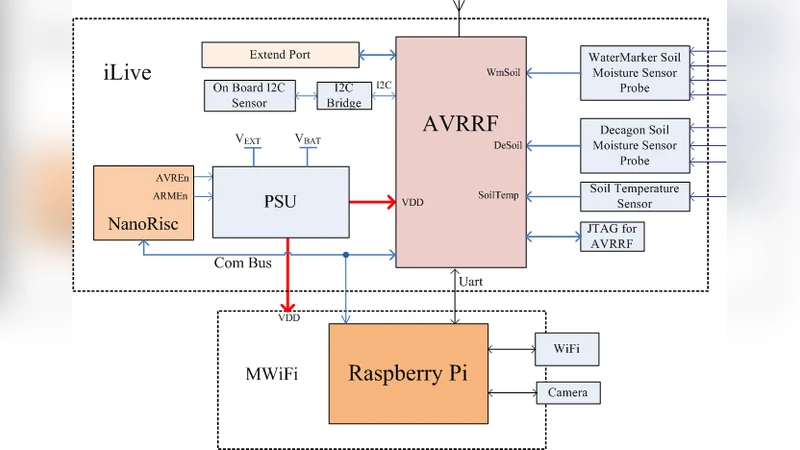
MiLive’s hardware consists of two tightly coupled boards. The iLive board is a conventional scalar sensor node equipped with an 8‑bit AVR microcontroller, an ultra‑low‑power 4‑bit NanoRisc, and an IEEE 802.15.4 radio. It supports a suite of environmental sensors (soil moisture, temperature, air humidity, light) and consumes only 0.1 mA in idle and about 20 mA when active. The second board, called MWiFi, is a Raspberry Pi (700 MHz ARM1176JZF‑S, GPU, ISP) running a full Linux OS, capable of handling USB/CSI cameras, performing on‑node image compression, and communicating via IEEE 802.11.
A dedicated Power Management Unit (PMU) controlled by the NanoRisc can independently switch the power supplies of the AVR and the Raspberry Pi, enabling three operational modes:
- Scalar Wireless Sensor Network (SWSN) mode – only iLive is powered; the system operates at ultra‑low power for years on two AA batteries but can only transmit low‑rate scalar data over 802.15.4.
- Wireless Multimedia Sensor Network (WMSN) mode – iLive is shut down and MWiFi runs continuously, using 802.11 to stream high‑resolution images or video. Power draw rises to ~453 mA, limiting battery life.
- Hybrid SWMSN mode – both boards are active, but the Raspberry Pi is turned on only when a contextual trigger (e.g., a sudden change in scalar sensor readings) is detected. This event‑driven activation dramatically reduces average power consumption while still allowing multimedia capture when needed.
The authors compare MiLive with existing low‑performance (MeshEye, Cyclops, etc.) and medium‑performance (Stargate, CITRIC, IMote2) WMSN nodes. MiLive offers a higher‑frequency processor, up to 512 MB RAM, and dual‑radio capability, surpassing the memory and computational limits of earlier platforms and enabling on‑node execution of sophisticated algorithms such as disease classification or insect detection.
Software-wise, the Raspberry Pi runs a standard Linux stack and employs the Babel mesh routing protocol for the 802.11 network. Babel’s hybrid distance‑vector design, combined with proactive and reactive updates, provides robustness against link failures and mobility—critical for outdoor agricultural fields. The iLive side uses the BitCloud stack for IEEE 802.15.4 communication. Inter‑board communication is realized through UART/USB or SPI, while the PMU receives power‑control signals via GPIO.
Energy measurements show that the Raspberry Pi dominates consumption: idle current ≈33 mA, rising to 453 mA with the Wi‑Fi dongle attached. In contrast, iLive’s idle current is only 0.1 mA. By keeping the Pi powered off most of the time and using scalar sensor thresholds to trigger multimedia acquisition, the average current can be reduced to as low as 0.01 mA in deep‑sleep, extending node lifetime by an order of magnitude compared with a continuously running WMSN.
A real‑world deployment is described where a mesh of MiLive nodes covers a large field. The nodes collect scalar data continuously; when a predefined environmental change is sensed, the Pi is powered on, captures an image, compresses it, and forwards it over the Babel mesh to a central gateway. A web‑based GUI visualizes both scalar trends and received images, demonstrating end‑to‑end functionality.
The paper concludes that MiLive successfully combines modularity, multicore processing, dual‑radio support, and context‑aware power management to meet the demanding requirements of precision agriculture. While the current hardware still relies on the relatively power‑hungry Raspberry Pi, the open architecture allows future integration of low‑power SoCs, hardware accelerators, or energy‑harvesting modules to further improve autonomy. The platform also provides a testbed for collaborative processing between scalar and multimedia nodes, paving the way for more advanced, energy‑efficient smart‑farm deployments.
Comments & Academic Discussion
Loading comments...
Leave a Comment