Deep learning based inverse method for layout design
Layout design with complex constraints is a challenging problem to solve due to the non-uniqueness of the solution and the difficulties in incorporating the constraints into the conventional optimization-based methods. In this paper, we propose a des…
Authors: Yujie Zhang, Wenjing Ye
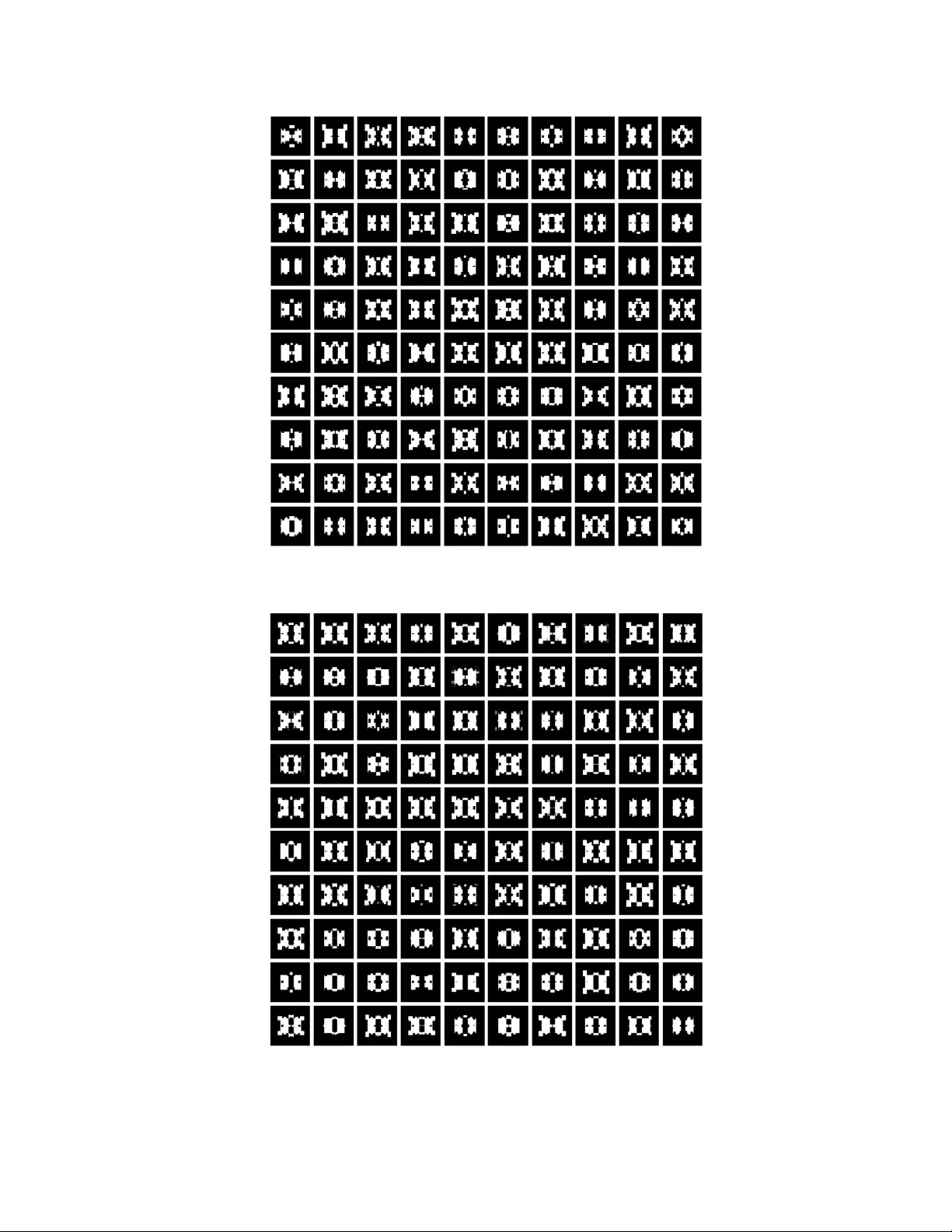
Deep learning based inverse method for layout design Yujie Zhang, Wenjing Ye * Department of Mechanical and Aerospace Engineering Hong Kong University of Science and Technology *Corresponding author: mewye@ust.hk Abstract Layout design with complex constraints is a challenging problem to solve due to the non-uniqueness of the solution and the difficulties in incorporating the co nstraints into the conventional optimization-based methods . In this paper, we propose a desi gn method based on the recently developed ma chine learning technique, Variational Autoencoder (VAE). We utilize the learning capability of the V AE to learn the constraints and the generative capability of the VAE to generate design candidates that automatically satisfy all the constraints. As such, no constraints need to be imposed during the design stage. In addition, we show th at the VAE network is also capable of learning the underlying ph ysics of the design p roblem, leadi ng to an efficient design tool that does not need any ph ysical sim ulation once the netwo rk is constructed. We demonstrated the perfor mance of the method on two cases: inverse design of surface diffusion induced morphology change and mask design for optical microlithography. Keywords: Variational Autoencoder; I nverse method; L ayout design; De ep learning; Artificial neural network; 1. Introducti on Inverse problems are encountered in man y fields of engineering and science. In a typical inverse problem, parameters or la youts are sought in order to achieve certain system outcomes. Examples of inverse problems can be found in material design [1,2] , structure optimiz ation [3-6], determination of radiative properties o f the medium [ 7,8] , model parameter estimation [ 9,10], and image s ynthesis [11,12]. Most existing methods for solvi ng inverse probl ems are based on optimiz ation techniques, in which the desired system performance is casted as the objective function and the unknown parameters/layout are the design v ariables. Among the di fferent t ypes of design p roblems, layout designs are particularly challenging becau se of the difficult y in identif ying a set of suitable design variables that define the layout. T opological optimi zation (TO) of fers an attractive approach for solving this type of problem. Currently th e most popular TO method is the density-based method in which the design domain is discretized into pixels/voxels and the optimal layout/structure i s found by determining the mate rial density of each pix el/voxel based on a chosen optimization strategy [13,14]. An alternative and powerful TO method i s the level-set based method, which utili zes level- set functions to implicitly define the boundaries of the layout. The optimal layout is found b y controlling the motion of the level-set functions according to the underly ing physics and the opti mization st rategy [ 15-17]. I n both methods, gra dient-based optimization methods are commonl y employed. Hence sensitivity calculation of the objective function with r espect to the design variables is required. For d ynamic problems, sensitivities could be dif ficult to obtain due to the high computational cost and the large memory consumption required to store all intermediate solutions [18-20] . In addition, not all the proble ms ha ve differentiable objective functions, a nd thus non-gradient based approaches, such as genetic evolutional structure optimi zation, must be employed. Ho wever, these methods are known for their inefficiency because of the n eed for a lar ge number of forward cal culations. Another ke y challenge in topologic al optimization techniques is the control of the shape of the optimal layout. S hape control is necessary due to, for ex ample, the need for including a few ex plicit shapes in the design, manufacturing constraints such as minimum f eature size and manufacturing cost , aesthetic consideration and connection/installation requirements. These constraints are often cannot be formulated analytically in t erms of design va riables and t he optimiz ation parameters, and thus are difficult to be incorporated in the opti mization proce ss particularly when th e densit y-based methods are employed. Recent work on overcoming this challenge includ es the development of feature-driven, level-s et function based TO methods to incorporate features into the freeform design domain [ 21,22], and the d ensity- based TO method for imposing minimum and maximum length scales [23]. In r ecent years, machine learning approaches have shown remarkable success in a variety of application areas such as image recognition [24], natural language processing [25], P DE solver [26, 27], quantum mechanics [28] and multiscale modeling of materials [29,30] . One major advantage of many machine- le arning techniques is their ability of learning the hidden relationship of data, which is otherwise difficult to be reveal ed and model ed . Variational Auto-encoders (VAEs) are recentl y developed proba bilistic models for learning complic ated distributions of datasets [31,32]. The main function of a VAE is to provide a tr actable and efficient mapping between lat ent variable s, which follow a prescribed distribution, and the given dataset. By sampling the latent variables f rom the known dist ribution, this mapping can be used to generate new data points that share the same salient features as those in the given set. The applications of VAEs have been mostly in image processing [31,33-35] , which was the targeted application initially . Since last year, innovative applications of VAEs in physical systems such as phase and phase transition identification, learning hard quan tum dist ribution have emerged [ 36-38], demonstrating the great potential of VAEs in a variety of application areas. I nverse design with constrains is a problem of searching an optimal solution in a design sp ace confined b y constraints. To a large extent, one can view this design space as a specific one associated with a certain but unknown distribution. I t is then possible to construct a VAE model to learn the unknown distribution by providin g a dataset satisf ying all the constraints. Once the m apping is established, the capabilit y of the VAE of generating new datapoint s that automatically satisfy the constraints would allow us t o conduct the design without imposing an y constraints since the sea rch is within the confin ed space id entified by the VAE. Apart from that , VAEs are built on top of neural networks, which are powerful function approxim ators. Thus t he physical relationship betw een the inputs and the obje ctive function can also be learnt b y VAEs, leading to a design method that does not require any ph ysical sensitivity calculations. Another potential benefit of the VAE is that once the mo del is constructed for a certain t ype of physical s ystem, it can be used repeatedl y to conduct designs with different objective function values and/or physical parameters without any ph ysical simulation . There has no prior work on the applications of VAEs in solving inverse p roblems and thus the possible benefits of VAEs in this area have not been explored. In this pape r, we propose a VAE-based design method for inverse design of layout/structures. Of particular interest are problems with shape constraints. We construct the VAE model with neural networks and tr ain t he model using a dataset in which each datapoint consisting of two parts: the initi al la yout satisfying the shape constrains and the corresponding outcome that could be, for example, an image or a value. This allows the VA E to le arn not onl y th e shape constraints, but also the physical correlati on between the initial lay out and the out come. S uch a feature is particularl y useful fo r problems in which the ph y sical correlation is difficult or ver y costly to model. The final design is found by finding the optimal latent variables that generate the desired outcome using the decoding part of the VAE mod el, that is the ge nerative f eature o f the VAE. Two very different problems namel y m ask design for opti cal mic rolithography and the inverse design for surface diffusion induced morpholo gy change are s elected to demonstrate the performance of the proposed method. 2. Neural net work and inverse design A standard VAE mod el contains an encoder and a decoder as shown schematicall y in Fig. 1 . For each input datapoint, the encoder finds a co rresponding lat ent variable from a prescribed distribution, typicall y the Gaussian dis tribution, and this latent variable is th en used to reconstruct the i nput datapoint via the d ecoder. If a new latent variable dra wn from the prescribed distribution is provided to the decoder, a ne w datapoint would be generated. Fig. 1. T he architecture o f the proposed Variational Auto -encoder for inverse problems. T he initial shape and final shape are put together to form one input datapoint. Both the encod er and the decoder consist of four layers with 512 nodes in each layer. The latent di mension is 100 To utilize VAE for inverse design, we pair the ini tial la yout with the outcome to form one datapoint. In both our model problems, the desired outcom e is also a shape. Hence our input datapoint is an image with the left part being the ini tial la yout and the right par t being the final shape as shown in Fig. 1 . We first train the VAE to reconst ruct input images. This is done by minimizing the loss function typically used in th e VAE model [31]. This loss function is composed of the reconstruction error and the Kullback-Leibler (KL)-divergence error, (1) where denotes the reconstruction error and denotes the KL-divergence error, whi ch measures the difference betw een the distribution of the latent variables and a normal di stribution. We use ADAM optimizer [ 39] with default parameters. The learning rate is and the batch size is 128. Four la yers with each la yer consisting of 512 nodes are u sed in both the encoder and the d ecoder parts. The latent dimension is set to be 100. Activation function for the encoder and the d ecoder is exponential linear unit, and sigmoid fun ction is chosen to be the activation function of the last layer, tha t i s, the output layer. After trainin g, the decoder of the VAE model is used to perform the design. The goal of the inverse design is to find the initial shape with certain constraints for a target ed final structure. W ith the decoder, the d esign problem becomes finding an optimal latent variable that generates the targeted final structu re. The following optimization problem is formulated for this purpose: (2) (3) (4) where represents the target ed final shape, is the image generated b y th e VAE, and denote the final structure and the initial layout extracted form the generated image respectively. is a regularization term used to improve the quantity of the g enerated shapes. The fir st term in is to guarantee th e volume denoted as is conserved, which is neede d in the f irst ex ample. The second term is to guarantee the smoothness of the generated shapes . is a measurement of noise, defining as the sum of the absolute differences in the values of neighboring pixels. , are two positive constants. In the first example, the two constants in are set as and . L-BFGS-B optimi zation [40] is used to solve Eq. (2). After the optimal latent variable is obtained, the optimal initial shape can be ex tracted from the image as . 3. Results 3.1. First example: inverse design for surface diffusion induced morphology change Surface di ffusion induced morpholog y change refers to the shape a nd/or topology change in structures due to atom migration driven by ch emical potential gradients along the surface. Denote b y the increase in chemical p otential per atom that is transferred from a point of zero curvature to a point of curvature on the surface. It can be expressed as [41] (5) where is the surface mean curvature, is the surfa ce tension coefficient and is the molar volume. Nonzero gradients o f this chemical potential along th e su rface induce a drift of atoms with a surface flux given by (6) wh ere is the surface d iffusion coefficient, is the ph y sical thickness of the diffusion layer, is Boltzmann constant, is temperature and is the surface gradient. This surfac e flux results in a movement of surface in its normal direction with the velocity determined by the conservation law as , (7) where is the Laplace-Beltrami operator, is the outward normal vector at the surface and . A t y pical example of morphology change due to surface diffusion is illustrated in Fig. 2 in which the evolution of an ini tial trench structure shown in (a) due to surface diffusion is depicted. It can be seen from this figure that not only the shape but also the topology of the structure has changed with time. Fig. 2. A t ypical ca se of surface diffusion induced morphology c hange: (a) the initial structure (b) – (d) evolved structure at di fferent time instants Morphology change by surface diffusion can be f ound in man y proces s es , for example, structural evolution of nanoporous metals during thermal coarsening and d ealloying [42] . It affects material properties and performance and thus should be controlled if possible. Recently an innovative usage of this mechanism in microfabrication was proposed. It has been shown that buried cavities/microchannels ca n be self -assembl ed simply b y annealing a prestructured silicon wa fer at high temperature [43,44], without masks and bonding process. This technique also allows monol ithic int egra tion of MEMS-COMS [44], thus avoiding the material- and process- in compatibility issues inherent in th e traditional integration sc hemes. Multiple microchannels with complicated archi tecture have been fabricated [ 45 ], and subattogram mass sensing and an active-matrix tactile sensor have also been demonstrated based on this fabrication technique [43,44]. The final stable structure after annealing is solely determined b y th e initial structure. In many applica tions, the architec ture, the locations and the sizes of the cavities or bubbles have to be pr ecisely controlled in order to achieve certain functi onality. Th is calls for a c areful design of the initial structure, which after the annealing proc ess produces a final structure with the desired geometry . Such an inverse design problem is challenging due to the foll owing reasons. Firstl y structural evolution is a ti me -dependent problem and it is extremely time consumin g to si mulate the evolution process be cause, as it is well known, the surface diffusion is a numericall y stiff problem. Calculating sensitivity information required in the gradient-based optimiz ation me thods would be even ha rder, if not impossible. Secondly the solution is non -unique in the sense that not only the initial structure is non-unique for the desired final structure, each intermediate structure during evolution is also a potential solution. However due to the fabrication constraints, only c ertain sh apes of the initial structure are practicall y feasible. Thus this design problem would be a challenging one for conventional TO methods. Here we apply the proposed VAE based method to solve this inverse problem. We limit the shapes of the initial structure to be periodic trench structure s, which are easy shap es to fabricate usin g conventional microfabrication techniques. To train the VAE network, we create 10800 datapoints with 10000 datapoints for training and 800 for testing. Each datapoint contains a unit cell of the initial structure and a corresponding final structure obtained from an in -house surface diffusion solver described in the section of methodolo gy. Both structures are represented by pix els with a size of , of which the periodicity 64 is in the dire ction. The initial structure is generated b y placing on e or two trenches randomly within the unit cell. The dim ensions of each trench are chosen randomly as well. Samples of the training data are shown in Fig. 3 . Fig. 4 shows some samples of the datapoints randomly select ed from the testing dataset and the reconstructed images, which are identical to the c orresponding input images. The trained VAE n et is then used to design the ini tial structure for a ta rgeted final structure. Fig. 5 shows fifteen samples of the pre dicted ini tial structu res for v arious targeted final structures drawn from the testin g datas et. It can be seen that all the predicted structures are trench-like stru ctures, ind icating that the shape co nstraints have been leant ver y well by the constructed VAE mod el. To evaluat e the design accuracy, we first smooth the designs b y running a solver o f the Cahn-Hillard equation with constant mobility for several itera tions using a very small time step. We then run the surface- diffusion solver on the smoothed designs to obtain the corresponding final shapes. As shown in Fig. 5 , the simul ated final structures match quite well with the targeted final structures, demonstrating the success of the proposed design method. It also shows that the constructed VAE net has the ability to lea rn both the design constraints and the diffusion mechanism that evolves the initial shape to its final shape. To quantitatively measure the design accurac y, we use a binar y accuracy defined as the percentage of the matched pixels, that is, the ratio of the total number of the corrected predicted pixels and the total number of pixels. The accurac y bet ween the targeted fin al shapes and the simulated final shapes evaluated on all 800 testing data is 97.6%. Fig. 3. Samples of the training data from the dataset Fig. 4. Im ages selected from the testing data (first row) and the corresponding reconstructed images (second ro w) Fig. 5. Samples of the design results 3.2. Second example: inverse mask synthesis Optical lithograph y is a standard micro/nano manufacturing process for fabricating integrated circuits ( IC), microelectromechanical s ystems and oth er micro/nano devices/systems. The resolution of the photolit hgrapy is hindered b y the distorti on in the transferred patterns on silicon wafers caused b y the diff raction nature of the lights and the inherent limitations of the optical s y stem, which results in short circuits, yield loss and malfunction of MEMS devices. One effecive way to correct the distortion is to pe r- compensate it by designing smart masks, th at is, the inverse image s ynthesis method. Much work has b een done in this area and the majority emplo ys methods similar to density-based TO methods [11,46]. Here we show that the proposed VAE based desi gn method can be easily appli ed to s y nthesize smart masks. For demonstration purpose, we will consider a simple case similar to the one studied in [11]. As shown in Fig. 6, a pair of squares is to be printed onto the silicon wafer. Due to the distortion, which is modeled approximated using the convolution of the input pattern with a 2 -D Gaussian kernel to calculate the aerial image formation and a hard-thresholding operation to simulate the resist effect [11], the transferred pattern is far from the desired squares. T he goal of the inverse mask s ynthesis is to design a mask such that the transferred pattern is the two squares shown in Fig. 6 (a). Similar to the previous ex ample, we first train the VAE model to reconstruct the input image s, which compose of pairs of im ages: the mask and the corresponding transferred pattern. The architecture of the network is the same as that of the previous example , except that the latent dimension is chosen to be 10, and and are set to be zero in this example. To generate the training data, a s ystematic method for producing mask images is developed based on the following strategies: 1. All masks should be symmetric since the desired transferred pattern is s y mmetric. 2. Ma sk s should be as simple as possible. Here we will onl y conside r ima ges that are created b y adding or removing rectangular shapes from the two squares at some control points as shown in Fig. 7 . We start with a minimum number of con trol points and continue to add on more points if nece ssar y. 3. The aspe ct ratio of the rectangular shap es is chosen to be within [0.5, 2.0] . This is to ensure that the synthesized mask is within a specified region. According to the above criteria, a total of 10000 images are generated. Fig. 8 shows some samples of the training images . To evaluate the ge neration c apability of the VAE net, new images are generated from the trained network by sampling the la tent variables. Fig. 9 shows some of the ge nerated new shapes. As it can be s een, all these new ima ges satisfy th e criteria specified above, demonstrating the learnin g capabilit y o f the network. We then perform the d esign procedure b y searching a sp ecific latent variable that produces a transferred shape to be as close as the two squares shown in Fig. 6 (a). Fig. 10 (a) shows the mask obt ained from the desi gn procedure, which is ver y diff erent from the two s quares and hard t o obtain based on intuition. I t is nevertheless still si mple and generally satisfies the p rescribed criteria. Fig. 10 (b) shows the transferred pattern, which is much closer to the target ed shape than the one shown in Fig. 6 (b). (a) (b) Fig. 6. (a) T he initial mask; (b) The transferred pattern corresponding to the i nitial mask Fig. 7. Control points (red solid circles) for generati ng the training ima ges Fig. 8. Samples of the training mask images Fig. 9. Generated images by the VAE thro ugh sampling the latent variables (a) (b) Fig. 10 . (a) The p redicted input mask; (b ) The output shape of the input mask shown in (a) 4. Discussion The proposed VAE based design m ethod utilizes the learning capabilit y of the VAE model to learn the hidde n features shared between input data and the ph ysical correlation between the inputs and the outputs, and uses the generative c apability of the VAE to generate new design candidates that have similar features as those in the input data. As such, desi gn constraints that are difficult to b e formulated or incorporated into the conventional topological optimization proce dures are automatically included in the design. As demonstrated in the two examples, the proposed VAE based i nverse design method is ver y easy to implement and works for different physical probl ems despite the rather sh allow network used. I t does not need an y sensitivit y calculations . Only fo rward solutions are needed to generate the training data, which can be obtained either by modeling and simulation or from ex periment al measurements. This feature is particularly attractive for problems that are too complex to analyze. Moreover, the p erformance of the VAE model can alwa y s be enhanced b y providing more training dat a and constructing a more advanced network utilizing deep network archit ecture and convolutional neural network. For example, in t he case of mask s ynthesis, while the demonstrated VAE network is constructed specifically for the two -square case, a deep er VAE net can be constructed b y providing more tr aining d ata containing v arious types of mask image s. Such a V AE net can then be used to design smart masks for an y pattern s, and it would be much more efficient than the conventional methods in which the design procedure, which includes numerous forward calculations and/or sensitivity analysis, must be re-run each time when a new mask is to be sy nthesized. While in this paper only two design proble ms are solved to demonstrate th e performance of the V AE desi gn method, the a pplication scope of the method is not limited just within the areas of these two problems. An y la yout designs pa rticularly those with complex constraints, for example, design of thin-film morphology for structural color applications [2], template design for directed assembl y of block-copol y mer morphologies [2] and design of heater surface to produce desired temperature and heat flux distribution [47,48], can be potential applications for the VAE m ethod. The extension to those problems is, in principle, straightforward. Ap pe ndix : S urf ac e di ffus ion so lve r A phase-field model is used to des cribe interface evolution caused b y surface diffusion, which is shown as follows: (A.1) (A.2) (A.3) (A.4) In these equations, denotes the order parameter for the phases of the s ystem: represents a void phase and represents a solid phase; is the chemical potential; is a parameter controlling the thickn ess of the interface; is the bulk free energy; and is the mobility. As this model converges to Mullins sharp interface model (Eq. (7)) for surface diffusion, see [49]. The phase-field equations are solved numerically on a periodic domain b y usin g an operator-splitting-based, quasi-spectral, semi-implicit time-stepping scheme. The s emi- implicit scheme for Eq. (A.1) can be written in the following form [50], (A.5) where and are two positive stabilizing para meters chosen to guarantee the numerical stability. Performing Fourier tra nsform on Eq. (A. 5), we obtain, (A.6) where is the Fourier transform of , and stands for Fourier transform. Then, we ca n derive th e following explicit time-steppin g scheme in th e spectrum space, (A.7) Re fer enc es 1. Mlinar, V.: Utilizati on of inverse approach in the des ign of materials over nan o- to macro-scale . Ann. Phys.-Berlin 52 7 (3 -4), 187-2 04 (2015). doi:10. 1002/andp.20140 0190 2. Jain, A., Bollinger, J.A., Truskett, T.M.: Inverse Methods for Material Design. Aiche Journal 60 (8), 273 2-2740 (2014). doi:10. 1002/aic.14491 3. Kirsch, U.: A unified reanalysis approach for structural analysis, design, and o ptimizati on. Structural and Multidisciplinary Optimization 25 (2), 67-85 (2003 ). doi:10.1007 /s00158- 002-0269-0 4. Sigmund, O., Maute, K.: Topology optimization approaches A comparative review. Structural and Multidisciplinary Optimization 48 (6), 1 031-1055 (2 013). doi:10.10 07/s00158-013- 0978-6 5. Mohammadi, B., Pironne au, O.: Shape optimization in fluid mechanics. Annual Review of Fluid Mechanics 36 , 255-279 (20 04). doi:10.1146/ann urev.fluid.36.05080 2.121926 6. Burger, M ., Osher, S.J.: A survey in m athe matics for industry - A survey on level set methods for inverse problems and optimal design. European Jou rnal of Applied Mathema tics 16 , 263-301 (2005). d oi:10.1017/s 0956792505006 182 7. Ego rov, A.A.: Inverse problem of theory o f the laser irradiation scattering in two -dimensional irregular integrated optical waveguide in the presence of statistic no ise. Laser P hysics Letters 2 (2), 77 (2004). 8. Agrawal, B.M., Mengüç , M.P.: Forward and inverse analysis of single and multiple scattering of collimated radiation in an axisymmetric system. Inter national Jo urnal of Heat and Mass Transfer 34 (3), 633-6 47 (1991). 9. Forest, C.E., Stone, P.H., Sokolov, A.P., Allen, M.R., Webster, M .D.: Quantifying uncertainties in climate system proper ties with the use of recent climate o bservations. Science 295 (5552), 113-11 7 (2002). 10. Forest, C.E., Allen, M.R., Stone, P.H., Sokolov, A.P.: Constraining uncertain ties in climate models using climate change detection techniques. Geophysical Research Letters 27 (4), 569-572 (2000). 11. Poonawala, A., Milanfar, P.: Mask design for optical m icrolithography - An inverse imaging problem. Ieee Transact ions on Image Processing 16 (3), 774-788 (2007). doi:10.1109/tip.2 006.891332 12. Sayegh, S.I., Saleh, B.E.: Image design: generation of a prescribed image at the output of a band -limited system. IEEE transactions on pattern analysis and machine intellig ence(4), 441-445 (1983). 13. Bendsøe, M .P., Sigmund, O.: Material interpo lation schemes in topology optimization. Archive of applied mechanics 69 (9 -10), 635-6 54 (1999). 14. Bendsø e, M.P.: Optimal shape design as a material distribution pro blem. Structural optimization 1 (4), 193-202 (1989). 15. Wang, S., Wang, M.Y.: Radial basis functions and level set method for structural topol ogy optimization. Interna tional journal for numerical meth ods in engineering 65 (12) , 2060- 2090 (2006). 16. Wang, M.Y., Wang, X., Guo, D.: A level set method for structur al topology optimization. Computer methods in applied mechanics and engineerin g 192 (1 -2), 227-246 (200 3). 17. Osher, S.J., Santosa, F.: Level set methods for optimization problems involving geometry and constraints: I. frequ encies of a two-density inhomogeneous drum. Journal of Computational Ph ysics 171 (1), 272-288 ( 2001). 18. Villanueva, C.H., Maut e, K.: CutFEM topology op timization of 3D laminar incompr essible flow problems. Computer Methods in Applied Mechanics and Engineering 3 20 , 444- 473 (2017). 19. Vaz, L., Hinton, E.: FE-shape sensitivity o f elastoplastic response. Structural and Multidisciplinary Optimization 10 (3), 231-238 (1 995) . 20. Nakshatrala, P., Tortorelli , D .: To pology optimiz ation f or effective energy propag ation in rate-independent elastoplastic material systems. Computer M ethods in Applied Mechanics and Engin eering 295 , 305-326 (2015). 21. Zhou, Y., Zhang, W., Zhu, J., Xu, Z.: Feature-driven topology optimizati on method with signed distance functi on. Computer Methods in Appli ed Mechanics and Engineering 310 , 1- 32 (2016). 22. Zhang, W., Zhou, Y., Zhu, J.: A comprehensive study of feature definiti ons with solids and voids for to pology optimization. Computer Methods in Applied Mechanics and Engineering 325 , 2 89-313 (2017). 23. L azarov, B.S., Wang, F., Sigmund, O.: Length scale and manufacturability in density-based topology optimizati on. Archive of Appli ed Mechanics 86 (1 -2), 189-218 (2016). 24. Krizhevsky, A., Sutskever, I., Hinton, G.E.: Imagenet classification with dee p convolutional neural networks. In: Advances in neural information processing systems 2012, pp. 1097 - 1105 25. LeCun, Y., Bengi o, Y., Hinton, G.: Deep l earning. Nature 521 (7553), 436-444 (2015). 26. Raissi, M., Perdikaris, P., Karniadakis, G.E.: Physics Informed Deep Learning (Part II): Data- driven Discovery of Nonlin ear Partial Differential Equati ons. arXiv prepr int arXiv:1711.105 66 (2017). 27. Raissi, M., Perdikaris, P., Karniadakis, G.E.: Physics Informed Deep Learning (Part I): Data - driven Solutions of Nonlinear Partial D ifferential Equations. arXiv preprint arXiv:1711.105 61 (2017). 28. Carleo, G., Troyer, M.: Solving the quantum many-body problem with artificial neural networks. Science 3 55 (6325), 602-606 (2 017). 29. Wang, K., Sun, W.: A multiscale multi -permeability poroplasticity model lin ked by recursive homogenizations and dee p learning. Computer Methods in Applied Mechanics and Engineering 334 , 3 37-380 (2018). 30. Bessa, M., Bostanabad, R., Liu, Z., Hu, A., Apley, D.W., Brinson, C., Chen, W., Liu, W.K.: A framework for data-driven analysis of m aterials under uncertainty: Countering the curse of dimensionalit y. Computer Methods in Applied M echanics and Engineering 320 , 633- 667 (2017). 31. Kingma, D .P., Welling, M.: Auto -encoding variation al baye s. arXiv preprint arXiv: 1312.6114 (2013). 32. Doersch, C.: Tutorial on variational aut oencoders. arXiv preprint arXiv:1 606.05908 (2016). 33. Sohn, K., Lee, H., Yan, X.: Learning structured out put representation using deep conditional generative models. In: Advances in Neural Informa tion Processing Systems 2 015, pp. 3483-3491 34. Rezende, D.J., Moha med, S., Wierstra, D.: Sto chastic backpropagati on and approximate inference in deep gen erative models. arXiv preprint ar Xiv:1401.408 2 (2014). 35. Kingma, D.P., Mohamed, S., Rezende, D.J., Wellin g, M.: Semi-supervised learning with deep generative models. In: Advances in Neural Informa tion Processing Systems 2 014 , pp. 3581-3589 36. Wetzel, S.J.: Unsupervised learning o f phase transitions: from principle component analysis to variational aut oencoders. arXiv preprint ar Xiv:1703.0243 5 (2017). 37. Rocchetto, A., Grant, E., Strelchuk, S., Carleo, G., Severini, S.: Learning hard quantum distributions with variational autoencoders. arXi v preprint arXiv:1 710.00725 (2017). 38. Cristoforetti, M., Jurman , G., Nardelli, A.I., Furla nello, C.: Towards meaningful physics from generative m odels. arXiv preprint arXi v:1705.09524 (2017). 39. Kinga, D., Adam, J.B.: A m ethod for stochastic o ptimization. In: International Conference on Learning Representa tions (ICLR) 20 15 40. Byrd, R.H., Lu, P., Nocedal , J., Zhu, C.: A limited m emory algorithm for bou nd constrained optimization. SIA M Journal on Scientific C omputing 16 (5), 1190-1208 ( 1995). 41. Mullins, W.W.: Theory of thermal grooving. Journal of Applied Physics 28 (3), 333-339 (1957). doi:10.1063/1. 1722742 42. Chen-Wiegart, Y.-c.K., Wang, S., Chu, Y.S., Liu, W., McNulty, I., Voorhees, P.W., Dunand, D.C.: Structural evolution of nanoporous gold during thermal coarsening. Acta materialia 60 (12), 49 72-4981 (2012). 43. Kim, J., Song, J., Kim, K., Kim, S., Song, J., Kim, N., Khan, M.F., Zhang, L., Sader, J.E., Park, K.: Hollow Microtube Resonators via Silicon Self-Assembly toward Subattogram Mass Sensing Appli cations. Nano letters 16 (3), 1537-1545 (201 6). 44. Zeng, F., Wong, M.: A Self-Scanned Active-Ma trix Tactile Sensor Realize d Using Silicon- Migration Techn ology. J. Microelectr omech. Syst. 24 (3), 677-68 4 (2015). 45. Zeng, F., Luo, Y., Yobas, L., Wong, M.: Self-formed cylindrical microc apillaries through surfa ce migration o f silicon and their application to single -cell analysis. Journal of micromechanics and microengineering 23 (5), 055001 (2013). 46. Zhou, M., Lazarov, B.S., Sigmund, O.: Topology optimization for o ptical microlithograph y with partially coher ent illumination. International Journal f or Numerical Met hods in Engineering 109 (5), 631-647 (2017). 47. Franca, F.H.R., Ezekoye, O.A., Howell, J.R.: Inverse boundary design combining radiation and convection heat transfe r. Journal of Heat Tran sfer-Transactions of the As me 123 (5), 884- 891 (2001). doi: 10.1115/1.13 88298 48. Howell, J.R., Ezekoye, O.A., Morales, J.C.: Inverse design model for radiative heat transfer. Journal of Heat Transfer-Transactions of the ASME 122 (3), 492 -502 (2000). doi:10.1115/1. 1288774 49. Lee, A.A. , Mnch, A., Sli , E.: Sharp -Interface Limits of the Cahn -- Hilliard Equation with Degenerate Mobil ity. SIAM J. App l. Math. 76 (2), 433-456 (2016). 50. Jiang, W., Bao, W., Thompson, C.V., Srolovitz, D.J.: Phase field approach for simulating s olid- state dewetting pr oblems. Acta materialia 60 (15), 5578-5592 (2012).
Original Paper
Loading high-quality paper...
Comments & Academic Discussion
Loading comments...
Leave a Comment