PSO and CPSO Based Interference Alignment for K-User MIMO Interference Channel
This paper investigates how to use a metaheuristic based technique, namely Particle Swarm Optimization (PSO), in carrying out of Interference Alignment (IA) for $K$-User MIMO Interference Channel (IC). Despite its increasing popularity, mainly in wireless communications, IA lacks of explicit and straightforward design procedures. Indeed, IA design results in complex optimization tasks involving a large amount of decision variables, together with a problem of convergence of the IA solutions. In this paper the IA optimization is performed using PSO and Cooperative PSO (CPSO) more suitable for large scale optimization, a comparison between the two versions is also carried out. This approach seems to be promising.
💡 Research Summary
**
This paper addresses the challenging problem of interference alignment (IA) in the K‑user multiple‑input multiple‑output interference channel (MIMO IC) by employing meta‑heuristic optimization techniques, namely Particle Swarm Optimization (PSO) and its cooperative variant (CPSO). IA seeks to confine all interfering signals into a reduced‑dimensional subspace at each receiver while preserving the desired signal subspace, thereby enabling each user to decode its data streams free of interference. In general K‑user MIMO ICs, closed‑form IA solutions exist only for very low‑dimensional configurations; otherwise, the design of the precoding matrices V_i and decoding matrices U_i becomes a high‑dimensional, non‑convex optimization problem.
The authors formulate IA as the minimization of the Interference Leakage (IL) cost function
(f(\mathbf{x}) = | \mathbf{r}(\mathbf{x})|^2),
where (\mathbf{x}) stacks all complex entries of the V and U matrices. Because the variables are complex, they are split into real and imaginary parts using Wirtinger calculus, resulting in a real‑valued objective defined over (N_v = 2K(M+N)d) dimensions (with M = N = 5 antennas per node and d = 2 data streams per user in the simulations).
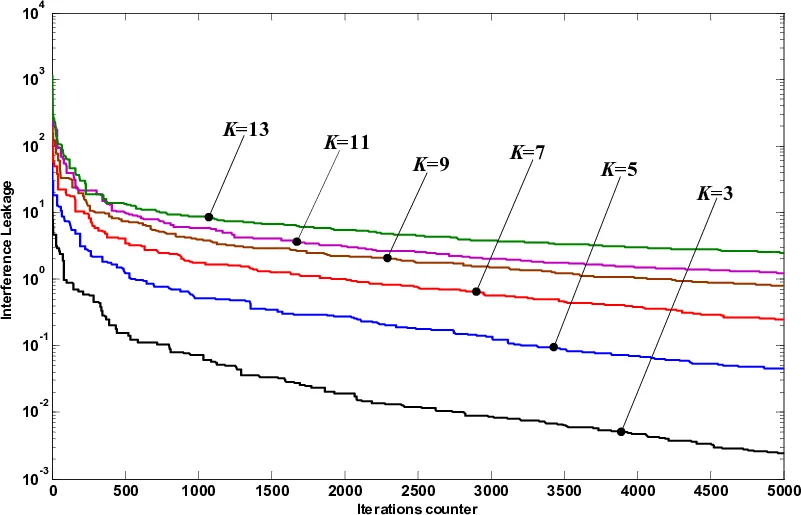
Standard PSO updates each particle’s velocity and position based on its personal best and the global best, with an additional scaling factor (\omega) to balance exploration and exploitation. The authors set (\omega = 3) and a swarm size of 100 particles, allowing up to 5,000 iterations. Experimental results show that while PSO can reduce IL for small K (e.g., K = 3), its convergence slows dramatically as K grows, and the final IL values remain far above the levels required for practical IA (e.g., IL ≈ 0.25 for K = 7, and ≈ 2.5 for K = 13).
To overcome the “curse of dimensionality” inherent to PSO, the paper introduces Cooperative PSO (CPSO). CPSO partitions the full solution vector into (n) one‑dimensional sub‑vectors, each handled by an independent 1‑D swarm. For a given dimension j, the fitness of a particle is evaluated by constructing a context vector that concatenates the current global best values of all other dimensions with the candidate value of dimension j. This approach effectively reduces each sub‑problem to a simple 1‑D search while preserving the coupling through the context vector. The authors employ a swarm size of 50 particles per 1‑D sub‑swarm and set (\omega = 10^{-3}).
Simulation scenarios consider K = 3, 5, 7, 9, 11, and 13 users, each equipped with M = N = 5 antennas and transmitting d = 2 streams. The total number of real decision variables ranges from 120 (K = 3) to 520 (K = 13). Results demonstrate that CPSO achieves IL values on the order of (10^{-5}) to (10^{-6}) across all K, comparable to the benchmark in Gomadam et al. (2011) and substantially better than the plain PSO. Moreover, CPSO converges within roughly 2,000–3,000 iterations, whereas PSO requires the full 5,000 iterations and still fails to reach comparable IL levels.
The key contributions of the work are: (1) casting IA for large‑scale MIMO ICs as a high‑dimensional real‑valued optimization problem; (2) applying a dimension‑decomposition cooperative co‑evolution strategy (CPSO) to mitigate the dimensionality curse; (3) providing extensive simulation evidence that CPSO outperforms standard PSO in both convergence speed and final IL performance.
Nevertheless, the study has limitations. The CPSO implementation treats all dimensions as independent 1‑D sub‑components, ignoring possible statistical dependencies among the entries of V and U matrices. Consequently, the context vector always uses the current global best for other dimensions, which may lead to sub‑optimal coordination. Future research directions suggested include (i) analyzing and exploiting the inter‑variable dependence to design adaptive sub‑swarm sizes or grouping strategies; (ii) hybridizing CPSO with deterministic IA techniques such as alternating minimization to further accelerate convergence; and (iii) validating the approach under realistic channel models (correlated fading, mobility) and hardware constraints.
In summary, the paper demonstrates that cooperative co‑evolutionary PSO is a viable and promising alternative to conventional algebraic IA methods for large‑scale K‑user MIMO interference channels, offering improved scalability and robustness at the cost of additional algorithmic complexity that can be mitigated through further research.
Comments & Academic Discussion
Loading comments...
Leave a Comment