Should Engineers be Concerned about Vulnerability of Highway Bridges to Potentially-Induced Seismic Hazards?
This paper evaluates the vulnerability of highway bridges in areas subjected to human induced seismic hazards that are commonly associated with petroleum activities and wastewater disposal. Recently, there has been a significant growth in the rate of such earthquakes, especially in areas of Texas, Oklahoma, and Kansas. The magnitudes of these earthquakes are usually lower than tectonic earthquakes that can occur in high seismic regions; however, such induced earthquakes can occur in areas that historically have had negligible seismicity. Thus, the infrastructure in these locations was likely designed for no to low seismic demands, making them vulnerable to seismic damage. Ongoing research is aimed at evaluating the vulnerability bridge infrastructure to these human induced seismic hazards. In this paper, fragility curves are developed specifically for steel girder bridges by considering major sources of uncertainty, including uncertainty in ground motions and local soil conditions expected in the Texas, Oklahoma, and Kansas region, as well as uncertainty in design and detailing practices in the area. The results of this fragility analysis are presented herein as a basis for discussion of potential seismic risks in areas affected by induced earthquakes.
💡 Research Summary
The paper addresses the emerging concern that human‑induced seismicity—primarily linked to petroleum extraction and wastewater disposal—has been increasing dramatically in the central United States, especially in Texas, Oklahoma, and Kansas. Although the magnitudes of these events (generally M 3–5.8) are lower than those of tectonic earthquakes in high‑seismic regions, they occur in areas that historically have experienced negligible seismic activity. Consequently, many highway bridges were designed for little or no seismic demand and may be vulnerable to damage when such induced events occur.
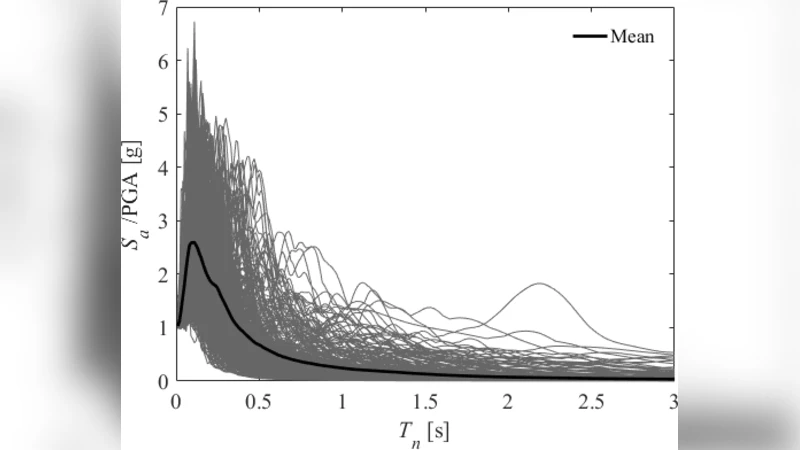
To quantify this vulnerability, the authors develop probabilistic fragility curves for multi‑span, simply‑supported steel‑girder bridges, which are among the most common bridge types in Texas. The methodology proceeds in four main steps. First, a suite of more than 200 recorded ground motions from 2005 onward—most of them from Texas, Oklahoma, and Kansas—is assembled. These records span depths of 2.4–14.2 km, magnitudes of 3.6–5.8, and peak ground accelerations (PGA) up to 0.6 g. Their 5 %‑damped elastic pseudo‑acceleration spectra are normalized by PGA to capture the variability of the seismic input.
Second, bridge geometric parameters (number of spans, span length, deck width, vertical under‑clearance) are extracted from the FHWA National Bridge Inventory and the Texas Department of Transportation databases. Using Latin Hypercube Sampling, eight representative bridge configurations are generated, reflecting the observed distributions (spans 2–8, lengths 20–90 ft, under‑clearance 13–24 ft, deck widths 20–80 ft).
Third, for each configuration, material properties (steel yield strength, concrete compressive strength, reinforcement ratios) are treated as random variables based on regional data and literature. This yields a total of 64 bridge models (8 configurations × 8 material realizations). The models are built in OpenSees as three‑dimensional nonlinear finite‑element systems: beam‑column elements represent girders, bent caps, and columns; rotational springs at column ends capture flexural, shear, and combined failure modes; bearing behavior (fixed and expansion types) is modeled with experimentally calibrated nonlinear springs; and pile‑bent abutments are represented with passive and active resistance components. The column spring models are calibrated against a large experimental database (319 rectangular and 171 circular columns) and incorporate ACI backbone parameters for flexure, splicing, and shear.
Fourth, each bridge model is subjected to ten randomly selected ground motions, scaled to a range of PGA values, resulting in 640 nonlinear time‑history analyses performed on the DesignSafe cyber‑infrastructure. For each analysis, demands on columns, bearings, and abutments are recorded. The authors then construct a Probabilistic Seismic Demand Model (PSDM) and a Probabilistic Seismic Capacity Model (PSCM) for each component, assuming lognormal distributions for demand and capacity. Using the standard fragility formulation (probability that demand exceeds capacity), component‑level fragility curves are generated, and these are combined to produce system‑level fragility curves for the steel‑girder bridge class.
The resulting fragility curves reveal that even modest PGA levels (≈0.2 g) can produce a 30 % or higher probability of column failure, and similar probabilities for bearing and abutment damage. The analysis highlights that bridges lacking seismic detailing—particularly those with insufficient shear reinforcement in columns—are especially susceptible to shear failure under induced shaking. The findings suggest that the current low‑seismic design standards in the region may be inadequate for the evolving induced‑seismic hazard.
In conclusion, the study provides the first probabilistic fragility framework tailored to human‑induced earthquakes for a prevalent bridge type in the central United States. It underscores the need for updated seismic risk assessments, potential retrofitting strategies, and incorporation of induced‑seismic scenarios into bridge design codes. Future work is planned to extend the approach to other bridge typologies, incorporate soil‑structure interaction, and refine ground‑motion prediction models specific to induced seismicity.
Comments & Academic Discussion
Loading comments...
Leave a Comment