Evaluation of matrix factorisation approaches for muscle synergy extraction
The muscle synergy concept provides a widely-accepted paradigm to break down the complexity of motor control. In order to identify the synergies, different matrix factorisation techniques have been used in a repertoire of fields such as prosthesis co…
Authors: Ahmed Ebied, Eli Kinney-Lang, Loukianos Spyrou
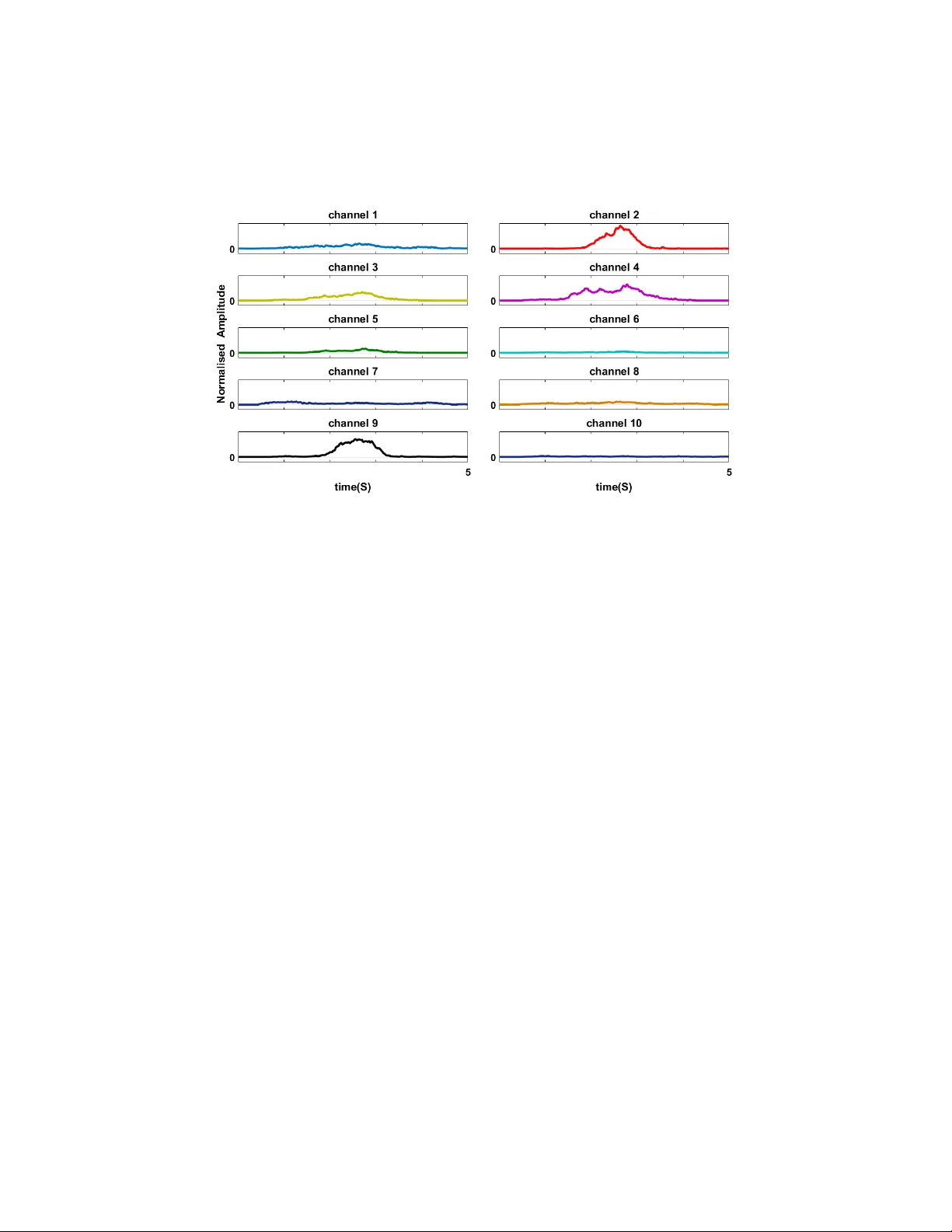
Ev aluation of Matrix F actorisation Approac hes for Muscle Synergy Extraction Ahmed Ebied a, ∗ , Eli Kinney-Lang a , Loukianos Sp yrou a , Ja vier Escudero a a Scho ol of Engine ering, Institute for Digital Communications, The University of Edinbur gh, Edinbur gh EH9 3FB, Unite d Kingdom Abstract The m uscle synergy concept pro vides a widely-accepted paradigm to break down the complexit y of motor control. In order to iden tify the synergies, differen t matrix factorisation tec hniques ha ve been used in a rep ertoire of fields such as prosthesis control and biomec hanical and clinical studies. Ho wev er, the rele- v ance of these matrix factorisation tec hniques is still op en for discussion since there is no ground truth for the underlying synergies. Here, we ev aluate fac- torisation techniques and inv estigate the factors that affect the quality of esti- mated synergies. W e compared commonly used matrix factorisation metho ds: Principal comp onent analysis (PCA), Indep endent comp onent analysis (ICA), Non-negativ e matrix factorization (NMF) and second-order blind identification (SOBI). Publicly av ailable real data w ere used to assess the synergies extracted b y each factorisation method in the classification of wrist mo v emen ts. Synthetic datasets were utilised to explore the effect of muscle synergy sparsity , lev el of noise and n umber of c hannels on the extracted synergies. Results suggest that the sparse synergy mo del and a higher n umber of channels would result in b et- ter estimated synergies. Without dimensionality reduction, SOBI sho wed b etter results than other factorisation methods. This suggests that SOBI would b e an alternativ e when a limited num b er of electro des is av ailable but its p erformance w as still p o or in that case. Otherwise, NMF had the b est p erformance when I W ord coun t: 4402 ∗ Corresponding author Email addr ess: ahmed.ebied@ed.ac.uk (Ahmed Ebied ) Pr eprint submitte d to Me dical Engine ering and Physics June 6, 2018 the num b er of c hannels w as higher than the num ber of synergies. Therefore, NMF w ould b e the b est metho d for muscle synergy extraction. Keywor ds: Muscle synergy, Matrix factorisation, Surface electrom yogram, Non-negativ e matrix factorisation, second-order blind identification, Principal comp onen t analysis, Indep endent component analysis. 1. In tro duction 1.1. Muscle syner gy “Ho w do es the cen tral nervous system (CNS) con trol b o dy mov ements and p osture?” This question has b een discussed for ov er a cen tury with no conclu- siv e answer. The co ordination of muscles and joints that accompanies mo v ement requires multiple degree of freedoms (DoFs). This res ults a high level of com- plexit y and dimensionality [1]. A possible explanation to this problem considers the notion that the CNS constructs a mov emen t as a combination of small groups of m uscles (synergies) that act in harmony with eac h other, thus reducing the dimensionalit y of the problem. This idea could be traced to the first decades of the t wen tieth cen tury [2] and has b een formulated and developed through the years [3, 4, 5] to reach the Muscle Synergy hypothesis [6, 7, 8]. The mus- cle synergy concept p osits that the CNS ac hieves any motor con trol task using a few synergies com bined together, rather than controlling individual muscles. Although the m uscle synergy hypothesis is criticized for b eing v ery hard to b e falsified [9], a rep ertoire of studies hav e provided evidence and supp ort for it. Those pieces of research could be categorized into tw o main categories: direct stim ulation and b ehavioural studies. The stim ulation approac hes were conducted by exciting the CNS at differen t lo cations to study the resulting activ ation pattern. Earlier studies fo cused on the organization of motor resp onses evok ed b y micro-stimulation of the spinal cord of different vertebral sp ecies, such as frogs [3, 4, 5, 10, 11], rats [12] and cats [13]. They rev ealed that the resp onses induced by sim ultaneous stim ulation of different lo ci in the spinal cord are linear com binations of those induced by 2 separate stim ulation of the individual locus. Those findings w ere supp orted b y another direct stimulation studies where a relativ ely long p erio d of electric stim ulation applied to different sites in the motor cortex resulted in complex mo vemen ts in rats [14], prosimians [15] and macaques [16, 17]. The c hemical micro-stim ulation has been used through N-methyl-D-aspartate ion tophoresis injected in to the spinal cord of frogs whic h evok ed an electrom y ographic (EMG) patterns that could b e constructed as a linear com bination of a smaller group of m uscle synergies [7]. Similarly , the b ehavioural studies rely on recording the electrical activity of the muscles (electrom yogram, EMG) during a sp ecific task (or tasks) or natural b eha viour. Then, a n umber of synergies is extracted from the signals using com- putational techniques. The identified synergies should b e able to describ e the recorded signal for the related task or b ehaviour. Studies hav e b een carried out on cats where four m uscle synergies w ere sufficien t to reproduce 95% of p ostural hind-lim b m uscles resp onse data [18] and five synergies accounted for 80% of total v ariability in the data [19]. Similar research on monk eys during grasping activit y sho w ed that three muscle synergies accoun ted for 81% of v ariability [16]. In h umans, muscle synergies were iden tified from a range of motor b ehaviours [20, 21] with the ability to describ e most of the v ariability in EMG signals. In addition, other studies sho w that complex motor outputs such as upper limb reac hing mo v ements [22], cycling [23, 24] and h uman postural con trol [25] are a result of the com bination of few muscle synergies. In the recent y ears, man y studies applied the m uscle synergy concept to anal- yse and study bo dy mo vemen ts and m uscle coordination in div erse applications. F or instance, it has b een used to establish the neurom uscular system mo del [26]. Moreo ver, the hypothesis has b een used in many clinical applications [27] in ad- dition to several biomechanical studies such as walking and cycling [28, 29]. The extracted synergies are utilised in prosthesis control through classification [30, 31] and regression [32]. 3 1.2. Mathematic al mo dels for muscle syner gy In all studies, the muscle synergies are estimated from the recorded electri- cal activity of the m uscle. Signals are either collected using surface EMG or in v asiv ely using needle EMG. Then, the EMG recordings needs to b e mo delled in order to compute the m uscle synergies. Tw o main m uscle synergy mo dels ha ve b een proposed: the time inv ariant or sync hronous mo del [6, 7] and the time-v arying or asynchronous mo del [33, 8]. The electrical activit y for single muscle or channel m ( t ) is a vector that could b e expressed according to the time-in v arian t mo del as a combination of sync hronous synergies s (scalar v alues activ ated at the same time) m ultiplied b y a set of time-v arying co efficients or w eighting functions w as shown in equation 1 m ( t ) = i = r X i =1 s i w i ( t ) (1) where r is the num b er of sync hronous synergies. Since synergies con tribute to each muscle activity pattern with the same w eighting function w i ( t ), the synergy mo del is sync hronous without any time v ariation. On the other hand, the time-v arying synergies are asynchronous as they are compromised b y a collection of scaled and shifted wa v eforms, eac h one of them sp ecific for a muscle or channel. Thus, the muscle activity m ( t ) can b e describ ed according to the asynchronous mo del with a group of time-v arying synergy v ectors scaled and shifted in time by c and τ , respectively , as sho wn in equation 2. m ( t ) = i = r X i =1 c i s i ( t − τ i ) (2) In this case, the mo del is capable of capturing fixed relationships among the m uscle activ ation w av eforms across muscles and time. By means of comparison, time-in v arian t synergies can acquire the spatial structure in the patterns but an y fixed temp oral relationship can b e reco vered only indirectly from the w eighting functions asso ciated with its sync hronous synergy . Although the time-v arying mo del pro vides a more parsimonious represen ta- tion of the muscle activit y compared to the time-inv ariant mo del, some studies 4 ha ve sho wn evidence that the m uscle synergies are sync hronised in time [34, 10]. Therefore, most recen t m uscle synergies studies apply the time-inv ariant mo del for synergy extraction. This is done by using matrix factorization tec hniques on m ultichannel EMG activit y to estimate the muscle synergies and their weigh ting functions. 1.3. Comp arison of Matrix factorization te chniques According to the time-inv ariant mo del, the estimation of m uscle synergies (spatial profile) and their weigh ting functions (temp oral profile) from a multi- c hannel EMG signal is a blind source separation (BSS) problem. This problem is approached by matrix factorisation techniques to estimate the set of basis v ectors (synergies). V arious matrix factorisation algorithms hav e b een applied based on different constrain ts. The most commonly used factorisation tec h- niques to extract synergies for m y o electric con trol and clinical purp oses are principal component analysis (PCA) [35] which was applied in [36], indepen- den t component analysis (ICA) [37] that was used in [30] and [38], in addition to non-negative matrix factorization (NMF) [39] whic h hav e b een used in [40, 32] and [41]. In this pap er, these three techniques are compared among themselv es and to second-order blind identification (SOBI) [42], a technique which has not b een used for muscle synergy estimation previously . A first ev aluation of the matrix factorisation algorithms for muscle synergy extraction was reported in 2006 [43] where the algorithms were tested with simulated data under different lev els and kinds of noise and they were applied on real data to show the similarities b e- t ween their estimated synergies. A more recent study [44] used join t motion data to ev aluate kinematics and muscle synergies estimated by PCA, ICA and NMF using the qualit y of reconstructing the data b y synergies as a metric for ev aluation. Here, we are concerned with nature and num ber of muscle synergies and the factors that affect their quality which hav e not b een discussed by those studies. The sparsity of synergies is in v estigated where synthetic sparse and non-sparse synergies are compared to study their effect on the matrix factorisa- 5 tions. Moreov er, the ratio betw een num ber of channels and synergies (dimension reduction ratio) is studied. Those comparisons are carried out under different noise lev els to show the robustness of factorisation metho ds to noise. In addi- tion, synergies extracted from a real dataset by the four matrix factorisation tec hniques w ere used to classify betw een wrist mo vemen ts. The classification accuracy w as used as a metric in the factorisation metho ds comparison. W e aim to compare curren t matrix factorisation techniques in addition to SOBI and inv estigate the factors that affect the quality of their extracted synergies suc h as sparsity and channel/synergy ratio. 2. Methods 2.1. R e al dataset W e used the Ninapro first dataset [45, 46] whic h consists of recordings for 53 wrist, hand and finger mov emen ts. Eac h mo vemen t/task has 10 rep etitions from 27 health y sub jects. The dataset contains 10-channel signals rectified by ro ot mean square and sampled at 100 Hz as sho wn in Figure 1. The real dataset is used in the comparison b etw een matrix factorisation techniques. Moreov er, it is used as a part of the synthetic data creation as discussed in 2.2. F or the real data comparison, the three main degree of freedoms (DoF) in- v estigated for the wrist motion are wrist flexion and extension (DoF1), wrist radial and ulnar deviation (DoF2), and wrist supination and pronation (DoF3). W rist mov ement through these three degrees of freedom are essential for pros- thetic con trol [47]. Th us, they may highligh t the application of muscle synergies in m yoelectric control. 2.2. Synthetic data The performance of eac h matrix factorisation algorithm w as tested using syn thetic datasets as ground truth. Since the studies [34, 10] sho wed an evi- dence that the muscle synergies are sync hronised in time, the data was generated according to the time-in v arian t mo del [6] in whic h EMG activity for j th -c hannel 6 Figure 1: Example of 10-channel EMG en velopes recorded during wrist extension mov ement for 5 s of Sub ject 4/rep etition 1 (the amplitude is normalised only in figure to highligh t the differences betw een c hannels). is the summation of its coefficients in each synergy ( s ij ), weigh ted by the re- sp ectiv e weigh ting function ( w i ( t )), as the follo wing: m j ( t ) = i = r X i =1 s ij w i ( t ) + g ( ) (3) where m j ( t ) is the sim ulated EMG data ov er c hannel j , while is a Gaussian noise v ector and g ( x ) is the Heaviside function used to enforce non-negativit y . F or m -channel data, this mo del could be expanded into its matrix form. In this case, the syn thetic EMG data M is a matrix with dimensions ( m c hannels × n samples) as M ( m × n ) = S ( m × r ) × W ( r × n ) + g ( E ) (4) where r is the num b er of synergies ( r 0.05, while num b er of c hannels has a significan t effect with [ F (1 , 11) = 19 . 94 , p = 0 . 003] as 12-c hannels datasets p erforms b etter than 8-channel signals (shown in Figure 5). As for the level of noise, the 10 dB SNR had a significantly worse p erformance than 15 and 20 dB SNR with the effect of noise significant at [ F (2 , 11) = 24 . 22 , p = 0 . 007] b y 1-w a y ANO V A. This indicates that, the MDL method for estimating the correct n umber of synergies performs b etter with low er noise and more a v ailable c hannels, as exp ected. 14 8-channels 12-channels 8-channels 12-channels 0 20% 40% 60% 80% Correct estimation 10dB 15 dB 20 dB Sparse Non-sparse Figure 5: Percen tage of correct synergy num b er estimation using the MDL metho d across the three settings (noise, num b er of channels and sparsity). 3.2. F actorisation p erformanc e c omp arison using synthetic data The four matrix factorisation metho ds w ere compared on the basis of tw o criteria: synergy full iden tification success rate and the normalised grand a ver- age of correlation coefficients for the fully identified synergies. The comparison w as done on 10000 trials (10 datasets of 1000 trails) for each com bination of the three settings (sparsit y , SNR and num b er of c hannels). An example of one setting of non-sparse, 12-channel with 15 dB SNR is shown in Figure 6. All the four factorisation tec hniques had con verged for all trails except for ICA which failed to con verge in 1.48% of the trails. The four factorisation methods w ere assessed by their abilit y to fully identify all 4 true synergies b y matching them according to their Pearson’s correlation co efficien ts v alues. In order to rule out an y statistical chance from it, a tw o- sample t -test w as conducted to compare the success rate of eac h tec hnique and the randomly generated synergies. All the techniques succeeded to reject the null h yp othesis ( p < 0.05) for all the settings. Hence, there is a significant difference betw een the matc hing success rate for eac h of the matrix factorisation metho ds and the randomly generated synergies. An example of the success rate for one of the settings is shown in Figure 6a, while the av erage success rate to fully identify the true synergies for all settings is represen ted in Figure 7. NMF 15 PCA ICA SOBI NMF Chance 0 5000 10000 Trails Complete Synergy Identification Fully Match Partial Match 76.3% 45.9% 61.7% 75.6% 28.7% (a) Synergy Matrix Weighting Function 0 0.2 0.4 0.6 0.8 1 Normalised Similarity PCA ICA SOBI NMF (b) Figure 6: The results for non-sparse, 12 channels dataset with 15dB SNR. Panel 6a, the success ratio for the factorisation techniques to fully match the true synergies is shown. Panel 6b, the normalised similarity v alues for each tec hnique single trial with the same settings. Error bars indicate standard deviation. and PCA are has the highest success rates to fully identify synergies. The correlation co efficients of the matched synergies w ere normalised b y the random synergy correlation coefficients as shown in Figure 6b. Then the normalised correlation co efficient of synergies (synergy matrix) were av eraged across trials. The grand av erage for each factorisation metho d was normalised b y the chance’s grand a verage. In Figure 8, the normalised grand av erage (simi- larit y metric) for the four matrix factorisation methods is plotted for all different settings (sparsit y , n umber of c hannels and noise lev el). It is worth mentioning that although NMF hav e the highest similarity for all settings except for the four channel case (the results for the sparse, four-channel setting for NMF are mostly negativ e). On the other hand, all four algorithms p erform worse with four c hannels (no dimension reduction) with SOBI b eing the best algorithm among them in this case. In order to explore the significance of those settings the t wo-w a y ANOV A w as p erformed with p ost-ho c m ultiple comparison test. The result sho ws that 16 PCA ICA SOBI NMF 0 100% Success rate 76.3% 45.9% 61.7% 75.63% Figure 7: Violin graph for the success rate of full synergy iden tification for eac h method across all settings. The mean and median are represented in the Figure as red crosses and green squares resp ectively . n umber of c hannels and sparsity had a significan t effect on the grand normalised a verage at [F(2,688)=1364.5, p ≤ 0.05] and [F(1,400)=7.35, p =0.007] resp ec- tiv ely . The multiple comparison test shows that sparse synergies and the higher n umber of channels sho w b etter similarity lev els. On the other hand, the noise lev el fails to reject the n ull h ypothesis. This means that the level of noise used in these experiments did not affect the quality of estimated synergies significantly unlik e the sparsity or num ber of c hannels. In addition, this was supp orted by the interaction results, where factorisation metho ds and num ber of channels in- teraction show ed a significant effect on the grand normalised a verage, as well as factorisation metho d and sparsity interaction. On the con trary , the noise lev el and factorisation techniques interaction ha ve no significance on the grand normalised a verage. The computational efficiency was compared after each tec hnique ran for 100 times on Matlab 9 with Intel core i7 pro cessor(2.4 GHz, 12 GB RAM) and the median v alue for the running time w ere computed. PCA and SOBI w ere the fastest with (0.0012 s and 0.0015 s ) resp ectively follow ed by NMF with 0.0063 s while ICA was significan tly slow er b y 0.6419 s . 17 SNR10 SNR15 SNR20 SNR10 SNR15 SNR20 SNR10 SNR15 SNR20 0 1 Sparse SNR10 SNR15 SNR20 SNR10 SNR15 SNR20 SNR10 SNR15 SNR20 0 1 Non-Sparse PCA ICA SOBI NMF 8-Channels 12-Channels 4-Channels Figure 8: The normalised grand av erage of correlation co efficients for the fully identified synergies compared across all 3 settings (sparsity , SNR and n umber of channels) for the 4 matrix factorisation metho ds. Error bars indicate standard deviation. 3.3. F actorisation p erformanc e c omp arison using R e al data An example of the four matrix factorisation metho ds is sho wn in Figure 3 b y applying them on 10-channel EMG data. In order to sho w the similarities and differences in the estimated synergies and their w eigh tings functions of each tec hnique. F or example, synergies extracted by PCA and SOBI ha v e similarities in this example since b oth tec hniques are based on cov ariance matrices. The n umber of synergies needed in this example w as chosen to b e tw o according to the MDL metho d. In addition, to compare betw een the matrix factorisation techniques, a one- comp onen t synergy w as used to train a k -NN classifier ( k =3) in order to classify b et ween t wo an tagonistic mo vemen ts (one DoF) for each technique. This was calculated for the three wrist DoFs separately as shown in T able 1. In addi- tion, the same synergies w ere used to classify b etw een all six mo vemen ts (three DoFs). The av erage classification error rate and its standard deviation for the 27 sub jects is also represented in T able 1. 4. Discussion and Conclusion In this paper, we compared the most common matrix factorisation tec h- niques (PCA, ICA and NMF) for m uscle synergy estimation alongside SOBI, 18 T able 1: The classification error count and (error p ercentage) for each wrist’s DoF (Sample size=216) and all 3 DoFs (sample size=648) across 27 sub jects PCA ICA SOBI NMF DoF1 (wrist flexion and extension) 1 (0.46%) 28 (12.96%) 8 (3.70%) 1 (0.46%) DoF2 (wrist radial and ulnar deviation) 12 (5.56%) 29 (13.43%) 19 (8.80%) 1 (0.46%) DoF3 (wrist supination and pronation) 7 (3.24%) 31 (14.35%) 18 (8.33%) 5 (2.31%) All 3 DoFs (all 6 mo vemen ts) 43 (6.64%) 122 (18.83%) 65 (10.03%) 41 (6.33%) a BSS metho d that had not b een applied for synergy extraction y et. Many studies rely on muscle synergy concept such as my oelectric con trol and biome- c hanical research. How ev er, only tw o studies [43, 44] compared v arious factori- sation metho ds (excluding SOBI) for synergy estimation without inv estigating the factors that affect the factorisation qualit y - except for noise. Herein, the comparison w as held on real data and syn thetic signals generated with known synergies and under differen t settings. Using the syn thetic data w e studied the effect of those settings on the muscle synergy extraction for each tec hnique. The sparsity nature of synergies and lev el of noise w as in vestigated in addition to the num ber of channels needed to extract the four syn thetic synergies. The ability of the four factorisation metho ds to extract synergies from synthetic data w as judged according to tw o metrics: success rate to fully iden tify synergies (Figure 7) and the correlation co efficients b etw een true and estimated synergies (Figure 8). Moreov er, the synthetic data was used to assess the MDL metho d to determine n umber of synergies needed under those three 19 settings. F or the real datasets, since there is no ground truth to compare synergies estimated, w e compared the factorisation metho ds according to the abilit y of their extracted synergies to classify wrist mov emen ts (T able 1) as a proof of concept for prosthesis con trol [30, 40]. PCA an d NMF had the b est classification accuracy follo wed by SOBI, while ICA had the lo west accuracy . On the other hand, the syn thetic datasets results show ed that NMF and PCA had better success rate to fully identify the four true synergies than SOBI and ICA. Ho wev er, NMF and SOBI had the b est normalised grand a verage of correlation co efficients (similarity level) b etw een estimated and true synergies follo wed by PCA then ICA. Notably , NMF p erformed po orly with four-channel datasets when there w as not an y dimension reduction. In general, all algorithms p erform b etter with higher n umber of channels compared to synergies, where SOBI was the b est algorithm when there is no dimension reduction. There- fore, SOBI would be a relev ant algorithm in situations with limited num b er of electro des as it is preferable to minimise the num ber of electro des for practical prosthesis con trol [54, 55]. The tw o-w a y ANOV A sho wed that the tested range of SNR has no signifi- cance effect on the factorisation p erformance, although it is noticed that ICA w as the most unaffected metho d to noise according to the multiple compari- son test. On the other hand, sparsity had a significant effect ( p < 0.05) on the correlation b etw een true and estimated synergies. According to the multiple comparison test, the sparse synergies are easier to estimate by all factorisation metho ds. Moreov er, num b er of channels shows a significan t effect ( p < 0.05) on the correlation b etw een estimated synergies and true ones. In addition, higher n umber of channels to n um b er of synergies ratio provides better synergy extrac- tion. Regarding the estimation of the n um b er of synergies, the m ultic hannel EMG signal is reduced in to a low er subspace for the purp ose of synergy extraction. The estimation of this subspace’s dimension or, in other words, the n umber of synergies is crucial for the factorisation pro ces s. In the literature, there are 20 t wo main approac hes to determine the appropriate n umber of synergies: the functional and the mathematical ones. The functional approach determines the n umber of synergies according to the m yoelectric con trol requirements such as assigning tw o [56, 57] synergies for eac h DoF. On the other hand, the math- ematical approach relies on explained v ariance (using tests suc h as scree plot and Bart test) or the lik eliho o d criteria (suc h as Ak aik e information criteria and MDL) [58]. Here, we explored the MDL as an alternative for v ariance explained metho ds. The results show that MDL p erforms b etter with higher channel to synergy ratio. This supp orts the current challenges for effective synergy iden- tification with limited n umber of electro des. How ev er, further inv estigation is needed to compare b etw een different num ber of synergies estimation metho ds using syn thetic datasets with v arious settings. Other limitations are w orth noting. The results may b e biased to wards NMF due to the non-negative nature of the simulated synergies. How ever, this choice is supported by previous studies [40] whic h suggested the usefulness of NMF due to the additive nature of the synergies. In addition, further examination is needed if the setting of EMG acquisition changes dramatically (really bad SNR, m uch higher n um b er of c hannels, etc.) to ev aluate the v alidity of our conclusions in those settings. Finally , since v arious studies employ the muscle synergy in prosthesis control, a simple approach ( k -NN classifier) was used in this pap er as an example to guide synergy application and to supp ort the syn thetic results. W e treated this part of the study as a pro of of concept. Additional work is needed with more adv anced techniques and v ariety of tasks and mo vemen ts. In conclusion, this paper compared matrix factorisation algorithms for m us- cle synergy extraction and the factors that affect the quality of estimated syn- ergies. Our findings suggest that the presence of sparse synergies and higher n umber of c hannels would improv e the quality of extracted synergies. When the num ber of channels equal to synergies (no dimension reduction), SOBI p er- formed b etter than other metho ds although the p erformance w as still p o or in this case. Otherwise, NMF is the b est solution for robust synergy extraction when num ber of channels/m uscles is higher than the required m uscle synergies. 21 Declarations Comp eting in terests: None declared F unding: None Ethical appro v al: Not required References References [1] A. D’Av ella, M. Giese, Y. P . Iv anenko, T. Sc hac k, T. Flash, Editorial: Mo dularit y in motor control: from m uscle synergies to cognitiv e action represen tation., F ron tiers in computational neuroscience 9 (2015) 126. doi: 10.3389/fncom.2015.00126 . [2] C. S. Sherrington, Flexion-reflex of the limb, crossed extension-reflex, and reflex stepping and standing, The Journal of Ph ysiology 40 (1-2) (1910) 28–121. doi:10.1113/jphysiol.1910.sp001362 . [3] E. Bizzi, F. A. Mussa-Iv aldi, S. F. Giszter, Computations underlying the execution of mo v emen t: a biological p ersp ectiv e., Science (New Y ork, N.Y.) 253 (5017) (1991) 287–91. doi:10.1126/science.1857964 . [4] S. F. S. Giszter, F. F. A. Mussa-Iv aldi, E. Bizzi, Conv ergen t force fields organized in the frog’s spinal cord., The Journal of Neuroscience 13 (2) (1993) 467–491. [5] F. A. Mussa-Iv aldi, S. F. Giszter, E. Bizzi, Linear combinations of prim- itiv es in vertebrate motor con trol., Pro ceedings of the National Academy of Sciences of the United States of America 91 (16) (1994) 7534–7538. doi:10.1073/pnas.91.16.7534 . [6] M. C. T resc h, P . Saltiel, E. Bizzi, The construction of mov emen t b y the spinal cord., Nature neuroscience 2 (2) (1999) 162–7. doi:10.1038/5721 . 22 [7] P . Saltiel, K. Wyler-Duda, A. D’Av ella, M. C. T resc h, E. Bizzi, Muscle synergies enco ded within the spinal cord: evidence from fo cal in traspinal NMD A iontophoresis in the frog., Journal of neurophysiology 85 (2) (2001) 605–619. [8] A. D’Av ella, P . Saltiel, E. Bizzi, Combinations of muscle synergies in the construction of a natural motor b ehavior., Nature neuroscience 6 (3) (2003) 300–308. doi:10.1038/nn1010 . [9] M. C. T resc h, A. Jarc, The case for and against m uscle synergies., Current opinion in neurobiology 19 (6) (2009) 601–7. doi:10.1016/j.conb.2009. 09.002 . [10] W. J. Kargo, S. F. Giszter, Individual Premotor Driv e Pulses, Not Time- V arying Synergies, Are the Units of Adjustment for Lim b T ra jectories Con- structed in Spinal Cord, Journal of Neuroscience 28 (10) (2008) 2409–2425. doi:10.1523/JNEUROSCI.3229- 07.2008 . [11] C. B. Hart, S. F. Giszter, Modular premotor drives and unit bursts as primitiv es for frog motor b ehaviors., The Journal of neuroscience : the official journal of the Society for Neuroscience 24 (22) (2004) 5269–82. doi: 10.1523/JNEUROSCI.5626- 03.2004 . [12] M. C. T resc h, E. Bizzi, Resp onses to spinal microstim ulation in the c hron- ically spinalized rat and their relationship to spinal systems activ ated by lo w threshold cutaneous stimulation, Exp erimental Brain Research 129 (3) (1999) 0401–0416. doi:10.1007/s002210050908 . [13] M. A. Lemay , W. M. Grill, Mo dularity of motor output evok ed by in- traspinal microstim ulation in cats., Journal of neuroph ysiology 91 (1) (2004) 502–14. doi:10.1152/jn.00235.2003 . [14] F. Haiss, C. Sch w arz, Spatial segregation of different mo des of mo vemen t con trol in the whisk er represen tation of rat primary motor cortex., The 23 Journal of neuroscience : the official journal of the So ciety for Neuroscience 25 (6) (2005) 1579–87. doi:10.1523/JNEUROSCI.3760- 04.2005 . [15] I. Stepniewsk a, P .-C. F ang, J. H. Kaas, Microstim ulation rev eals sp ecialized subregions for different complex mov emen ts in p osterior parietal cortex of prosimian galagos., Proceedings of the National Academy of Sciences of the United States of America 102 (13) (2005) 4878–83. doi:10.1073/pnas. 0501048102 . [16] S. A. Ov erduin, A. D’Avella, J. Roh, E. Bizzi, Mo dulation of Muscle Syn- ergy Recruitmen t in Primate Grasping, Journal of Neuroscience 28 (4) (2008) 880–892. doi:10.1523/JNEUROSCI.2869- 07.2008 . [17] S. a. Ov erduin, A. D’Av ella, J. M. Carmena, E. Bizzi, Muscle synergies ev oked b y microstim ulation are preferentially encoded during behavior., F ron tiers in computational neuroscience 8 (Marc h) (2014) 20. doi:10. 3389/fncom.2014.00020 . [18] L. H. Ting, J. M. Macpherson, A limited set of m uscle synergies for force con trol during a p ostural task., Journal of neurophysiology 93 (1) (2005) 609–13. doi:10.1152/jn.00681.2004 . [19] G. T orres-Oviedo, J. M. Macpherson, L. H. Ting, Muscle synergy orga- nization is robust across a v ariet y of p ostural perturbations., Journal of neuroph ysiology 96 (3) (2006) 1530–1546. doi:10.1152/jn.00810.2005 . [20] V. C.-K. K. Cheung, Cen tral and Sensory Contributions to the Activ a- tion and Organization of Muscle Synergies during Natural Motor Behav- iors, Journal of Neuroscience 25 (27) (2005) 6419–6434. doi:10.1523/ JNEUROSCI.4904- 04.2005 . [21] E. J. W eiss, M. Flanders, Muscular and p ostural synergies of the human hand., Journal of neurophysiology 92 (1) (2004) 523–35. doi:10.1152/jn. 01265.2003 . 24 [22] A. D’Av ella, A. P ortone, L. F ernandez, F. Lacquaniti, Con trol of F ast- Reac hing Mov emen ts by Muscle Synergy Combinations, Journal of Neu- roscience 26 (30) (2006) 7791–7810. doi:10.1523/JNEUROSCI.0830- 06. 2006 . [23] J. M. J. J. M. W akeling, T. Horn, Neuromechanics of muscle synergies during cycling, Journal of neurophysiology 101 (2) (2009) 843–54. doi: 10.1152/jn.90679.2008 . [24] F. Hug, N. a. T urpin, A. Couturier, S. Dorel, Consistency of m uscle syn- ergies during p edaling across differen t mechanical constrain ts., Journal of neuroph ysiology 106 (1) (2011) 91–103. doi:10.1152/jn.01096.2010 . [25] L. H. Ting, J. L. McKa y , Neuromec hanics of m uscle synergies for p osture and mo vemen t., Curren t opinion in neurobiology 17 (6) (2007) 622–8. doi: 10.1016/j.conb.2008.01.002 . [26] S. Aoi, T. F unato, Neuromusculosk eletal mo dels based on the m uscle syn- ergy hypothesis for the in v estigation of adaptiv e motor control in lo co- motion via sensory-motor co ordination, Neuroscience Researc h 104 (2016) 88–95. doi:10.1016/j.neures.2015.11.005 . [27] D. T orricelli, F. Barroso, M. Coscia, C. Alessandro, F. Lunardini, E. Brav o Esteban, A. D’Avella, Muscle Synergies in Clinical Practice: Theoretical and Practical Implications, in: J. L. Pons, R. Ray a, J. Gonz´ alez (Eds.), Emerging Therapies in Neurorehabilitation I I, V ol. 10 of Biosystems & Biorob otics, Springer International Publishing, Cham, 2016, pp. 251–272. doi:10.1007/978- 3- 319- 24901- 8 . [28] M. M. Nazifi, H. U. Y oon, K. Beschorner, P . Hur, Shared and T ask-Sp ecific Muscle Synergies during Normal W alking and Slipping, F rontiers in Hu- man Neuroscience 11 (F ebruary) (2017) 1–14. doi:10.3389/fnhum.2017. 00040 . 25 [29] G. Martino, Y. P . Iv anenko, A. D’Avella, M. Serrao, A. Rana v olo, F. Draic- c hio, G. Capp ellini, C. Casali, F. Lacquaniti, Neuromuscular adjustments of gait asso ciated with unstable conditions, Journal of Neuroph ysiology 114 (2011) (2015) jn.00029.2015. doi:10.1152/jn.00029.2015 . [30] G. Raso ol, K. Iqbal, N. Boua ynay a, G. White, Real-Time T ask Discrimi- nation for Myoelectric Control Employing T ask-Specific Muscle Synergies., IEEE transactions on neural systems and rehabilitation engineering : a publication of the IEEE Engineering in Medicine and Biology So ciety 24 (1) (2016) 98–108. doi:10.1109/TNSRE.2015.2410176 . [31] J. Ma, N. V. Thak or, F. Matsuno, Hand and W rist Mo vemen t Control of My o electric Prosthesis Based on Synergy, IEEE T ransactions on Human- Mac hine Systems 45 (1) (2015) 74–83. doi:10.1109/THMS.2014.2358634 . [32] N. Jiang, H. Reh baum, I. V ujaklija, B. Graimann, D. F arina, In tuitiv e, on- line, simultaneous, and proportional my oelectric con trol ov er tw o degrees- of-freedom in upp er limb amputees., IEEE transactions on neural sys- tems and rehabilitation engineering : a publication of the IEEE Engi- neering in Medicine and Biology Society 22 (3) (2014) 501–10. doi: 10.1109/TNSRE.2013.2278411 . [33] A. D’Avella, M. M. C. M. T resch, Mo dularity in the motor system: de- comp osition of muscle patterns as combinations of time-v arying synergies, Citeseer 1 (2002) 141–148. doi:10.1.1.19.8895 . [34] C. B . Hart, S. F. Giszter, Distinguishing sync hronous and time-v arying synergies using p oin t pro cess interv al statistics: motor primitiv es in frog and rat., F ron tiers in computational neuroscience 7 (May) (2013) 52. doi: 10.3389/fncom.2013.00052 . [35] J. E. Jackson, A User’s Guide to Principal Comp onents, Wiley Series in Probabilit y and Statistics, John Wiley & Sons, Inc., Hob oken, NJ, USA, 1991. doi:10.1002/0471725331 . 26 [36] R. Ranganathan, C. Krishnan, Extracting synergies in gait: using EMG v ariability to ev aluate control strategies., Journal of Neurophysiology 108 (5) (2012) 1537–44. doi:10.1152/jn.01112.2011 . [37] A. Hyv¨ arinen, E. Oja, Independent component analysis: algorithms and applications, Neural Net w orks 13 (4-5) (2000) 411–430. doi:10.1016/ S0893- 6080(00)00026- 5 . [38] W. J. Kargo, D. A. Nitz, Early skill learning is expressed through selection and tuning of cortically represented m uscle synergies., The Journal of Neu- roscience 23 (35) (2003) 11255–69. doi:10.1162/089892903322307384 . [39] D. D. Lee, H. S. Seung, Learning the parts of ob jects b y non-negative matrix factorization., Nature 401 (6755) (1999) 788–91. doi:10.1038/ 44565 . [40] C. Choi, J. Kim, Synergy matrices to estimate fluid wrist mov ements by surface electrom yograph y, Medical Engineering and Physics 33 (8) (2011) 916–923. doi:10.1016/j.medengphy.2011.02.006 . [41] D. J. Berger, A. D’Av ella, Effectiv e force control by muscle synergies., F ron tiers in computational neuroscience 8 (April) (2014) 46. doi:10.3389/ fncom.2014.00046 . [42] A. Belouc hrani, K. Ab ed-Meraim, J.-F. J. Cardoso, E. Moulines, A blind source separation technique using second-order statistics, IEEE T ransac- tions on Signal Pro cessing 45 (2) (1997) 434–444. doi:10.1109/78.554307 . [43] M. C. T resch, V. C.-K. K. Cheung, A. D’Av ella, Matrix factorization algo- rithms for the identification of muscle synergies: ev aluation on simulated and exp erimental data sets., Journal of neurophysiology 95 (4) (2006) 2199– 2212. doi:10.1152/jn.00222.2005 . [44] N. Lambert-Shirzad, H. F. M. V an der Lo os, On iden tifying kinematic and m uscle synergies: a comparison of matrix factorization methods using 27 exp erimen tal data from the health y p opulation, Journal of Neurophysiology 117 (1) (2017) 290–302. doi:10.1152/jn.00435.2016 . [45] M. A tzori, A. Gijsb erts, C. Castellini, B. Caputo, A.-G. M. Hager, S. El- sig, G. Giatsidis, F. Bassetto, H. M ¨ uller, Electromy ograph y data for non- in v asiv e naturally-con trolled rob otic hand prostheses., Scientific data 1 (2014) 140053. doi:10.1038/sdata.2014.53 . [46] M. A tzori, A. Gijsb erts, I. Kuzb orskij, S. Elsig, A. G. Hager, O. De- riaz, C. Castellini, H. Muller, B. Caputo, A.-G. M. Hager, O. Deriaz, C. Castellini, H. Muller, B. Caputo, Characterization of a b enchmark database for my o electric mo v ement classification, IEEE T ransactions on Neural Systems and Rehabilitation Engineering 23 (1) (2015) 73–83. doi: 10.1109/TNSRE.2014.2328495 . [47] D. F arina, N. Jiang, H. Reh baum, A. Holobar, B. Graimann, H. Dietl, O. C. Aszmann, The extraction of neural information from the surface EMG for the con trol of upp er-limb prostheses: Emerging a ven ues and c hal- lenges, IEEE T ransactions on Neural Systems and Rehabilitation Engineer- ing 22 (4) (2014) 797–809. doi:10.1109/TNSRE.2014.2305111 . [48] G. T orres-Oviedo, L. H. Ting, Muscle synergies characterizing human p ostural resp onses., Journal of neurophysiology 98 (4) (2007) 2144–56. doi:10.1152/jn.01360.2006 . [49] H. Ab di, L. J. Williams, Principal comp onent analysis, Wiley Interdisci- plinary Reviews: Computational Statistics 2 (4) (2010) 433–459. arXiv: arXiv:1011.1669v3 , doi:10.1002/wics.101 . [50] A. Hyv¨ arinen, A family of fixed-p oint algorithms for indep endent comp o- nen t analysis, in: IEEE 5 th In t. Conf. on Acoustics, Speech and Signal Pro cessing (ICASSP), 1997, pp. 3917–3920. doi:10.1109/ICASSP.1997. 604766 . 28 [51] M. W. Berry , M. Browne, A. N. Langville, V. P . Pauca, R. J. Plemmons, Algorithms and applications for appro ximate nonnegativ e matrix factoriza- tion, Computational Statistics and Data Analysis 52 (1) (2007) 155–173. doi:10.1016/j.csda.2006.11.006 . [52] A. Cichocki, S. Amari, K. Siw ek, T. T anak a, A. H. Phan, Icalab to olb oxes, h ttp://www.bsp.brain.riken.jp/ICALAB. [53] N. Jiang, J. L. G. V est-Nielsen, S. Muceli, D. F arina, EMG-based simulta- neous and proportional estimation of wrist/hand kinematics in uni-lateral trans-radial amputees., Journal of neuro engineering and rehabilitation 9 (1) (2012) 42. doi:10.1186/1743- 0003- 9- 42 . [54] E. A. Clancy , C. Martinez-Luna, M. W artenberg, C. Dai, T. R. F arrell, Tw o degrees of freedom quasi-static EMG-force at the wrist using a mini- m um n umber of electrodes, Journal of Electrom yograph y and Kinesiology 34 (2017) 24–36. doi:10.1016/j.jelekin.2017.03.004 . [55] S. Muceli, N. Jiang, D. F arina, Extracting Signals Robust to Electro de Num b er and Shift for Online Sim ultaneous and Prop ortional Myoelec- tric Con trol by F actorization Algorithms, IEEE T ransactions on Neural Systems and Rehabilitation Engineering 22 (3) (2014) 623–633. doi: 10.1109/TNSRE.2013.2282898 . [56] S. Muceli, A. T. Boy e, A. D’Avella, D. F arina, Iden tifying representativ e synergy matrices for describing muscular activ ation patterns during mul- tidirectional reaching in the horizon tal plane., Journal of Neurophysiology 103 (3) (2010) 1532–1542. doi:10.1152/jn.00559.2009 . [57] N. Jiang, K. B. Englehart, P . a. P arker, Extracting simultaneous and pro- p ortional neural con trol information for multiple-dof prostheses from the surface electrom yographic signal, IEEE T ransactions on Biomedical Engi- neering 56 (4) (2009) 1070–1080. doi:10.1109/TBME.2008.2007967 . 29 [58] S. Ik eda, K. T oy ama, Independent comp onent analysis for noisy data - MEG data analysis, Neural Netw orks 13 (10) (2000) 1063–1074. doi:10. 1016/S0893- 6080(00)00071- X . App endix A. Minimum description length (MDL) The MDL method for determining the num ber of synergies is p erformed by calculating the maximum lik eliho o d estimates of factor loading matrix A and the unique v ariances diagonal matrix Ψ according to the factor analysis model C = AA T + Ψ (A.1) where C is the cov ariance matrix of M m × n the multi-c hannel EMG signal matrix with m c hannels and n samples. This is done for different num ber of synergies ( r ) betw een 1 ≤ r ≤ 1 2 (2 m + 1 − √ 8 m + 1) in order to minimise the MDL. The b oundary for r is set by comparing the num b er of equations with unkno wns in order to hav e an algebraic solution for equation A.2. L ( A , Ψ ) = − 1 2 n tr ( C ( Ψ + AA T ) − 1 ) + log (det( Ψ + AA T )) + m log 2 π o (A.2) MDL = − L ( A , Ψ ) + log n n m ( r + 1) − r ( r − 1) 2 (A.3) The n um b er of synergies r are selected to minimise the MDL v alue in equation A.3. 30
Original Paper
Loading high-quality paper...
Comments & Academic Discussion
Loading comments...
Leave a Comment