A dedicated codec for compression of Gravitational Waves Sound
A dedicated codec for compression of gravitational waves sound with high quality recovery is proposed. The performance is tested on the available set of gravitational sound signals that has been theoretically generated at the Massachusetts Institute …
Authors: Laura Rebollo-Neira
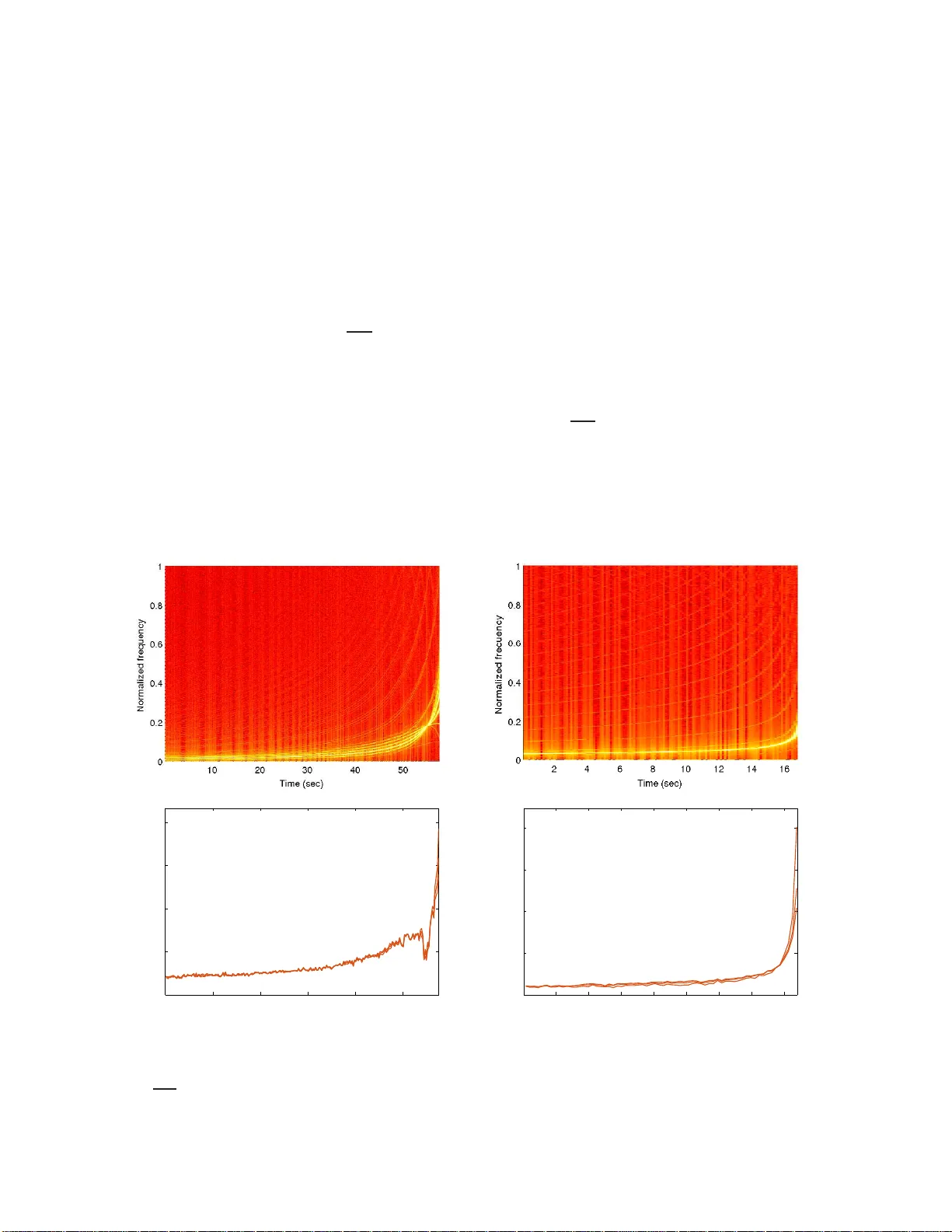
A dedicated co dec for compression of Gra vitational W a v es Sound Laura Reb ollo-Nei ra Mathemat ics Department Aston Univ er sit y B4 7ET Birmingha m, UK Abstract A dedicated cod ec for compression o f gra vitational wa v es sound with high qualit y reco very is prop osed. The p erformance is tested on the a v ailable set of gravi tational sound signals th at has b een theoretic ally generated at the Massac h usetts Institute of T ec hnology (MIT). The appr oac h is based on a mo del for data reduction rend er in g high qualit y ap p ro ximation of the signals. The reduction o f dimensionalit y is ac hiev ed b y selecting ele m entary co m p onents f r om a redundant set ca lled a dictionary . Comparisons with t h e compression standard MP3 d emons trate the merit of the dedicated tec hniqu e f or compr essing this t yp e of sound. 1 In tro du ction After the celebrated first detection of a g ra vitational w av e (GW) on Sept 2015 [1] five more detections [2 – 6] ha v e confirmed Einstein’s theory of general relativit y . Predictions from the Laser Interferomete r Gra vitat io nal-W a v e Observ atory (LIGO) and Virgo Scien tific Collab oration assert that w eekly or ev en more often detections can b e expected in the near future. Scien tists en visage the prospect as the b eginning of a new era in astronomy , whereb y the ve ry early Univ erse will b e studied by the sound that w as made in its formation. Theoretically , G Ws are modelled and generated using t ec hnique s of num erical relativit y [7 – 9], from whic h audio represen tation can b e dev elop ed. In particular, the group of Prof. Hughes at MIT has pro duced and made av ailable the gravitational w av es sound (GWS) signals whic h hav e b een used in this study . The nu merically sim ulated signals are supp orted b y a n um b er of publications [11 – 15] and nice ly presen ted on a w ebsite [16 ]. This w ork uses those signals to demonstrate a dedicated sc heme for the compression of GWS with high quality reco very . The proposal falls within the usual transform co ding sch eme. It c o nsists of three main steps: 1) T ransformation of the sound signal. 2) Quan tization of the transformed data. 3) Bit- stream en tropy co ding. Ho w eve r, it differs fro m the tra dit io nal compression t echniq ues from the b eginning. Instead of considering an orthogonal tra nsformation, the first step is realized by appro ximating the signal using a redundan t dictionary from where the elemen tary comp onen ts for represen ting the signal are selected t hrough a greedy pursuit strategy . This strategy giv es r ise to what is kno wn as sparse represen tat io n of a signal. In the area o f audio pro cessing a num b er o f differen t tasks hav e b een sho wn to b enefit b y the sparsit y of a represen tatio n. The relev an t literatur e is extensiv e. As a sample w e refer to [17 – 27]. Here w e focus on comp r ession of G WS signals, whic h do require a dedicated framew ork for their sparse represen tation. In part icular, the dictionary w e use for the prop osed co dec w as introduced in a recen t publicatio n as p oten tially go o d to ac hieve sparse represen tation of G WS b y partitioning the signal [28]. No w it stands as a crucial comp onen t of a co dec for hig h quality p oin t-wise reco very of the compressed signal. 1 Since t he G WS under consideration is in the range of h uman hearing, it is inte resting to realize comparisons with the p opular compression standard MP3. The results demonstrate a significant impro v ement in compression p erformance for the equiv alen t quality of the reco v ered signal. More precisely , the signal is required to yield a Signal to Noise R atio (SNR) competitive with MP3 outcomes with respect to b oth, the whole signal and the elemen ts of the signal partition. The b enefits of the prop osed dedicated fo rmat for enco ding GWS go b ey ond the compression p erformance. Certainly , the underlying represen tation of the data g enerates a reduced set whic h con tains information ab out the elemen tary comp onen ts o f the signal. Hence, in addition to r ecov ering the signal from a compressed file with high quality , one can also r ecov er its reduced represen tatio n in terms of elemen tary comp onen ts. Since the reduced represe ntation giv es rise to an accurate appro ximation of the signal, it can b e of assistance to signal pro cessing tech niques relying on a reduction of dimensionalit y a s a first step of further pro cessing. The main goals o f the n umerical tests of Section 3 are: • T o pro duce strong evidence that high quality approximation of tw o differen tly generated types of GWS can b e achie ved as a sup erp osition o f elemen tary compo nents of differen t nature. A comp onen t of elemen ts generated b y a discrete v ersion of trigonometric functions, and a comp onen t consisting of pulses of small supp ort. • T o demonstrate that the ab o v e describ ed decomp osition can b e stored in a file whic h is signif- ican tly smaller than that obtained with the compression standard MP3. The go als are ac hieve d b y testing the metho d on t he av ailable audio r epre sentation of GWs which are group ed, according to their theoretical mo deling, as follo ws [16]: • Extreme mass ratio inspiral (EMRI). Gra vitatio na l w av es pro duced when a relativ ely lig ht compact ob ject orbits around a m uc h hea vier black hole and gra dually deca ys. • Binaries. Emitted during the merger of tw o b o dies of roughly the same mass. The first direct detection of a G W b elongs to t his category . 2 Metho d The principal constituen t of the prop osed co dec is the mathematical mo del of the sound signal. As already men tioned, the mo del is realized by selecting elemen tar y comp onen ts of a dedicated dictionary containing atoms of differen t nature. Th us, the metho d for selecting t he suitable atoms for the appro ximation of a g iv en signal is also relev an t to the mo delling. F or this task w e use the Optimized Orthogonal Matchin g Pursuit (OOMP) metho d [30], whic h is step wise optimal in the sense o f minimizing the norm of the appro ximation error a t eac h iteration step. Throughout the description of the metho ds R and N stand for the sets of real and natural n um b ers, resp ectiv ely . Boldface letters a re used t o indicate Euclidean vec to rs a nd their corresp onding comp onen ts are represen ted using standar d mathematical fonts, e.g., f ∈ R N , N ∈ N is a ve ctor of comp onen ts f ( i ) , i = 1 , . . . , N . The inner pro duct op eration is indicated as h · , ·i . A partition of a signal f ∈ R N is realized by a set of disjoin t pieces f q ∈ R N b , q = 1 , . . . , Q , whic h for simplicity a re assumed to b e all of the same size and suc h that QN b = N , i.e., it holds t ha t f = ˆ J Q q =1 f q , where the concatenation op eration ˆ J is defined as fo llows: f is a v ector in R QN b ha ving comp onen ts f ( i ) = f q ( i − ( q − 1 ) N b ) , i = ( q − 1) N b + 1 , . . . , q N b , q = 1 , . . . , Q . Hereinafter eac h elemen t of the signal partition f q will b e refereed to as a ‘blo c k’. 2 2.1 OOMP app ro ximat ion Giv en a signal f partitioned in to Q blo c ks f q ∈ R N b , q = 1 , . . . , Q , , t he k q -term approx imat io n of eac h blo c k is mo delled b y the sup erposition f k q q = k q X n =1 c q ( n ) d ℓ q n , q = 1 , . . . , Q. (1) The elemen ts d ℓ q n , n = 1 , . . . , k q in (1), called ’atoms’ are selected here from a dedicated dictionary D = { d n ∈ R N b , k d n k = 1 } M n =1 through the OO MP approach [30] whic h, for eac h blo c k q op erates a s follo ws. The algo rithm is initia lize d b y setting: r 0 q = f q , f 0 q = 0, Γ q = ∅ and k q = 0. The first atom for the atomic decomp osition of the q -th blo c k is selected as the one corresp onding to the index ℓ q 1 suc h that ℓ q 1 = arg max n =1 ,...,M h d n , r k q q i 2 . (2) This first atom is used to assign w q 1 = b 1 ,q 1 = d ℓ q 1 , calculate r 1 q = f q − d ℓ q 1 h d ℓ q 1 , f q i and itera t e as prescribed b elo w. 1) Upgrade the set Γ q ← Γ q ∪ ℓ k q +1 , increase k q ← k q + 1, and select the index of a new ato m for the appro ximation as ℓ q k q +1 = arg max n =1 ,...,M n / ∈ Γ q |h d n , r k q q i| 2 1 − P k q i =1 |h d n , ˜ w q i i| 2 , with ˜ w q i = w q i k w q i k . (3) 2) Compute the correspo nding new v ector w q k q +1 as w q k q +1 = d q ℓ k q +1 − k q X n =1 w q n k w q n k 2 h w q n , d q ℓ k q +1 i . (4) including, for n umerical accuracy , t he re-orthog o nalizing step: w q k q +1 ← w q k q +1 − k q X n =1 w q n k w q n k 2 h w q n , w q k q +1 i . (5) 3) Upgrade v ectors b k q ,q n as b k q +1 ,q n = b k q ,q n − b k q +1 ,q k q +1 h d q ℓ k q +1 , b k q +1 ,q n i , n = 1 , . . . , k q , b k q +1 ,q k q +1 = w q k q +1 k w q k q +1 k 2 . (6) 4) Calculate r k q +1 q = r k q q − h w q k q +1 , f q i w q k q +1 k w q k q +1 k 2 . (7) 5) If for a give n ρ the condition k r k q +1 q k < ρ has b een met compute the co efficien ts c k q ( n ) = h b k q n , f q i , n = 1 , . . . , k q . Otherwise rep eat steps 1) - 5). 3 Remark 1: F or eac h v alue of q the criterion (3) in the metho d ab o v e giv es the index minimizing the lo cal residual norm k f q − f k q q k with r esp ect to the newly selected atom. Moreo ver, t he approx- imation o f eac h blo c k q is completed at once tot a lly indep enden t of the other blo c ks. In previous publications [28, 31] we hav e show n the b enefit in ranking the blo c ks for their sequen tial step wise appro ximation to minimize the total residual error k f − f K k , with K = P Q q =1 k q . Suc h a strategy is called Optimized Hierarc hical Blo c k Wise OOMP (OHBW- OOMP). How ev er, for the particular application to compression, the quan tization pro cedure plays also a role in the a ppro ximation b y mapping small co efficien ts to zero and quantiz ing the others. Consequen tly , for the set of signals considered in this work the compression results rendered b y b oth metho ds are pra ctically equiv a len t. 2.2 The Dictionary The dictionary used for the approximation consists o f t w o sub-dictionaries of differen t nature. One of them is a trigonometric dictionary D T , whic h is t he union of the dictionaries D C and D S giv en b elo w. D x C = { w c ( n ) cos π (2 i − 1)( n − 1) 2 M , i = 1 , . . . , N b } M n =1 D x S = { w s ( n ) sin π (2 i − 1)( n ) 2 M , i = 1 , . . . , N b } M n =1 , where w c ( n ) and w s ( n ) , n = 1 , . . . , M are normalization f actors. In the n umerical sim ulatio ns we ha v e considered M = 2 N b and N b = 2048 . The o ther sub-dictionary is constructed by translation of the prototype atoms, p 1 , p 2 and p 3 in Fig. 1. 0 2 4 6 8 10 12 14 16 0 0.2 0.4 0.6 0.8 1 Figure 1: Protot yp e atoms p 1 , p 2 and p 3 , wh ic h generate the dictionaries D P 1 , D P 2 and D P 3 b y sequential translations of one p oin t. Denoting b y D P 1 , D P 2 and D P 3 the dictionaries ar ising b y translations of the a t oms p 1 , p 2 , a nd p 3 , resp ectiv ely , the dictionary D P is built as D P = D P 1 ∪ D P 2 ∪ D P 3 . The whole dictiona r y is then built as D = D T ∪ D P , with D T = D C ∪ D S . This dictionary w as previously in tro duced a s p oten tially suitable for a ppro ximation of GWS [28]. In this study it stands out as b eing essen tial for a c hieving high quality approx imatio n of most o f the signals whic h hav e b een compressed with t he prop osed co dec. 4 2.3 Co ding Strategy Previously to en tropy enco ding the co efficien ts resulting fro m approx imating a signal b y partitioning, the real num b ers need to b e con verted in to in t egers. This op eration is kno wn as quan tizatio n. F or all the n umerical cases w e ha ve ado pt ed a simple uniform quan t izat io n tec hnique. The a bsolute v alue co efficien ts | c q ( n ) | , n = 1 . . . , k q , q = 1 , . . . , Q, are con ve rted to in tegers a s follows : c ∆ q ( n ) = ⌊ | c q ( n ) | ∆ + 1 2 ⌋ , (8) where ⌊ x ⌋ indicates the largest in t eger n um b er smaller or equal to x and ∆ is the quantization parameter. The signs of the co efficien ts, represen ted a s s q , q = 1 , . . . , Q , are enco ded separately using a binary alphab et. F or creating the stream of n um b ers to enco de the signal mo del we pro ceed as in a recen t w ork [2 7]. The indices of the atoms in the atomic decomp ositions of eac h blo c k f q are first sorted in ascending order ℓ q i → ˜ ℓ q i , i = 1 , . . . , k q , whic h guaran tees that, for eac h q v alue, ˜ ℓ q i < ˜ ℓ q i +1 , i = 1 , . . . , k q − 1. This order of the indices induces an order in t he unsigned co efficien ts, c ∆ q → ˜ c ∆ q and in the corr esp onding signs s q → ˜ s q . The ordered indices are stored as smaller p ositiv e num b ers by taking differences b et w een tw o consecutiv e v alues. By defining δ q i = ˜ ℓ q i − ˜ ℓ q i − 1 , i = 2 , . . . , k q the follo w string stores t he indices fo r blo c k q with unique recov ery ˜ ℓ q 1 , δ q 2 , . . . , δ q k q . The n umber ‘0’ is then used t o separate the string corresp onding to different blo c ks and entrop y co de a long string, st ind , whic h is built as st ind = [ ˜ ℓ 1 1 , . . . , δ 1 k 1 , 0 , ˜ ℓ 2 1 , . . . , δ 2 k 2 , 0 , · · · , ˜ ℓ k Q 1 , . . . , δ Q k Q ] . (9) The corresp onding quan tized mag nitude of the co efficien ts are concatenated in the strings st cf as follo ws: st cf = [ ˜ c ∆ 1 (1) , . . . , ˜ c ∆ 1 ( k 1 ) , · · · , ˜ c ∆ k Q (1) , . . . , ˜ c ∆ k Q ( k Q )] . (10) Using ‘0’ to store a p ositiv e sign and ‘1’ to store negative one, the signs are placed in the string, st sg as st sg = [ ˜ s 1 (1) , . . . , ˜ s 1 ( k 1 ) , · · · , ˜ s k Q (1) , . . . , ˜ s k Q ( k Q )] . (11) The next enco ding / deco ding sc heme summarizes the ab ov e describ ed pro cedure. Enco ding • Giv en a partition f q ∈ R N b , q = 1 , . . . , Q of a signal, appro ximate eac h blo ck f q b y the a t o mic decomp ositions ( 1 ). • Quan tize, as in (8), the absolute v alue co efficien ts to obtain c ∆ q ( n ) , n = 1 , . . . , k q , q = 1 , . . . , Q . • F or each q , sort the indices ℓ q 1 , . . . , ℓ k q in ascending order to hav e a new order ˜ ℓ q 1 , . . . , ˜ ℓ k q and the re-ordered sets ˜ s q (1) , . . . , ˜ s q ( k q ), and ˜ c ∆ q (1) , . . . , ˜ c ∆ q ( k q ), to create the strings: st ind , as in (9), and st cf , and st sg as in (10) and (11), resp ectiv ely . All these strings are enco ded, separately , using adaptiv e arithmetic co ding. Deco ding • Rev erse the arithmetic co ding to recov er strings st ind , st cf , st sg . • In v ert the quantization step as | ˜ c r q ( n ) | = ∆ ˜ c ∆ q ( n ) . (12) 5 • Reco v er the approximated partition thr o ugh the linear com binatio n f r ,k q q = k q X n =1 ˜ s q ( n ) | ˜ c r q ( n ) | d ˜ ℓ q n . (13) • Assem ble the reco v ered signal as f r = ˆ J Q q =1 f r ,k q q . (14) 3 Results Giv en the appro ximation f r of a signal f , the quality o f suc h a n appro ximation is assessed b y the SNR calculated as SNR = 10 log 10 k f k 2 k f − f r k 2 , (15) where k · k indicates the 2- norm. The lo cal SNR with resp ect to ev ery blo ck in the partition, whic h w e indicate as snr( q ) , q = 1 , . . . Q , is calculated as snr( q ) = 10 log 10 k f q k 2 k f q − f r ,k q q k 2 , (16) where f r ,k q q is the approxim a t ion of the blo c k f q . Both, the mean v alue ( snr) and standard deviation (std) of these lo cal quan tities a r e relev an t to comparison of p oin t-wise qualit y reco ve ry . Accordingly , w e define snr = 1 Q Q X q =1 snr( q ) , and std = v u u t 1 Q − 1 Q X q =1 (snr( q ) − snr) 2 . (17) In order t o use the SNR and snr as measures of quality fo r comparison, the MP3 signal has to b e optimized in relation to those quantities. This is carried out b y the following op erations [27]. • Shifting: Since MP3 in tro duces a shift with resp ect to the o r iginal signal, to compute the SNR that shift should b e rev ersed. Denoting b y f M the nume rical signal retriev ed from the MP3 file, the optimal time shift ˆ τ is determined to b e the time shift maximizing t he cross-correlatio n with the o riginal signal, i.e. ˆ τ = arg max τ = − N/ 2 ,...,N / 2 N X n =1 f ( n ) f M ( n + τ ) . (18) • Scaling: In order to neutralize the effect of any m ultiplicativ e and/or a dditiv e constan t whic h could affect the SNR v a lue, we allow for suc h tw o constan ts and adjust them to maximize the SNR as follows: Denoting by ˆ f M the MP3 signal after the shifting o peration, w e consider the linear form a ˆ f M + b and fix the v alues of a and b for whic h k f − ( a ˆ f M + b ) k 2 tak es t he minim um v alue, i.e. a = h f , f M i − ( 1 N P N i =1 ˆ f M ( i ))( 1 N P N j =1 f ( j )) k ˆ f M k 2 − 1 N ( P N i =1 f M ( i )) 2 b = 1 N N X i =1 f ( i ) − a 1 N N X i =1 ˆ f M ( i ) . 6 While the additiv e constan t b is not relev ant, the scaling constan t a pro duces an imp ortant correction whic h significan tly increases the SNR. The compression p o w er is determined b y the compression ratio (CR) defined as follows CR = Size of the file with the signal Size of the compressed file . (19) In all the n umerical examples the files of the signals are giv en in W A V format. The compression is realized on a single audio channel. The mean v alue of all the signals is pra ctically zero. As discus sed b elo w, after the shifting and scaling o peration for lo w v alues of CR (e.g. CR=2 a nd CR=4) MP3 reco vers signals of high qualit y with resp ect to b oth measures, t he SNR and the snr. The prop osed co dec, henceforth to b e refereed to as ‘dictionary co dec’ (D C), is set to pro duce a n appro ximation of the orig ina l signal matc hing either the SNR or the snr v alue ac hiev ed by the MP3 signal (whatev er quantit y is the largest one). As seen in the tables b elo w, by matc hing the largest quan tity of either SNR, or snr, the other measure is guaran teed to b e larger than the v alue a ttained b y the MP3 signal. 3.1 Numerical Case I As a first numeric a l example w e conside r the audio represen tation of a detected G W, the c hirp gw151226 [29]. This is a short signal, it consists of N = 65536 p oin ts with sampling frequency of 41 kHz. F or CR=2 the p oint-wise qualit y of the signal recov ered from the MP3 file is excellen t: SNR=74.6 dB and snr = 70 . 2 dB. These v alues should b e appreciated b y taking into account that SNR=74.6 dB corresp onds to a mean square erro r b et w een the approximation a nd the signal of order 10 − 9 . Since in t his case the SNR is greater than the snr the DC is set to pro duce the same v alue of SNR. With this restriction the resulting snr is 7 1.7dB, i.e. larg er than the v a lue yielded b y MP3. The huge difference b et w een the tw o enco ding pro cedures is the CR. Denoting by CR M the CR with resp ec t to the MP3 file a nd CR D that of the DC file, for SNR=74.6 dB one has CR M = 2 and CR D = 2 3! While for larger v alues of CR M the qualit y of the r ecov ered signal decreases, up to CR M = 10 the quality of the MP3 signal is still v ery go o d. T able 1 display s t he v alues of SNR and snr, a s w ell as the corresp onding CRs pro duced b y b oth formats. These a re differen tiated b y the notation SNR M and snr M , used to indicate the v alues pro duced b y the MP3 format, and SNR D and snr D , used to indicate the v alues pro duced by the DC format. SNR M SNR D snr M std M snr D std D CR M CR D 74.5 dB 74 .5 dB 70.2 dB 6.3 71.7 dB 5.9 2.1 23.2 73.8 dB 73 .8 dB 69.8 dB 6.4 71.1 dB 5.7 4.2 24.9 71.3 dB 71 .3 dB 66.9 dB 6.7 68.4 dB 5.8 8.4 61.2 69.4 dB 69 .4 dB 65.2 dB 6.2 66.4 dB 5.9 10.4 69.3 T able 1: Comparison of CR M and CR D , for the sound represen t a tion of the detected chirp gw151226 . The first column giv es the v alues of SNR M pro duced b y the MP3 signal reco vered from files with CR M as listed in the 7th column. The second column are the identical v alues of SNR D pro duced b y the signal reco vere d from the DC files with CR D as listed in the last column. The 3rd and 5th columns a r e the v alues of snr M and snr D , resp ectiv ely . The 4th and 6th columns are the corresp onding standard deviations. 7 3.2 Numerical Case I I In this case the group of GWS has b een n umerically simulated at MIT [16]. The GWs b elong to the EMRI category with circular orbit. The signals are organized in tw o la rge subgroups, according to the spin of the larg er black hole: spin 99 . 8% of the maxim um v alue and spin 35 . 94% of the maxim um v alue. Eac h subgroup contains 16 signals, each of which is c har a cteriz ed by t w o angles: the orbital plane and the viewing angle. The signals corresp onding t o spin 99 . 8% are listed in the first column T able 2 and T able 3. The signals corresp onding to spin 35 . 9 4 % are listed in the first column of T able 4 and T able 5 . The frequency o f these signals is 8kHz and w ere compressed with MP3 a t the lo we st p ossible r ate, CR M = 2, in the first instance. The reco ve r ed signals pro duce the v alues of snr M and SNR M giv en in the second and sixth columns of T able 2. Since in this case snr M > SNR M the DC w as set to pro duce snr D = snr M . This guaran tees that SNR D > SNR M for all signals. The actual v alues of snr M v ary with the signals, but for a ll of them the reco v ery is of go o d quality . It corresp onds to mean square errors of order of 10 − 8 . As can b e observ ed in the t a ble, for all the signals the compression p erformance of the DC format is clearly sup erior to MP3. T able 3 displa ys the equiv a len t results but corresp onding to a larger compression ratio of MP3 (CR M = 4). Signal snr M std M snr D std D SNR M SNR D CR M CR D E1 67.9 2.1 67.9 0 .2 65.8 67.8 2 6.8 E2 65.0 2.9 65.0 0 .4 58.9 64.9 2 5.3 E3 63.7 3.3 63.7 0 .5 54.4 63.6 2 5.2 E4 66.9 3.4 66.9 0 .6 55.2 66.7 2 5.6 E5 63.4 1.8 63.4 0 .2 62.4 63.4 2 6.0 E6 62.2 2.9 62.3 0 .2 58.9 62.1 2 5.1 E7 61.6 2.9 61.6 0 .2 57.9 61.6 2 4.9 E8 62.8 2.9 62.8 0 .3 59.4 62.8 2 5.2 E9 65.7 2.2 65.7 0 .3 64.5 65.7 2 6.4 E10 64.1 2.1 64.1 0 .2 62.4 64.1 2 5.6 E11 62.7 1.8 62.7 0 .2 62.2 62.7 2 5.5 E12 63.7 2.2 63.7 0 .2 63.0 63.7 2 5.8 E13 68.5 4.4 68.5 0 .4 64.3 68.5 2 6.3 E14 66.8 2.4 66.8 0 .4 65.8 66.8 2 5.6 E15 63.7 2.7 63.7 0 .6 62.7 63.6 2 5.7 E16 64.5 2.9 64.5 0 .4 62.6 63.7 2 5.9 T able 2: Comparison of CR M and CR D v alues for GWs within the EMRI category for circular orbit and spin 99 . 8% of the maxim um v alue. Eac h signal listed in the first column corresp onds to a particular orbital plane and viewing angle. The second column shows t he snr M v alues pro duced b y the MP3 signals reco v ered from a file corresp onding to CR M = 2. The sixth column sho ws the corresp onding v alues of SNR M . All the other figures in the ta ble a rise when setting the D C to ach ieve snr D = snr M . 8 Signal snr M std M snr D std D SNR M SNR D CR M CR D E1 60.3 2.4 60.3 0 .3 58.2 60.2 4 9.7 E2 55.5 4.2 55.5 0 .4 47.9 55.4 4 7.9 E3 54.1 4.9 54.1 0 .4 45.5 54.0 4 7.6 E4 57.5 4.0 57.5 0 .6 51.5 57.4 4 8.3 E5 54.9 2.9 54.9 0 .2 52.4 54.8 4 8.8 E6 52.4 4.2 52.4 0 .2 44.9 52.3 4 7.6 E7 52.2 5.0 52.2 0 .2 39.7 52.1 4 7.1 E8 53.6 3.9 53.6 0 .3 43.0 53.6 4 7.5 E9 56.5 2.7 56.5 0 .2 55.3 56.4 4 9.6 E10 54.7 1.8 54.7 0 .2 53.8 54.6 4 8.2 E11 53.2 2.4 53.2 0 .2 51.9 53.2 4 8.1 E12 54.4 2.8 54.4 0 .2 52.0 54.4 4 8.4 E13 59.4 3.4 59.4 0 .4 57.3 59.4 4 8.8 E14 57.4 2.2 57.3 0 .3 56.7 57.4 4 7.7 E15 55.5 2.2 55.5 0 .3 51.2 55.5 4 7.7 E16 55.0 2.6 55.0 0 .5 51.2 55.0 4 8.4 T able 3: Same description as in T able 2 but fo r CR M = 4. T able 4 and T able 5 hav e equiv alent description as T able 2 and 3, resp ectiv ely , but the signals b elong t o the EMRI group with spin 3 5 . 94% of the maxim um v alue. Signal snr M std M snr D std D SNR M SNR D CR M CR D S1 71.8 3.2 71.8 0 .6 68.8 71.7 2 10.2 S2 70.2 2.4 70.2 0 .7 67.9 70.1 2 6.6 S3 69.7 2.2 69.7 0 .5 67.3 69.6 2 6.4 S4 69.5 2.4 69.5 0 .5 67.3 69.4 2 6.4 S5 70.8 2.3 70.8 0 .5 68.9 70.8 2 7.7 S6 68.8 1.9 68.8 0 .4 67.9 68.7 2 5.5 S7 65.0 3.3 65.0 0 .4 61.1 65.0 2 5.4 S8 64.8 1.9 64.8 0 .4 63.9 64.7 2 5.8 S9 69.9 2.5 69.9 0 .3 68.2 69.9 2 5.2 S10 67.1 1.7 67.1 0 .4 66.6 67.2 2 4.6 S11 63.4 2.3 63.4 0 .5 62.3 63.5 2 4.5 S12 61.7 2.0 61.7 0 .2 60.9 61.7 2 4.5 S13 66.0 3.2 66.0 0 .6 62.8 66.1 2 4.9 S14 63.0 7.2 63.0 1 .6 61.6 64.4 2 4.9 S15 59.0 8.4 59.0 1 .3 59.5 60.2 2 4.9 S16 51.8 2.0 51.8 0 .3 51.0 51.9 2 4.7 T able 4: Same description as for T able 2 but the signals b elong to the EMRI group with spin 35 . 94% of the maximum v alue. 9 Signal snr M std M snr D std D SNR M SNR D CR M CR D S1 66.3 3.2 66.3 0 .5 61.9 66.4 4 13.1 S2 62.9 2.7 62.9 0 .5 58.7 62.8 4 9.2 S3 61.4 2.9 61.4 0 .5 57.5 61.2 4 9.3 S4 61.6 2.4 61.6 0 .5 58.6 61.5 4 9.0 S5 64.1 2.9 64.1 0 .5 61.3 64.0 4 10.3 S6 61.1 2.1 61.1 0 .4 59.2 61.0 4 7.9 S7 57.3 2.5 57.3 0 .4 54.8 57.3 4 7.8 S8 56.8 2.5 56.8 0 .4 54.5 56.8 4 8.3 S9 61.3 2.6 61.3 0 .3 59.9 61.2 4 8.0 S10 58.1 2.2 58.1 0 .4 56.7 58.1 4 7.2 S11 54.2 2.6 54.2 0 .5 52.9 54.3 4 7.1 S12 53.8 2.0 53.8 0 .2 53.0 53.8 4 6.8 S13 56.8 2.9 56.8 0 .6 54.4 56.8 4 7.7 S14 55.1 7.4 55.1 1 .2 54.0 56.1 4 7.0 S15 51.0 7.5 51.0 1 .2 51.7 52.0 4 7.0 S16 44.7 2.7 44.7 0 .7 43.1 44.6 4 6.6 T able 5: Same as the description o f T able 4 but for CR M = 4. 3.3 Numerical Case I I I This group of signals has also b een sim ulated at MIT. All the signals b elong to the Binary cat ego ry , for circular syste ms, a nd are differen tiated by the mass of the larger b o dy . The first t wo signals listed in T ables 6 and 7 corresp ond to b o dies of roughly the same mass. The first signal (B1) is generated b y binary neutron star s each of 1.5 solar masses. The second signal (B2) is generated by binary blac k ho les , eac h of 2.5 solar masses. Signals B3 a nd B4 are pro duced b y binary blac k holes with mass ra tio 3:1. The signal B3 do es not include spin effects while B4 includes rapid spinning o f b oth b o dies . The minim um p ossible v alues of CR M are giv en in the eigh th column of T able 6. In this case SNR M > snr M for all the signals. Hence, t he D C was set to ac hiev e SNR M = SNR D (second and third columns of T able 6). These v alues pro duced snr D > snr M for all the signals. The remark able p erformance of the DC emerges from the CR D figures listed in the last column of T able 6. Signal SNR M SNR D snr M std M snr D std D CR M CR D B1 70.2 70.2 66.2 8.5 67.2 8.0 2.7 51 .7 B2 70.3 70.3 65.2 10.4 66.5 9.5 2.6 34.2 B3 59.0 59.0 58.5 2.0 58.8 0.6 2.7 29 .3 B4 55.6 55.6 54.9 2.1 55.2 0.7 2.7 28 .9 T able 6: Comparison of the CR M and CR D v alues for the audible part of the signals in the Binary group. The second column give s the v alues of SNR M pro duced b y the MP3 signal recov ered f rom files with CR M as listed the 8th column. The 3rd column are the iden tical v alues of SNR D pro duced b y the signal reco vere d from the DC files with CR D as listed in the last column. The 4th and 6th columns a r e the v alues of snr M and snr D , resp ectiv ely . The 5th and 7th columns are the corresp onding standard deviations. 10 Signal SNR M SNR D snr M std M snr D std D CR M CR D B1 68.8 68.8 65.9 8.6 65.9 7.8 5.4 56 .2 B2 68.6 68.6 65.0 10.5 65.0 9.4 5.2 36.9 B3 53.4 54.1 53.9 2.9 53.9 0.4 5.5 37 .5 B4 49.3 49.6 49.7 3.4 49.7 0.4 5.5 39 .3 T able 7: Same description a s T able 6 but for double v alues of CR M . 4 Discuss ion The results o f T ables 1-7 demonstrate the remark able compression p ow er of the DC, in comparison to MP3 at equiv alen t high quality o f the reco v ered signal. F or all cases the relation CR D = γ CR M (20) holds for v alues of γ v arying from a minim um v a lue γ min = 1 . 7 for signal S12 in T able 5 to a maxim um v alue γ max = 1 9 . 2 for signal B1 in T a ble 6. T able 8 shows the mean v alue ¯ γ in eac h of the ab o ve tables. It also sho ws the corresp onding std as w ell as the v alues of γ min and γ max in eac h of the tables. T able ¯ γ std γ min γ max 1 7 .7 2.3 5.9 11.0 2 2 .8 0.3 2.4 3.4 3 2 .1 0.2 1.8 2.4 4 2 .9 0.7 2.2 5.1 5 2 .2 0.6 1.7 3.2 6 1 3.5 3.9 10.8 19.2 7 7 .7 1.4 6.8 9.7 T able 8: St a tistic of the fa ctor γ (c.f. (20)) for T able 1 -7. The second column corr esp onds to the mean v alue with resp ect to the signals in each table. The third column give s the corresp onding standard deviation. It is w o rth commenting that the comp onen t of the dictionary containing the atoms of small supp ort plays an essen tial role of ac hieving la rge v alues of CR D for high quality recov ery . This is m uc h mor e imp ortant f or the group of EMRI sound. F or example, if the compression of signal E1 in T able 2 is carried out in the same wa y but excluding the sub-dictionary with those ato ms, the v alue of CR D drops from 6.8 to 3.5. Nev ertheless, ev en if for appro ximating E1 at the quality of T able 2 t he p ercen tage of atoms of small supp ort is significant (41%) the contribution to the signal appro ximation is minor. The norm of the signa l E1 is 207.6 and t he norm of comp onen t generated b y the ato ms of small supp ort is only 2 .1 . This comp onen t of small norm is needed to ac hiev e the high v alues of snr D and SNR D required in this study . Con trar ily , for compression of low er quality reco v ery these atoms play no role for most signals. A t low er qualit y , ho we ver, the p o we r of the DC increases substan tially . F or example, when compressing with MP3 and CR M = 8 the signal E1 the recov ered signal pro duces snr M = 4 1 . 3 dB. The DC ac hiev es the same v a lue of snr D (and SNR D > SNR M ) for CR D = 53! 11 4.1 Bey ond Compression The success of the DC in pro ducing a small file stems fro m t he ability of constructing a signal approx - imation of go o d qualit y , but inv o lving less elemen tary comp onen ts than the num b er of samples giving the signal. Let’s supp ose that to represen t at the desired qualit y the blo c k f q in the signal partition one needs k q dictionary atoms, and let’s normalize these v alues ˜ k q = k q / P Q q =1 k q for comparison purp oses. As sho wn in Fig. 2 the num b ers ˜ k q , q = 1 , . . . , Q render meaningful informat io n ab out the signal in ternal v ariations ov er time. In the low er graphs of Fig. 2 eac h of these v alues is lo cated in the horizontal axis at the cen t er of the corresp onding blo c k (of size N b = 2 0 48) and provides a condensed digital summary of the sound. The left upp er graph is the spectrogr a ms of the signal E1. The lines in the low er left graph join the v alues ˜ k q , q = 1 , . . . , 225 resulting when appro ximating this signal at t hree differen t qualities: snr D = 65, 60 and 55 dB. As observ ed in the graph, the three lines are v ery close to eac h other and accoun t for the no de in the sp ectrogram whic h o ccurs a t around 55 secs. The right upp er graph of Fig.2 is the sp ectrogram of the signal S1. This signal differs fro m the signal E1 only in the spin (35 . 9 4% of the ma ximum v alue). Also in this case, the three lines connecting the v alues ˜ k q , q = 1 , . . . , 66 for approximations of snr D = 65, 60, and 55 dB are close t o eac h other and accoun t for the main feature o f the sp ectrogram, whic h is c ha r a cteriz ed b y a rise of frequency to wards the end. It is a n intere sting feature of the digital summary , giv en b y the p oints in the low er g r a phs, the small cardinalit y in relation to the length of the signal: 2 25 p oin ts for the signal E1 giv en b y N = 4608 0 0 samples a nd 66 p oin ts for the signal S1 given by N = 1 3 5168 samples. 0 10 20 30 40 50 0 0.006 0.012 0.018 0.024 Time (sec) 0 2 4 6 8 10 12 14 16 0 0.04 0.08 0.12 0.16 Time (sec) Figure 2: The up per graph s are the sp ectrograms of the signals E1 (left) and S1 (right). The lines in the low er graphs join the v alues ˜ k q = 1 , . . . , Q resulting wh en appro ximating these signals at thr ee d ifferen t qualities: snr D = 65, 60, and 55 dB. In the left graph eac h of the thr ee lines joins Q = 225 p oin ts. In the righ t graph Q = 66 p oin ts. 12 5 Conclus ions A dedicated co dec for compression o f gravitational sound with high quality reco v ery has b een pro - p osed. The p ow er o f the format t o store this type of sound stems from the mathematical mo del for represen t ing t he signal. The mo del is based on recursiv e selection of elemen tary comp onen ts appro x- imating the signal with accuracy . The comp onen ts, called atoms, are c hosen from a redundant set, called a dictionary , whic h is the union of t wo sub-dictionaries consisting of atoms of differen t nature. One sub-dictionary con tains trigonometric a toms. The other sub-dictionary con tains pulses of small supp ort. While the con tribution o f the atoms of small supp ort to the signal approximation is minor, they are necessary to obtain approx imatio ns of high accuracy . A t lo wer quality recov ery (less than 50 dB) this sub-dictionary could b e av oided and the compression p o w er of the prop osed co dec would b e ev en more p oten t. Nonetheless, the study rep orted here fo cuses on compression with high qualit y p oin t-wise reco very . The prop osal was tested on t he sound represen tation of the detected short c hirp gw151226 , and on a set of longer signals numerically sim ulated at MIT. Comparisons with the compression standard MP3 resulted in a significant incremen t of compression p ow er for equiv a len t quality o f the reco v ered signal. As a b ypro duct, the co dec generates a condensed digital summary of the sound whic h could b e of assistance for iden tification ta sk s. Note: All the results in this pap er can b e repro duced using the MA TLAB softw ar e whic h has b een made av ailable on [32]. Ac kno wle dgmen t Thanks are due to Karl Skretting for making av aila ble the Arith06 f unction [33] for arithmetic co ding, whic h has b een used at the en tropy co ding step. The author is grateful to Prof Hughes and the p eople from his group who part icipated in the sim ulation of the signals used in this study . References [1] B. P . Abb ott et al. (LIGO Scien tific Collab oration and Virgo Collab oration), “Observ ation of Gra vitat io nal W av es from a Bina r y Black Hole Merger”, Phys. R e v. L ett. 116 , 061 1 02 (201 6 ), DOI: 10.1103/Phy sRevLett.116.06 1102 [2] B. P . Abb ott et al. (LIG O Scien tific Collab oratio n and Virgo Collab oratio n), “ GW151226: Observ ation of Gravitational W av es from a 22-So lar-Mass Binar y Blac k Hole Coalescence” , Phys. R ev. L ett. , 116 , 24110 03 (2016) D OI 10.1103 /Ph ysRevLett.116.241 103. [3] B. P . Abb ott et al. (LIG O Scien tific Collab oratio n and Virgo Collab oratio n), “ GW170104: Observ ation of a 50- So lar-Mass Binary Blac k Hole Coalescence at Redshift 0 .2”, Phys. R ev. L ett. , 118 , 221101 (2017) DOI:10.1103/ Ph ysRevLett.118.2211 01. [4] B. P . Abb ott et al. (LIGO Scientific Collab oration and Virgo Colla b oratio n),“GW170814: A three-detector observ at ion of gravitational wa ve s from a binary blac k hole coalescence”, Phys. R ev. L ett. , 119 , 1411 01 (2017) DOI:10.110 3/Ph ysRevLett.119.14 1101. [5] B. P . Abb ott et al. (LIG O Scien tific Collab oratio n and Virgo Collab oratio n), “ GW170608: Observ ation of a 19- solar-mass Binary Blac k Hole Coalescenc e”, The Astr ophysic al Journal L etters , 851, 2 (2017). 13 [6] B. P . Abb ott et al. (LIGO Scien tific Collab oration and Virgo Colla bora t io n),“GW170817: Ob- serv ation of Gravitational W a ve s from a Binary Neutron Star Inspiral”, Phys. R ev . L ett. , 119, 161101 (2017). D OI:10.1103/Ph ysRevLett.119.16110 1. [7] F. Pretorius, “Ev olution of Binary Blac k-Hole Spacetimes”. Ph ys. Rev. L ett. 95 121101 (2015). doi:10.1103/ Phys R evLett.95.1 21101. [8] M. Campanelli, C. O. Lousto, P . Marronetti, Y. Zlo c ho wer, “Accurate Ev olutions of Orbiting Black - Hole Binaries without Excision”, Ph ys. R ev . Lett. 96 11110 1 ( 2006) doi:10.1103/ Phys R evLett.96.1 11101. [9] J. G . Bake r, J. Cen trella, D- Il Choi, M. Koppitz, J. v an Meter, ( 2 006). “ Gra vitational-W a ve Extraction from an Inspiraling Configuration of Merging Black Holes”. Phys. R ev. L ett., 96 111102. doi:10.1103/Phys RevLett.96.11 1102. [10] L. Blanchet, Liv ing R ev. R elativ . (2014) 17: 2 . h t t ps://do i.org/10.12942/lrr- 2014-2 [11] S. A. Hughes, “The ev o lution of circular, non-equatorial orbits of Kerr bla ck ho les due to gra vitatio nal-w a v e emission”, Phys. R ev. D , 61 , 084004 ( 2000). [12] S. A. Hughes, “Ev olution of circular, non-equatorial orbits of Kerr black ho les due to gra vitatio nal-w a v e emission: I I. Inspiral tra jec to ries a nd gravitational w av eforms”, Phys. R ev. D , 64 , 0640 04 (2001 ) . [13] K. G lampedakis, S. A. Hughes, D. Kennefic k, “Approximating the inspiral of test b o dies into Kerr black ho les ” , Phys. R ev. D , 66 , 064005 (200 2 ). [14] S. A. Hughes, S. Drasco, E. E. Flanagan, J. F ranklin, “Gra vitat io nal radiatio n reaction and inspiral w a veforms in the adiabatic limit, Phys. R ev. L ett. 94 , 221101 (2005). [15] S. D rasco and S. A. Hughes, “Gra vitationa l w a ve snapshots of generic extreme mass ratio inspi- rals”, Ph ys. R ev. D , 73 , ( 2 006). [16] http://gmu nu.mit.edu/sounds [17] E. Rav elli, G. Ric hard and L. D a udet, “Union of MDCT bases for a udio co ding”, IEEE T r ans- actions on Audio, Sp e e ch, and L anguage Pr o c e ssing , 1361– 1372 (2008). [18] H. Lee, P . Pham, Y. Largman, and A Y Ng, “Unsup ervise d feature learning for audio classification using conv olutional deep b elief net w orks”, Adv a nces in Neural Information Pro cessing Systems 22, 1096–1104 (2 0 09). [19] M. D. Plum bley , T. Blumensath, L. Daudet, R. Grib onv al, and M. E. Davie s, “Sparse repre- sen tations in audio and music: F rom co ding to source separation,” Pr o c . IEEE, 98, 995–10 05 (2010). [20] J. Nam, J. Herrera, M. Slaney , and J. Smith, “Learning sparse feature represen tatio ns fo r music annotation and retriev al,” in Pro ceedings of the 13 International So ciet y for Music Information Retriev al Conference, 565–58 70 (2012). [21] H. Henaff , K. Jarrett , K. K avuk cuoglu , and Y. LeCun , “ Uns up ervised learning of sparse features fo r scalable audio classification, in Pro ceedings of the 15 t h In ternatio na l So ciet y fo r Music Information Retriev al Conference (2014), pp. 7782. 14 [22] L. F. Y u , L. Su , and Y. H. Y ang , “Sparse cepstral co des and p o w er scale for instrumen t iden tification”, in Pro ceedings of IEEE In ternational Conference on Acoustics, Sp eec h and Signal Pro cess ing (2014) , pp. 7460–7464 . [23] Y. V aizman, B. McF ee, and G. Lanc kriet, “Co deb o ok-based audio feature represen tation for m usic informa t io n retriev al”, IEEE/ACM T r ansactions on A udio , S p e e ch an d L ang uage Pr o- c essi ng , 22 , 1483–1493 (2 014). [24] M. P a n teli, E. Benetos and S. Dixon (2016), Learning a F eature Space for W orld Music Style Similarit y . 17th International So ciet y for Music Information Retriev al Conference (ISMIR 2016), pp 53 8 -544). [25] Y. Ha n, S. Lee, J. Nam, and K. Lee, “Sparse feature learning fo r instrumen t iden tification: Effects of sampling a nd p o oling metho ds”, The Journal o f the A c oustic al So ci ety of Americ a 139 , 22 90–2298 (201 6). [26] L. Reb ollo-Neira and G . Aggar w al, “A dedicated greedy pursuit algorithm for sparse sp ectral mo delling of m usic sound”, Journal of The A c o ust ic S o ciety of Americ a , 140, 2933–2943 (2 016). [27] L. Reb ollo-Neira and I. Sanche s, , “Simple sche me for compressing sparse represen tation of melo dic mus ic”, Ele ctr onics L etters (201 7 ) DOI:10.10 4 9/el.2017.3908 [28] L. Reb ollo-Neira and A. Plastino, “Sparse represen tatio n of Gr avitational Sound”, Journal of Sound and Vibr a tion , 417 , 306–314 (2017) DOI:10.10 1 6/j.jsv.2017.12.007 [29] http://www .ligo.org/multimedia [30] L. Reb ollo-Neira and D . Lo w e, “Optimized orthogo nal matc hing pursuit approach ” , IEEE Signal Pr o c ess. L etters , 9 , 13 7–140 (2002) . [31] L. Reb ollo-Neira, “Co op erativ e greedy pursuit strategies for sparse signal represen tatio n by partitioning”, Signal Pr o c e ssing, 125 , 365–375 (2016). [32] http://www .nonlinear-approx.info/examples/node010.html [33] http://www .ux.uis.no/ ∼ karlsk/proj99 15
Original Paper
Loading high-quality paper...
Comments & Academic Discussion
Loading comments...
Leave a Comment