Stackelberg Game Approaches for Anti-jamming Defence in Wireless Networks
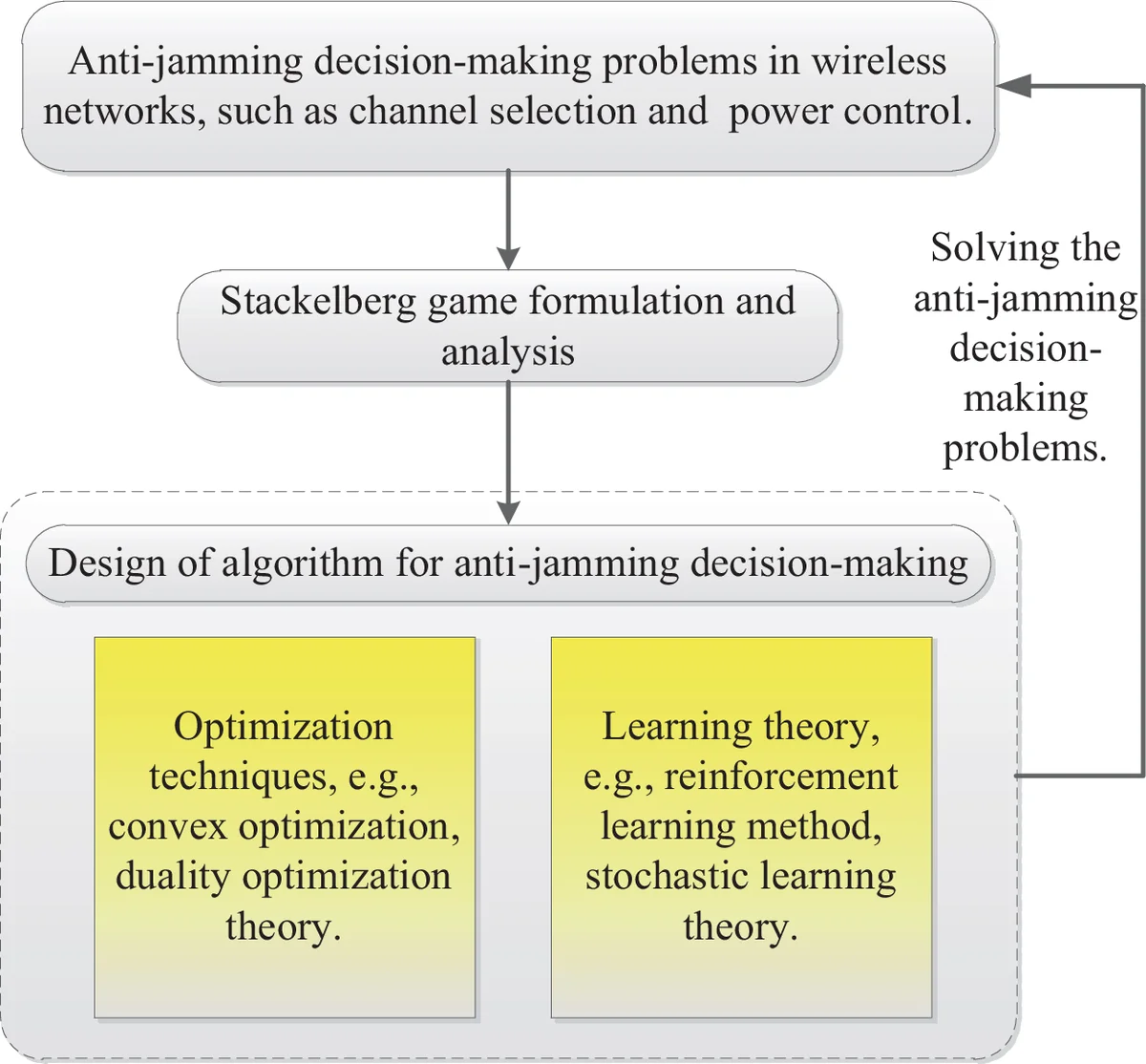
This article investigates the anti-jamming communications problem in wireless networks from a Stackelberg game perspective. By exploring and analyzing the inherent characteristics of the anti-jamming problem, we present and discuss some technical challenges and fundamental requirements to address them. To be specific, the adversarial characteristic, incomplete information constraints, dynamics, uncertainty, dense deployment, and heterogeneous feature bring technical challenges to anti-jamming communications in wireless networks. Then, for the purpose of improving system performance, four requirements for anti-jamming communications are presented and discussed. Following the advantages of the Stackelberg game model in anti-jamming field, we formulate an anti-jamming decision-making framework based on the Stackelberg game for anti-jamming defence in wireless networks. Moreover, two preliminary case studies are presented and discussed for better understanding of the anti-jamming Stackelberg game problem. Finally, some future research directions are also provided.
💡 Research Summary
This paper addresses the critical problem of jamming attacks in wireless networks by proposing a comprehensive anti‑jamming defense framework grounded in Stackelberg game theory. The authors begin by highlighting the vulnerability of wireless communications to a range of attacks, emphasizing that jamming is especially damaging because it directly degrades spectrum efficiency and overall system performance. Traditional countermeasures—such as spread‑spectrum techniques (FHSS, UFH, RCSC‑DSSS) and resource‑allocation methods—are either spectrally inefficient or lack the flexibility needed for modern, densely deployed, heterogeneous networks.
To capture the intrinsic adversarial nature of the jammer–defender interaction, the paper adopts the Stackelberg game, a hierarchical game model where the defender (leader) moves first and the jammer (follower) reacts after observing the leader’s action. This sequential structure naturally reflects the real‑world situation in which legitimate users can detect or estimate jammer behavior and then adjust their transmission parameters, while intelligent jammers can learn from the users’ strategies to maximize disruption.
The authors identify six technical challenges that any anti‑jamming solution must confront: (1) adversarial behavior, (2) incomplete information about the opponent, (3) uncertainty due to measurement errors, (4) dynamic environmental changes (e.g., time‑varying channels, traffic loads, jammer mobility), (5) dense network deployments where inter‑user interference co‑exists with external jamming, and (6) heterogeneous networks comprising devices with diverse service requirements (communication, navigation, radar, etc.). From these challenges they derive four fundamental requirements: real‑time cognition and prediction, hierarchical and distributed decision‑making, multi‑objective optimization, and learning‑based adaptability.
The anti‑jamming process is decomposed into three stages: (i) Jamming Cognition, where cognitive radio techniques, machine‑learning‑based detection, and localization methods (range‑based and range‑free) are employed to acquire partial knowledge of the jammer’s presence and characteristics; (ii) Anti‑jamming Decision‑Making, where a Stackelberg game is formulated. The leader’s strategy set includes transmission power, channel selection, and waveform parameters; the follower’s strategy set consists of jamming power, frequency, and timing. Utility functions incorporate transmission success probability, power consumption, spectral efficiency, and latency, while constraints capture hardware limits such as power‑amplifier linearity and channel‑switching delays. Bayesian game theory and reinforcement learning are integrated to handle incomplete information and to update beliefs about the opponent’s type. (iii) Waveform Reconfiguration, which implements the chosen parameters across power, spectrum, and spatial domains, balancing the trade‑offs between increased power (which may distort amplifier linearity) and channel hopping (which incurs re‑synchronization overhead).
Two illustrative case studies validate the framework. The first case investigates a power‑control Stackelberg game: the defender selects its transmit power to maximize a utility that penalizes both outage probability and energy use, while the jammer chooses its jamming power after observing the defender’s choice. Simulation results show a reduction of jammer‑induced outage by over 20 % and a 15 % improvement in energy efficiency compared with static power allocation. The second case examines a multi‑channel selection game in a dense network scenario. By modeling inter‑user interference with a hypergraph and embedding it into the lower‑level game, the Stackelberg equilibrium yields channel assignments that lower the jammer’s success probability by more than 30 % and increase overall spectral efficiency by 12 % relative to random channel hopping.
The paper also discusses future research directions. First, the integration of deep reinforcement learning and meta‑learning is proposed to enable rapid online adaptation to evolving jammer tactics. Second, extending the model to multi‑leader/multi‑follower settings would capture scenarios with multiple coordinated jammers and collaborative defenders. Third, blockchain‑based trust mechanisms could facilitate secure information sharing among distributed nodes, enhancing cooperative defense without exposing vulnerabilities. Fourth, joint optimization of energy consumption and security metrics is highlighted as a key challenge for forthcoming 6G and ultra‑dense IoT deployments.
In summary, the authors demonstrate that Stackelberg game theory provides a powerful, analytically tractable, and practically adaptable tool for anti‑jamming defense. By explicitly modeling hierarchy, incomplete information, and dynamic environments, the proposed framework outperforms conventional static or purely reactive schemes, offering a promising pathway toward resilient, spectrally efficient wireless communications in the face of increasingly intelligent jamming threats.
Comments & Academic Discussion
Loading comments...
Leave a Comment