Optimization of the Energy-Efficient Relay-Based massive IoT Network
To meet the requirements of high energy efficiency (EE) and large system capacity for the fifth-generation (5G) Internet of Things (IoT), the use of massive multiple-input multipleoutput (MIMO) technology has been launched in the massive IoT (mIoT) n…
Authors: Tiejun Lv, Zhipeng Lin, Pingmu Huang
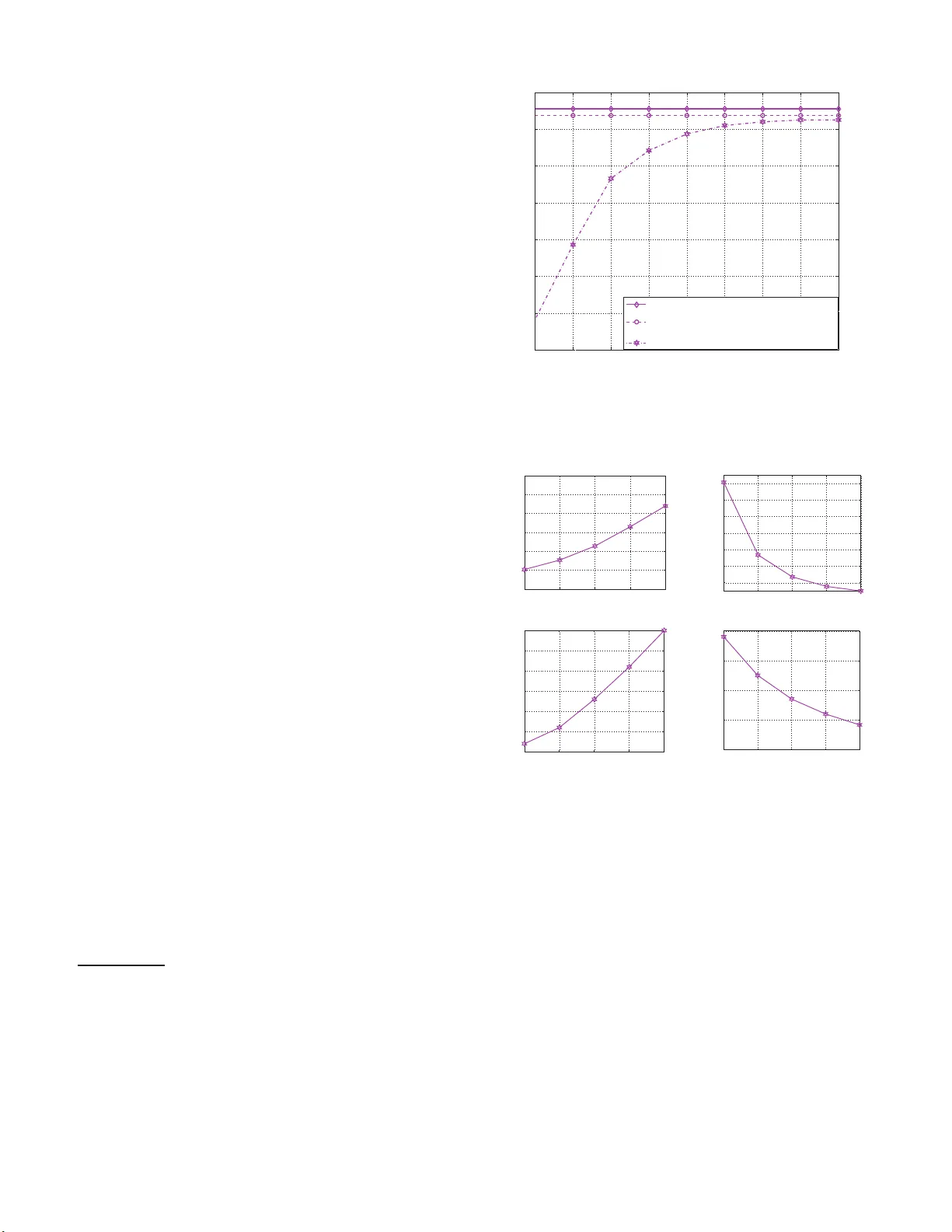
1 Optimizati on of the Ener gy-Ef ficient Relay-Based massi ve IoT Netw ork T iejun Lv , Se nior Member , IEEE , Zhipeng Lin, Student Membe r , I EEE , Pingmu Hua ng, and Jie Zeng, Senior Member , IEEE Abstract —T o meet the requirem ents of high energy efficiency (EE) and large system capacity for the fifth-generation ( 5G) In- ternet of Things (IoT), the use of massive mul t i ple-input multiple- output ( MIMO) technology has b een laun ched in the massive IoT (mIoT) netw ork, where a large number of d evices ar e conn ected and scheduled simu ltaneously . Th is p aper considers the energy- efficient design of a multi-pair decode-and - forward relay-based IoT network, in which multiple sources simultaneously transmit their in f ormation to the corr esponding destinations via a relay equipped with a large array . In order to obtain an accurate yet tractable expression of the EE, firstly , a closed-form expression of the EE i s derived und er an idealized simplifying assumption, in which the location of each d evice is kn own by the n etwork. Then, an exact i ntegral-based expression of the EE is d eriv ed un der the assumption that the devices are randomly scattered fo llowing a uniform distribution and transmit power of the relay is eq ually shared among the destination devices. F urthermore, a simple yet efficient lower bound of the EE is obtained. Based on t h is, finally , a low-complexity ener gy-efficient resource allocation strategy of the mIoT netw ork is pro posed under the specific quality- of-service (QoS) constraint. The proposed strateg y d etermines the near -optimal number of relay antennas, the near -optimal transmit power at the relay and near -optimal density of activ e mIoT device pairs in a giv en cove rage area. Nu merical results demonstrate th e accuracy of the perf ormance analysis and the efficiency of the proposed algorithms. Index T erms —Energy efficiency , resour ce allocation, massi ve MIMO, d ecode-and -fo rward relay , green mIoT . I . I N T R O D U C T I O N Internet o f Th in gs (Io T), an emergin g tech nology attractin g significant attention, pr o motes a heightened level o f awareness about our world and has b een used in various areas, suc h as governments, in d ustry , and academia [1], [2]. In Io T , not only are various thin gs ( e.g., sensor devices an d cloud computin g systems) with substantial energy consump tion, but also the connec tio n of th ings ( e . g., rad io frequ ency iden ti- fication (RFID) and fifth -generation (5G) network) and the interaction of thing s (e.g., d ata sensing and commu nications) are consuming a large amou nt o f ene rgy . Im proving energy efficiency (EE) h a s become one of the main g oals and de sign challenges f or th e pr e sented IoT networks [3]. I n o r der to achieve the most efficient e n ergy usage, various innovati ve ‘ gr een IoT ’ techniques hav e be e n developed d uring th e last few years [4]–[ 6]. The financial support of the National Natural Scie nce Foundatio n of China (NSFC) (Grant No. 61671072) is grateful ly acknowl edged. T . Lv , Z. L in, P . Huang, and J. Zeng are with the School of Information and Communicat ion Engineerin g, Beijing Univ ersity of Posts and T el ecom- municati ons, Beijing 100876, China (e-mail: {lvtiejun, linlzp, pmhuang, zengji e}@bup t.edu.cn). On th e other hand , connectivity is the foun dation fo r a IoT network . It is envisioned that b illions of devices will b e connected in the 5G I o T network b y 2 020 to build a smart city [7], [8]. As on e m ajor segmen t o f the IoT n etwork, the massive IoT (mIo T) refers to the app lications th at ar e enabled by c o nnecting a large num b er of IoT d evices to an internet- enabled system [ 9], [1 0]. Th is network is typically used for the scenarios char acterized by low power , wide cov erage and stron g sup port for devices on a massi ve scale, such as agricultur e produ ction detection, power u tilization co llection, medical mo nitoring and vehicle sched uling [11]–[13]. The r e is a target th at connec tion de n sity in the ur ban environment will be 1 m illion devic es / km 2 [14], [1 5]. Considering the connectio n target and the energy limitation of mIoT networks, the massive multiple- in put mu ltip le-output (MIMO) technique (equipp ed with a large-scale antenna array) , wh ich can in- crease the n etwork capacity 10 times or more withou t requ ir ing more spectrum and simultan e o usly improve the EE of w ir eless systems on the ord er of 100 times [16], [17], h as attracted increasing a tten tion o n u tilization in mIoT networks [18]– [20]. As p resented in [ 21], as on e of the m ajor enab ling technolog ies fo r 5G wireless systems, massi ve MIMO systems are capab le of increasin g th e EE by orders of mag nitude compare d to sing le- antenna systems, in particu larly when combined with simultaneous schedulin g of a large nu mber of terminals (e.g., ten s o r hu ndreds) [22], [23]. Relying on a realistic power co nsumption mo del, the au thors of [24] proved that the op timal system param eters are capable of max imizing the EE in multi-device massive MIMO systems. In [2 5], low- complexity antenn a selection meth ods and p ower allocation algorithm s were pr oposed to improve th e EE of large- scale distributed antenna systems. The au thors o f [26] intended to optimize th e glo b al EE of the uplink and d ownlink of multi- cell massi ve MIMO. A jo int pilot assignme nt and resour c e allocation strategy was stu d ied in [27] to maximiz e the E E of multi-cell massiv e M I MO n etworks. As a p arallel research avenue, a relay -based mIoT network was shown to constitute a pr o mising technique of expanding the coverage, redu cing the power con sumption an d ach ieving energy-efficient transmission. I n [5], by optimizing the av ail- able b andwidth o f a relay-b ased mIoT n etwork, the energy consump tion of all th e relay BSs is minim iz e d . Similar to the observations in sing le-hop massi ve MIMO system s, it was shown in [28] that by inv oking a relay equipped with a large- scale antenna ar r ay an d a simple relay transceiver (e.g., line ar zero-fo rcing (ZF) tran scei ver), the spe ctrum ef ficiency (SE) of a two-hop relay system becomes propo rtional to th e number of 2 relay antennas. Th erefore, the com bination of massiv e MIMO and cooperative relayin g constitutes an ap pealing option for energy-efficient mI oT networks. When writing this p aper, we find that the existing litera- ture rar e ly focused on the research of th e relay-b a sed m IoT networks an d th a t on massive MI MO aided relay systems mainly p a id atten tion to the analy sis o f the SE. For instance, the asymptotic SE of massi ve MIMO aided relay systems was inves tigated in [29], while the SE of massi ve MIMO relay sy stems was stud ie d in [30]. Howe ver , to the best o f our knowledge, there are a pau city of co ntributions to the energy-efficient transmission an d resource a llocation strategies in massi ve MIMO relay-based mIoT systems. It is challenging to extend the existing energy-efficient d e sig ns co nceived f or single-hop m assi ve MIMO systems [ 24], [ 25], [27] to the one s adopted in massi ve MIMO relay systems. Due to the fact that, compar e d to single- hop tran sm ission schemes, both the design of the signal processing schemes used at the relay an d the p erforman ce an a lysis of the m a ssive MIMO relay systems are fundame n tally depende nt on the mo re co mplex two-hop channels. Ther efore, it is important to design ene rgy-efficient resource allocatio n strategy fo r a m assi ve M IMO relay-b ased mIoT network. Contrary to the ab ove background, in this pap er , we conside r the pe rforman ce analysis an d energy-e fficient resou rce allo- cation op tim ization o f a ma ssive MIMO decode-an d-forward (DF) r e lay based mIoT network supporting mu ltiple pair s of m obile m I oT devices. W e assume that the channe l state informa tio n (CSI) is estimated relyin g o n the minimum mean- square er ror (M MSE) c r iterion, and the relay employs a low- complexity lin e ar ZF tra n scei ver . The m ain contributions of this paper are summ a r ized as fo llows. • Ass uming th at the location of ea c h mobile device is known, we derive a clo sed -form expr ession of the EE in th e co nsidered mIo T network using a massive MIMO aided DF relay . Ad ditionally , a simp lified analytical ex- pression is also derived for the special case where e q ual transmit power is alloca ted to a ll d estination devices by the relay . • Furthermore, assuming that the device locations follow a unifor m rando m distribution, we derive an exact integral- based expression of the EE. Howe ver , since this expres- sion cannot be integrated out, a simple yet efficient lower bound of the EE is also deri ved. Th e analytical results lay the foun dation o f predictin g the EE a nd of und erstanding how it changes with re spect to the transmit power , the number of relay antennas and th e numb e r of active mIoT device pairs. • B ased on the lower bo und d eriv ed, we prop ose an energy - efficient resou rce allocation strategy wh ich d etermines the n ear-optimal relay transmit p ower , the near -optimal number o f relay antennas an d the ne a r-optimal number of active mIoT device pairs u nder the g iv en quality- of-service (QoS) co nstraint. T h e orig inal EE optimiza- tion pro blem relying o n the exact but intrac tab le EE expression is transform e d into a pr oblem that max imizes the lower bound o f the EE. This transformation m akes it f easible for us to solve the latter EE optimization 1 s t U s e r P a i r K th Devic e Pai r 1 st Devic e Pai r 1 S 2 S K S 1 s t U s e r P a i r Massi ve M IMO DF R e l ay 1 K D + 2 K D + 2 K D Fig. 1: The system model considered: A two-hop relay system supports K ac tive mIo T devices commun icating with th eir individual destination mIoT d evices via a m assi ve MIMO aided DF relay , which mitigate s th e in ter-stream interfer ence with a large n umber of antennas. problem , which eventually giv es the near-optimal system configur ation of energy- efficient massiv e MIMO relay systems suppor ting multiple mIoT device pa ir s. The remaind er of th is pap er is organized as follows. Both the system mode l and tran smission sch e m e of the mIoT n etwork using the massiv e MIM O aided m u lti-pair DF relay ar e de- scribed in Section II. In Section III, the EE optimization prob- lem is formulated by employing a re a listic power c o nsumption model. In Section I V , we d eriv e the EE expressions with known device locations and un if orm random distribution o f device location s, respectively . Then , in Section V , an en ergy- efficient resou rce allocation strategy is pro posed based on th e EE expressions d eriv ed. Num e rical results are pr ovided und er div erse system configur ations. In Section VII , we analyze the conv ergence and the com putational comp lexity o f the propo sed algorithm s. Finally , our co nclusions are drawn in Section VI II. Notations: W e use upperca se and lowercase boldface le tter s for den oting matrices and vectors, respectiv ely . ( · ) H , ( · ) T and ( · ) † denote th e conjug ate tr anspose, transpose and pseudo - in verse, respectively . || · || , tr ( · ) , E [ · ] an d V a r [ · ] stand for the Euclidean no rm, the trace of matrice s, the expe c tation an d variance operato rs, respectively . [ A ] i,j represents the en tr y at the i -th row an d th e j -th co lumn of a matrix A . C N ( 0 , Θ ) denotes the circu larly sym metric co mplex Gaussian d istribu- tion with zero mean and the covariance matrix Θ , while a.s. − − → denotes th e almost sur e convergence. 2 F 1 ( · ) r epresents the hypergeom etric function, an d |A| deno tes the cardinality of a set A . Finally , [ · ] + denotes max { 0 , ·} . I I . S Y S T E M M O D E L A N D T R A N S M I S S I O N S C H E M E As shown in Fig. 1, we consider a massi ve MI MO aided dual-ho p DF r e lay mIoT system sup porting K p airs of single- antenna so urce-destinatio n mI oT devices (i.e., active mI oT device pair s), w h ich are selected f rom N p airs of can didate mIoT devices for data transmission with the aid of the M - antenna ( K ≪ M ) relay 1 . The system operates ov er a 1 It was shown in [31] that by using simple relay transce i vers (e.g., linear ZF- based transcei vers), a massiv e MIMO rela y system is ca pable of significa ntly alle vi ating the int erferenc e among dif ferent data streams. 3 bandwidth of B Hz and the channe ls are static within the time/frequ e ncy coh e rence interval o f T = B C T C symbol duration , where B C and T C are the cohere n ce bandw id th and coheren ce time, respectively . Particularly , each mIoT device as well as the r e la y uses the total bandwidth of B H z . W e focus on the active mIoT device pairs and assume that th e k -th mIoT device (sou rce n ode) demands to commun icate with the ( k + K ) -th device (de stina tion node) 2 . The set o f activ e mIoT device pairs is denoted b y S , satisfying |S | = K . The relay opera tes in th e half-d u plex time-d i vision dup lexing (TDD) mode. Each coherence interval is divided into thr e e time phases, as shown in Fig. 2, namely th e ch annel estimatio n (CE) phase, the source- to -relay transmission ( S → R ) phase, and the relay-to- destination transmission ( R → D ) phase. Coherence Interval #I Coherence Interval #I+1 CE Phase S R Phase R D Phase Fig. 2: Partitioning o f a coheren ce interval. Let G S = [ g S , 1 , · · · , g S ,K ] ∈ C M × K and G D = [ g D , 1 , · · · , g D ,K ] T ∈ C K × M denote the channel m a tr ices from th e K acti ve sources to th e relay and fr om the r e lay to the K active destinations, respectively . The chan nel ma tr ices characterize both the small-scale fading (SSF) and the large- scale fading (LSF). More p recisely , G S and G D can be expressed as G S = H S D 1 / 2 S , G D = D 1 / 2 D H D , (1) where H S ∈ C M × K and H D ∈ C K × M are the SSF channel matrices and their en tr ies ar e indepen dent and identica lly d is- tributed (i.i.d. ) with C N (0 , 1) . T he LSF chann el matrices D S and D D are m odelled as diago nal matrices with [ D S ] k,k = β k and [ D D ] k,k = β k + K , k = 1 , 2 , · · · , K , respectively . A. CE a t the Relay In the CE p h ase, the re lay a c quires the CSI of activ e devices by using th e MMSE cha n nel estimator given in [3 2]. Let ˆ G S and ˆ G D be th e cha nnel estimates of G S and G D , respectiv ely . Then, we have G S = ˆ G S + ˜ G S , G D = ˆ G D + ˜ G D , (2) where ˜ G S and ˜ G D are the complex-valued Gaussian d is- tributed estimation err or matrice s of G S and G D , re sp ecti vely . According to th e or thogon ality principle [3 2], ˆ G S and ˜ G S are in depend e n t of each other . Similarly , ˆ G D and ˜ G D are indepen d ent of each other as well. For the clarity of an alysis, we tem porarily assume that the LSF channel matrices, D S and D D , are perfectly estimated. In Section I V -B and in its subseq uent sections, this assumption 2 In this paper , the direct link between any source node and destinati on node is ignored due to large path-l oss. will then be removed. Accord ing to (2), the column s of ˆ G S , ˜ G S , ˆ G D and ˜ G D obey the d istributions of ˆ g S ,k ∼ C N 0 , β ′ k I M , ˆ g S ,k ∼ C N 0 , β k − β ′ k I M , ˆ g D ,k ∼ C N 0 , β ′ k + K I M , ˆ g D ,k ∼ C N 0 , β k + K − β ′ k + K I M , (3) where β ′ i = τ r ρ p β 2 i 1+ τ r ρ p β i , i = 1 , 2 , · · · , 2 K . Furth ermore, ρ p is the ratio of the transmit power of each pilot symb ol to th e noise power at the relay ’ s receiver , wh ile τ r ( τ r ≥ 2 K ) is the pilot sequence length of each device. B. Da ta T r ansmission The relay uses the channel estimates obtained above a n d th e low-complexity linear ZF transceivers. More specifically , the relay uses a ZF r eceiv er to detect the signals transm itted fro m the K active so urces, and then it uses a Z F tr ansmit precoding scheme to forward th e signals to the K acti ve destination s. In the S → R p h ase, K so urces simultaneo u sly transmit their signals x d = p P tx , d s ∈ C K × 1 to th e relay , in which s = [ s 1 , . . . , s k , . . . , s K ] T is the inf ormation- bearing symbol vector satisfying E [ ss H ] = I K , s k is the symbo l d eliv ered from the k -th mIoT device to the relay , a nd P tx , d is the average transmit power of each mI oT device. The signal y R ∈ C M × 1 received at the relay is given by y R = G S x d + n R , (4) where n R ∈ C M × 1 denotes the add iti ve wh ite Gau ssian noise (A WGN) ob eying C N ( 0 , σ 2 R I M ) at the relay . The relay perfo rms ZF detection relyin g on y R . More specifically , up on multiplying with the ZF filtering matrix F 1 = ˆ G H S ˆ G S − 1 ˆ G H S ∈ C K × M , the transmitted symbols having been superimp osed over th e channel a r e separated in to K n on-interf ering sym b ols, which ar e denoted as x R ∈ C K × 1 and given b y x R = F 1 y R = F 1 G S x d + F 1 n R . (5) Therefo re, the k - th sym bol x R ,k (i.e., the k - th element of x R ) is given by x R ,k = p P tx , d E f H 1 ,k g S ,k s k + p P tx , U K X j 6 = k f H 1 ,k g S ,j s j + p P tx , d f H 1 ,k g S ,k − E f H 1 ,k g S ,k s k + f H 1 ,k n R , (6) where f 1 ,k is the k - th co lu mn of F 1 . Then, the signal-to- interferen ce-plus-no ise ratio (SINR) of the k -th device p air in th e S → R phase is formu lated as [3 3] γ (1) k = P tx , U E h f H 1 ,k g S ,k i 2 / ( P tx , d V ar f H 1 ,k g S ,k + P tx , d K X j 6 = k E h f H 1 ,k g S ,j 2 i + σ 2 R E h f 1 ,k 2 i ) . (7) 4 During the R → D pha se, the relay deco des the info rmation symbol vector s from x R as ˆ s = [ ˆ s 1 , · · · , ˆ s k , · · · , ˆ s K ] T that satisfies E [ ˆ s ˆ s H ] = I K , and multiplies the Z F prec o ding matrix of F 2 = ˆ G H D ˆ G D ˆ G H D − 1 ∈ C M × K both b y the power allocation matrix at the relay an d b y ˆ s , yielding x R = F 2 P ˆ s , (8) which is bro adcast to all the K activ e destinatio ns. Here, P = diag √ p 1 , . . . , √ p K is the power allocation matrix used at the relay . The long - term av erage total transmit power constraint at the relay is thu s g i ven by P tx , R , tr x R x H R ≤ P R max , (9) where P tx , R represents the average total tran smit p ower at the relay , an d P R max is the max imum average total transmit power av ailable at the relay . Th e sign a l y D ∈ C K × 1 received at the K a cti ve destina tio ns is given by y D = G D x R + n D = P ˆ s + ˜ G D x R + n D , (10) where n D ∈ C K × 1 denotes the A WGN at the d estinations and it obeys C N ( 0 , σ 2 D I K ) . T hus, the signa l received at the k -th activ e d estination is y D ,k = √ p k E g H D ,k f 2 ,k ˆ s k + √ p k g H D ,k f 2 ,k − E g H D ,k f 2 ,k ˆ s k + K X j 6 = k √ p j g H D ,k f 2 ,j ˆ s j + n D ,k , (11) where n D ,k is the k -th element of n D , while f 2 ,k is the k -th column of F 2 . The SINR at the destination U k + K for the k -th transmitted data stream is given by [33] γ (2) k = p k E h g H D ,k f 2 ,k i 2 p k V ar g H D ,k f 2 ,k + P K j 6 = k p j E h g H D ,k f 2 ,j 2 i + σ 2 D . (12) As a result, the end-to - end ach ievable rate of the k -th m I oT device pair can be g i ven by R k = min n R (1) k , R (2) k o , (13) where R (1) k = log 2 1 + γ (1) k , R (2) k = lo g 2 1 + γ (2) k . An overhead occupyin g τ r = 2 K symbol intervals is used to facilitate the pilo t- based CE dur ing each cohe r ence interval o f T sym bols. Ther efore, we have to take the overhead-indu ced dimensiona lity loss of 2 K/T into account when calcu lating the sum rate whic h is expr e ssed as R sum = 1 − 2 K T B 2 K X k =1 R k . (14) I I I . E E O P T I M I Z A T I O N P RO B L E M F O R M U L AT I O N W e employ a realistic power consumptio n model similar to those used in [24], [25], [3 4]. The tota l power consum ption of the system consider ed is q uantified as P tot = P P A + P C , (15) where we have P P A = η − 1 P A , d 2 1 − 2 K T K P tx , d + η − 1 P A , d 4 K 2 T ρ r σ 2 r + η − 1 P A , R 2 1 − 2 K T P tx , R , (16) P C = P FIX + P TC + P SIG , (17) with P P A representin g the power co nsumed by p ower ampli- fiers (P As), in which P tx , d and ρ r σ 2 r are the d ata transmit power and pilot tran smit power of each active sou r ce device, respectively , while η P A , d ∈ (0 , 1) and η P A , R ∈ (0 , 1) are the efficienc y o f the P As at the devices and at th e relay , respectively . Fur thermore , P C denotes the total circuit power consump tion, in w h ich P FIX is a con stant acco unting for the fixed power con sumption requir e d for c o ntrol signalling , site- cooling and the load-indep endent base-ban d sign al pr ocessing, P TC indicates the power co nsumption of the transceiver’ s radio-f r equency (RF) cha in s, and P SIG accounts for the power consump tion of th e load-d e p endent sign al processing . T o be more sp ecific, we have P TC = M P R + 2 K P d + P SYN , P SIG = B T 8 M K 2 L R + B 1 − 2 K T 4 M K L R + B T 1 3 L R ( K 3 + 9 M K 2 + 3 M K ) , (18) where P R and P d represent the p ower requ ired to run the circuit compon ents attach ed to each an tenna at the relay an d at the devices, respec ti vely , while P SYN is the power con su med by the o scillato r . The first ter m of P SIG describes the p ower consump tion of CE, while the remaining two terms a c count for the power r equired by the computatio n of the ZF detection matrix F 1 and the ZF pr ecoding matrix F 2 . Still referrin g to (18), L R denotes the com putational efficiency quantified in terms of the complex-valued arithmetic oper a tions per Joule at the relay . As a result, the EE η EE [bits/Joule] is defined as 3 η EE ( P , S , M ) = R sum /P tot . (19) It is plau sible that η EE is a fu n ction of the following sy stem resources: the power allocation matrix P used at the r e la y , the set S of active mIo T device pairs, and the nu mber of the relay antennas, M . In th is p aper , the energy- e ffi cient resource allocation is formu lated as the fo llowing optimization problem. max P , S , M η EE ( P , S , M ) , s . t . C1 : P tx , R ≤ P R max , C2 : S ∈ U , C3 : M ∈ { 1 , 2 , . . . , M max } , (20) C4 : p k ≥ 0 , k = 1 , · · · , K, C5 : R k ≥ R 0 , k = 1 , · · · , K, 3 It can be readily seen from (15)-(18) that the total power consumption highly depend s on the number of relay antennas M , on the relay power alloc ation matrix P and on the select ion of the acti ve m IoT de vice pairs S . Choosing an appropri ate power consumpti on model is of paramoun t importanc e, when deal ing with the ener gy-ef fici ent resource alloca tion in massi ve MIMO aided multi-pair relay mIoT . 5 where the ob jecti ve function η EE ( P , S , M ) is define d by (19). In ( 20), C1 en sures tha t the sum of power allo cated to the K data streams does n ot exceed the m aximum transmit power av ailable to the relay , while C2 is a comb inatorial constraint im posed on the de vice-pair selection, where U denotes the gr o up of all the a vailable sets o f active device pairs. T he co n straint associated with the nu mber of relay antennas M is specified b y C3 , in which M max is the largest possible numbe r , and C4 is the bou ndary constra in t o f the relay power allo cation variables. I n additio n, f o r som e mIo T application scenar ios ( e.g., ag riculture produ ction detection ), system energy is limited or electr ic ity is gener ated by means of unpred ictable ren e wable en ergy , su c h as wind and solar . One requirem ent in terms of the system oper ation is to guarantee approp riate Qo S, which is a pro file a ssocia ted to each data instance. QoS can regulate the nonfun ctional pro perties of informa tio n [3 5]. C5 rep r esents th e QoS con straint for each device pair, where R k is the achievable rate of the k - th pair device, and R 0 is a given th reshold. I V . E E A N A LY S I S O F T H E M A S S I V E M I M O A I D E D M U LT I - PA I R D F R E L A Y S Y S T E M From (14), (19) an d ( 20), we can see that it is challen g ing to calcu late the EE in real time, because the EE d epends on specific LSF ch annel co e fficients and requir es challengin g optimization inv olving matrix variables. T o overcome this predicame nt, in this section , we firstly deri ve a closed-form expression of the EE und er the assumption that th e mIo T device locations are known. Sub seq uently , an EE expression is p r ovided for the scenario whe r e the device locations are assumed to be indepen d ent and unifo r mly distributed ( i. u.d.) random variables in th e c overag e area. In these expressions, both the instantaneou s chan nel co e ffi cients an d the matrix variables will disappea r, hence the instantaneo us CSI and the comp lex matrix calculatio n s a r e no longer need ed in our resource allocation. A. E E Analysis Assuming Known Device Location s In this subsection, upon assumin g that the m IoT device locations ar e known a priori (i.e. , the LSF channel co efficients are a ssumed to be perfectly estimated), we derive a closed- form expr e ssion of the E E. As the system rate R k for finite system dim ensions is difficult to calculate, we consider the large system limit, where M and K grow in finitely large while keeping a finite ra tio M /K . Howev er , as we use the asymptotic ana lysis only as a to o l provide tight approx imations for finite M , K . In what follows, we will derive deter ministic approx imations o f the system r ates R k . T hus, considerin g both the SE and total power consump tion, a closed-for m determin- istic approx imations of th e EE in the system considered is presented in the following theo rem. Theorem 1. Using linear ZF transceivers with imperfect CSI , as well a s assuming that the mIoT device location s a r e known a priori, the EE of the ma ssive MIMO aided multi-pair r elay system considered can be calcula te d by η EE ( P , S , M ) a.s. − − → 1 − 2 K T B 2 R ( P , S , M ) P tot ( P , S , M ) , (21) wher e R ( P , S , M ) = K X k =1 min n R (1) k , R (2) k o (22) with R (1) k and R (2) k being calculated as R (1) k a.s. − − → log 2 1 + ( M − K ) P tx , U β ′ k P tx , d A 1 + σ 2 R ! , R (2) k a.s. − − → log 2 1 + p k ˜ β k + K P tx , R + σ 2 D ! , (23) in wh ich A 1 = K X j =1 β j − β ′ j = K X j =1 ˜ β j , ˜ β k + K = β k + K − β ′ k + K . (24) The total power co nsumption P tot ( P , S , M ) is g iven by (15) , wher e we have P tx , R a.s. − − → P K k =1 p k β ′ k + K − 1 M − K . (25) Pr o of: See Append ix I. According to (2 5), th e long-term average total transmit power constraint (9) of the relay can be rewritten as P K k =1 p k β ′ k + K − 1 M − K ≤ P R max . (26) Remark 1 . In Theo rem 1, we obtain the closed-f o rm ex- pression of the EE, wh ich on ly d e p ends on the LSF ch a n nel coefficients of active mIoT device pairs and on the co nfig- urable system parameters. This expression is a funda m ental one that char acterizes the relationship between the EE and ( P , S , M ) for the gene r al case, and acts as sou rce in th e sub - sequent section. In the expression, the comp lica ted calcu lation in volving large- dimensional matrix variables tha t r epresent the SSF channel coefficients is avoided. In practical re la y aided sy stem s, the comp utational resou rces of the r elay a re limited. Hen ce, optimally solv ing the mixed- integer nonlinear optimiza tio n problem of (20) may b ecome computatio nally un affordable to the relay . As shown in Fig. 5, the average EE performanc e of the b r ute-forc e search aid ed optimal power allocatio n is only sligh tly hig her than th at of the equ al power a llocation strategy . Theref ore, the equal power allocation strategy can be u sed at the relay for r educing the computatio nal complexity o f directly solving (20). More specifically , up on con sidering the equal p ower allocation that satisfies (26) for any k = 1 , . . . , K , the p ower allocation coefficients are calculated as p k = ( M − K ) P tx , R A 2 , ∀ k , (27) where A 2 = P K k =1 β ′ k + K − 1 . As a result, compared to the o ptimal power allocation (21) that optimizes p k ( k = 1 , · · · , K ) fo r ea ch m IoT device pair, it becomes feasible for us to only op timize the total transmit power P tx , R , whe n the 6 relay’ s tran smit p ower is equally allocated to all the destination devices. Substituting (27) into (21), we arri ve at the following corollary con cerning the EE und er the assumption of u sing equal power allocation at th e relay . Corollary 1. Th e EE η EE associated with the equal power allocation at the r elay is calcu lated as η EE ( P tx , R , S , M ) a.s. − − → 1 − 2 K T B 2 R ( P tx , R , S , M ) P tot ( P tx , R , S , M ) , (28 ) wher e R ( P tx , R , S , M ) = K X k =1 min R (1) k , R (2) k , (29) with R (1) k = R (1) k (given by (23) ) and R (2) k a.s. − − → log 2 1 + ( M − K ) P tx , R ˜ β k + K P tx , R + σ 2 D A 2 . (30) Again, P tot ( P tx , R , S , M ) is given by (1 5) . B. E E Analysis Assuming i.u.d. Device Location s In the p revious subsection, we have derived the closed-form expression o f the EE u nder the assump tion tha t the device locations are known a priori . This assumption imposes an extremely hig h co mplexity burden and implementatio n cost, especially in h igh-mob ility environments, becau se the channel coefficients will chang e rapid ly and it is difficult to select the activ e device pairs instan tly in practical mobile commu nication systems [36]. In this subsection , we conside r a more gen e ral scenario in wh ich th e mIoT devices are assumed to be i.u .d. in the relay’ s coverage ar ea, and derive the co r respondin g EE expression as a functio n of th e tota l relay transmit power P tx , R , the n umber o f active mIoT device pairs |S | = K and the n umber of relay antennas M . Th e EE expression obtained in this scen ario provides furthe r insights into the selection of EE-optim a l system param eters. W e assume that th e relay’ s coverage area is mo delled as a disc an d the relay is lo cated at the g eometric c e nter of this disc. Furthe r more, all the acti ve so u rce and de stination devices are assum ed to be i.u.d . in the disc, wh o se radius R satisfies R min ≤ R ≤ R max . The LSF channe l coefficient of the k -th activ e mIoT de vice is modelled as β k = cl − α k , where l k is the distance between the k -th mIoT device and th e r elay , α is the path-loss expo nent, and c is the pa th -loss at the reference distance R min . The probab ility density func tio n (PDF) of l k is f ( l k ) = 2 l k R 2 max − R 2 min , R min ≤ l k ≤ R max , (31) where R max is the radiu s of the circular cell. In The o rem 2 , we first gi ve the expr e ssion of th e EE assuming i.u.d. device loca tio ns. Theorem 2. Given the other pa rameters, using linear ZF transceivers with imperfect SSF chann el coefficients estimated by the MMSE estimato r and assumin g that a ll the d evices ar e i.u.d. in the r elay’ s coverage ar ea, the EE o f the massive MIMO aide d multi-pair r elay system considered with equal r elay po wer a llocation is formulated as e η EE ( P tx , R , K , M ) a.s. − − → 1 − 2 K T B 2 e R ( P tx , R , K , M ) P tot ( P tx , R , K , M ) , (32) wher e e R ( P tx , R , K , M ) = K min n e R (1) k , e R (2) k o , (33) with e R (1) k a.s. − − → Z R max R min log 2 1 + ( M − K ) P tx , U β ′ k P tx , d ˜ A 1 + σ 2 R ! f ( l k ) dl k , (34) e R (2) k a.s. − − → Z R max R min log 2 1 + ( M − K ) P tx , R P tx , R ˜ β k + K + σ 2 D ˜ A 2 × f ( l k + K ) dl k + K , (35) ˜ A 1 = cK 2 K ρ r ( R 2 max − R 2 min ) ( R 2 max 2 F 1 1 , 1 α ; α + 2 α ; − R α max 2 K cρ r − R 2 min 2 F 1 1 , 1 α ; α + 2 α ; − R α min 2 K cρ r ) , (36) ˜ A 2 = K c ( R 2 max − R 2 min ) ( 1 2 K ρ r R 2( α +1) max − R 2( α +1) min c ( α + 1) + 2 R α +2 max − R α +2 min α + 2 ) 2 . (37) Again, P tot ( P tx , R , K , M ) is given by (15) . Pr o of: See Append ix II. Remark 2 . Theorem 2 characterizes th e relatio n ship be- tween the E E and ( P tx , R , K , M ) unde r the condition of e q ual power allocation and rand om device locatio ns. Accor ding to Theorem 2, we are capable of e valuating the E E without using any ch annel co efficients and withou t co mplex matrix calculations. This results in a substantial complexity reduction of the real-time onlin e comp utation. Howe ver , a s far as solving the o ptimization pro b lem associated with the e nergy-efficient resource allocation is concern ed, (32) remain s excessively complex d ue to the tedious integral in (33). In order to circumvent the aforeme n tioned obstacle, a lower bound o f (32) is derived as follows. Corollary 2. A lower bou nd o f (32) is given by e η EE ( P tx , R , K, M ) ≥ e η EELB ( P tx , R , K, M ) ( 3 8) = 1 − 2 K T B K 2 e R LB ( P tx , R , K, M ) P tot ( P tx , R , K, M ) , wher e e R LB ( P tx , R , K, M ) = min n e R (1) LB , e R (2) LB o , (39) 7 with e R (1) LB = log 2 1 + ( M − K ) K P tx , d P tx , d ˜ A 1 + σ 2 R ˜ A 2 , e R (2) LB = log 2 1 + ( M − K ) K P tx , R P tx , R ˜ A 1 + K σ 2 D ˜ A 2 . (40) Pr o of: See Append ix III. Remark 3 . It can be observed from Corollary 2 that the lower bou n d e η EELB ( P tx , R , M , K ) and up per bo und e η EEUB ( P tx , R , M , K ) de riv ed are repr e sented b y a simple closed-for m expr ession without the tediou s integral in (33), which is significantly beneficial for efficiently solv ing the op ti- mization problem a ssocia ted with o ur ene rgy -efficient re so urce allocation. V . E N E R G Y - E FFI C I E N T R E S O U R C E A L L O C AT I O N F O R M A X I M I Z I N G T H E L O W E R B O U N D O F T H E E E Let u s comm ence with a brief discussion abou t the rationale and significa n ce of th e analy tical r esults we have o b tained so far . Th e o rem 1 quantifies the EE of the massive MIMO aided mIo T network consider ed under the assumption tha t the positions of the devices a re kn own. The network considered in this paper is a narrow-band mIo T (NB-mIo T) network, which has been stand ardized in 3GPP Release 1 3 [3 7] to suppo rt a large n u mber o f low-power devices [38]. In addition , co nsid- ering more general and practical mIo T application scenar ios, e.g., environmental monitoring and ag r iculture inspection, where the devices are i.u.d. a n d their energy is limited, it is significantly v ital f or contr olling electrical devices to p r operly address issues r elated to QoS and en ergy distribution. Th eorem 2 g i ves th e exact integral expression of the EE. Ho wev er , it remains an open challenge to deal with an optimizatio n problem wh ose ob jectiv e f u nction (i.e., the EE herein) is giv en by c o mplex in tegra ls. T raditional optimiz a tio n tools, such as conv ex optimiza tio n, g enetic algo rithms, exhaustive sear ch and so fo rth, becom e futile in th is scenario . As a remedy , in Corollary 2, a simple lower bo u nd of the E E is deri ved, wher e the tediou s integral vanishes. Na tu rally , in this section , we reform u late the original energy-efficient resource allocation problem (20) as th e fo llowing optimization p r oblem 4 that maximizes the lower bou nd of the EE. max P tx , R ,K,M e η EELB ( P tx , R , K , M ) , s . t . C1 ′ : M ∈ { 1 , 2 , . . . , M max } , C2 ′ : K ∈ { 1 , 2 , . . . , M − 1 } , (41) C3 ′ : 0 ≤ P tx , R ≤ P R max , C4 ′ : e R LB ≥ R 0 . 4 This optimizatio n problem is quite differe nt from the con v ention al resource alloc ation problem that targ ets at specific mIoT device pairs. In this paper , we intend to optimize the EE, which is a system-lev el metric to be determined by solving the resource alloc ation optimizat ion proble m of (41). In particular , when solvin g (41), it is unnecessa ry for the rela y to kno w the SSF and LSF component s of the CSI of eac h mIoT de vice pair . It is plausible that (41) is a non-co n vex pro blem, which remains mathematically ch allenging to solve. Noneth eless, it has beco me tractable. For obtainin g the global optimal solutio n of (41), typically we have to carr y out brute - force search over the feasible-solution space, which leads to a po te n tially prohib iti ve computatio nal comp lexity . Therefo re, instead of solving (41) dire c tly , we pr opose a sub-op timal strategy b y decomp o sing (41) in to three sub problems, i.e., Subp roblem I : optimization of the relay’ s transmit power P tx , R for a given M , K ; Subprob lem II : optimizatio n of the n umber of relay antennas M for the given P tx , R and K ; an d Subpr oblem III: optimization of the numb er of active mI oT device pairs K for the giv en P tx , R and M . Then, an iter ati ve strategy is used, which solves this pair of subprob lems sequentially in e a ch iteration, as detailed below . A. S ubpr oblem I: Optimization o f the Relay’s T r ansmit P ower For a given K and M , the subpro blem of optimizin g P tx , R is written as max P tx , R e η EELB ( P tx , R ) , s . t . C3 ′ , C4 ′ , (42) which is a non -conv ex fractio nal program ming problem d ue to the no n-differentiable objective func tion e η EELB ( P tx , R ) . By introdu c ing a slack variable λ ( λ > 0) , (4 2) is tr a n sformed into a quasi-co nvex fractional progr a m ming problem as follows. max P tx , R ,λ e η EELB ( P tx , R , λ ) s . t . C3 ′ , λ ≥ R 0 , e R (1) LB ≥ λ, e R (2) LB ≥ λ, (43) where e η EELB = ( 1 − 2 K T ) BK 2 λ P CF + E P A P tx , R with P CF = η − 1 P A , d 2 1 − 2 K T K P tx , d + 4 η − 1 P A , d T K 2 ρ r σ 2 R + P C and E P A = η − 1 P A , R 2 1 − 2 K T . The obje c tive of the optimization pro blem (43) is in a quasi-con cav e fractio nal form, which is difficult to address directly . T herefor e , u sing Din kelbach’ s algorithm [39], [40], we tran sform it into a parameter iz e d subtractive fo rm as follows. F ( ξ ) , max P tx , R ,λ 1 − 2 K T B K 2 λ − ξ P CF + η − 1 P A , R 2 1 − 2 K T P tx , R ! s . t . C3 ′ , λ ≥ R 0 , e R (1) LB ≥ λ, e R (2) LB ≥ λ. (44) In (44), F ( ξ ) is a strictly decr easing and co ntinuou s fu nc- tion, which is co n vex for all ξ ∈ R . Moreover, F ( ξ ) = 0 has a unique solution denoted by ξ ∗ . W e know th a t F ( ξ ∗ ) and the objective function of (43) resu lt in the same optimal solution , and the optim al ob jecti ve function value of (43) is ξ ∗ [39], [40]. Ther efore, th e primal pro b lem ( 4 3) is eq uiv alent to the newly de fin ed p arametric problem (44). Let us now turn to solving the prob lem (44). It is plausible that all the constraints of (44) are either affine or co nvex w .r .t ( λ, P tx , R ) fo r a given M , K and ξ . Similarly , 8 the objective function of (44) is also affine w .r .t ( λ, P tx , R ) . As a result, (4 4) is a con cav e op timization pro blem. It can be readily verified th at (44) satisfies Slater’ s co ndition [41], hence the optima l solutio n o f (44) may b e obtained equivalently by solving its Lagran gian dual pro blem min µ 1 ,µ 2 ,µ 3 ,µ 4 ≥ 0 max P tx , R ,λ L ( P tx , R , λ, µ 1 , µ 2 , µ 3 , µ 4 ) , (4 5 ) where L ( P tx , R , λ, µ 1 , µ 2 , µ 3 , µ 4 ) = 1 − 2 K T B K 2 λ − ξ P CF + η − 1 P A , R 2 1 − 2 K T × P tx , R ! + µ 1 e R (1) LB − λ + µ 2 e R (2) LB − λ + µ 3 ( P R max − P tx , R ) + µ 4 ( λ − R 0 ) , (46) and µ 1 , µ 2 , µ 3 , µ 4 are the L agrange multipliers. The dual problem (45) can be deco mposed into two layer s: the inn er-layer maximization pr o blem and o uter-layer mini- mization pro b lem. Th e optimal solution o f (45) ma y be re a d ily obtained by an iter a ti ve metho d. T o elab orate a little further, we first solve the following inner-layer m aximization problem max P tx , R ,λ L ( P tx , R , λ, µ 1 , µ 2 , µ 3 , µ 4 ) (47) for th e fixed L agrange mu ltipliers µ 1 , µ 2 , µ 3 and µ 4 , as well as for the g iv en parameters ξ , M , K . Let the first-ord er deriv ati ves of L w .r .t. ( λ, P tx , R ) b e zero, yielding ∂ L ∂ λ = 1 − 2 K T B K 2 − µ 1 − µ 2 + µ 4 = 0 , ∂ L ∂ P tx , R = ξ η − 1 P A , R 2 2 K T − 1 − µ 3 + µ 2 ln 2 α 1 + 1 ( α 1 + 1) P tx , R + α 2 − 1 P tx , R + α 2 = 0 , (48) where α 1 = ( M − K ) K ˜ A 2 ˜ A 1 and α 2 = K σ 2 D ˜ A 1 . The optimal transmit power P ∗ tx , R is then calculated as P ∗ tx , R = − ( α 1 + 2) α 2 + q ( α 1 + 2) 2 α 2 2 + 4 ( α 1 + 1) α 3 2 ( α 1 + 1) , (49) with α 3 = α 1 α 2 µ 2 µ 3 + ξη − 1 P A , R 2 ( 1 − 2 K T ) ! ln 2 − α 2 2 and µ 4 = 2 K T − 1 B K 2 + µ 1 + µ 2 . (50) By substituting (50) into (46), (4 5) is r ewritten as follows: min µ 1 ,µ 2 ,µ 3 ≥ 0 max P tx , R ˆ L ( P tx , R , µ 1 , µ 2 , µ 3 ) , (51) where ˆ L ( P tx , R , µ 1 , µ 2 , µ 3 ) = 1 − 2 K T B K 2 R 0 − ξ P CF + η − 1 P A , R 2 1 − 2 K T P tx , R ! + µ 1 e R (1) LB − R 0 + µ 2 e R (2) LB − R 0 + µ 3 ( P R max − P tx , R ) . (52) For th e ou ter-layer minimiz a tio n p roblem, since the La- grange fu nction ˆ L is d ifferentiable, the gr adient method may be readily used for u p dating the L agrange multip liers µ 1 , µ 2 and µ 3 as follows. µ ( n +1) 1 = h µ ( n ) 1 − τ µ 1 e R (1) LB − R 0 i + , µ ( n +1) 2 = h µ ( n ) 2 − τ µ 2 e R (2) LB P ∗ tx , R − R 0 i + , µ ( n +1) 3 = h µ ( n ) 3 − τ µ 3 P R max − P ∗ tx , R i + , (53) where the sup e rscript ‘ n ’ den otes the iteratio n index, τ µ 1 , τ µ 2 and τ µ 3 are the step sizes used for moving in the direction of the negative gra d ient for th e du al variables µ 1 , µ 2 and µ 3 , respectively . Finally , the op timization p roblem (43) un der th e given K and M can be solved by a two-stage iterativ e algorith m. In the first stage, the param e ter ξ is upd ated using Dinkelbac h ’ s method [39], [4 0]. In the second stage, th e op timal L a grange multipliers a n d P ∗ tx , R are obtained f or the giv en ξ . The detailed iterativ e p rocedur e is sum marized in Algorithm 1. Algorithm 1 Iter ati ve algorithm for o ptimizing the transmit power of the relay • I nitialization : ξ (0) > 0 , µ 10 > 0 , µ 20 > 0 , µ 30 > 0 , ǫ 1 > 0 , ǫ 2 > 0 , τ µ 1 , τ µ 2 , τ µ 3 and m = 0 • Repeat (cor r esponding to the first stage ) • m ← m + 1 , n = 0 , µ (0) 1 = µ 10 , µ (0) 2 = µ 20 , µ (0) 3 = µ 30 . 1) Repeat (corr esponding to the secon d stage) 2) n ← n + 1 . 3) C alculate P ∗ tx , R with (49) under the given µ ( n − 1) 1 , µ ( n − 1) 2 , µ ( n − 1) 3 and ξ ( m − 1) . 4) Update µ ( n ) 1 , µ ( n ) 2 and µ ( n ) 3 by (53). 5) ∆ µ 1 = µ ( n ) 1 − µ ( n − 1) 1 , ∆ µ 2 = µ ( n ) 2 − µ ( n − 1) 2 , ∆ µ 3 = µ ( n ) 3 − µ ( n − 1) 3 . 6) Un til ∆ µ 1 ≤ ǫ 1 , ∆ µ 2 ≤ ǫ 1 and ∆ µ 3 ≤ ǫ 1 . 7) ξ ( m ) = ( 1 − 2 K T ) BK 2 e R LB ( P ∗ tx , R ) P CF + η − 1 P A , R 2 ( 1 − 2 K T ) P ∗ tx , R • Until 1 − 2 K T B K 2 e R LB P ∗ tx , R − ξ ( m ) × P CF + η − 1 P A , R 2 1 − 2 K T P ∗ tx , R ! ≤ ǫ 2 is satisfied. • ξ ∗ ← ξ ( m ) . • Output ξ ∗ , P ∗ tx , R . B. S ubpr oblem I I : Optimization o f th e Number of Rela y An- tennas Giv en P tx , R and K , the optimization of the number of relay antennas is form ulated as max M e η EELB ( M ) , s . t . C1 ′ , C4 ′ . (54) 9 W e can observe that the optimization variable M in ( 54) takes integer value. Therefor e, this optimization p roblem is an intractable non- con vex pro b lem. T o address this challeng e, we firstly relax M to a real variable M ′ . Then, by introducing a slack variable χ ( χ > 0) , ( 54) is transf o rmed into a q uasi- conv ex f r action pr ogramm ing p roblem a s f ollows. max M ′ ,χ b e η EELB M ′ , χ , s . t . C1 ′ , χ ≥ R 0 , e R (1) LB ≥ χ, e R (2) LB ≥ χ, (55) where b e η EELB = ( 1 − 2 K T ) BK 2 χ P fixm + P cm M ′ with P fixm = P P A + P FIX + P P A + 2 K P U + P SYN + B T K 3 3 L R and P cm = P R + B T 8 K 2 L R + B 1 − 2 K T 4 K L R + B T 9 K 2 +3 K 3 L R . Compared to (43), it is easy to see that (55) has the completely exact same form as (43). Therefo re, imitating Algorithm 1, we can obtain an optimal solutio n M ′ ∗ of (55). Fin ally , the optimal solution o f M is calculated by M ∗ = ⌈ M ′ ∗ ⌉ , wh ere ⌈·⌉ is the ceiling fu nction. C. Subpr oblem III: Op timization o f the Number of Active Device P airs Giv en P tx , R and M , the op timization of the nu mber o f activ e d e vice pairs is for mulated as max K e η EELB ( K ) , s . t . C2 ′ , C4 ′ . (56) Since the objective function of (56) inv olves the h ypergeo- metric function , it is cha llenging to ob tain the closed-form expression of the optimal solutions K ∗ . T o elabo rate a little further, we cannot relax K as a con tin uous variable K ′ for solving ( 5 6), since it is difficult to r e f ormulate the h yper- geometric function of (56) in to a concave o r quasi-concave function w .r .t. K ′ . Fortunately , the feasible region of (56) is { 1 , 2 , . . . , M − 1 } , which is d iscrete and finite. There f ore, we can efficiently solve (56) using a on e-dimension al search method. So far , Subpro blem I, Subproblem II and Subproblem I I I have been solved sequ entially . In a similar fashion, the optimal solutions to the three subp roblems are tr e ated in tur n as the initial values of each othe r in the remainin g iteratio ns, and the o ptimization problem (41) can th en be efficiently solved relying on this iterati ve method. For the sake of clarity , our energy-efficient reso urce allocation algorithm co nceived to maxim iz e the lower bound of the EE is summarized as Algorithm 2. V I . C O N V E R G E N C E A N D C O M P U TA T I O N A L C O M P L E X I T Y A N A L Y S I S In this section, we will present a conv ergence a n alysis of Algorithm 2 and a detailed complexity an alysis so as to get a better insigh t in to the co mputation al com p lexity of th e propo sed algorithm. From Section V , we know tha t Algor ith m 2 includes thr ee sequential solvin g p r ocesses correspon ding to three subpr o b- lems. For Subproblem I, since (4 4) repr esents a con vex Algorithm 2 Energy- efficient resource allo cation algor ith m fo r maximizing the lower bou nd of the EE • I nput: The maximum n u mber of iteration s N lo op , the accuracy toler ance ǫ , and an initial v alue o f the vector ( P tx , R , K, M ) • Output: P ∗ tx , R , K ∗ , M ∗ 1) As sume n = 1 ; 2) Update P ( n ) tx , R by Algorithm 1; 3) R eplace M ( n ) by the op timal so lution obtained fr om solving (54) using the similar me th od up dating P ( n ) tx , R ; 4) R eplace K ( n ) by the optim al solution o btained from solving (56) using the one- dimensional search m ethod; 5) n ← n + 1 , repeat 2), 3) and 4); 6) If e η EELB P ( n ) tx , R , K ( n ) , M ( n ) − e η EELB × P ( n − 1) tx , R , K ( n − 1) , M ( n − 1) < ǫ or n = N lo op , then stop the iteration ; 7) P ∗ tx , R , K ∗ , M ∗ ← P ( n ) tx , R , K ( n ) , M ( n ) . 40 80 120 160 200 0 2 4 6 8 M max lg O (.) ES method Proposed algorithm Fig. 3: Com plexity com p arisons of Algorith m 2 and the ES method a g ainst different M max s. Note that the y- axis uses a base 10 logarithm ic scale. optimization prob lem w .r .t. ( λ, P tx , R ) , it is gu aranteed that the solution s obtain ed in the seco nd stage of Algor ithm 1 conv erge to th e o ptimal solution P ∗ tx , R for each giv en ξ . Moreover , accord ing to [41], the first stage of Algorithm 1 is also guaran teed to converge, since it sequentially looks for the optimal value o f th e u n iv ariate parameter ξ ∗ with the aid o f multiple iteratio n s. Therefo re, subprob lem I can conv erge to a unique v alue. For Subproblem II, since it has the sam e solvin g process a s Sub problem I, Subprob lem II can also conv erge to a fixed value an d obtain an op timal so lution of M . As for Subpr o blem III, the o ptimal solution of K is obtained by exhaustiv e search (ES). As a r esult, the proposed Algorithm 2 eventually c on verges. I n Section VII, we have carried out extensi ve nu m erical simulation s, wh ere the con vergence of Algorithm 2 is always e mpirically a c h iev ed. From (20), we can see that η EE in the original optimizatio n problem is a function of the relay power alloc a tion matrix, 10 P , the set of active mIoT device pair s, S , and the numb er of the relay antennas, M . This is a comp licated non- con vex problem , so we c an on ly emp loy the ES method to find its optimal solution. Because P = diag √ p 1 , . . . , √ p K , the optim a l solution of P can be fo und by searching over p 1 , p 2 , . . . , p K under the assumption that each o f them takes discrete values [42]. Thus, the compu tational com p lexity of this step is O ( D K ) , where D is the num ber of power lev els th at can be taken by p k . Since there are K pair s of activ e mI oT devices in the set, S , and all of them are selected from the grou p of all the a vailable sets of activ e UE p a ir s ( K ≤ M − 1 ), the co mplexity of UE-p a ir selection is O ( C K M − 1 ) . Furtherm ore, M is a discrete and finite variable. As a result, the total com plexity of solving (20) by using the ES method is O ( P M max M =1 P M − 1 K =1 M C K M − 1 D K )= O M max D 2( D + 1) M max − M max D − D ) − 2( D + 1) M max +2] / (2 D 2 ) . As the largest n umber of the relay antennas M max is la rge enough, the com p utational comp lexity is approx imately equal to O ( M max D M max − 1 ) . The refo rmulated optimization prob lem ( 41) is also a non - conv ex pr oblem. T o obtain the global o ptimal so lution of (4 1), we have to use the ES meth od over th e feasible-solu tio n space. Thus, the total complexity is O ( D ′ M max ( M max − 1)) , where D ′ denotes the nu mber of power le vel of relay’ s to tal transmit power , P tx , R . When M max is large enough , the com putational complexity is ap proximate ly equal to O D ′ M 2 max . Comp a r ed with the com putational complexity of solving (20), it is obvious that the compu tational com plexity o f solv in g (41) has been significantly reduced . On th e other hand , since the ES metho d can lead to a prohib iti ve comp utational com plexity , we pr opose Algorithm 2 to solve (41) by de c omposing this prob lem into three subprob lems. Assume that I in1 is the number of in ner it- erations requir ed fo r reac h ing c o n vergence of ξ by using the Dinkelbach’ s method in subproblem I . Th e complex- ity of u pdating th e relay’ s total transm it power P tx , R is O (3 I in1 I ou1 ) , wher e I ou1 is the nu mber of outer iterations. Similarly , in sub problem II, the comp lexity of upd ating the number o f relay an tennas M is O (3 I in2 I ou2 ) , wh ere I in2 and I ou2 are the number of inner an d ou ter iterations in sub- problem II , respec ti vely . T h e on e-dimension al search m e thod used in subpro blem III has a complexity of O ( M max − 1) . If Algor ithm 2 converges after I lo op iterations, the total complexity is O ( I lo op (3 I in1 I ou1 + 3 I in2 I ou2 + M max − 1)) . When M max is la rge enoug h , the computation a l com plexity is appr oximately e q ual to O ( I lo op M max ) . W e can see th at the computatio nal complexity of the proposed algo rithm is gre a tly less than that of the ES metho d wh en D ′ is comparab le to I lo op . In Fig. 3, we com pare th e computation al com plexity of the pr oposed algor ith m with that of the ES method in terms of the largest number of the relay antennas M max , whe re D ′ = 50 and I lo op = 50 . It is ob served that Algorithm 2 exhibits a complexity redu ction significantly co mpared with the ES method fo r any M max . V I I . N U M E R I C A L R E S U LT S In this section, we evaluate the EE perf o rmance of the massi ve MIMO aided mIoT network an d de m onstrate the accuracy o f our an a lytical results via numerical simu lations. As a stron g candid ate fo r suppo r ting mIo T commu nications [43], a small-cell cellular network is considered, and the simulation parame ters a re summ arized in T able I. All the simulation param eters in this ta b le are in accord ance with the n arrow-band IoT (NB-IoT) network [37] which promises to improve the c ellular systems for mIoT by suppo r ting a large num ber of IoT d e vices [3 8]. As part of 3 GPP Release 13 [37], NB-Io T has been standardiz e d for mIo T , an d the required band width f o r NB-IoT is 180 KHz fo r both up link and downlink. Our numer ical stu dies will d emonstrate the ef- ficiency of the pro posed op tim ization strategy , and the impact of several relev ant system para meters on th e optimal r elay transmit power , on the optimal n umber of relay antenn as and on the optimal selection of th e active mIo T device pa ir s. T ab le I: Sim ulation Parameter s Parame ter V alue Referen ce distanc e: R min 35 m LSF model: β k = cl − α k 10 − 0 . 53 l 3 . 76 k Tra nsmission bandwid th: B 20 MHz Channel cohere nce bandwidth: B c 180 KHz Channel cohere nce time: T c 10 ms Fixe d power consumption: P FIX 18 W T otal noise po wer: B σ 2 -96 dBm Computati onal efficie ncy at the relay : L R 12 . 8 Gflops W P A ef ficie ncy at the relay : η P A , R 0.39 P A ef ficie ncy at de vices: η P A , U 0.3 Circuit po wer consumpt ion at the relay: P R 1 W Circuit po wer consumpt ion at dev ices: P d 0.1 W A. A c curacy of the Ana ly tica l EE In Fig. ?? , the E E η EE and the correspo nding average rate defined as R = 1 K P K k =1 R k are n umerically ev alu- ated assum ing R max = 25 0 m , R 0 = 1 bit / s / Hz , and P tx , d = 2 0 dBm . W e also show the analytical EE giv en in (28) a nd the corr e sp onding average rate der ived from (29) (marked as Ap px. 1), the ana lytical EE given in ( 3 2) and the co rrespond ing average rate derived from (33) (marked as Appx. 2), as well as the EE lower bou nd g i ven in (38) and the correspon ding rate (39) (marked as L B). Moreover , wh en device locations have non-u n iform distribution, simu latio n val- ues o f the EE (marked as Sim.) are also provided. T o construct a no n-unifo rm distribution ac ross the whole coverage area, we segment the coverage area into two nested circula r cells, where activ e mIoT de vices of the two cells follow unifo rm distributions with different p robability densities. The ra dii of the ne sted circular cells are 10 0 m and 250 m, respec tively . It can b e clearly seen from Fig. ?? that the a n alytical EE expressions derived and the E E lower bo und are accurate ev en in a system of finite d imensions. Mor eover , Fig. ?? (a)- Fig. ?? (c) show the EE versus the numb er of active mIoT device p a irs, K , versus the nu mber o f relay antennas M , and versus the re la y ’ s tran smit power P tx , R , re sp ecti vely . Meanwhile, the corr espondin g av erage rate is shown in Fig. ?? (d)-Fig. ?? (f). It c a n be obser ved fro m Fig. ?? (a)-Fig. ?? (c) that given the values of the o ther param eters, regardless of whether the q uality of CE is high (e.g., when ρ r = 100 , as shown by the purp le curves) or not (e.g ., when ρ r = 0 . 1 , 11 as shown b y the blue curves), the EE is no t a monoto nically increasing/d ecreasing f unction of K , M or P tx , R . The optimal value of K , M or P tx , R maximizing the EE is usually not on the b oundar y . Howe ver , the a verage rate increases with M and P tx , R , but d ecreases with K . Explicitly , in order to improve the average r ate of all the activ e device pairs, the system needs m ore r elay anten nas, highe r relay transmit p ower , or fewer pairs of active mIoT devices sup p orted simultane o usly . Furthermo re, as shown in Fig. ?? (a)-Fig. ?? (c), it is worth noting that the lower b ound giv en by (38) is close to the analytical EE of (3 2). Therefore, (38) is a sufficiently tight lower boun d. At th e same time, when th e assump tion that all the devices follow i.u .d. does no t hold, the EE perform ance will degrade owing to model mismatch . B. Conver gence and Optimality of th e Pr oposed Optimization Strate gy In Fig. 5, we show the co n vergence of the propo sed iterative resource a llo cation app roach presented in Algo r ithm 2 by examining the EE a ttain ed versus the number of iterations. It can be observed that the maximu m EE obtained using Algorithm 2 appear s after 8 iter a tio ns, and this maxim um EE value is in d eed generated by th e optimum system par a meters of P ∗ tx , R , K ∗ , M ∗ = ( 36 . 6 , 31 , 8 1) . In or der to show the optimality of Alg orithm 2, we provid e a pair o f perfo rmance benchm a rks th at cor respond to solving the pr oblem (2 0) based on Theor em 1 (i.e. , using optimal power allocation ) and on Theor em 2 (i. e . , u sing equal p ower allocation) via th e high- complexity br ute-force search in g (i.e., exhaustiv e searching ), respectively . It is observed that after Alg orithm 2 co n verges, the gap between the EE values achieved by Alg orithm 2 an d by so lving th e p roblem ( 2 0) b ased on The o r em 2 with the brute-f o rce searc hing b ecomes small. Moreover, the optim um system p arameters ob tained by solving (20) based on The or em 2 u sing the brute-for ce searching are P ∗ tx , R , K ∗ , M ∗ = (37 , 30 , 81) , which ar e also close to those ac hiev ed by Algo- rithm 2. Therefo re, the propo sed Algo rithm 2 is ne a r-optimal. It represents an ap pealing de sig n op tion, b ecause it is cap able of substantially redu c in g the comp utational comp lexity at the expense of a margina l per formance lo ss. Mean while, the g ap between the two bench marking algor ithms is also small, whic h justifies the employm ent of the lo w-complexity eq ual power allocation at the relay . In Fig. 6 ( a)-Fig. 6(c), we investigate the imp act of the coverage are a rad ius R max on the optimu m system p a - rameters P ∗ tx , R , ρ ∗ UE , and M ∗ , re sp ecti vely , where ρ UE = K π ( R 2 max − R 2 min ) is the density of th e acti ve m IoT device p a ir s in the giv en relay ’ s coverag e a rea. Th e co rrespond ing optimu m EE is shown in Fig. 6(d). W e can readily ob serve that as R max becomes large, P ∗ tx , R and M ∗ are in creased, while ρ ∗ UE is decr e ased. In o ther words, for the sake of optimizing the EE, th e o ptimum design should in crease the relay ’ s tr a nsmit power , u se m ore a n tennas at the relay and redu ce the d evice density , if a larger coverage area of the re lay is requir ed. This conclusion is also sup ported by the resu lts shown in Fig. 6(d), where we can see that the optimum EE is indeed reduced wh en the coverage ar e a o f the relay beco mes larger , provided that 1 2 3 4 5 6 7 8 9 0 1 2 3 4 5 6 7 Iteration Number n EE (Mbits/Joule) Optimal power allocation with brute−force search (solving (19) relying on Theorem 1) Equal power allocation with brute−force search (solving (19) relying on Theorem 2) Equal power allocation with Algorithm 2 Fig. 5 : Conver gence and optimality of the proposed Algor ithm 2. Assume R 0 = 1 bit / s / Hz , M max = 1 2 8 , P R max = 50 dBm , ρ r = 100 , a n d P tx , U = 20 dBm. 100 150 200 250 300 20 25 30 35 40 45 50 R max (m) P tx,R * (dBm) (a) 100 150 200 250 300 200 400 600 800 1000 1200 1400 R max (m) ρ UE * (UEs/km 2 ) (b) 100 150 200 250 300 60 65 70 75 80 85 90 R max (m) M * (c) 100 150 200 250 300 0 5 10 15 20 R max (m) EE * (Mbits/Joule) (d) Fig. 6: The op timum EE an d the o ptimum system parameters P ∗ tx , R , ρ ∗ UE , M ∗ versus different values of R max . Assume ρ r = 100 , R 0 = 1 bit / s / Hz , M max = 128 , P R max = 50 dBm , and P tx , d = 20 dBm. the values of the other system parameter s rem a in u nchanged . In fact, it is readily seen that we will have η ∗ EE → 0 a s R max → + ∞ . In Fig. 7(a) -Fig. 7(c), we sho w the impact of th e CE quality indica to r ρ r on the o ptimum system par a meters P ∗ tx , R , ρ ∗ UE , M ∗ . W e can observe from these figures th a t in poor CE scenarios, a hig her re lay transmit power , more activ e devices an d m o re relay a n tennas should b e used to make the system energy-efficient. Moreover, as expected, it can be re adily observed from Fig. 7(d) that h igh-qu ality CE is capable o f providing a high EE . Add itionally , as ρ r becomes large, the increase of the EE slows down and converges to the value that r elies on perfec t CSI estimatio n . This implies that although the system associated with high-q uality CE (i.e . 12 10 −2 10 0 10 2 36 37 38 39 40 41 ρ r P tx,R * (dBm) (a) 10 −2 10 0 10 2 150 200 250 300 350 400 ρ r ρ UE * (UEs/km 2 ) (b) 10 −2 10 0 10 2 50 100 150 200 250 ρ r M * (c) 0.01 100 100 3 4 5 6 7 ρ r EE * (Mbits/Joule) (d) Fig. 7: T he optimum EE a nd the optimum system par a m e- ters P ∗ tx , R , ρ ∗ UE , M ∗ versus the CE q uality indicator ρ r . Assume R max = 250 m , R 0 = 1 bit / s / Hz , M max = 128 , P R max = 5 0 dB m , and P tx , d = 20 dBm. ρ r = 10 2 ) is cap able o f ach ie ving a better EE perform ance than the system with poor CE (i.e. ρ r = 1 0 − 1 ), the pursuit of extremely high CE accuracy is un necessary (e.g. , ρ r ≥ 1 is shown to be ade quate by o ur simulations). In Fig. 8(a)- Fig. 8(d), we show th e optimum system param - eters P ∗ tx , R , ρ ∗ UE , M ∗ and the cor respondin g op timum EE versus th e variations o f the QoS con straint R 0 , respectively . It can be observed that for R 0 ≤ 4 bit / s / Hz , the v alue of P ∗ tx , R , ρ ∗ UE , M ∗ remains un changed , but for R 0 > 4 bit / s / Hz , P ∗ tx , R , ρ ∗ UE , M ∗ increases with the in c rease of R 0 . T o be m ore sp ecific, in our simulation s, the optimu m system parameters o b tained usin g Algorith m 2 under the assumption of R 0 ≤ 4 bit / s / Hz is P ∗ tx , R , ρ ∗ UE , M ∗ = (36 . 4 , 1 55 . 8 , 8 1) , which results in a Qo S constraint of e R LB = 5 . 53 bit / s / Hz . Therefore, in the case of R 0 ≥ 5 . 53 bit / s / Hz , the optimal so lu tion is found along the ed g es of the feasib le region that is affected by the QoS co nstraint. V I I I . C O N C L U S I O N W e have p rovided a series of analy tical EE expr essions f or the mI oT network using a massive M IMO aided multi-pair DF relay , an d p r oposed an iterative o p timization strategy to maximize the lower bound of the EE. Firstly , upo n a ssuming that th e mIoT device lo cations ar e kn own a priori , a closed- form exp r ession of the EE was d eriv ed. T he expr ession ob- tained only depen ds on the L SF ch annel coefficients and the configur able system param eters. Secondly , an exact integral expression of the EE was de r i ved for a mor e general scenario, where each device’ s position is assumed to be an i.u.d rando m variable in the relay’ s coverage area. Moreover , in ord e r to bypass solvin g complex integrals, we derived a simple but efficient lower boun d of the EE. Finally , a low-complexity iterativ e resource allocation strategy was propo sed to maxi- mize this lower bound . O u r numerical results demo nstrated th e 0 2 4 6 8 35 36 37 38 39 40 41 42 R 0 (bit/s/Hz) P tx,R * (dBm) (a) 0 2 4 6 8 150 155 160 165 170 175 180 R 0 (bit/s/Hz) ρ UE * (UEs/km 2 ) (b) 0 2 4 6 8 80 82 84 86 88 90 R 0 (bit/s/Hz) M * (c) 0 2 4 6 8 5.7 5.8 5.9 6 6.1 6.2 R 0 (bit/s/Hz) EE * (Mbits/Joule) (d) Fig. 8: The op timum EE an d the o ptimum system parameters P ∗ tx , R , ρ ∗ UE , M ∗ versus the QoS c onstraint R 0 , assuming R max = 250 m , ρ r = 100 , M max = 128 , P R max = 50 dBm , and P tx , d = 20 dBm . accuracy of the analytical exp r essions derived, an d verified the effecti veness and convergence speed of the p r oposed strategy . For futu re work, it would be inter esting to study the energy- efficient pr oblems in mob ile IoT environments instead o f the assumption that th e locations of all th e devices are fixed in this paper . W e will also derive an exact in tegral-based expr ession of the EE under th e assump tio n that the location s of devices are non-u niform distribution. A P P E N D I X I P RO O F O F T H E O R E M 1 Firstly , γ (1) k is derived. Obser ving (7), we have to calculate E h f H 1 ,k g S ,k i , V ar f H 1 ,k g S ,k , E h f 1 ,k 2 i and P K j 6 = k E h f H 1 ,k g S ,j 2 i . Since F 1 = ˆ G H S ˆ G S − 1 ˆ G H S , we ha ve F 1 G S = F 1 ˆ G S + ˜ G S = I K + F 1 ˜ G S , (57 ) which leads to E f H 1 ,k g s ,k = 1 , V ar f H 1 ,k g S ,k = E h f H 1 ,k ˜ g S ,k 2 i . (58) Then, we calculate E h f 1 ,k 2 i and V ar h f H 1 ,k g S ,k i . Applying [44, Theorem 14.3 ] , we can ob tain f 1 ,k 2 a.s. − − → ψ M K φ 2 − ψ 1 K β ′ − 1 k , (59) where φ and ψ ar e the unique solutions of φ = 1 M tr I M + K M 1 φ I M − 1 , ψ = 1 M tr I M + K M 1 φ I M − 2 . (60) 13 By solvin g the equation set ( ? ? ), we can get φ and ψ . Thu s, for (59), we have f 1 ,k 2 a.s. − − → β ′ − 1 k M − K . (61) By th e domin ated co n vergence theorem [45] an d the con tinu- ous mapping theore m [46], it is straig htforward to show that E h f 1 ,k 2 i − β ′ − 1 k M − K a.s. − − → 0 . (62) Furthermo re, since f 1 ,k and ˜ g S ,k are indep endent, we have V ar f H 1 ,k g S ,k = E h f H 1 ,k ˜ g S ,k 2 i = β k − β ′ k E h f 1 ,k 2 i a.s. − − → β k − β ′ k β ′ − 1 k M − K . (63) Next, we calculate P K j 6 = k E h f H 1 ,k ˜ g S ,j 2 i . From (57), we see that f H 1 k g s ,j = f H 1 ,k ˜ g S ,j for j 6 = k . Thus, we have E h f H 1 ,k g S ,j 2 i = E h f H 1 ,k ˜ g S ,j 2 i = β j − β ′ j E h f 1 ,k 2 i a.s. − − → β j − β ′ j β ′ − 1 k M − K . (64) Naturally , we can obtain K X j 6 = k E h f H 1 ,k ˜ g S ,i 2 i a.s. − − → β ′ − 1 k P K j 6 = k β j − β ′ j M − K . (65) Substituting (58), (62), (6 3) and (6 5) into (7), we have γ (1) k a.s − − → P tx , U ( M − K ) β ′ k P tx , U P K i =1 β i − β ′ i + σ 2 R . (66) Secondly , P tx , R is derived. Ac c ording to (8) a n d (9), we have P tx , R , tr x R x H R = tr F 2 P ˆ s ˆ s H P H F H 2 = tr P 2 ˆ G H D ˆ G D − 1 = K X k =1 p k f 2 ,k 2 a.s. − − → P K k =1 p k β ′ − 1 k + K M − K . (67) Thirdly , γ (2) k is derived. Observing (12), we need to c a l- culate E h g H D ,k f 2 ,k i , V ar g H D ,k f 2 ,k and E h g H D ,k f 2 ,j 2 i . Fol- lowing the same meth o dology used for calculatin g γ (1) k , we have E g H D ,k f 2 ,k a.s. − − → 1 , V ar g H D ,k f 2 ,k a.s. − − → β k + K − β ′ k + K β ′ − 1 k + K M − K , K X j 6 = k p j E h g H D ,k f 2 ,j 2 i a.s. − − → β k + K − β ′ k + K P K j 6 = k p j β ′ − 1 k + K M − K . (68) Substituting (67) and (68) into (1 2), we o btain γ (2) k a.s. − − → p k P tx , R β k + K − β ′ k + K + σ 2 D . (69) Finally , accordin g to ( 13) an d (19), we prove that (21) holds. A P P E N D I X I I P RO O F O F T H E O R E M 2 According to the assumption that all the mIoT devices are i.u .d., and the strong law of large n umbers, the value of A 1 conv erges a lmost surely to its expected value wh en K is sufficiently large, i.e., we h av e A 1 a.s. − − → ˜ A 1 when K → ∞ . This cond ition ca n be easily satisfied in massiv e MIMO systems. As a result, ˜ A 1 is calculated as A 1 a.s. − − → ˜ A 1 = K E l k h ˜ β k i = K c Z R max R min 1 l α k + 2 cK ρ r f ( l k ) dl k = cK 2 K ρ r ( R 2 max − R 2 min ) ( R 2 max 2 F 1 1 , 1 α ; α + 2 α ; − R α max 2 K cρ r − R 2 min 2 F 1 1 , 1 α ; α + 2 α ; − R α min 2 K cρ r ) . (70) Similarly , ˜ A 2 is expressed as A 2 a.s. − − → ˜ A 2 = K E l k + K β ′ k + K − 1 = K c Z R max R min 1 2 K ρ r c × l 2 α k + l α k f ( l k ) dl k = K c ( R 2 max − R 2 min ) × ( 1 2 K ρ r R 2 α +2 max − R 2 α +2 min c ( α + 1) + 2 R α +2 max − R α +2 min α + 2 ) 2 . (71) Next, we will formulate e R ( P tx , R , K , M ) r elying on the LSF channel coefficients. Accor ding to (70) and (7 1), we have e R ( P tx , R , K , M ) = K X k =1 min ( E l 1 ,...,l K R (1) k , E l 1+ K ,...,l 2 K R (2) k ) = K min n e R (1) k , e R (2) k o , (72) where e R (1) k = E l k " log 2 1 + ( M − K ) P tx , d β ′ k P tx , U e A 1 + σ 2 R !# = Z R max R min log 2 1 + ( M − K ) P tx , d β ′ k P tx , U e A 1 + σ 2 R ! f ( l k ) dl k , e R (2) k = E l k + K log 2 1 + ( M − K ) P tx , R P tx , R ˜ β k + K + σ 2 D ˜ A 2 = Z R max R min log 2 1 + ( M − K ) P tx , R P tx , R ˜ β k + K + σ 2 D ˜ A 2 × f ( l k + K ) dl k + K . (73) 14 A P P E N D I X I I I P RO O F O F C O RO L L A RY 2 According to the c o n vexity of lo g 2 1 + 1 x and using Jensen’ s in equality , we o b tain th e fo llowing lower boun d: e R (1) k = E l k " log 2 1 + ( M − K ) P tx , d β ′ k P tx , d e A 1 + σ 2 R !# ≥ log 2 1 + ( M − K ) P tx , d P tx , d ˜ A 1 + σ 2 R E l k β ′ k − 1 − 1 ! ( a ) = log 2 1 + ( M − K ) K P tx , d P tx , d ˜ A 1 + σ 2 R ˜ A 2 , e R (1) LB , (74) where ( a ) is ob tained by ap plying E l k β ′ k − 1 = E l k + K β ′ k + K − 1 = ˜ A 2 K . (75) Similarly , we have e R (2) k = E l k log 2 1 + ( M − K ) P tx , R P tx , R ˜ β k + K + σ 2 D ˜ A 2 ≥ log 2 1 + ( M − K ) P tx , R ˜ A 2 P tx , R E l k + K h ˜ β k + K i + σ 2 D − 1 ( b ) = log 2 1 + ( M − K ) K P tx , R P tx , R ˜ A 1 + K σ 2 D ˜ A 2 , e R (2) LB , (7 6) where ( b ) is ob tained b y ap plying E l k + K h ˜ β k + K i = E l k h ˜ β k i = ˜ A 1 K . ( 77) Substituting (74) and (76) into (7 2), we c a n readily obtain e R ( P tx , R , K, M ) ≥ K min n e R (1) LB , e R (2) LB o = K e R LB ( P tx , R , K, M ) . (78) According to (32), we have e η EE ( P tx , R , K, M ) ≥ e η EELB ( P tx , R , K, M ) = 1 − 2 K T B K 2 e R LB ( P tx , R , K, M ) P tot ( P tx , R , K, M ) . (79) R E F E R E N C E S [1] J. A. Stank ovic , “Resea rch directions for the interne t of things, ” IEEE Internet Things J ournal , vol . 1, no. 1, pp. 3–9, Feb . 2014. [2] A. Whitmore, A. Agarwal, and L. D. Xu, “The internet of things-A surve y of topic s and trends, ” L. Inf Syst F r ont , vol . 17, no. 4, pp. 261– 274, Apr . 2015. [3] S. P , N. S. V . Shet, and C. K, “Energy ef ficient network architect ure for loT applicati ons, ” in Int. Conf. Gr een Comput. Internet Things (ICGCIoT) , Noida, India, Oct. 2015, pp. 784–789 . [4] R. Arshad, S. Zahoor , M. A. Shah, A. W ahid 1, and H. Y u, “Green IoT: An inv estiga tion on energ y saving practices for 2020 and beyond, ” IEEE Access , vol. 5, pp. 15 667–15 681, J ul. 2017. [5] X. Liu and N. Ansari, “Green relay assiste d D2D communications with dual batteries in heterogeneous cellul ar netw orks for IoT, ” IEEE Internet Things J ournal , vol . 4, no. 5, pp. 1707–1715, Oct. 2017. [6] R. Mahapat ra, Y . Nijsure, G. Kaddoum, N. U. Hassan, and C. Y uen, “Energ y effici enc y trade-of f mechanism to wa rds w ireless green com- municati on: A survey , ” IEEE Commun. Survey s & T utoria ls , vol. 18, no. 1, pp. 686–705, Jan. 2016. [7] Mckinsey Global Institute, “The interne t of things: Mapping the v alue beyo nd the hype, ” June 2015, tec h. Rep. [8] A. Gharai beh, M. A. Salahuddin, S. J. Hussini, A. Khreishah, I. Khalil , M. Guizani , and A. Al-Fuqaha, “Smart cities: A survey on data man- agement, security , and enabling techno logies, ” IE EE Commun. Surve ys & T utorials , vol. 19, no. 4, pp. 2456–2501, Aug. 2017. [9] J. Zou, H. Y u, W . Miao, and C. Jiang, “Pack et-Base d preamble design for random access in massive IoT communication systems, ” IEEE Access , vol. 5, pp. 11 759–11 767, June 2017. [10] G. Hatt ab and D. Cab ric, “Energy-Ef ficient massi ve cellul ar IoT s hared spectrum access via mobile data aggrega tors, ” in P r oc. IEEE Int’l Conf. P ervasive Computing and Comm. (PER COM) , Rome, Italy , Oct. 2017, pp. 1–6. [11] M. W an g, W . Y ang, J. Zou, B. Ren, M. Hua, J. Zhang, and X. Y ou, “Cel- lular machine-type communicat ions: Physical challenges and solutions, ” IEEE W irel ess Commun. , vol. 23, no. 2, pp. 126–135, Apr . 2016. [12] H. Chaouchi , The Internet of Things: Connect ing Objects . Ne w Y ork, USA: W ile y , 2010. [13] H. Thapliyal, V . Khalus, and C. Labrado, “Stress detection and man- agement: A surve y of weara ble s m art hea lth devi ces, ” IEEE Consumer Electr onics Mag . , vol . 6, no. 4, pp. 64–69, Oct. 2017. [14] 5G Americas, “L TE and 5G technolo gies enabling the internet of things, ” http:/ /www . 5gameric as.org , Bell e vue, W A, USA, Dec. 2016. [15] Qualcomm T echnologie s, Inc., “Pa ving the path to narro wband 5G with L T E internet of things (IoT), ” http:// www .qual comm.com/5G , San Dieg o, CA, USA, June 2016. [16] Z . Ding, L. Dai, and H. V . Poor , “MIMO-NOMA design for small packet transmission in the int ernet of things, ” IEE E Access , vol. 52, no. 2, pp. 1393–1405, Apr . 2016. [17] E . G. Larsson, O. Edfors, F . Tufv esson, and T . L. Marzetta, “Massiv e MIMO for next generati on wireless systems, ” IEEE Commun. Mag . , vol. 52, no. 2, pp. 186–195, Feb. 2014. [18] R. Tia n, Y . L iang, X. T an, and T . Li, “Overlap ping user grouping in IoT oriente d massi ve MIMO systems, ” IEE E Access , vol. 5, pp. 14 177– 14 186, Jul. 2017. [19] J. Z uo, J. Zhang, C. Y uen, W . Jiang, and W . Luo, “Energ y ef ficient user associat ion for cloud radio access networks, ” IEEE A ccess , vol. 4, pp. 2429–2438, May 2016. [20] ——, “Ener gy efficie nt downli nk transmission for multi-cell massi ve D AS w ith pilot contamina tion, ” IEE E T ran s. V eh. T echnol . , vol. 66, no. 2, pp. 1209–1 221, Feb . 2017. [21] H. Q. Ngo, E. L arsson, and T . Marzett a, “Energy and spectral efficie ncy of very large multiuser MIMO systems, ” IE EE T ran s. Commun. , vol. 61, no. 4, pp. 1436–1449, Apr . 2013. [22] L . Lu, G. Y . Li, A. L. Swindlehur st, A. Ashikhmin, and R. Zhang, “ An ov ervie w of massive MIMO: Benefits and challenge s, ” IEEE Journal Sel. T opics Signal Pr ocess. , vo l. 8, no. 5, pp. 742–758, May 2014. [23] S. Buzzi, C. L . I, T . E. Klein, H. V . Poor , C. Y ang, and A. Zappone, “ A surve y of energy -ef ficient techni ques for 5G netwo rks and challen ges ahead, ” IEEE J ournal Sel. Area s Commun. , vol. 34, no. 4, pp. 697–709, Apr . 2016. [24] E . Bjornson, L. Sanguinetti, J. Hoydis, and M. Debbah, “Optimal design of energy-ef ficie nt multi-user MIMO systems: Is m assi ve MIMO the answer?” IEEE T rans. W ireless Commun. , vol. 14, no. 6, pp. 3059–3075, Jun. 2015. [25] J. Joung, Y . K. Chia, and S. S un, “Energy- ef ficient, large- scale distrib uted-a ntenna system (L-D AS) for multiple users, ” IEE E Journal Sel. T opics Signal Pr ocess. , vo l. 8, no. 5, pp. 954–965, Oct. 2014. [26] W . Liu, A . Zappone, C. Y ang, and E. Jorswieck, “Globa l EE optimiza- tion of massiv e MIMO systems, ” in Proc . IEEE Int. W orks. on Signal Pr ocess. Advances in W ir eless Commun. (SP A WC) , Stockholm, Sweden, Jun. 2015, pp. 221–225. [27] T . M. Nguyen, V . N. Ha, and L. B. Le, “Resource allocati on optimization in multi-user m ulti-c ell m assi ve MIMO networks considering pilot contamin ation, ” IEEE Access , v ol. 3, pp. 1272–1287, 2015. [28] H. A. Suraweera, H. Q. Ngo, T . Q. Duong, C. Y uen, and E. G. Lars- son, “Multi -pair amplify-and-forw ard relayi ng with very large antenna arrays, ” in P roc. IEEE Int. Conf . Commun. (ICC) , Budapest, Hungary , Jun. 2013, pp. 1–6. [29] S. Jin, X. Liang, K.-K. W ong, X. Gao, and Q. Z hu, “Ergodi c rate analysis for multipair massiv e MIMO two-way relay network s, ” IEEE T ra ns. W ireless Commun. , vol. 14, no. 3, pp. 1480–1491, Mar . 2015. 15 [30] H. Q. Ngo, H. Suraweera, M. Matthaio u, and E . Larsson, “Multipai r full-dupl ex relaying with massiv e arrays and linear processing, ” IE EE J ournal Sel. Areas Commun. , vol. 32, no. 9, pp. 1721–1737, Sept. 2014. [31] M. T ao and R. W ang, “Linear precoding for multi-pa ir two-way MIMO relay systems with max-min fairne ss, ” IEE E T rans. Signal Pr oce ss. , vol. 60, no. 10, pp. 5361–537 0, Oct. 2012. [32] S. M. Kay , Fundamentals of Statisti cal Signal Pr ocessing: E stimatio n Theory . Upper Saddle Ri v er , NJ, USA: Prentice Hall, Mar . 1993. [33] J. Hoydis, S. ten Brink, and M. Debbah, “Massi ve MIMO in the UL/DL of cellula r networks: Ho w many antenn as do we need?” IEEE Journa l Sel. Are as Commun. , vol. 31, no. 2, pp. 160–171, Feb . 2013. [34] J. Joung and S. Sun, “EMA: Ener gy-ef ficie ncy-a wa re multiple access, ” IEEE Commun. Lett . , vol. 18, no. 6, pp. 1071–107 4, Jun. 2014. [35] V . Gazis, “ A survey of standards for machine-to-mach ine and the internet of things, ” IEEE Commun. Survey s & T utori als , vol. 19, no. 1, pp. 482– 511, July 2017. [36] A. Hu, T . Lv , H. Gao, Z. Z hang, and S. Y ang, “ An E SPRIT-based approac h for 2-D localizat ion of inco herentl y distributed sources in massi ve MIMO systems, ” IE EE Jo urnal Sel. Signal P r ocess. , vol. 8, no. 5, pp. 996–1011, Oct. 2014. [37] 3GPP T S 36.212, “T echni cal specification group radio access network; e volv ed univ ersal terrestrial radio access (e-utra); multiple xing and channe l coding (rel. 13), ” Jun. 2016. [38] C. Pielli , A. Biason, A. Zanella, and M. Zorzi, “Joint optimizat ion of ener gy ef ficienc y and data compression in T DMA-based medium access control for the IoT, ” in Proc . IEEE Globecom W orkshops (GC W orkshops) , W ashington, DC, USA, D ec. 2016, pp. 1–6. [39] W . Dinkel bach, “On nonline ar fractional programming, ” Manage ment Scienc e , vol . 13, no. 7, pp. 492–498, 1967. [40] K. T . K. Cheung, S. Y ang, and L. Hanzo, “ Achi e ving maximum ener gy-ef ficien cy in m ulti-re lay OFDMA cellul ar netw orks: A fractiona l programming approach, ” IEEE T rans. Commun. , vol. 61, no. 7, pp. 2746–2757, Jul. 2013. [41] S. Boyd and L . V andenber ghe, Con ve x Optimizat ion . Cambridge , United Kingdom: Cambri dge Uni versit y P ress, Mar . 2004. [42] Y .-U. Jang, E.-R. Jeong, and Y . H . Lee, “ A two-step approach to po wer alloc ation for OFDM signa ls o ver two-wa y amplify-and-forw ard relay , ” IEEE T rans. Signal Proce ss. , vol. 58, no. 4, pp. 2426–2430, Apr . 2010. [43] Z . Dawy , W . Saad, A. Ghosh, J. G. Andre ws, and E. Y aacoub, “T o- ward massiv e machine type cellula r communica tions, ” IEEE W ir eless Commun. , v ol. 24, no. 1, pp. 120–128, Feb . 2017. [44] R. Couille t and M. Debbah, Random Matrix Methods for W ir el ess Communicat ions , 1st ed. Cambridge, United Kingdom: Cambridge Uni versi ty Press, Nov . 2011. [45] P . Billi ngsley , Prob ability and Measure , 2nd ed. New Y ork: John W ile y Sons Inc., 1986. [46] A. van der V aart, Asymptotic Statistics (Cambridg e Series in s tatisti- cal and Pr obabilist ic Mathe matics) , 1st ed. Ne w Y ork: Cambridge Uni versi ty Press, 1998.
Original Paper
Loading high-quality paper...
Comments & Academic Discussion
Loading comments...
Leave a Comment