UWB Channel Sounding and Modeling for UAV Air-to-Ground Propagation Channels
Unmanned aerial vehicles (UAVs) are expected to be used extensively in the near future in applications such as aerial surveillance, transportation, and disaster assistance. The conditions under which UAVs operate are different from those of conventio…
Authors: Wahab Khawaja, Ismail Guvenc, David Matolak
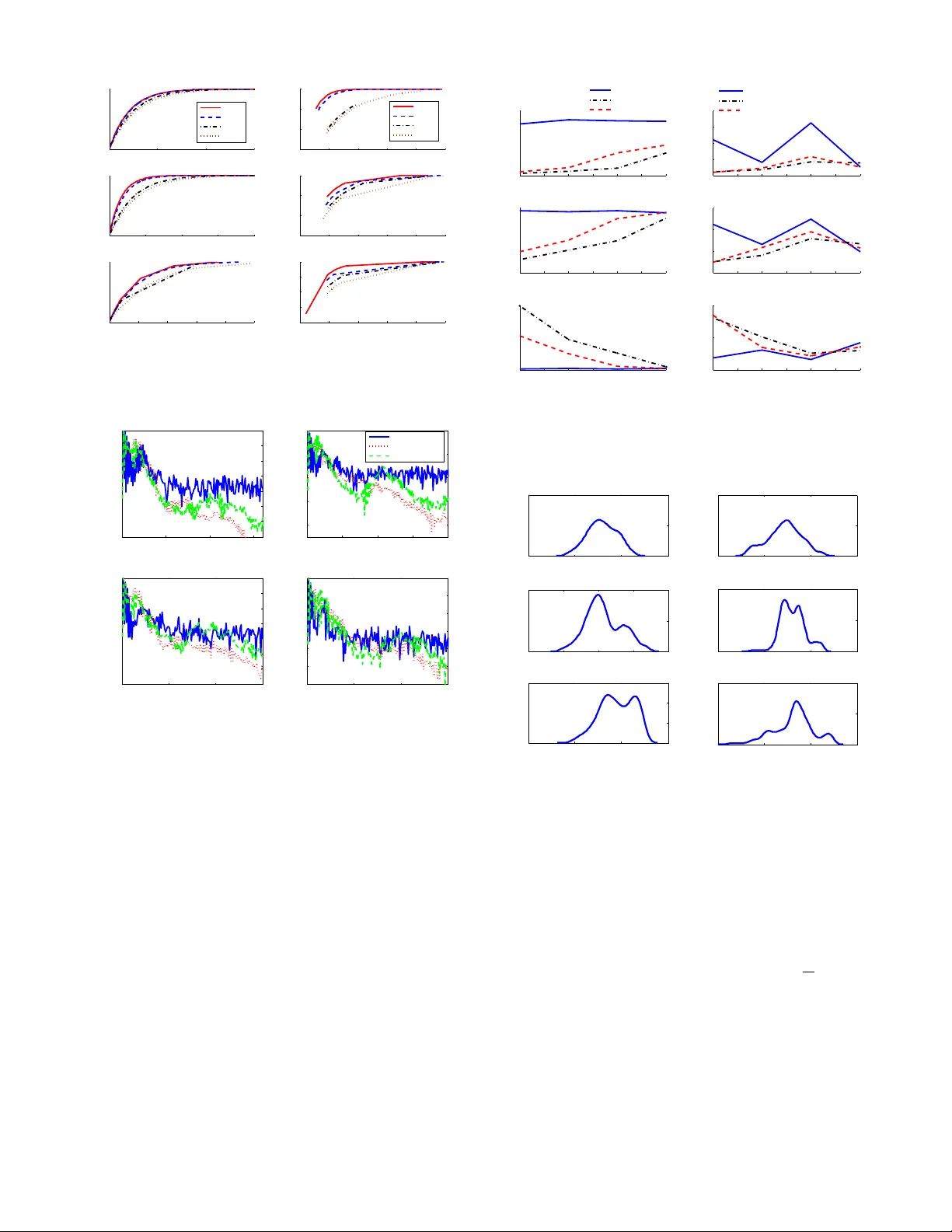
UWB Channel Sounding and Modeling for U A V Air -to-Ground Propagation Channels W ahab Khaw aja † , Ismail Guv enc ∗ † , Da vid Matolak ‡ ∗ Department of Electrical and Computer Engineering, Florida International Univ ersity , Miami, FL † Department of Electrical and Computer Engineering, North Carolina State Univ ersity , Raleigh, NC ‡ Department of Electrical and Computer Engineering, Univ ersity of South Carolina, Coloumbia, SC Email: { wkhaw001, iguv enc } @ncsu.edu, matolak@cec.sc.edu Abstract —Unmanned aerial vehicles (U A Vs) are expected to be used extensively in the near futur e in applications such as aerial surveillance, transportation, and disaster assistance. The conditions under which U A Vs operate are different fr om those of con ventional piloted aircrafts. This necessitates development of new air -to-ground (A G) propagation channel models f or U A Vs. T o our best knowledge, there are limited studies in the literature on sounding and modeling of ultrawideband (UWB) A G propagation channels. In this work, comprehensi ve UWB measur ements ar e conducted for various U A V communication scenarios using Time Domain P410 UWB kits. Both time and frequency domain analysis of the measured data are carried out. Based on the measured data, stochastic path loss and multipath channel models are developed to characterize A G UWB propagation channels. Index T erms —Channel sounding, drone, Ultrawideband (UWB), unmanned aerial vehicles (U A V). I . I N T RO D U C T I O N There has been an exceptional interest in commercial un- manned aerial v ehicles (U A Vs) during the past several years, which find applications in areas such as filming, entertainment, disaster relief, agriculture, construction management, and com- munications. According to market research firm T ractica, com- mercial U A V shipments are e xpected to rise drastically from 80,000 units in 2015 to 2.7 million units in 2025, and services enabled by commercial U A Vs will rise from $170 million in 2015 to $8.7 billion within the next 10 years [1]. Google and Facebook ha ve been recently inv estigating the use of unmanned aerial platforms to deli ver Internet connectivity in rural areas. UA Vs can also be used to deliv er broadband wire- less connectivity to hot spot areas during temporary events, and during emergencies/disasters such as earthquakes when the existing communications infrastructure can get damaged [2]. This emerging interest in U A Vs necessitates studying prop- agation characteristics for air-to-ground (AG) U A V channels for link b udget analysis and system design. T o this end, ultrawideband (UWB) signals [3]–[5] allo w to capture mul- tipath components (MPCs) with a fine temporal resolution, which makes UWB an appealing technology for dev eloping wideband propagation models. Large bandwidth of UWB can also facilitate high data rates, better penetration through materials, and co-existence with narrow band networks for U A V AG communications. T o our best kno wledge, there are no comprehensiv e and dedicated UWB channel models for U A V A G propagation channels. Current UWB propagation channel models de veloped for other scenarios [6]–[8] can Fig. 1. Experimental setup for UA V A G propagation measurements. not be applied to the U A V A G channels due to different propagation en vironments. While U A V propagation channels have been studied in the literature, most existing work focus on addressing path loss characteristics of A G channels. For example, a ray tracing based path loss model for A G channels has been proposed in [9] for urban areas, which is dependent on the elev ation angle between the flying platform and the ground station. In [10], a statistical propagation channel model for A G path loss has been proposed for urban en vironment. Again, the prediction is dependent on the elev ation angle between airborne transmitter and receiver on ground as well as properties of the urban en vironment, while it lacks corroborating measurement results. A geometric channel model for A G communication has been proposed in [11], which is applicable for both narro w and wideband channels. The model can be used to obtain ampli- tude, delay , time dif ference of arriv al, and phase of the arriving MPCs, and provides spatio-temporal characteristics of signals for multiple array antennas. In [12], A G channel model charac- terization has been performed using U A V based measurements ov er water in L and C frequency bands. The measurement results are used to generate path loss and wideband dispersi ve channel models based on tapped delay line model. In [13] marine channel model is carried out using U A Vs employing the ray tracing. Contribution of this work can be summarized as follows: 1) to report our UA V AG channel measurements (see Fig. 1) for the 3 . 1 – 5 . 3 GHz UWB spectrum, and 2) to develop statistical models to characterize the large scale fading, multipath prop- agation, and small scale fading in v arious scenarios based on the measured data. A comprehensi ve measurement campaign was carried out in open ground area and a sub-urban area in a v ariety of channel conditions. Our results sho w that the proposed stochastic model closely models the empirical UA V A G data. I I . U W B C H A N N E L S O U N D I N G F O R UA V S In this section, we will first describe our channel sounding procedure with T ime Domain P410 UWB kits. Subsequently , we will describe the U A V channel sounding e xperimentation for various AG scenarios. A. Channel Sounding with P410 Kits For UWB channel sounding, Time Domain P410 UWB radios are used in bi-static mode [14]. In this mode a trans- mitter radio sounds the channel by sending short duration pulses at regular intervals of time. The transmitted pulse repetition rate is 10 . 1 MHz. There is no need for physical synchronization between the transmitter and the receiver . A rake receiver is used for collection of MPCs at the receiver with an adjustable sampling rate. The frequency of operation for the P410 UWB kits is from 3 . 1 GHz to 5 . 3 GHz with an operational center frequency of 4 . 3 GHz. The maximum transmit power is limited to − 14 . 5 dBm from P410 radios, which falls within the FCC spectral mask. The antennas used in the experiment are BroadSpec UWB planar elliptical dipole antennas. The amplitude response of the antennas ov er the band is approximately flat. Clean algorithm [15] is used for obtaining refined channel impulse response (CIR). Fig. 3(a) shows the normalized am- plitude of the raw receiv ed pulses in blue. The wa veforms in red are the reconstructed ones by con volving the CIR in the Fig. 3(b) with the template wav eform. The difference is due to the imperfections in the clean algorithm. Fig. 3(b) is the CIR of the recei ved waveform obtained by performing decon volution of the recei ved wa veform with template wa veform. The dashed blue lines show the threshold that is being set at 10% of input signal, where all CIR samples below the threshold are discarded. B. Layout for UA V Channel Measur ements The U A V channel propagation measurements were carried out at Florida International Uni versity Campus using the P410 UWB kits. The transmitter radio is placed on T arot 650 quad- copter U A V belly such that the antenna is vertically facing down. In this setting, the beam pattern in the azimuth plane is in the form of circles spreading outward that can provide optimum cov erage. The recei ver is placed at two different heights from the ground. In UA V based A G channel sounding, the use of v ery high platforms from ground for U A Vs are rare [16]. Therefore, in our experiments, we varied the height of the UA V from 4 m to 16 m in steps of 4 m. W e considered three scenarios each in open and sub-urban areas, all with line-of-sight (LOS) communication. UAV P410Tx.r adio P410Rx. Radio1 (Scenario1) 1.5m Foliage 1.5m P410Rx. Radio3 (Scenario3) Laptop P410Rx. Radio2 (Scenario2) Fig. 2. Layout for the UA V channel sounding scenario. 0 10 20 80 90 −1 −0.5 0 0.5 1 Normalized a mplitude 0 10 20 30 40 50 60 70 80 90 −1 −0.5 0 0.5 1 (b) Time (n s ) 30 40 50 60 70 (a) Time (ns) N ormalized CIR Fig. 3. (a) Normalized amplitude of pulses with respect to time (blue represents receiv ed pulses and red represents reconstructed pulses), (b) CIR with respect to time. • Scenario 1: The terrestrial recei ver is at height of 1 . 5 m from ground and in foliage. W e placed the radios under the tree, such that branches and leaves were acting as foliage that hamper the direct LOS. • Scenario 2: The recei ver is at a height of 1 . 5 m from the ground, no foliage. • Scenario 3: The recei ver is placed at 7 cm from ground. A layout of three experimentation scenarios is shown in Fig. 2. In the experiments, the distance between the transmitter and receiv er is adjusted and calculated using the Global Positioning System (GPS) coordinates of each node. Due to the small link distance the ellipsoidal effect of earth is ne gligible. Therefore all the calculations for distance from GPS coordinates were based on the spherical earth. The raw data from measurements is in the form of CIRs, which are later processed in Matlab . For the path loss analysis, we obtained the data with the UA V in motion and the U A V hov ering at a fixed position for the three scenarios. The height of the UA V is also changed to four different distances. I I I . U W B C H A N N E L M O D E L I N G F O R UA V S Based on the collected measurement data as described in Section II, the characterization of A G channel model is divided into two main parts. In the first part, large scale fading is cov ered, which includes path loss and shadowing. In the second part, power delay profiles (PDPs) and small scale fading are considered based on the measured CIRs. The auxiliary parameters of the channel such as the mean excess delay and the root mean square delay spread (RMS-DS) are calculated from the measured PDPs. A. Larg e Scale P ar ameters For large scale parameter modeling, only LOS measure- ments for the A G channel were tak en. The v alue of the distance between the transmitter and the recei ver was calculated from each node’ s GPS longitude and latitude reading. The reference distance is taken as d 0 = 1 m. The relativ e orientation of UA V in the azimuth direction to the ground nodes is considered to be irrelev ant as the antennas are omni-directional and taken as zero. A modified free space path loss model (dB) in terms of both link distance and height is proposed based on the measured values when the UA V is assumed to be static: P L ( d ) = P L 0 + 10 α log 10 ( d/d 0 ) − 10 log 10 (∆ h/h opt ) + 10 log 10 c p + S, (1) where P L 0 (in dB) is the reference path loss correspond- ing to reference distance d 0 , α is the path loss exponent, ∆ h = | h gnd − h opt | , h gnd is the height of the receiver abo ve the ground, h opt (can v ary for dif ferent en vironments) is the minimum height of the receiv er that giv es the lowest path loss, C p = 10 log 10 c p > = 0 dB is the constant loss factor due to foliage and losses resulting from antenna orientations on U A V , and S ∼ N (0 , σ 2 ) is the shadowing v ariable, which is a zero mean Gaussian random variable with standard deviation σ . The v ariations in the path loss will be due to the link distance between the transmitter and receiv er and the clutter around it. Other minor factors that may influence path loss include the type of the antenna, its orientation on the U A V , and the type of the UA V , which are considered to be negligible in our case. As the motion of UA V introduces Doppler , the effect of frequency dependence on the path loss cannot be ignored [17]. The ef fect of the frequency change will be due to the Doppler effect, and (1) can be modified as follows: P L ( d ) = P L 0 + 10 α log 10 ( d/d 0 ) − 10 log 10 (∆ h ) /h opt + 10 log 10 c p + 10 x log 10 (( f e + ∆ f ) /f e ) + S, (2) where ∆ f = (∆ v /c ) f e , is the Doppler variation in the frequency due to the speed v of the U A V relati ve to the recei ver on the ground, f e is the emitted frequency , f = f e + ∆ f is the observed frequency at the recei ver , and x is the frequency dependence factor of path loss. At small velocities of few 10’ s of m/s, the factor 10 x log 10 (( f e + ∆ f ) /f e ) is essentially negligible. The measured av erage path loss (in dB) as a function of distance for U A V AG channels is obtained as follo ws [18] P L ( d ) = P L ( d 0 ) + 10 log 10 P ∀ i P d 0 [ i ] P ∀ i P d [ i ] , (3) P d [ i ] = N X k =1 | h [ i, k ] | 2 / N tot , i = 1 , 2 , ...T , (4) where N = 1 , 2 , ...N tot , and P d [ i ] is the av erage PDP at distance d with respect to time instants i obtained by a veraging ov er all the scans N , and P ∀ i P d 0 [ i ] , P ∀ i P d [ i ] gi ves the total energies from all MPCs at distances d 0 and d . Each scan N has a fixed time bin of T seconds and i represents the time index of the samples in the bin. N tot is the total number of scans. Each scan time bin captures samples at a sampling rate of T s . The total number of distinct samples in each scan bin are T /T s . In our case we hav e taken 25 scans or CIRs for each scenario, and therefore we have N tot = 25 . The v alue of T s is 0 . 06 ns, while the value of T is 100 ns. B. Channel Impulse Response In this paper, we model the CIR h ( t ) using the Saleh V alenzuela channel model [19] h ( t ) = N X n =0 M X m =0 a n,m ( t ) exp( j φ n,m ( t )) δ ( t − Γ n − τ n,m ( t )) , (5) where N is the total number of clusters, M is the total number of MPCs per cluster, a n,m ( t ) , φ n,m ( t ) , τ n,m ( t ) represents the amplitude, phase and delay of the m th MPC in the n th cluster as a function of time, Γ n is the delay of the n th cluster . The phase is considered to be uniformly distributed random variable between the interval [0 , 2 π ] , and therefore it is neglected. In UWB channel the amplitude and delay terms vary slo wly with respect to time and can be considered as time in variant. Therefore, we can re write (5) as follows h ( t ) = N X n =0 M X m =0 a n,m δ ( t − Γ n − τ n,m ) . (6) The distribution of arriv al times for clusters and MPCs within each cluster is modeled as Poison process with respective clus- ter and ray arri val rates represented as Λ and λ , respecti vely . Then, the distribution of cluster and ray arriv al times can be written as [19] p (Γ n | Γ n − 1 ) = Λ exp( − Λ(Γ n − Γ n − 1 )) , (7) p ( τ n,m | τ n,m − 1 ) = λ exp( − λ ( τ n,m − τ n,m − 1 )) . (8) The PDP within each non-ov erlapping cluster can be ob- tained as follows [17] P n ( t ) = E ( a 2 n,m ) exp( − τ n,m /β n ) δ ( t − τ n,m ) , (9) where P n ( t ) is the PDP for n th non-overlapping cluster , E stands for expected value, E ( a 2 n,m ) represents the av erage power due to m MPCs of the n th cluster , and β n is the intra cluster decay constant of n th cluster . The ov erall PDP from n clusters is giv en by P d ( t ) = P n ( t ) exp( − Γ n /µ ) δ ( t − Γ n ) , (10) where µ is the inter-cluster decay constant giv en by µ ∝ c d Γ + h/c h + ψ , with h being the height of the U A V , c d > 1 and c h > 1 are constants showing that the inter cluster decay constant is a function of cluster delay and height of U A V , and ψ ∼ N (0 , σ 2 c ) is a zero mean Gaussian random variable. The number of clusters C n is giv en by C n ∝ c e /h + γ , where c e > 1 is a constant dependent on the type of the environment, h is the height of the U A V above ground and γ ∼ N (0 , σ 2 N ) is a zero mean Gaussian random variable. The c e will hav e smaller value for nearby clutter conditions. The PDP in case of ov erlapping clusters can be modeled separately . Overlapping occurs when τ n − 1 ,m > Γ n − Γ n − 1 for some value of m . This results in overlapping of the clusters n and n − 1 . In order to find the PDP within each cluster for ov erlapping case, assume a contribution of duration χ from the neighboring clusters, where χ = Γ n − Γ n − 1 . Let P n c ( t ) represents the PDP of overlapping clusters n and n − 1 . The ov erall PDP for o ver-lapping clusters can be modeled as [19] P n c ( t ) = E ( a 2 n,m ) exp( − τ n,m /β n ) δ ( t − τ n,m ) if ( τ n − 1 ,m < Γ n − Γ n − 1 ) E ( a 2 n,m ) exp( − τ n,m /β n ) exp( − χ j /X ) δ ( t − τ n,m ) if ( τ n − 1 ,m > Γ n − Γ n − 1 ) while the overall PDP for all the clusters P d c ( t ) in o verlapping case is giv en by P d c ( t ) = P n c ( t ) exp( − Γ n /µ ) δ ( t − Γ n ) , (11) where X = E [ β n , β n − 1 ] , χ j represents the j th cluster ov erlap, j ∈ ( n, n − 1) . Generally the decay constant for the cluster is much larger than the MPC decay constant, and therefore, the additional exponential term in P n c ( t ) will decay much faster and the cluster energies are considered to be uncorrelated [19]. Using the PDP information, the mean excess delay and the RMS-DS can be obtained as t mean = P ∀ t tT s P d ( t ) P ∀ t P d ( t ) , (12) t rms = q t sq − t 2 mean , t sq = P ∀ t ( tT s ) 2 P d ( t ) P ∀ t P d ( t ) , (13) where t mean represents the mean excess delay , t rms represents the RMS-DS obtained from respective PDP . In this case we consider non-ov erlapping clusters, and the mean number of clusters is represented by C . C. Small Scale F ading The small scale amplitudes collected for each MPC at respectiv e delay bins for multiple CIRs follo w the Nakagami distribution given by F ( y ; m, Ω) = 2 m m y 2 m − 1 Γ( m )Ω m exp − my 2 Ω , (14) 8 9 10 11 12 40 50 60 70 (a) 10log10(h) m Path Loss (dB) 8 9 10 11 12 40 50 60 70 (b) 10log10(h) m Path Loss (dB) Scenario 1 Scenario 2 Scenario 3 8 9 10 11 12 40 50 60 70 (c) 10log10(h) m Path Loss (dB) 8 9 10 11 12 40 50 60 70 (d) 10log10(h) m Path Loss (dB) Fig. 4. Measured path loss versus distance, and linear line fitting to measured data for the three scenarios each in (a) Open area, v = 0 m/s, (b) Sub-urban area, v = 0 m/s, (c) Open area, v = 20 m/s, (d) Sub-urban area, v = 20 m/s. where m is the Nakagami shape factor , Ω is the spread con- trolling factor , and Γ( m ) is the Gamma function. Let Y be the random v ariable giv en by Y ∼ N ak ag ami m, Ω ; then, the parameters m and Ω are gi ven by [20] m = E 2 [ Y 2 ] / V ar[ Y 2 ] , Ω = E [ Y 2 ] , where the Nakagami m factor follows log-normal distribution. The mean η and standard de viation ξ of the m factor are gi ven by [17] η = m 0 − E [ m ] γ , ξ = v 0 − V ar[ m ] γ , (15) where m 0 , v 0 are the mean and variance of the first component of the clusters, respectiv ely , that are not affected by the delay . I V . E X P E R I M E N TA L A N D M O D E L I N G R E S U LT S In this section, based on the measurement results and propagation models described in the earlier two sections, we present our results for UWB A G propagation for various UA V communication scenarios in Fig. 2. First, results for large scale channel measurement and modeling results will be discussed, followed by multipath and small scale results. A. Larg e Scale Channel Characterization Based on the measured UWB signals at different U A V heights and for the three different scenarios in Fig. 2, the measured path loss versus distance, as well as the linear path loss model fit obtained from (1) for each scenario, are shown in Fig. 3. Results are reported both for open area and sub- urban area, and corresponding parameters for the path loss models are sho wn in T able I and T able II. It can be observed that the relativ e motion of the transmitter on U A V with respect to receiver introduces change in antenna’ s elev ation plane pattern, which introduces additional path loss and more variance in shadowing. The effect of frequency variance due to Doppler (2) has very little ef fect in our case due to low velocity of the U A V . The path loss in Fig. 4 is the highest for scenario 1 with U A V in motion, while it is smallest for scenario 2 (open, LOS T ABLE I P AT H L O S S PA R A M E T E R S F O R ( d = 5 . 6 m to 16 . 5 m ) O P E N A R E A . Scenario α P L 0 (dB) σ (dB) Open, scenario 1, v = 0 mph 2 . 6471 34 . 905 3 . 37 Open, scenario 2, v = 0 mph 2 . 5418 24 . 9965 3 . 06 Open, scenario 3, v = 0 mph 2 . 9442 25 . 8091 2 . 799 Open, scenario 1, v = 20 mph 2 . 6533 34 . 906 4 . 02 Open, scenario 2, v = 20 mph 2 . 6621 24 . 996 3 . 91 Open, scenario 3, v = 20 mph 2 . 9423 25 . 809 3 . 44 case) (1). Path loss is higher for scenario 3 as compared to scenario 2, due to (apart from small change in link distance) capturing of more ground reflections when the recei ver is abov e ground at an optimum height h opt . In other words, h opt is the minimum height of the receiv er above ground from where we start to capture substantially different behavior of MPCs when compared to the receiv er on ground. Another possible reason for the higher path loss in scenario 3 is due to more ground absorption of ener gy and incident angle that is a function of height. In the sub-urban area the path loss is larger than in the open area. −10 −5 0 5 10 0 0.02 0.04 0.06 0.08 0.1 0.12 PDF Open Sub−urban Shadowing Variable (dB) Fig. 5. PDF of shadowing variable in open area and sub-urban area. In Fig. 5, the probability density function (PDF) of the variance of path loss is sho wn for both open and sub-urban areas. Results show that the v ariance of the path loss is larger for the sub-urban area when compared to the open area measurements. CB = 1 5 t rms (16) B. Multipath Channel Characterization In order to get insights about the multipath channel char- acteristics, we ha ve studied v arious aspects of UA V multipath channel measurements. In Fig. 6, channel frequency responses (CFRs) for different scenarios are obtained by taking the FFT of the respective CIRs for different U A V heights. For open area scenario, except for near sharp nulls for any band on the order of 50 MHz, CFR is fairly flat; howe ver , as the U A V T ABLE II P AT H L O S S PA R A M E T E R S F O R ( d = 5 . 6 m to 16 . 5 m ) S U B - U R BA N A R E A . Scenario α P L 0 (dB) σ (dB) Sub-urban, scenario 1, v = 0 mph 2 . 7601 30 . 4459 4 . 8739 Sub-urban, scenario 2, v = 0 mph 2 . 606 24 . 747 4 . 31 Sub-urban, scenario 3, v = 0 mph 3 . 0374 21 . 96 4 . 897 Sub-urban, scenario 1, v = 20 mph 2 . 8350 30 . 446 5 . 3 Sub-urban, scenario 2, v = 20 mph 2 . 667 24 . 833 4 . 96 Sub-urban, scenario 3, v = 20 mph 2 . 961 22 . 73 4 . 71 3.5 4 4.5 5 x 10 9 −20 0 20 (a) Frequency (Hz) CFR (dB) −40 3.5 4 4.5 5 x 10 9 −20 0 20 (c) Frequency (Hz) CFR (dB) −40 3.5 4 4.5 5 x 10 9 −20 0 20 (e) Frequency (Hz) CFR (dB) −40 3.5 4 4.5 5 x 10 9 −20 0 20 (b) Frequency (Hz) CFR (dB) −40 h = 4 m h = 8 m h = 12 m h = 16 m 3.5 4 4.5 5 x 10 9 −20 0 20 (d) Frequency (Hz) CFR (dB) −40 3.5 4 4.5 5 x10 9 −20 0 20 (f) Frequency (Hz) CFR (dB) −40 Fig. 6. CFRs for open and sub-urban areas, for dif ferent U A V heights. (a) Open (scenario 1), (b) Sub-urban (scenario 1), (c) Open (scenario 2), (d) Sub-urban (scenario 2), (e) Open (scenario 3), and (f) Sub-urban (scenario 3). height increases, frequency selectiv e fading is more visible especially in scenario 1, we observe deep fades that become more frequency selecti ve as the U A V height increases. Fig. 7 shows the cumulati ve distrib ution function (CDF) for the time of arriv al (TO A) of the MPCs for various scenarios. The MPCs are selected by defining an amplitude threshold of − 32 . 5 dB, and ev erything belo w this threshold is counted as noise and discarded. CDFs in case of open area are closely bound, showing no presence of distant reflectors. In case of sub-urban area the CDFs show more MPCs at larger values of delay , possibly due to arriv al of distant MPCs incurring a larger number of reflections. The arri val rate is the highest for scenario 1, due to close by reflections from tree trunk and the branches of the trees. The PDPs for open area are shown in Fig. 8 for four different heights of the U A Vs and they follow decaying exponential distribution with multiple MPC clusters. There are major power contributions from delayed clusters around 8 ns and 40 ns for scenario 2 and scenario 3. The value of µ for scenario 2 and scenario 3 is larger compared to scenario 1 due to lar ger Γ . The value of Γ that is representation of the clustering delay from MPCs is smallest in case of foliage due to nearby reflections. Similarly due to smaller value of c e for scenario 1 compared to the other two, we hav e smaller observed C n . Similar measurements in sub-urban area (not reported due to space constraints) show that PDP has more uniform contributions from delayed MPCs forming 0 5 10 15 0 0.5 1 TOA of MPCs (ns) CDF h=4m h=8m h=12m h=16m 0 10 20 30 40 0 0.5 1 TOA of MPCs (ns) CDF 0 20 40 60 80 100 0 0.5 1 TOA of MPCs (ns) CDF 0 20 40 60 80 100 0.4 0.6 0.8 1 TOA of MPCs (ns) CDF h=4m h=8m h=12m h=16m 0 20 40 60 80 100 0.4 0.6 0.8 1 TOA of MPCs (ns) CDF 0 20 40 60 80 100 0.2 0.4 0.6 0.8 1 TOA of MPCs (ns) CDF Fig. 7. CDF versus time of arriv al of MPCs. (a) Open (scenario 1), (b) Sub- urban (scenario 1), (c) Open (scenario 2), (d) Sub-urban (scenario 2), (e) Open (scenario 3), and (f) Sub-urban (scenario 3). 0 2 0 4 0 6 0 −30 −25 −20 −15 −10 −5 0 (a) Delay (ns) Normalized Avg. PDP (dB) −35 0 2 0 4 0 6 0 8 0 −40 −30 −20 −10 0 (b) Delay (ns) Normalized Avg. PDP (dB) 0 2 0 4 0 6 0 −35 −30 −25 −20 −15 −10 −5 0 (c) Delay (ns) Normalized Avg. PDP (dB) 0 2 0 4 0 6 0 −30 −25 −20 −15 −10 −5 0 (d) Delay (ns) Normalized Avg. PDP (dB) Open scenario 1 Open scenario 2 Open scenario 3 Fig. 8. PDP for open area for the three scenarios at UA V heights of (a) 4 m; (b) 8 m; (c) 12 m; (d) 16 m. delayed clusters due to reflections from nearby infrastructure, and larger µ compared to the open area PDPs. The number of clusters in open and sub-urban areas is approximately the same. The mean excess delay , RMS-DS, and coherence bandwidth for open and sub-urban areas are shown in Fig. 9. For both cases, the mean excess delay and RMS-DS are the highest for scenario 1, and lowest for scenario 2. The coherence bandwidth is calculated using the approximation 1 / 5 t rms , and it is minimum for foliage conditions. The coherence bandwidth is found to be at least 100 MHz. In order to study the fading distributions in different fre- quency sub-bands, we captured the histograms of the receiv ed signal strength at different sub-bands (each 150 MHz wide), ov er large number of realizations. Results at a U A V height of 12 m is shown in Fig. 10 for open area scenario. The mean of the PDFs shows a decrease at higher frequencies (due to larger attenuation) and the variances of the PDF shows an 4 6 8 10 12 14 16 1 2 3 Height (m) Mean excess delay (ns) 0 Open scenario 1 Open scenario 2 Open scenario 3 4 6 8 10 12 14 16 0.5 1 1.5 2 Height (m) RMS delay (ns) 0 4 6 8 10 12 14 16 2 3 4 5 x 10 8 Height (m) Coherence bandwidth (Hz) 1 4 6 8 10 12 14 16 1.4 1.6 1.8 2 Height (m) Mean excess delay (ns) Sub−urban scenario 1 Sub−urban scenario 2 Sub−urban scenario 3 4 6 8 10 12 14 16 0.5 1 1.5 Height (m) RMS delay (ns) 0 4 6 8 10 12 14 1 6 5 10 x 10 8 Height (m) Coherence bandwidth (Hz) 0 Fig. 9. Mean excess delay , RMS-DS and coherence bandwidth for open and sub-urban area at dif ferent UA V heights. (a) Open, mean excess delay , (b) Sub-urban, mean excess delay , (c) Open, RMS-DS, (d) Sub-urban, RMS-DS, (e) Open, coherence bandwidth, (f) Sub-urban, coherence bandwidth. −14 −8 0 0.5 1 −12 −10 (a) 3.5 − 3.65 GHz (dB/Hz) PDF −14 −8 0 0.5 1 −12 −10 (b) 3.55 − 3.7 GHz (dB/Hz) PDF −35 −15 0 0.1 0.2 −30 −25 −20 (c) 3.9 − 4.05 GHz (dB/Hz) PDF −35 −20 0 0.2 0.4 −30 −25 (d) 4.2 − 4.35 GHz (dB/Hz) PDF −100 −40 0 0.02 0.04 0.06 −80 −60 (e) 4.9 − 5.05 GHz (dB/Hz) PDF −100 −40 0 0.05 0.1 −80 −60 (f) 5.0 − 5.15 GHz (dB/Hz) PDF Fig. 10. PDF of the receiv ed signal strength at different frequency sub-bands at a height of 12 m (sub-urban area, scenario 3). increasing trend. W e also observed that the v ariances of the PDFs increase with U A V height (results not included). C. Small Scale Channel Characterization Based on the multipath propagation model presented in (5)- (13), we extracted model parameters from open area and sub- urban area measurements, which are reported in T able III. Results show that the mean number of clusters C is larger for the sub-urban area, while the inter-cluster decay constant µ is generally lar ger for the open area, except for scenario 1. Moreov er, based on the small scale fading model provided earlier in (14), (15), parameters extracted from our UWB A G channel measurements are presented in T able IV for open area and sub-urban area. The mean η is smallest and v ariance ξ is largest for Scenario 1 for both open area and sub-urban area T ABLE III U W B UA V C H A N N E L M O D E L PA R A M E T E R S F O R P D P . Parameters Scenario 1 Scenario 2 Scenario 3 Open area C 2 . 33 2 . 33 1 Λ (1/ns) 0 . 15 0 . 09 0 . 0498 λ (1/ns) 4 . 34 2 . 210 0 . 532 µ (ns) 2 . 5 2 . 91 4 . 42 β (ns) 0 . 5 0 . 9069 1 . 21 Sub-urban area C 2 . 66 2 . 66 2 . 66 Λ (1/ns) 0 . 789 0 . 0498 0 . 06 λ (1/ns) 0 . 827 0 . 717 0 . 615 µ (ns) 2 . 63 2 . 77 3 . 03 β (ns) 0 . 9 1 . 4 1 . 6 T ABLE IV U W B UA V C H A N N E L M O D E L PA R A M E T E R S F O R S M A L L S C A L E FA D I N G . Parameters Scenario 1 Scenario 2 Scenario 3 Open area η ( dB ) 1 . 36 1 . 67 1 . 45 ξ 2 . 19 0 . 64 0 . 79 Sub-urban area η (dB) 1 . 12 1 . 58 1 . 34 ξ 2 . 705 1 . 55 1 . 471 measurements. In general, variance is lar ger in sub-urban area compared to open area, due to larger number of scatterers. V . C O N C L U D I N G R E M A R K S A N D A P P L I C A T I O N S In this work, we conducted extensi ve UWB A G channel measurements for U A Vs for various open and sub-urban scenarios. Based on the empirical data, we have dev eloped statistical channel models for path loss, multipath, and small scale characterization of A G channels, which are shown to match closely with the empirical data. Our future work includes extending our propagation model to lar ger U A V communication distances and heights, in the mmW ave and in vestigate propagation models for air -to-air communication. Applications of the proposed channel model can be in cognitiv e radar and environmental sensing systems [21], 3G and 4G cellular networks and millimeter -wav e (mmW ave) based 5G future cellular networks. In order to reduce outage probability in densely populated areas (e.g. shopping malls and streets), U A Vs can act as mobile base stations (BSs) [22] to support the additional traffic [2]. In case of mmW av e communications, the proposed channel model needs to account for angle of arri vals and angle of departures of the MPCs due to e xtensive use of multiple antennas for mmW ave frequencies. Another application is vehicular to infrastructure networks, where the proposed channel model can be used after some modifications to account for the vehicle and U A V velocity . R E F E R E N C E S [1] Tractica, “Commercial drone shipments to surpass 2.6 million units annually by 2025, ” July 2015. [2] A. M. amd A. T uncer, A. Kumbhar , and I. Guvenc, “Unmanned aerial base stations for public safety communications, ” IEEE V ehic. T echnol. Mag., 2016. [3] Federal Communications Commission, “First report and order 02-48, ” Apr . 2002. [4] I. Guvenc, S. Gezici, and Z. Sahinoglu, “Ultra-wideband range estima- tion: Theoretical limits and practical algorithms, ” in Pr oc. IEEE Int. Conf. Ultra-W ideband (ICUWB) , vol. 3, 2008, pp. 93–96. [5] I. Guvenc, S. Gezici, Z. Sahinoglu, and U. C. Kozat, “Reliable commu- nications for short-range wireless systems, ” Cambridge University Press, 2011. [6] A. Molisch, D. Cassioli, C.-C. Chong, S. Emami, A. Fort, B. Kannan, J. Karedal, J. Kunisch, H. Schantz, K. Siwiak, and M. Win, “ A com- prehensiv e standardized model for ultrawideband propagation channels, ” IEEE T rans. Ant. Propag . , vol. 54, no. 11, pp. 3151–3166, Nov . 2006. [7] A. Molisch, “Ultrawideband propagation channels-theory , measurement, and modeling, ” IEEE Tr ans. V ehic. T ech. , pp. 1528–1545, Sept 2005. [8] H. Chaibi, M. Belkasmi, and Z. Mohammadi, “UWB outdoor channel characterization and modeling based on measurements, ” in W ireless Net- works and Mobile Comms. (WINCOM), 2015 International Confer ence on , Oct 2015, pp. 1–5. [9] Q. Feng, J. McGeehan, E. K. T ameh, and A. R. Nix, “Path loss models for air-to-ground radio channels in urban environments, ” in Proc. IEEE V ehic. T echnol. Conf. (VTC) , vol. 6, May 2006, pp. 2901–2905. [10] A. Al-Hourani, S. Kandeepan, and A. Jamalipour , “Modeling air-to- ground path loss for low altitude platforms in urban en vironments, ” in Pr oc. IEEE Global T elecommun. Conf. (GLOBECOM) , Dec. 2014, pp. 2898–2904. [11] W . G. Newhall and J. H. Reed, “ A geometric air-to-ground radio channel model, ” in Pr oc. IEEE Military T elecommun. Conf. (MILCOM) , vol. 1, Oct. 2002, pp. 632–636. [12] D. Matolak and R. Sun, “ Air -ground channel characterization for un- manned aircraft systems, part I: Methods, measurements, and models for over -water settings, ” IEEE T rans. V ehic. T echnol. , 2016. [13] Y . W u, Z. Gao, C. Chen, L. Huang, H. P . Chiang, Y . M. Huang, and H. Sun, “Ray tracing based wireless channel modeling over the sea surface near diaoyu islands, ” in 2015 Fir st International Conference on Computational Intelligence Theory , Systems and Applications (CCITSA) , Dec 2015, pp. 124–128. [14] W . Khawaja, K. Sasaoka, and I. Guvenc, “Uwb radar for indoor detection and ranging of moving objects: An experimental study , ” in 2016 International W orkshop on Antenna T ec hnology (iWA T) . IEEE, 2016, pp. 102–105. [15] Park, J J Hyuk, Jeong, Hwa-Y oung and W aluyo and Borgy, Multimedia and Ubiquitous Engineering: MUE 2013 . Springer Science & Business Media, 2014, vol. 240. [16] J. J. V acek, “Big brother will soon be watching-or will he-constitutional, regulatory , and operational issues surrounding the use of unmanned aerial vehicles in law enforcement, ” NDL Rev . , vol. 85, p. 673, 2009. [17] A. F . Molisch, K. Balakrishnan, D. Cassioli, C.-C. Chong, S. Emami, A. Fort, J. Karedal, J. Kunisch, H. Schantz, and U. Schuster , “IEEE 802.15. 4a channel model-final report, ” IEEE P802 , vol. 15, no. 4, 2004. [18] A. Merwaday , N. Rupasinghe, I. Guvenc, W . Saad, and M. Y uksel, “USRP-based indoor channel sounding for D2D and multi-hop commu- nications, ” in Proc. IEEE Wir eless and Micr owave Conf. (W AMICON) , June 2014, pp. 1–6. [19] A. Saleh and R. V alenzuela, “ A statistical model for indoor multipath propagation, ” IEEE J. Sel. Ar eas Commun. (JSA C) , vol. 5, no. 2, pp. 128–137, February 1987. [20] R. Kolar , R. Jirik, and J. Jan, “Estimator comparison of the nakagami-m parameter and its application in echocardiography , ” Radioengineering , vol. 13, no. 1, pp. 8–12, 2004. [21] H. Celebi, I. G ¨ uvenc ¸ , S. Gezici, and H. Arslan, “Cognitive-radio systems for spectrum, location, and en vironmental awareness, ” IEEE Antennas and Pr opagation Magazine , vol. 52, no. 4, pp. 41–61, Aug. 2010. [22] N. Rupasinghe, A. S. Ibrahim, and I. Guvenc, “Optimum hovering locations with angular domain user separation for cooperativ e UA V networks, ” in Pr oc. IEEE Global T elecommun. Conf. (GLOBECOM) , Dec. 2016.
Original Paper
Loading high-quality paper...
Comments & Academic Discussion
Loading comments...
Leave a Comment