Renormalization group theory for percolation in time-varying networks
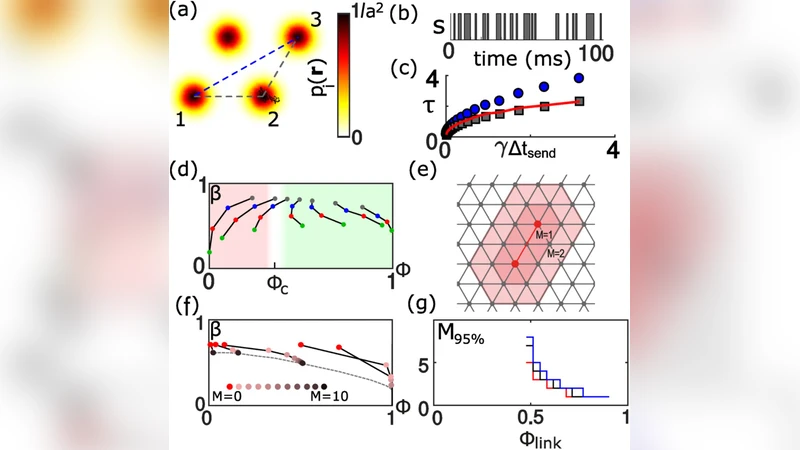
Motivated by multi-hop communication in unreliable wireless networks, we present a percolation theory for time-varying networks. We develop a renormalization group theory for a prototypical network on a regular grid, where individual links switch stochastically between active and inactive states. The question whether a given source node can communicate with a destination node along paths of active links is equivalent to a percolation problem. Our theory maps the temporal existence of multi-hop paths on an effective two-state Markov process. We show analytically how this Markov process converges towards a memory-less Bernoulli process as the hop distance between source and destination node increases. Our work extends classical percolation theory to the dynamic case and elucidates temporal correlations of message losses. Quantification of temporal correlations has implications for the design of wireless communication and control protocols, e.g. in cyber-physical systems such as self-organized swarms of drones or smart traffic networks.
💡 Research Summary
The paper addresses a fundamental gap in network theory: classical percolation models assume static links, whereas real wireless infrastructures—such as ad‑hoc sensor fields, drone swarms, or intelligent traffic systems—experience rapid, stochastic link failures. The authors formulate a percolation problem on a time‑varying network by placing a regular two‑dimensional grid of nodes and allowing each edge to switch between an “active” (usable) and an “inactive” (failed) state according to an independent two‑state Markov chain. The transition probabilities are denoted p_on (inactive → active) and p_off (active → inactive). The central question—whether a source node can reach a destination node through a sequence of active hops at a given time—becomes a dynamic percolation problem.
To make the problem analytically tractable, the authors introduce a renormalization‑group (RG) scheme. The lattice is partitioned into blocks of size b×b. A block is declared “open” if at least one active path exists across it; otherwise it is “closed”. By treating each block as a super‑edge, the original fine‑grained Markov process is coarse‑grained into a new two‑state Markov chain with effective transition probabilities α(b) (closed → open) and β(b) (open → closed). The RG transformation maps the pair (α,β) at scale b to (α′,β′) at scale 2b via a deterministic nonlinear function F derived from combinatorial counting of intra‑block paths. Repeating this transformation yields a flow in the (α,β) space.
A fixed‑point analysis shows that the only stable fixed point of F is α* = p_on/(p_on + p_off) and β* = p_off/(p_on + p_off). At this point the coarse‑grained process is a memory‑less Bernoulli trial: the state of a block at time t+1 depends only on its current state, and successive blocks become statistically independent. Consequently, as the hop distance between source and destination grows, the temporal correlations inherent in the original Markov links decay exponentially and eventually vanish. The rate of convergence to the Bernoulli fixed point is governed by the difference Δ = |p_on – p_off|; larger Δ (i.e., faster link dynamics) leads to quicker loss of memory.
The theoretical predictions are validated through extensive Monte‑Carlo simulations on 100×100 grids. Various (p_on, p_off) pairs are examined, and three performance metrics are recorded: (1) the probability that an active multi‑hop path exists, (2) the average latency until the first such path appears, and (3) the temporal autocorrelation function C(τ) = ⟨X_t X_{t+τ}⟩ – ⟨X⟩², where X_t indicates the existence of a path at time t. Results confirm that for short hop counts (≤5) the detailed Markov dynamics significantly affect connectivity, whereas for longer distances (≥10 hops) the connectivity probability converges to the Bernoulli prediction. When p_on ≈ p_off, the autocorrelation decays slowly, indicating persistent temporal memory; when one transition dominates, the decay is rapid and the system behaves almost like an i.i.d. percolation process.
From an engineering perspective, the findings have several implications. First, protocol designers can safely ignore long‑range temporal correlations when planning routes that span more than a modest number of hops, simplifying reliability analysis. Second, the derived Bernoulli fixed point provides a closed‑form expression for the effective percolation threshold in dynamic settings, enabling quick estimation of required link activation probabilities to achieve a target end‑to‑end reliability. Third, the RG framework offers a systematic way to incorporate link dynamics into higher‑level network control algorithms, such as adaptive retransmission timers, opportunistic routing, or swarm formation control, by adjusting parameters based on the estimated convergence rate Δ.
In summary, the authors extend percolation theory to time‑varying networks by mapping the existence of active multi‑hop paths onto a two‑state Markov process and then applying a renormalization‑group analysis. They demonstrate analytically and numerically that, as the spatial scale grows, the process loses its memory and converges to a simple Bernoulli percolation model. This work bridges a crucial theoretical gap, provides quantitative tools for assessing temporal loss correlations, and offers practical guidance for the design of robust communication and control protocols in modern cyber‑physical systems.
Comments & Academic Discussion
Loading comments...
Leave a Comment