Complex System Design with Design Languages: Method, Applications and Design Principles
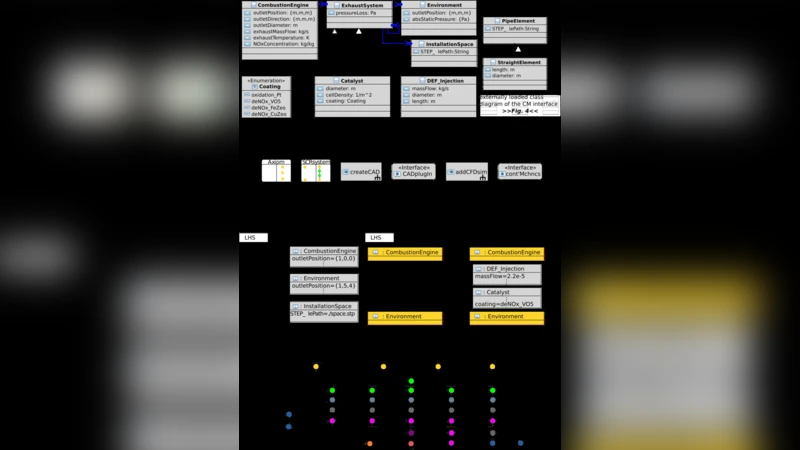
Graph-based design languages in UML (Unified Modeling Language) are presented as a method to encode and automate the complete design process and the final optimization of the product or complex system. A design language consists of a vocabulary (digital building blocks) and a set of rules (digital composition knowledge) along with an executable sequence of the rules (digital encoding of the design process). The rule-based mechanism instantiates a central and consistent global product data structure (the so-called design graph). Upon the generation of the abstract central model, the domain-specific engineering models are automatically generated, remotely executed and their results are fed-back into the central design model for subsequent design decisions or optimizations. The design languages are manually modeled and automatically executed in a so-called design compiler. Up to now, a variety of product designs in the areas of aerospace, automotive, machinery and consumer products have been successfully accelerated and automated using graph-based design languages. Different design strategies and mechanisms have been identified and applied in the automation of the design processes. Approaches ranging from the automated and declarative processing of constraints, through fractal nested design patterns, to mathematical dimension-based derivation of the sequence of design actions are used. The existing knowledge for a design determines the global design strategy (top-down vs. bottom-up). Similarity-mechanics in the form of dimensionless invariants are used for evaluation to downsize the solution for an overall complexity reduction. Design patterns, design paradigms (form follows function) and design strategies (divide and conquer) from information science are heavily used to structure, manage and handle complexity.
💡 Research Summary
The paper introduces a novel framework called “graph‑based design languages” that aims to digitize, automate, and integrate the entire design lifecycle of complex products and systems. At its core, a design language is composed of three elements: a vocabulary of digital building blocks, a set of composition rules that describe how those blocks can be combined, and an executable sequence that encodes the design process itself. By modeling these elements in UML as a directed graph, the authors create a single, global data structure – the design graph – that serves as the authoritative source of product information throughout all stages of development.
Once the abstract central model (the design graph) is generated, domain‑specific engineering models are automatically derived. These models may represent computational fluid dynamics, structural finite‑element analysis, electromagnetic simulation, or any other discipline‑specific analysis required for the product. The derived models are dispatched to remote execution environments (cloud clusters, high‑performance compute farms, or specialized simulators). Results from these runs are fed back into the design graph, updating node attributes, adding new nodes, or triggering additional rule executions. This closed‑loop feedback mechanism enables continuous refinement and optimization without manual data translation or re‑entry.
The authors distinguish two overarching design strategies that are selected based on the existing knowledge base for a given domain. In knowledge‑rich domains, a bottom‑up (incremental) approach is favored: individual components are optimized first, then assembled into higher‑level subsystems. In contrast, when introducing novel concepts or when knowledge is sparse, a top‑down (declarative) approach drives the process, starting from system‑level requirements and recursively decomposing them into lower‑level blocks. The design language can switch between these strategies simply by reconfiguring its rule set, offering flexibility without rewriting the underlying models.
A key innovation discussed is the use of dimensionless invariants (similarity mechanics) to reduce problem dimensionality. By normalizing physical quantities, the design space collapses into a set of non‑dimensional parameters that capture the essential behavior of the system. This enables rapid evaluation of design alternatives and supports the “divide and conquer” paradigm. The paper also presents fractal nested design patterns, which allow reusable sub‑graphs to be instantiated at multiple hierarchy levels, thereby promoting modularity and scalability. Declarative constraint processing further streamlines the workflow: designers declare constraints (e.g., mass ≤ X, natural frequency ≥ Y) and the engine automatically prunes infeasible branches of the design graph, dramatically cutting exploration time.
Four industrial case studies illustrate the practical impact of the approach: aerospace wing‑box optimization, electric‑vehicle power‑train layout, high‑speed machining tool design, and smart‑home appliance integration. Across these domains, the authors report a 30‑50 % reduction in design cycle time and performance improvements of 5‑15 % compared with traditional, manually driven processes. Moreover, the unified design graph eliminates data silos and interface mismatches, ensuring that all stakeholders—mechanical engineers, electrical engineers, software developers, and system integrators—operate on a consistent, up‑to‑date model.
Finally, the paper situates its contributions within broader information‑science concepts. It leverages classic design patterns, the “form follows function” paradigm, and the “divide and conquer” strategy to manage complexity. By providing both a visual, graph‑based representation and an executable rule engine, the framework delivers intuitive insight for human designers while simultaneously supporting high‑level automation. The authors argue that this dual capability is essential for future product development, where rapid innovation, cross‑disciplinary collaboration, and stringent performance targets demand a tightly integrated, knowledge‑driven design environment.
Comments & Academic Discussion
Loading comments...
Leave a Comment