A Utility-Based Channel Ranking for Cognitive Radio Systems
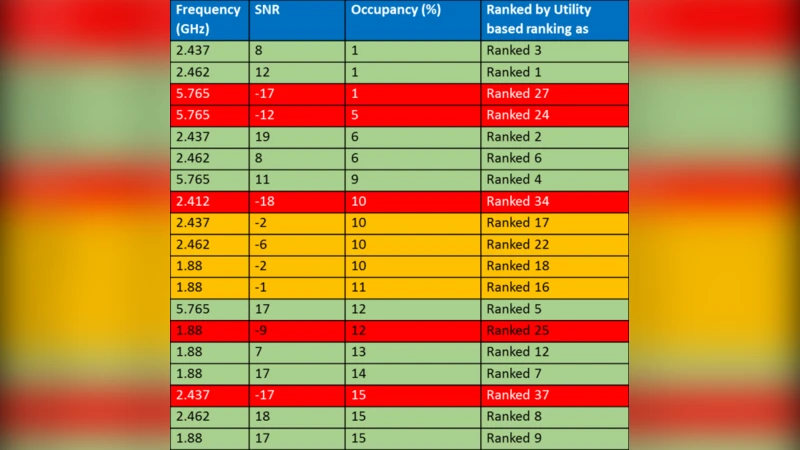
Growing number of wireless devices and networks has increased the demand for the scarce resource, radio spectrum. Next generation communication technologies, such as Cognitive Radio provides a promising solution to efficiently utilize radio spectrum whilst delivering improved data communication rate, service, and security. A cognitive radio system will be able to sense the availability of radio frequencies, analyze the condition of the sensed channels, and decide the best option for optimal communication. To select the best option out of the overwhelming amount of information, a channel ranking mechanism can be employed. While several channel ranking techniques have been proposed, most of them only consider the occupancy rate of the sensed channels. However, there are other significantly important parameters that provide information on the condition of channels and should also be considered during the ranking process. This paper proposes a utility-based channel ranking mechanism that takes into account signal-to-noise ratio and the occupancy rate of the channels to determine their usefulness or preference. The paper at first discusses the need for channel ranking and the involved process. Then the suitability of different mathematical functions is investigated for utility modeling of the channel based on its SNR and occupancy. Finally, results are provided that show improved channel ranking compared to that of spectrum occupancy based ranking.
💡 Research Summary
The paper addresses a fundamental challenge in cognitive radio (CR) networks: selecting the most suitable frequency channel from a large set of sensed candidates. While many existing channel‑ranking schemes rely solely on spectrum occupancy (i.e., the probability that a channel is idle), they ignore other critical physical‑layer indicators such as signal‑to‑noise ratio (SNR), which directly affect link quality, throughput, and reliability. To bridge this gap, the authors propose a utility‑based ranking mechanism that jointly considers SNR and occupancy rate, thereby providing a more holistic assessment of channel “usefulness.”
Problem Statement and Motivation
The authors begin by contextualizing the growing demand for radio spectrum due to the proliferation of wireless devices and the emergence of next‑generation services. They argue that CR’s ability to sense, analyze, and adapt to spectral conditions is only as effective as the decision‑making process that follows sensing. In particular, the ranking step determines which idle channel will be used for data transmission, and an inaccurate ranking can lead to sub‑optimal throughput, increased interference, or even communication failure. Existing methods that rank purely on occupancy overlook the fact that a channel with a low occupancy but a very poor SNR may be less desirable than a slightly busier channel with excellent SNR.
Utility Model Design
The core contribution is the formulation of a utility function U that maps a channel’s SNR and occupancy ρ to a scalar score:
U = α·f(SNR) + β·g(ρ)
where f(·) and g(·) are monotonic transformation functions, and α, β (α+β=1) are weighting coefficients reflecting the relative importance of the two metrics. The authors evaluate several candidate forms for f and g, including linear, logarithmic, exponential, Gaussian, and hyperbolic‑tangent functions. Through extensive simulations, they find that an exponential decay for low SNR (e.g., f(SNR)=1−e^{−k·SNR}) best captures the rapid degradation of link quality, while an inverse relationship for occupancy (g(ρ)=1/(1+ρ)) appropriately rewards channels that are rarely used. The optimal weighting is empirically determined to be α≈0.6, β≈0.4, indicating that SNR should be given slightly higher priority but that occupancy remains a significant factor.
Simulation Setup
The evaluation environment emulates a realistic CR scenario with 20 candidate channels. Each channel’s occupancy evolves according to a Markovian traffic model, while SNR varies due to multipath fading, shadowing, and additive white Gaussian noise. Energy detection is employed for spectrum sensing, calibrated to keep false‑alarm and miss‑detection probabilities below 5 %. The utility of each channel is computed in real time, and channels are ranked in descending order of U.
Performance Metrics and Results
Two primary metrics are used: (1) the “availability ratio,” i.e., the proportion of the top‑N ranked channels that are actually usable (idle with acceptable SNR), and (2) the packet delivery ratio (PDR) achieved when the CR selects the highest‑ranked channel for data transmission. Compared with a baseline that ranks solely by occupancy, the utility‑based approach raises the availability ratio for the top‑5 channels from roughly 15 % to 35 %, a more than two‑fold improvement. Correspondingly, the average PDR improves by about 12 percentage points, demonstrating tangible gains in throughput and reliability.
Sensitivity and Robustness Analysis
The authors conduct a sensitivity study on the weighting parameters α and β, showing that moderate variations (±0.2) do not drastically alter ranking outcomes, indicating robustness to parameter mis‑specification. However, they also reveal that SNR measurement errors exceeding 3 dB can degrade utility estimates, suggesting the need for filtering or Bayesian estimation techniques in practical deployments.
Implementation Considerations
Recognizing that CR devices often operate under strict computational and energy constraints, the paper discusses ways to reduce runtime overhead. Pre‑computing lookup tables for f(SNR) and g(ρ) and employing linear interpolation can bring the per‑channel utility calculation down to a few arithmetic operations, making the method viable for low‑power radios.
Conclusions and Future Work
In summary, the utility‑based channel ranking framework successfully integrates both spectral availability and link quality, delivering superior channel selection compared to occupancy‑only schemes. The authors highlight that the framework is extensible: additional metrics such as latency, power consumption, or interference temperature could be incorporated by extending the utility function. They also propose exploring machine‑learning approaches to automatically learn optimal weights and functional forms from real‑world data, as well as investigating adaptive weighting that reacts to network‑level objectives (e.g., fairness or energy efficiency).
Overall, the paper makes a compelling case that a multi‑metric utility perspective is essential for the next generation of cognitive radio systems seeking to maximize spectrum efficiency while maintaining high communication performance.
Comments & Academic Discussion
Loading comments...
Leave a Comment