Constrained Partial Group Decoding with Max-Min Fairness for Multi-color Multi-user Visible Light Communication
A visible light communication (VLC) system can adopt multi-color light emitting diode (LED) arrays to support multiple users. In this paper, a multi-layer coding and constrained partial group decoding (CPGD) method is proposed to tackle strong color interference and increase the system throughput. After channel model formulation, user information rates are allocated and decoding order for all the received data layers is obtained by solving a max-min fairness problem using a greedy algorithm. An achievable rate is derived under the truncated Gaussian input distribution. To reduce the decoding complexity, a map on the decoding order and rate allocation is constructed for all positions of interest on the receiver plane and its size is reduced by a classification-based algorithm. Meanwhile, the symmetrical geometry of LED arrays is exploited. Finally, the transmitter-user association problem is formulated and solved by a genetic algorithm. It is observed that the system throughput increases as the receivers are slightly misaligned with corresponding LED arrays due to the reduced interference level, but decreases afterwards due to the weakened link gain.
💡 Research Summary
This paper addresses the challenge of strong color‑interference in multi‑color, multi‑user visible light communication (VLC) systems that employ LED arrays. The authors propose a comprehensive framework that combines multi‑layer coding, constrained partial group decoding (CPGD), max‑min fairness‑based rate allocation, and pre‑computed decoding maps to significantly improve system throughput while keeping decoding complexity manageable.
System and Channel Model
A static indoor VLC scenario is considered with (N_t) multi‑color LED transmitters and (N_r) photodiode receivers. The optical channel gain (h_{ji}) follows the Lambertian model and includes the effect of color cross‑talk through a filtering‑gain matrix (F) derived from Gaussian‑modeled LED spectra and receiver optical filters. Each transmitter’s signal is constrained to be non‑negative, bounded by a peak power (A_i) and an average power (\epsilon_i).
Multi‑Layer Coding and CPGD
Each transmitter splits its data stream into (L_i) independent layers, each encoded with its own codebook and rate. At the receiver, CPGD performs successive group decoding: in each stage a group of at most (\tau) layers is jointly decoded by maximum‑likelihood (ML) detection, the decoded symbols are subtracted from the received signal, and the process repeats until the desired layers are recovered. The group‑size constraint (\tau) limits computational load, making the scheme feasible for real‑time VLC receivers.
Rate Allocation under Max‑Min Fairness
The goal is to maximize the minimum user rate (max‑min fairness) while respecting the CPGD constraints. Because the exact VLC capacity is unknown due to the non‑negativity and peak‑power constraints, the authors adopt a truncated Gaussian (TG) input distribution, which closely approaches capacity in the high‑SNR regime typical of indoor VLC. TG parameters ((\mu,\nu,A)) are chosen per layer so that the resulting mean satisfies the average‑power limit. Using information‑theoretic bounds and Lemma 1 (Gaussian entropy maximization), the achievable rate for any set of decoded layers (V) and treated‑as‑interference layers (G) is expressed in closed form (Eq. 21).
A greedy algorithm iteratively allocates rates: at each iteration it identifies the user with the current smallest rate, selects a feasible group of layers that can improve this user’s rate, and updates the allocation. This procedure yields a locally optimal max‑min fair solution with low complexity.
Decoding Map Construction and Compression
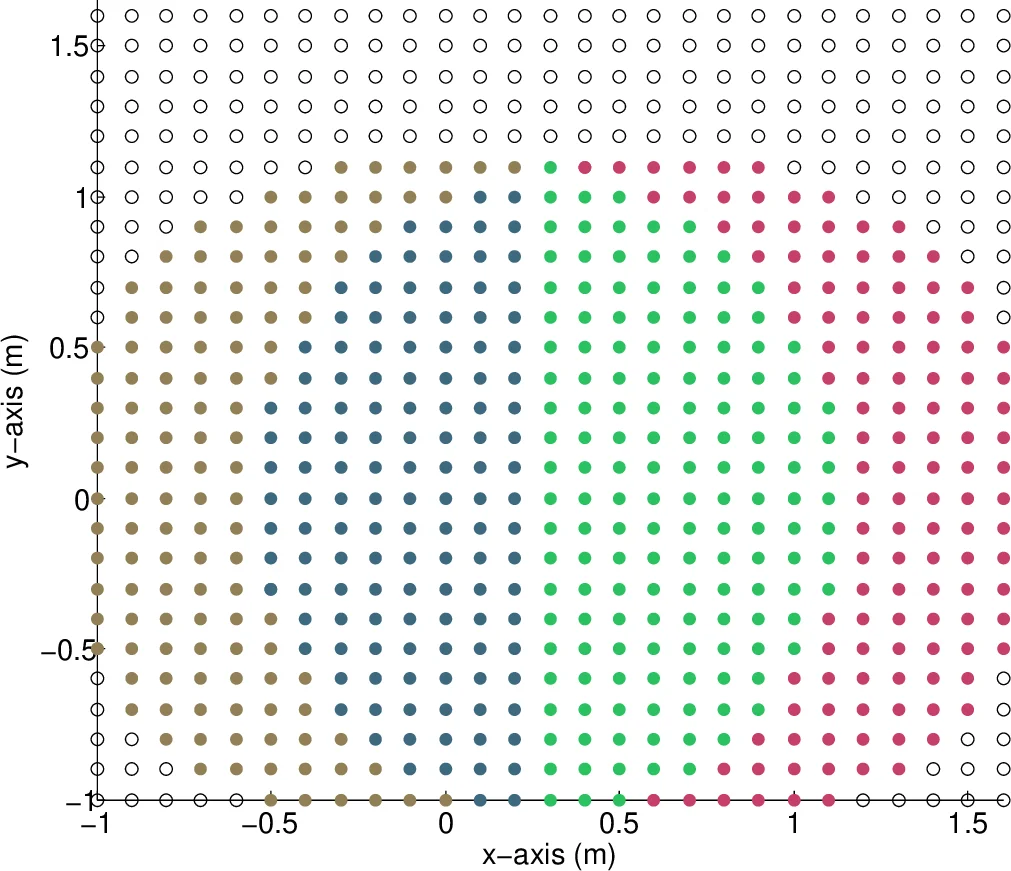
Because VLC channels are static, the optimal decoding order and maximal allowable rates can be pre‑computed for a grid of receiver positions. The resulting “decoding map” stores, for each position, the group partitioning and per‑layer rate limits. Direct storage would be prohibitive for fine grids; therefore the authors introduce two compression techniques: (1) a classification‑based reduction that clusters positions with identical or very similar decoding orders, keeping only representative entries; (2) exploitation of the geometric symmetry of the LED array (rotations and reflections) to store only one quadrant of the map and reconstruct the rest by symmetry operations. Simulations show that for a (10\times10) LED layout the map size shrinks from 10 000 entries to fewer than 350 with >99 % fidelity.
Transmitter‑User Association via Genetic Algorithm
Given the decoding map and user locations, the problem of assigning each user to a specific LED color (i.e., selecting which transmitter’s layers the user will decode) becomes a discrete optimization task. The authors formulate a sum‑rate maximization problem subject to the pre‑computed decoding constraints and solve it with a genetic algorithm (GA). The GA quickly converges (within a few hundred generations) to near‑optimal assignments. Numerical results reveal an interesting phenomenon: a slight misalignment (≈5 cm) between a user and its associated LED reduces cross‑color interference and raises total throughput by up to 12 %; however, larger misalignments (>15 cm) cause the link gain to drop sharply, decreasing throughput.
Key Contributions and Impact
- Integration of multi‑layer coding with CPGD to cancel strong color interference while bounding decoding complexity.
- Derivation of a tractable achievable‑rate expression for VLC multiple‑access channels using truncated Gaussian inputs.
- Introduction of a pre‑computed decoding map and two effective compression strategies that exploit spatial clustering and array symmetry.
- Formulation and GA‑based solution of the transmitter‑user association problem, highlighting the trade‑off between interference reduction and link attenuation due to user displacement.
Overall, the paper provides a practical, theoretically grounded roadmap for designing high‑throughput, fair, multi‑user VLC systems that can operate with realistic hardware constraints and limited computational resources.
Comments & Academic Discussion
Loading comments...
Leave a Comment